Nothing compares to the simple pleasure of a bike ride.
–John F. Kennedy
Filed under: two-wheeled thoughts | Tagged: bikes | Leave a comment »





Nothing compares to the simple pleasure of a bike ride.
–John F. Kennedy
Filed under: two-wheeled thoughts | Tagged: bikes | Leave a comment »
 Here’s an interesting one for you. I had to do a little research to figure out exactly what I have here, and I’m still unclear on a few issues. Please pardon my rather lengthy introductory remarks.
Sam Spade is a character created by Dashiell Hammett in The Maltese Falcon, which I have not read but very much want to. Dashiell Hammett shares some early pulp-classic mystery genre credit with Raymond Chandler, who I have read (just a little) and enjoyed; also, Hammett was partner to Lillian Hellman for some 30 years. “The Adventures of Sam Spade” was a radio series in the 1940’s through 1951, based on Hammett’s character, but I think that Hammett was uninvolved (or marginally involved) in the radio version. His name (says Wikipedia) was removed from the show when his association with the Communist Party became known.
This three-cd set presents six episodes of the radio show, “digitally remastered” and “including never-before-released episodes” – I take it to mean these are original recordings, then, although I haven’t been able to confirm that in my (casual) online research. They do include advertisements for Wildroot Creme Oil, a hair product that was the show’s sponsor. These advertisements are initially somewhat charming in being period pieces, but they are many, and like any advertisement, they get old. Again, this speaks to the authentic feel of the production.
So what about the stories? The six episodes are… “The Insomnia Caper” (1948), “Sam and the Psyche” (1946), “Love Letter” (1949), “The Overjord Caper” (1949), “The Bow Window Caper” (1947), and “The Charogagogmanchogagogchabuna-mungamog Caper” (1949). Howard Duff plays Sam Spade and Lurene Tuttle plays his secretary Effie. These are radio shows rather than your average audiobook, so they include sound effects – gunshots, breaking glass, revving engines, traffic noise – and not just reading of the stories; rather than a single narrator doing voices for different characters, various actors play each character. This is classic pulp stuff, and it’s great fun. There is a definite element of tongue-in-cheek (at least that’s my reading, I can’t speak to the original intent, and the 1940’s are pretty remote to me, but surely…?) in Sam’s character: he is the exemplar of the wise-cracking, hard-boiled, tough-guy detective.
Each story tends to involve a person hiring Sam as a PI, often against Sam’s own wishes: in “Love Letter”, he gets a love letter from a woman he doesn’t know and heads to the assigned meeting point to find himself immediately involved in a situation he’d rather have avoided. His clients are as dodgy as any other character in the story; and there is often a woman who tries to seduce (or seduces) Sam, as a means of distracting him from a plot. Howard Duff’s gruff playing of the role is a large part of the effective mood of these stories.
While the plot of each is formulaic and somewhat forgettable, and the characters are rather stock, that needn’t detract from the fun of these stories. Formulas are often successful and that’s why they’re repeated (think about Agatha Christie). As a regular listener to audiobooks, this radio format that came with multiple actors and sound effects was a refreshing change. The Adventures of Sam Spade is a little simplistic, and definitely easy listening, but great fun, and different from the usual fare.
Filed under: book reviews | Tagged: audio, classics, mystery, noir, pulp fiction | 3 Comments »

Thanks to Rose City Reader for hosting this meme. To participate, share the first line or two of the book you are currently reading and, if you feel so moved, let us know what your first impressions were based on that first line.
I’ve been waiting for some time to get around to this one, and I love the mood and foreboding atmosphere established in the opening pages.
The train tore along with an angry, irregular rhythm. It was having to stop at smaller and more frequent stations, where it would wait impatiently for a moment, then attack the prairie again. But progress was imperceptible.
The personification of the train is very effective. Angry, impatient, attacking. Good stuff!
Filed under: book beginnings | Tagged: misc fiction | 11 Comments »
A dryly witty journey from female to male, with musings on what it means to be a man.

T Cooper, the author of several successful novels (including The Beaufort Diaries and Lipshitz 6), is fascinated by masculinity, perhaps in part because he’s had to work a little harder than the average man to get there: he was born female. Yet even as he explores the essence of masculinity and his own experiences with gender in Real Man Adventures, he expresses some reluctance to delve into the personal.
There is definitely some autobiographical content, but Cooper takes his own privacy seriously, as well as that of his wife and daughters, and is less interested in hashing out the details of his own life than he is in exploring the meaning and role of masculinity in society and the difficulties facing transgender men and women. Real Man Adventures sidesteps the concept of a straightforward memoir, instead compiling a whimsical collection of miscellanea: letters, interviews, lists and original art all help Cooper and his readers explore together what makes a man. This structure works perfectly, and feels like a conversation with Cooper himself.
Deeply honest, even while guarding a few precious items of privacy, Real Man Adventures is a brave book. Cooper does a great service not only to transgender people whose paths might be made a little clearer, but also to their loved ones, neighbors and acquaintances, who should find it a little easier to navigate relationships and communications thanks to this frank discussion. And the irreverent, wry humor throughout keeps Cooper’s brash personality at center stage, where it belongs.
This review originally ran as a *starred review* in the Nov. 27, 2012 issue of Shelf Awareness for Readers. To subscribe, click here, and you’ll receive two issues per week of book reviews and other bookish fun!
Filed under: book reviews | Tagged: creative nonfiction, LGBTQ, memoir, nonfiction, Shelf Awareness, starred | 2 Comments »
Next to a leisurely walk I enjoy a spin on my tandem bicycle. It is splendid to feel the wind blowing in my face and the springy motion of my iron steed. The rapid rush through the air gives me a delicious sense of strength and buoyancy, and the exercise makes my pulse dance and my heart sing.
–Helen Keller
Thanks, Pops, for this week’s two-wheeled thought. Lovely. Couldn’t have said it better!
Filed under: two-wheeled thoughts | Tagged: bikes | 3 Comments »
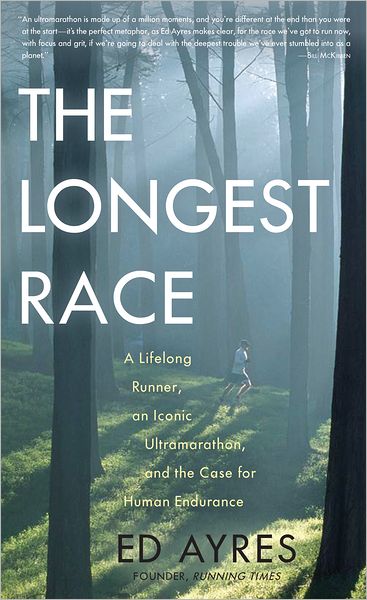 As I read The Longest Race, I thought of my father throughout. He is a marathon runner and a trail runner, and has been contemplating issues of climate change, sustainable living, and humans’ place in nature quite a bit recently. I thought this would be a perfect book for him in its combination of themes, which you can read about in my review. Here, he responds. [His page numbers come from my advance review copy.]
Julia has already done her usual commendable job reviewing this book; my personal interest in Ayres’ two main themes – running, and human degradation of our earthly habitat – compel me to comment further (as she knew it would.) At the same time, I want to parse her use of “metaphor” to describe how running and human development are related in Ayres’ story. While he does often employ metaphor, I believe in many cases he is saying that running actually is part of human development and does have an impact on how we relate to the world. Such is the hubris that plays a part in his tale.
For the above reasons, I really enjoyed this read. That doesn’t mean I found it uniformly superb or satisfying, but the book’s strengths were more than enough to keep me going.
Using a 50-mile ultra to structure his narrative worked better than I expected. There were few threads about his race that required following intently, and those were not lost as we periodically reconnect to that story. The more esoteric subjects he contemplates along the way vary greatly – just as would one’s thoughts during the hours of such an endurance event. In fact, that is an example of the athletic authenticity I found throughout. While I was only familiar with Ayres generally as editor of the early magazine “Running Times,” his deep experience as a lifelong runner shows through. His mental meanderings during a 50-miler – and their sometimes-questionable lucidity – are a familiar element of “running long.”
I was not familiar with Ayres’ background in the themes of human impact on the earth; he worked for the Worldwatch Institute and describes how this commitment evolved from a Quaker upbringing and through a lifetime’s experience. Along the run, we gather bits of his own back-story and “meet” such characters as Mohammed Ali, Mikhail Gorbachev and Ted Taylor (nuclear weapon physicist); such moments are fun and interesting – and chilling, as with his quotation from Taylor evoking the cold war’s nuclear terror (p.94). Also chilling is Ayres’ observation that for those who study the science of ecology, the survival of modern human society is “not just an abstract, academic concept;” it is very immediate.
We learn with him on his journey; e.g. Jared Diamond’s observation that agriculture is “in many ways a catastrophe from which we have never recovered” (p.102) – or “anthropomorphism as a major root cause of the ecological crisis” as noted by many literary luminaries over the years (p.106) – or the 1992 consensus-scientists’ dire & explicit climate change declaration so long ago (p.163) – or a reminder that the regressive “progress” of a suburban lifestyle model may prove to be a mere 2-generation phenomenon. We also meet such authorities as Paul Shepard, Rachel Carson and Wendell Berry along the way.
Similarly, Ayres has much to offer about running itself – not just practical stuff, but history and science as well. He met and/or learned from such names as Joan Benoit, Ted Corbitt and George Sheehan. He cites a Joe Henderson article that I know I read at the same time 25 years ago. Ayres is not the namedropper – that’s my doing throughout here – but rather all these names simply arise as part of his story.
His introduction to the JFK ultra event’s origin unwinds into a period piece on the Kennedy Physical Fitness campaign (which I too experienced), including analysis of JFK’s civic motivation and his 1960 column in Sports Illustrated (who knew?!). I loved learning of David Carrier’s fascinating theory of primitive “persistence hunting,” where humans demonstrated the superior endurance trait that we runners still attempt to conjure (Ch.4). In fact, the role of endurance running throughout early history is compelling – including the Chasquis, the Inca runner-messengers.
Chasqui runner
The brief 23 page Appendix, “Notes for an Aspiring Ultrarunner,” is an worthy overview but any really interested reader will do well to research the many other references available.All together, I enjoyed the blending of themes, emotions and ideas in Ayres’ book. Here is a single passage where Ayres is so nicely able to blend his heritage, running and science:
“The last sounds of the spectators faded, and, after a period of silence that could have been either five minutes or the hundred years it takes for a Quaker kid to sit through Sunday meeting, I found myself glancing left and right, the way I’d been taught as a teenager to drive a car – keep your eyes moving, don’t get fixated on the road ahead. Maybe that was a vestige of the hunter-gatherer’s need to read his surroundings.”While it is different in some ways, a reader drawn to Ayres book may also appreciate Long Distance, by Bill McKibben. Here you would find a foremost climate change writer who instead writes about his experience pursuing an endurance goal (cross-country skiing) and the lessons he derives for surviving in our every day lives. (Interestingly, the one promotional blurb on the cover of Ayres’ book is a McKibben quote.)
Finally, I must note two of my own favorite observations about running, which he mentions along the way. One is the uncanny and almost inexplicable way that a seasoned trail runner, moving quicker than the eyes seem to process, can cover rough ground dense with rocks & roots – and yet every footstep survives the gauntlet (“almost inexplicable” because there is a scientific story, of course); this phenomenon is well-captured in the exclamation “do my feet have eyes of their own?!” (p.58)
The other fave comes after he has related the many challenges that can test a runner’s resolve and motivation, all the aches & pains & setbacks – which are all so easily overcome by the most sublime moments (or preferably hours!) This he also captures with a mere phrase: “When running is good, there is nothing like it.” (p.98) Alas, as we age, it becomes harder to remember that lesson – but after 35 years it can still be good, and there is still nothing like it.
So glad you liked it, Pops. Thanks for sharing.
Filed under: book reviews | Tagged: climate change, creative nonfiction, nature, nonfiction, Pops, sports | 2 Comments »
Thanks to Rose City Reader for hosting this meme. To participate, share the first line or two of the book you are currently reading and, if you feel so moved, let us know what your first impressions were based on that first line.
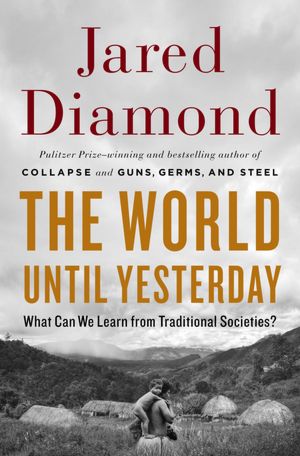
Jared Diamond, author of Collapse and Guns, Germs and Steel, has a new book coming out with the new year. It is subtitled “what can we learn from traditional societies?” and seeks to answer that question. It begins:
April 30, 2006, 7:00 A.M. I’m in an airport’s check-in hall, gripping my baggage cart while being jostled by a crowd of other people also checking in for that morning’s first flights. The scene is familiar: hundreds of travelers carrying suitcases, boxes, backpacks, and babies, forming parallel lines approaching a long counter, behind which stand uniformed airline employees at their computers.
Unfortunately the passage is too long to quote in its entirety, so take my word for it that Diamond begins making deeply thought-provoking points within just a few pages. Keep your eyes open for this one, kids.
This quotation comes from an uncorrected advance proof and is subject to change.
Filed under: book beginnings | Tagged: nonfiction | 5 Comments »
A call for the preservation of Alaska’s natural heritage, with exquisite photos.
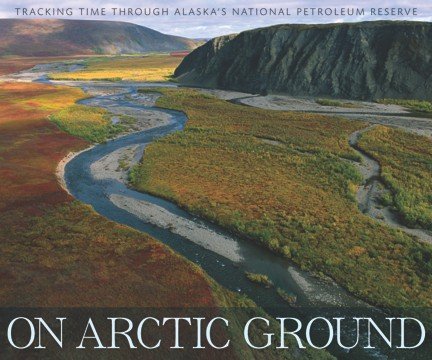
At 23 million acres, Alaska’s National Petroleum Reserve is the largest single unit of public lands in the United States, none of it permanently protected. Rich in oil, gas and coal, it is also home to an astounding diversity of plants and animals, many endangered and threatened; the migratory birds of six continents begin their lives in the Reserve. Debbie S. Miller’s On Arctic Ground is a striking plea for the conservation of this irreplaceable natural space.
Although it can be read cover to cover, the best way to enjoy this book is to take its short chapters one by one. Each provides mind-boggling details–like the bar-tailed godwit’s nonstop, 7,000-mile migration from western Alaska to New Zealand–and makes the starkly moving point that this incomparable area is highly vulnerable. Breathtaking full-page pictures throughout offer stunning portrayals of the Reserve’s strange and spectacular life forms.
This review originally ran in the Nov. 23, 2012 issue of Shelf Awareness for Readers. To subscribe, click here, and you’ll receive two issues per week of book reviews and other bookish fun!
Filed under: book reviews | Tagged: coffee table books, gift reviews, nature, nonfiction, Shelf Awareness | Leave a comment »