The Used World by Haven Kimmel

usedworldMy love affair with Haven Kimmel continues.

Billed as the third in a “loose” trilogy begun with The Solace of Leaving Early and continued with Something Rising (Light and Swift), The Used World inhabits the same space but doesn’t share many of the same characters. In fact, I couldn’t connect any characters from Something Rising, although several are tangential to Solace. I looked again, and Amazon (et al) calls this a “trilogy of place,” so, okay. I’ll start there. The place is Hopwood County, Indiana, and the little town of Jonah. Presumably it is based in part on Kimmel’s own hometown in that state. There are drugs and dysfunction and small-town bigotry and meanness, but it’s not all bad; there are also big-hearted people and open minds, and Pastor Amos Townsend (you’ve seen his name before in an earlier book review) is a bright star. I like that he is simultaneously transcendent, intelligent, & thoughtful, and deeply fallible & human. He has company, in this book, in the three women of a secondhand shop called Hazel Hunnicutt’s Used World Emporium.

Hazel is the proprietor, in her 60’s, decidedly eccentric and devoted to her aged mother and her cats. She turns out (naturally) to have an interesting history which I won’t get into here. Claudia Modjeski is a loner and accustomed to being stared at: she is 6’5″ and well-built, and occasionally gets called sir. And then there’s Rebekah Shook, a fragile woman who only recently escaped her father’s hellfire-and-brimstone cult of condemnation and is still being made to pay for it. Into their lives come a baby boy quite literally forgotten at a nearby meth camp, and an unwanted pregnancy, and everyone’s world shifts a little.

As I’ve said about all the Kimmel books I’ve read recently, this is lovely. She has a fine, crystallized perspective on middle America. The language continues to be stunning: Kimmel is a word wizard. The erudition present in her other books I’ve read, where one or more characters are so cerebral and caught up in the theoretical as to be nearly loony, is not so much present here; but there is decidedly more religious nuttiness. There are really good people, but also less good things (case in point: forgotten baby at meth camp). As a recurring theme, romance and beauty will blossom in the most unlikely places, and I confess I’m a sucker for that. Watch closely for the little details. I had to go back and reread a bit to track a character who starts off as insignificant and suddenly looms. Kimmel is a tricky one. Subtlety. Surprises.

I may have to stop reviewing her books. I feel inadequate.


Rating: yet another 9 for Kimmel, what can I say? 9 pit bulls. (There will always be dogs in her books. I like that I can rely on that.)

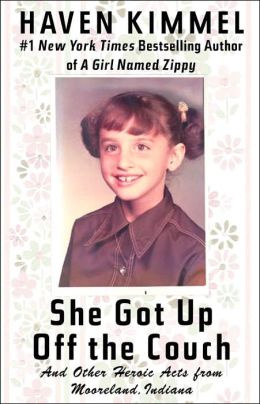
Next up: Kimmel’s best-known, award-winning memoir, A Girl Named Zippy, about which I am (understandably, I think) excited, but also nervous because I don’t always agree with the general consensus about which book is an author’s best. I am also excited, perhaps even more so, about her later memoir of her mother, entitled She Got Up Off the Couch – not least because I hope to write my mother’s memoir one day, too.

Teaser Tuesdays: Junius and Albert’s Adventures in the Confederacy by Peter Carlson

Teaser Tuesdays is a weekly bookish meme, hosted by MizB of Should Be Reading. The idea is to open your current read to a random page and share a few sentences. And try not to include spoilers!

junius

The title of this book is both playfully appealing and a little confusing, as some folks I’ve mentioned it to think it might be a children’s book. It is not. It is a history of two young Northern journalists who travel south during the American Civil War to act as war correspondents, are captured and imprisoned for many months, and eventually escape to trek north again. However, the playfulness remains: in the title, in the writing, and yes, in the story itself. Our two heroes share a certain cynical wit that occasionally lightens what is a quite sad story. As in…

Browne might be the only war correspondent in history to describe his near-death experience by quoting Goethe’s grandmother.

I liked this one line for what it says about the book as a whole – both its subject, and its presentation. Don’t you think?

This quotation comes from an uncorrected advance proof and is subject to change.

What The World’s Strongest Librarian is Reading

Following up on my review of Josh Hanagarne’s new book, The World’s Strongest Librarian, and my interview of the man himself: this section didn’t get printed in Shelf Awareness but I thought my readers might be interested. I certainly was! For one thing, The Black Count is on my list.

So, from our interview conversation: What the World’ Strongest Librarian is Reading.


Josh says, “I read a book almost every day. Because I can’t sleep. It’s really hard for me to go to sleep with the tics, so that’s one of the silver linings, that I get to read so much. I shouldn’t say I read a book every day, but I finish a book almost every day. I read everything from juvenile books to big giant books that I’ll finish after eight days of reading.”

What good books have you read lately?

Truth in Advertising by John Kenney. It has never been this fun to be cynical. Kenney was an insider in advertising and copyrighting in New York, and it is just the most brutal look at the superficial world of advertising, and the storytelling – I really want everybody to go read it.

The Black Count: Glory, Revolution, Betrayal, and the Real Count of Monte Cristo by Tom Reiss is about Alexander Dumas’ father, who was the basis for The Count of Monte Cristo. He was a black man during the Napoleonic campaigns, and he rose to great power in a time when the world and the military were definitely ruled by whites. He winds up being imprisoned for something like 20 years, and the whole time he’s in prison his jailer is trying to poison him. Then it turns into this incredible story, if anything more swashbuckling and gigantic than The Three Musketeers or The Count of Monte Cristo. It’s a crash course in the Napoleonic campaigns that doesn’t feel like a history book. It’s just a wonderful book, the wildest adventure story.

I have been rereading Mark Twain, which I always am.

I just read a University Press book, Conversations with David Foster Wallace, that was quite good. Very theory-intensive, which I don’t enjoy so much anymore, but really good since I’m a fan of Wallace’s.

I just read The Liar’s Club by Mary Karr again.

And, The Twits by Roald Dahl. I just read that with Max. Max is finally old enough to want Roald Dahl. And that has made me happier than anything.”


See more of Josh’s book reviews and related and unrelated writings at his blog, The World’s Strongest Librarian.

Maximum Shelf author interview: Josh Hanagarne

Following yesterday’s review of Josh Hanagarne’s new book, The World’s Strongest Librarian, here’s my interview with the man himself.


Josh Hanagarne: The World’s Strongest Librarian Writes

Josh Hanagarne is from Moab, Utah, and lives with his wife, Janette, and son, Max, in Salt Lake City, where he works at the beautiful main branch of the SLC Public Library. His memoir, The World’s Strongest Librarian, touches on the bizarrely various pieces of his life: his struggles with Tourette Syndrome; his journey to becoming a husband and a father; his love affair with books and libraries that would eventually lead to a career; an obsession with the gym that became a penchant for tearing phone books and full decks of cards; and a less-than-smooth lifelong relationship with the Mormon Church, where he still finds family and friends but less faith than he once held.

worldsstrongest

Your book includes a lot of personal and painful history that belongs not only to you but to your wife and family as well. What was the process for sharing those personal details?

It was hard. During the first draft I didn’t think too much about how people were going to react. When I started going through on the second draft, I started showing things to Janette or to my mom and asking, is this accurate? Is this something you’re okay with having in here? Sometimes it was, sometimes it wasn’t. Whenever anybody was mildly uncomfortable with something, I just took it out–nothing of real consequence. I guess when you write a memoir, you choose which periods of your life you’re going to represent, and then you choose which episodes best represent those periods. If you’re a normal person, sometimes that means you’ll look good and sometimes it means you’ll look bad. So that wasn’t fun, but it was honest, I think, without being tedious and self-flagellating.

I’ve always used humor kind of in self-defense, because I knew if I could make people laugh I could make them focus on something other than my tics. I think this book is kind of sad, and I think a lot of humor is rooted in something sad. I believe Kurt Vonnegut and Mark Twain both talked towards the ends of their lives about having various forms of irony fatigue, because humor was mainly a self-defensive tool for them. I think in any book where you get to pick and choose what you put in, the sadder stuff’s going to get sadder, and the funny stuff’s probably going to get funnier.

You’ve included Dewey classification numbers under each chapter heading. Do you think this resonates with the general population, or mostly just librarians?

I don’t know. I think most people, even if they don’t get it, will probably be intrigued. Some people have pointed out that they don’t all work out exactly the way capital-“L” Librarians think they should, to which I will just say, the numbers do exactly what I want them to do. I think it’s eye-catching. I didn’t necessarily think of it as being gimmicky, because it really does tie in thematically with each chapter. What I really like about it is that you can kind of see what’s coming and yet sometimes not have any clue how one thing will lead to the next.

Tell us about the process of writing this book: When did you write? Were you still working at the library?

This is probably going to disappoint a lot of aspiring writers who put off writing until they have hours of free time every day, but I don’t think I ever sat down and wrote for more than 15 minutes at a time. I just can’t; the tics won’t let me. I wrote whenever I could. I’d guess I rarely wrote more than half an hour total in a day. I do write really fast. I found out that, at least now, I’m the sort of writer who has to make a gigantic mess and then clean it up, because if I start trying to anticipate all the editorial questions on the fly, I just freeze up and I don’t get anything done. So I wrote a lot more to get to this book than I probably could have, if I were another writer. I wrote the first draft totally on my own and then I sent it to my editor, and things had just been going so well that I kind of assumed, yeah, my first draft is surely anyone else’s fourth or fifth. Then my editor sent it back and said, you’ve got to get rid of 120 pages. We can’t even talk yet. Fix this. Which was a great lesson to learn, and not an easy one. But editing was really kind of fun, because Megan [Newman] is really the right editor for me. I think it took three total drafts between us, but about eight on my part. I learned that it takes a hideous amount of work to appear spontaneous. But it was a lot of fun. The shortest way to answer your question is: I wrote every day, I only wrote for a few minutes at a time, and I just kept going. A big part of it is being willing to show up.

Was the writing process cathartic for you?

If this book hadn’t come about, I think I’d probably still be going through the motions in church, trying not to make waves. The ideas I’ve gotten from church have everything to do with my relationship to my body, and the explanations I thought I owed for my life. In writing the book, I realized, I’m actually going to have to deal with this. So I got into the sticky situation of writing a book about how much I love my family and yet gently distancing myself from the church, knowing that that would be painful for my family. That was the biggest catharsis: realizing that I was going to have to deal with that shift in faith. Spending so much time thinking about that, and trying to word it correctly, is what taught me what I actually do think about it all.

Would you say that you had a message or even a cause to communicate with this book, related to Tourette’s, or libraries, or anything else?

I’m not much of a crusader. But when I go speak to groups of people with disabilities, or their parents, or special educators, the reaction I get is so humbling and overwhelming. If people I speak to are actually getting out of this story what they tell me they are, I knew I really needed to do this book as well as I can. So that it can go be me in all the places I can’t be. There’s definitely no downside to spreading the word about Tourette’s. This story seems to inspire some people without me ever needing to claim I can inspire anyone. As far as libraries, obviously this whole book is my love letter to books and libraries. That’s not necessarily what I intended, but for me to write about myself honestly, that’s the only thing that could have happened.

What do you most want people to know about you that’s not in your book?

To entertain my son occasionally in the morning when I put my pants on, I will hold them up at about waist height and I will try to jump into my pants. So I jump all the way up in the air and tuck my knees in and if I do it right, my feet come through the pants and I’m dressed. And if it goes wrong it goes really badly wrong. And about one of every 10 times I can put my pants on this way. Once in a while. You know, one out of 10 might be optimistic.


This interview originally ran on April 9, 2013 as a Shelf Awareness special issue. To subscribe, click here, and you’ll receive two issues per week of book reviews and other bookish fun!

Maximum Shelf: The World’s Strongest Librarian by Josh Hanagarne

Maximum Shelf is the weekly Shelf Awareness feature focusing on an upcoming title we love and believe will be a great handselling opportunity for booksellers everywhere. The features are written by our editors and reviewers and the publisher has helped support the issue.

My editor recently asked me if I’d like to put together my first Maximum Shelf for them, and said she had just the book in mind for me: The World’s Strongest Librarian: A Memoir of Tourette’s, Faith, Strength, and the Power of Family, by Josh Hanagarne. (My father found this a hilarious expression of what my editor thinks of me. I’ll let you work that one out. I haven’t.) I was thrilled; and I loved the book. Because this would make for an extra long blog post, I’ve split the Max Shelf issue into two posts for you, so please enjoy my review today and my interview with the gracious & funny Josh tomorrow.


worldsstrongest

Josh Hanagarne, blogger at The World’s Strongest Librarian, “might be the only person whose first three-hundred-pound bench press was accompanied by the Recorded Books production of Don Quixote.” This is just one of his remarkable singularities. A gentle giant who tears phone books for fun, at 6’7″ he tends to catch the eye at the Salt Lake City Public Library, even when his Tourette Syndrome is not acting up. His memoir explores these contradictions and oddities, and his remarkable journey from idyllic childhood to painfully jerky young adulthood to a contented family and work life.

Hanagarne had a happy childhood, beloved by his mother, an incorrigible prankster and devout Mormon, and his devoted, irreverent bear of a father. He grew up in libraries, a passionate bookworm disturbed only by the tics that began in first grade but would go undiagnosed until high school (although his father suspected Tourette’s from the beginning). By young adulthood, they were not only embarrassing but violent and debilitating. He would eventually suffer a hernia from the force of his involuntary shouting tics, and his larger movements resulted in injury to himself and chaos in his immediate surroundings. After high school he spent years trying numerous cures, in and out of college, working various jobs and struggling with depression. Lifting weights at the gym stilled the tics somewhat, and for a while he got regular Botox injections in his vocal cords to quiet the shouts and whoops. During that time he met and married a lovely Mormon folklorist named Janette. For the first eight months of marriage, he couldn’t speak to her above a whisper.

Although deeply in love, the atmosphere of Josh and Janette’s story early in their marriage remains clouded. For years they try to get pregnant. Janette suffers two miscarriages and they are harshly rejected by the Mormon Church as adoptive parents. Josh continues to tussle with Tourette’s. For a short time, he finds a position as assistant special educator quite satisfying, not least because his tics become unremarkable in a room full of special needs. But he soon leaves that job, because he seeks challenge: crucially, he aspires to overcome Tourette’s, to beat his tics into submission. Pondering what might present the greatest challenge to a man who can’t keep quiet, Josh is drawn to the quietest place he knows, a place that has always offered succor and delight. He gets a job as a clerk in the library and begins a master’s program in library science. And a key piece of marital bliss is finally achieved when Janette delivers a healthy baby boy named Max.

Josh continues to battle Tourette’s in the gym, discovers kettlebell lifting along the way, and makes a new friend in Adam Glass, a former Air Force tech sergeant and strongman: he bends wrenches and horseshoes and tears decks of cards and phone books. Josh’s story takes an inspiring turn as the twitchy librarian and the foul-mouthed strongman gradually develop a friendship; as Adam helps Josh build strength, together they also begin to understand and subdue the tics. He finds Adam a little strange, and the explanation for his social awkwardness is also what makes him the perfect mentor for overcoming Tourette’s: Adam is autistic.

The adult Josh Hanagarne who relates his story is content and stable, happily married, thrilled to be a father to four-year-old Max, and working full-time at the Salt Lake City Public Library. As he relates his stranger-than-fiction story, he intersperses present-day anecdotes from a workplace that he wryly notes is rife with strange and occasionally smelly patrons and events. He muses eloquently and powerfully about the role of libraries in society, and their future possibilities. Throughout his life and this book, Josh struggles with his Mormon faith, as he sets off on the expected mission and faces myriad challenges in school, work, marriage and parenthood. In telling a story about family, church and Tourette Syndrome, he always circles back to libraries and to books, in many charming literary references. And always central to Josh’s story is his love of family. From his loving parents and exceptionally close siblings through the clear delight Josh finds in marriage and fatherhood, he stresses the inestimable gift of a loving family.

Josh’s memoir is thoughtful, heartfelt, often hilarious– and unsparingly honest. He is not proud of every moment in his own past, but he shares nonetheless. The image of the man today who wrote this book and who works in a large branch of a public library in a large city is that of a serious yet funny, mature, loving family man, and this image is only partly at odds with the earlier, less secure young man we come to know in these pages. The younger Josh was unsure and unstable, and the author is more comfortable in his own skin. But both have tics, and stories to tell.


This review originally ran on April 9, 2013 as a Shelf Awareness special issue. To subscribe, click here, and you’ll receive two issues per week of book reviews and other bookish fun!


Rating: 9 minutes of calm.

Tomorrow: I interview The World’s Strongest Librarian.

from NYT magazine (thanks Mom)

I just wanted to share this brief piece from a recent New York Times Magazine. Via my mother – thanks, Mom.

(I tried to link to the printable version because it involves no pictures or graphics, which I find distracting. It redirects to the main article. Click print if you’re like me. [I was given a clipping of the print version, and that was nice.])

My mother didn’t include a note explaining the relevance of this piece. I think there is value in the observation of how much can be said in very few words, for obvious starters. But the poignancy is possibly the real point. Take what you will from it; I’m trying not to clutter it up with my own words.

Teaser Tuesdays: Crossing the Borders of Time by Leslie Maitland, again

Teaser Tuesdays is a weekly bookish meme, hosted by MizB of Should Be Reading. The idea is to open your current read to a random page and share a few sentences. And try not to include spoilers!

crossing

I continue to enjoy this memoir by the daughter of a French-German Jew who fled the Nazis as a teen and thereby lost her love. I did tease you from it last week, but I thought these lines were too evocative, thoughtful and real not to share.

His impromptu recital was a peaceful close to a day that had wakened to the tumult of athletes speeding through narrow Renaissance streets, crowds cheering at corners and loudspeakers blaring. That evening I would leave feeling grateful for the quiet bravery of all the Ficks and the Fimbels, people who risked their lives to wrestle with power in places whose names are not even footnotes in history’s pages.

The setting for this scene is a French town the author is visiting, one of the several towns along her family’s route from Freiburg eventually to the United States. Fick and Fimbel are two men who helped them escape occupied France. The athletes are triathletes in competition, and the impromptu recital is given especially for the visiting Maitland by Fick, now a very old man, on the organ in his church; and I think all together they make a fine sweeping view of this place in time. For one thing (referencing Maitland’s title), the Renaissance streets that now see triathletes whizzing by on what I’m sure are very fancy bikes surely never expected such a thing. And then add the organ music played by a quietly heroic man for the daughter of a woman he hasn’t seen in many decades… there is something profound in this vignette, isn’t there?

The Solace of Leaving Early by Haven Kimmel

solaceofleavingLangston Braverman has recently returned to her hometown of Haddington, Indiana. Very close to receiving her PhD she walked out of her oral exams. She is a strange, exceptionally erudite but socially fragile and problematic young woman. She has a dog named Germane: “named not after Germaine Greer, but as in: Germane to this conversation.” (I love that.)

Amos Townsend is Haddington’s pastor, of only a year or two now. He is tormented by the death of a local named Alice; he feels that he should have been able to stop her death, and he is struggling with his faith, which is actually nothing new.

Alice’s two children are left in limbo; their crazy aunt Gail has turned out to be unfit, and their grandmother Beulah is clearly too near death herself to wrangle with two traumatized little girls. Upon Alice’s death, they dispose of their original names, Madeline and Eloise, and state that they are now called Immaculata and Epiphany. They wear costumes from a Renaissance drama from school, that their mother made, all the time. Complete with hats: the tall cone-shaped kind with ribbons streaming off the tops.

Langston’s mother AnnaLee picks up some of the slack, and then insists that Langston step up: she is not in school, not working, and these children need her. Of course, Amos plays a role as well, so that this village will truly raise a child.

Langston and Amos are the stars of this story (along with the striking Immaculata and Epiphany, of course). When they meet, they repel one another like magnets. Despite sharing tastes and interests in reading, philosophy, theology, and (I can’t stress this enough) their particular brands of weird, they repel. And, as is clearly a theme in Kimmel’s work, the cerebral content, the philosophies and theologies that shape this part of the story are complex and thoroughly explored. I think I said this in my last Kimmel review, but: her many references partly pique me to go off and study, and partly exhaust me, making me so glad I don’t have to read Whitehead and Tillich and Frithjof Schuon. It makes me sit back and …wonder… that all these strange, complex, learned thoughts that Langston has are thoughts that Kimmel had to have first, had to conceive to put them in her heroine’s mouth; think of that.

Immaculata and Epiphany see Mary (the Mother of God) in the dogwood tree in their grandmother Beulah’s backyard. Naturally, because that is the kind of world this is. It is very strange and is a kind of beautiful, and again I observe that Kimmel’s gift is to create a midwestern small-town world that is both hopelessly humdrum and depressing and everyday, and also strange and exalted and worthy of examination.

What happens to our exquisitely odd cast of characters should definitely remain a surprise to you, reader. It’s pretty great, though.

I love this author SO MUCH that I am struggling to write reviews; but I will keep reading her. Next up is The Used World, and I am, of course, working to get my hands on her best-known bestselling memoir, A Girl Named Zippy.

I’ll close, as I tend to with Kimmel, with a few lines from the book that particularly caught my eye. Where these have, in the past, been lovely examples of her use of language, these are more concepts that I really liked. There is a book theme here. And the language is great – observe the curry comb, is that an image or what – but it’s the concepts that I like most here:

Amos knew as well as anyone what went into writing a book, having written a master’s thesis, and he considered the process to be akin to having one’s nerves stripped with a curry comb.

Maybe he knows what goes into writing a book as well as anyone… who hasn’t written a book?

The most intractable aspect of his bachelorhood was that Amos was uncomfortable eating without reading; he felt as if he were wasting both time and food.

Me too, Amos. I’m right there with you.

Amos tapped his fingers on his bony knees. “Why do you have a book and I don’t?”

“Because I’m a woman, Amos.”

“Yes, but why do you have a book and I never do in a situation like this?”

AnnaLee put the book down. “I carry a bag. I also have safety pins and emergency money, and a package of those little wet towelettes. We live in Indiana. I could get stopped by a train, I could get bored. I always carry a book.” She went back to reading.

How perfect is that. “We live in Indiana, Amos!” Perhaps it goes without saying that I, too, try to keep a book with me at all times? I fail on safety pins and wet towelettes, though.

I’m sure I’ve failed to do this book justice. But it’s divine.


Rating: 9 ribbons on a hat.

book beginnings on Friday: The Solace of Leaving Early by Haven Kimmel

Thanks to Rose City Reader for hosting this meme. To participate, share the first line or two of the book you are currently reading and, if you feel so moved, let us know what your first impressions were based on that first line.

solaceofleaving

I am still super excited about Haven Kimmel! The other day I picked up The Used World and read the first few pages, compulsively, and only later noticed that it is (apparently) the third in a “loose” trilogy that began with The Solace of Leaving Early. So I put down the latter (effortfully), and picked up this one. (The book in the middle is Something Rising (Light and Swift), which I loved.) It begins:

It wasn’t given to Langston Braverman to know the moment she became a different person; she only knew later, looking back on the afternoon a simple storm arrived and stayed for days, the afternoon she first saw the children. The woman Langston had been was immune to visions and visitations; she was a head-dweller, an Attic Girl who could quote theologians on the abandonment of reason, but who, nonetheless, trusted reason the way one trusts one’s own skin.

I can already recognize the thinking characters that Kimmel favors. I’m ready.

A White Heron by Sarah Orne Jewett

I found this story online, for free, here. Thanks to the Open Library project.


thanks to the Boston Public Library for sharing

thanks to the Boston Public Library for sharing

I finally got around to this one, and I’m so glad I did. I’ve seen it referenced before, but it was in Iodine that I saw the allusion that finally got me. And it was pretty easy to find online in full-text form, so no excuses.

It is a simple story. A girl named Sylvia (Sylvy) lives with her grandmother in the woods; she is fortunate to have been the one of a “houseful of children” to be chosen for this life, because she was very unhappy with people and in the city, and now she blossoms. The birds and trees are her friends. She meets a hunter, a pleasant enough young man, who initially scares Sylvy (because he is people) but who she comes to like and esteem. He is seeking a rare bird, a white heron, who does not usually roost in these parts but who Sylvy has seen and knows. In her admiration for the hunter, Sylvy climbs a very tall tree before dawn – a feat of great proportions – to locate the heron’s nest. Perhaps you can see where the central conflict comes from.

This is a very fine example of the art of the short story. It is a brief tale, and simple, but layered and allegorical and very moving. There are only three human characters, of whom the hunter remains unnamed and the grandmother is usually referred to simply as “the grandmother”; only Sylvy consistently gets a name. This adds to the simplistic, and the symbolic, effect. On the other hand, the natural world is well characterized. I love the cow:

…though she wore a loud bell she had made the discovery that if one stood perfectly still it would not ring.

Or the tree Sylvy climbs:

…it must truly have been amazed that morning through all its ponderous frame as it felt this determined spark of human spirit wending its way from higher branch to branch… The old pine must have loved his new dependent.

We can see here the important role that nature plays. Indeed, Sylvy herself is part bird:

…her bare feet and fingers… pinched and held like bird’s claws to the monstrous ladder [of the tree] reaching up, up, almost to the sky itself.

Her tree-climbing adventure seems to me to clearly be an epic journey of a rather religious nature; but I am inexpert in religious texts & symbolism, so I’m not sure I can articulate that for you.

Part of what I love about this story is the deceptive ease with which we sympathize with the bird over the hunter. I read this story in the car, and Husband expressed an interest, so I summarized it for him (which was a pleasure in itself), and he took it for granted that we want the bird, as it were, to win. Well, that’s an easy conclusion to come to; we’re animal lovers, he rescues baby birds that fall out of nests (I call him St. Francis), we like the woods. And this hunter, after all, is a sporting sort, interested in bagging a rare species, rather than feeding his family. But I don’t think the same sympathies would have occurred, let alone been obvious, to Jewett’s original audience (in 1886); they certainly aren’t obvious to the hunter and the grandmother in the story. In other words, Husband and I had very clear-cut sympathies, but I think we read this story differently than it would have read in 1886. The fact that it is moving to us today as it presumably was then, but in a different way, is remarkable to me, and thought-provoking.

This is a lovely little short story in the style of realism, in praise of nature over human industry, allegorical and sweet and very powerful. I have left quite a bit unsaid – like, the ending – because I want you to read it. The link’s at the top of this post, and it won’t take long. Go.


Rating: 9 breaths of fresh air.