Eating Dirt: Deep Forests, Big Timber, and Life with the Tree-Planting Tribe by Charlotte Gill

eating dirtDoubly recommended by the authors of Fire Season and Dirt Work, this one moved to the top of the list.

Eating Dirt is the memoir of a tree planter. Charlotte Gill works seasonally planting trees in the Canadian west. She is employed by a company of tree planters, who contract in turn with big business – mostly logging – to replant sections of clear-cut land, usually. The daily job is to travel out to the plot in question (via beat-up truck, or boat, or by foot), load up one’s bags – a belted & suspendered piece involving two side saddle-bags and one at the rear, at hip height – with seedlings, stomp around on varying surfaces, and use a shovel and one’s hands to repeatedly insert seedlings in soil (clay, gravel, duff). It involves much bending, and the loss of fingernails. They encounter cougars, bears, muck, dirt, rain, bugs, rocks, and unspeakably sore muscles.

Gill has quite a bit in common with Christine Byl of Dirt Work: the dirty, male-dominated outdoor environment, the satisfaction of a job well done in a world populated by trees, twigs, green and brown and wild things. Not to overemphasize these two books’ similarities – because each is unique and lovely on its own and neither is derivative – but they both caused the same combined reaction in me, of yearning jealousy and thankfulness that I don’t do that for a living. What can I say. I love to be outside and wish I spent more days and nights there, but I also fret enough over my bad knees with my office job, and I like taking a shower and feeling clean after being dirty. In fact, the question at the front of my mind as I’ve finished this book is: what did clean mean in those years that make up the majority of human history, in which we didn’t have seemingly endless showers at our command?

Dirtiness aside, Gill writes with humor and wisdom and the kind of occasionally zoomed-out perspective that I like in a nature-based memoir. A little research into the history of earth, trees, and people – and the relationships between them – brings her perspective, that of just one person, into focus within a larger picture. And as a bonus, she’s based in the same general region that my parents recently moved to. We have all been learning about the Pacific Northwest – including the trees of the area – and this book offered some welcome insights to that end.

One of the more surprising subjects of Eating Dirt, for me, was the ambiguous or controversial nature of the work. I read “tree-planting tribe” and expected that it would be all green-ness and good; but as I said in my opening synopsis, Gill’s employers are most often logging companies, banking on the profitability of trees, not their inherent worth as trees themselves.

And we got paid… by the very same business that cut the trees down, which canceled the altruism right out of the equation.

Any good they provide, then, is already offset by those who paid for their planting. It’s not as simple as it seems at first glance, and Gill wastes no time in making that point.

Her voice is gritty, and her perspective not so much unapologetic in general as clear-eyed about its dual nature. She’s funny and clearly likeable – like Byl, someone I’d like to know, although I’d be intimidated by both women’s toughness. I enjoyed what I learned about the world from Gill, but also very much value what she’s encouraged me to think about.

Nature has done its big job. Like a ball thrown up in the air, all has risen, crested, and begun its arc back down into earth. After many years spent outside we come to see this – the parabola – as the contour of life itself. It’s the path the sun takes across the sky. The shape of a story. Ours included. Beginning, middle, and end.

Right up there with some of my favorites of the past few years. Recommended.


Rating: 7 red tree voles.

book beginnings on Friday: Heart-Shaped Box by Joe Hill

Thanks to Rose City Reader for hosting this meme. To participate, share the first line or two of the book you are currently reading and, if you feel so moved, let us know what your first impressions were based on that first line.

heart-shaped box

I’m sure you will recall that I was entranced by Joe Hill’s NOS4A2; so naturally I enter his debut novel with high hopes. It begins:

Jude had a private collection.

He had framed sketches of the Seven Dwarfs on the wall of his studio, in between his platinum records. John Wayne Gacy had drawn them while he was in jail and sent them to him. Gacy liked golden-age Disney almost as much as he liked molesting little kids; almost as much as he liked Jude’s albums.

I’d say that’s a fairly impactful few lines, considering 1) the mention of a well-known serial killer and 2) the implication that our man Jude is a famous musician of the creepy variety. As you might guess, the following paragraphs describe further items in his collection; and none are as benign as this first one, a series of Disney-themed sketches. I’m on board so far!

did not finish: The Borrower by Rebecca Makkai (audio)

borrowerI made it exactly 25 pages into this one (although via audio, which was about 30 minutes, give or take). I remember hearing about The Borrower ever since it came out in 2011, and it sounded real cute: children’s librarian befriends sweet little boy who might be gay and whose censorious, bigoted, ultra-religious parents are a drag; she ends up either liberating or kidnapping him, depending on your angle, and they have adventures together. Nice story, right? In fact, it opens with a story time reading of Roald Dahl’s Matilda, which drives home the fact that this plot has been done before. And that’s no complaint or criticism. As Makkai notes in the voice of her narrator, “you can always count on a librarian for a derivative prose style.” I can dig that little joke (and also fear it is too true).

But things went south quickly after that. Faced with the censorious mother, Lucy (the librarian/narrator) rails that she would never “defy the Constitution” by refusing to check out certain books to a ten-year-old boy at his mother’s request. Now, I sympathize with Lucy’s gut reaction and not with the nasty mother; but I think it’s only respectful to be clear on what the Constitution actually says. The First Amendment protects the right to speech, press and assembly; it most certainly does not protect the right to read anything one likes (unfortunately), and the rights of minors have been curtailed in our courts in favor of their parents’ right to decide for them, with abundant clarity. This use of the “defy the Constitution” argument was outrageous and left me reeling. From a librarian, no less!

Next Lucy notes that

I wasn’t at all concerned about (the boss) enforcing this, or even remembering it a month later. And if she tried to fire me because I’d checked out a book to a patron of the public library, I’d have so much free legal representation within ten minutes that her gin-soaked head would spin.

Well, that’s bold – and naive. If this librarian were fired for checking out a book to a ten-year-old that the child’s mother had expressing forbidden her to check out to him, I think her legal case would be in some doubt; and while it’s conceivable that the ACLU or a similar organization would take the case on, I wouldn’t bet my job on it. I’d put the chances pretty low, in fact. To think that every unjustly-fired, underpaid city employee gets “so much free legal representation within ten minutes” to make heads spin is… idealistic, at best.

And then Lucy snobs out on her profession of librarianship, except oops, it might not be fair to call her a professional because she’s non-degreed and thus in most work environments ineligible to be called a “librarian” at all (this is a subject on which there is some controversy within the field and I don’t want to enter into that now, but I think it does bear on the credibility of this novel): in reference to the cardigan she’s wearing,

I hated that I’d started to look like a librarian. This wasn’t right. In college, I’d smoked things. My first car had angry bumper stickers. I came from a long line of revolutionaries.

Now this made my head spin. Librarians are about as diverse as any other demographic group you’d care to examine, and certainly there are those cardigan-clad shh-ing grannies with buns; but there is also no dearth of tattooed, funny-looking, hipster, punk, revolutionary-as-hell librarians. And you know what? Some of us wear cardigans, too. Despite the disappointingly cartoonish view of librarians represented by these lines, they also made me wonder if Makkai realizes who her audience is for this book: I am assuming that at least in part those attracted by her basic plot would be librarians (I am one), and she just alienated us with her snobby narrator.

So. This review threatens to be as long as the tiny piece of this book that I read; I should stop. I think I’ve effectively communicated that I was disgusted by the 25 pages’ worth that I listened to, and very comfortable turning away towards greener pastures. In fact, I’m now starting a novel by Joe Hill, whose librarian character in NOS4A2 was possibly a little bit of a cariciature in the other direction – with her purple hair and all – but also closer to the librarians I know. So there.


I am not assigning this a number rating after such a brief read but clearly if I did, it would be a low number of my grumbles.

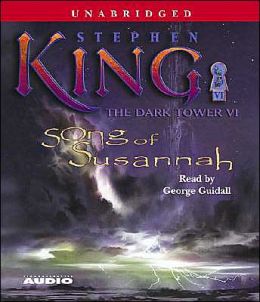
Wizard and Glass by Stephen King (audio)

wizard and glassHow to continue to describe the outrageously imaginative, engrossing masterpiece that is Stephen King’s Dark Tower series? Oh my word.

Wizard and Glass is book 4 and, I think, my favorite so far. We met the gunslinger in book 1; met his three compatriots in book 2; and were reunited with the boy Jake in book 3. As this next installment opens, the ka-tet of Roland, Eddie, Susannah, Jake and Oy find themselves in Kansas; but it is a strange, other-worldly Kansas, perhaps parallel to the one we recognize. Along the road, the group stops for the night and Roland tells a story. This telling will fill the vast bulk of the book, so that as in The Wind Through the Keyhole, it’s a story within a story, with the inner one taking top billing.

Roland’s tale is that of his first love, his first adventure and battles as a gunslinger, and the genesis of his quest for the Dark Tower, which is by this point a quest willingly shared by his companions. It’s a great story, what King does best.

Roland begins by referring to the way he won his guns, and his right to be a gunslinger, in a fight against his teacher, Cort. Roland was 14, and his father was angry, and also worried, and sent Roland away along with his two best friends, Cuthbert and Alain. They travel to the back-country town of Hambry, in the barony of Mejis, where they are given a deceptively simple task that immediately complicates. Roland encounters a young woman named Susan and falls in love; their love is (naturally) thwarted by her unwilling role in the intrigue in which Mejis is entwined. Roland, Cuthbert and Alain, assisted by Susan and a deeply likeable local named Sheemie, will end up doing battle with the forces of “the good man” (who is of course bad) in this outer barony; and Roland’s love is doomed.

This story is endlessly moving, and engrossingly suspenseful. There is something sweepingly large and yet entirely believable about the teenage love story of Roland and Susan; and Cuthbert and Alain, who until now have been referred to only obliquely, become fully-developed great friends to the reader as well as to Roland. The reader is every bit as enthralled as Roland’s contemporary ka-tet (Eddie, Susannah, Jake and Oy) are; and I loved the slight jolt King inserts when Eddie breaks in to ask how Roland could know the story from all angles: what Susan thought, what the witch did when she was alone… this reminds us just when we’re starting to lose ourselves in Roland’s tale, that we’re actually still on the side of the road in Kansas with the new ka-tet, at the same time.

When Roland finishes talking, the five companions continue on the road towards… the emerald city. Genres, and worlds, mash up again when they come to the emerald castle and encounter the Wizard (of Oz?) – he of the book’s title, and we’ll also see the glass for the first time (which played such a role in Roland’s story). At the finish of the book, relatively little has happened to our main characters; they return to following the path of the Beam in search of the Dark Tower. But the wizard does entreat them to abandon their quest, and each in turn gets to articulate that he or she is by Roland’s side by choice now and from now on. The saga continues.

I am reeling; I never wanted this book to end; I reveled in it and rather tore at my hair when I realized I’m still wait-listed at my local library for the next in the series. (The horror!) My former policy of reading series willy-nilly with no respect for their order is gone; I am a purist. Stephen King has reformed me.


Rating: 9 pulses of pink.

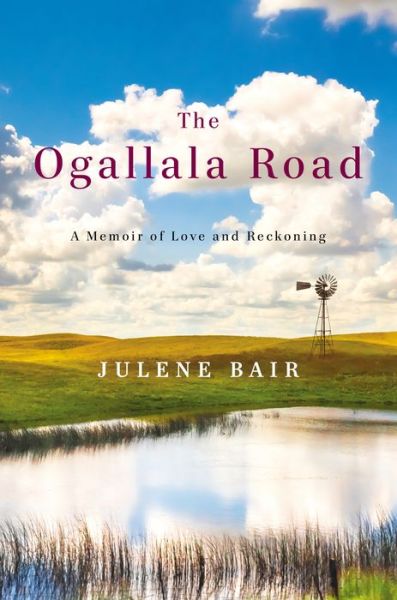
Teaser Tuesdays: The Ogallala Road by Julene Bair

Teaser Tuesdays is a weekly bookish meme, hosted by MizB of Should Be Reading.

ogallala

I found very thought-provoking Julene Bair’s memoir of returning with mixed feelings to the family farm. My full review will not be out until a little closer to its March publication date, but for now, a few lines that got me thinking:

Our sense of beauty is a survival instinct, telling us that a place can sustain us for generations to come. I’d always known this in my bones, but it wasn’t until many years after I left Kansas and discovered my passion for wilderness that the intuition became conscious. This creek was now ugly. That didn’t bode well for the underlying aquifer’s ability to support life in the future.

Part of me nods firmly at this, and part of me wonders if beauty is really the same thing as lifegiving. Perhaps it’s all in the eye of the beholder? Please weigh in, Pops.

This quotation comes from an uncorrected advance proof and is subject to change.

movie: Urban Cowboy (1980)

Husband was dismayed to learn that I hadn’t seen Urban Cowboy, set in my hometown and rather iconic; it stars the nightclub Gilley’s and is mentioned in one of my favorite songs by one of my favorite bands. My excuse is (as usual) that I’m not real good with pop culture; also, this movie is older than I am.

winger

So we put it on. Urban Cowboy is set at the beginning of the 1980’s, when young Bud Davis leaves his family on the farm and heads into Houston (actually, Pasadena, a dirty oil-refining suburb) to look for a job. He starts off by staying with an aunt and uncle; the latter works at the refinery and gets Bud a job. They also take him to the local, Gilley’s, a honky-tonk nightclub that was at the time the largest nightclub of any kind in the world (according to Guinness, says the Texas State Historical Society and others). There he immediately falls into the kind of lifestyle his mom back home probably worried about: drinking hard every night of the week and showing up to work hungover; and meeting Sissy, a beautiful, flirtatious youngster with whom he is quickly entangled. They drink, fight, get married. She wants to ride the new mechanical bull set up at Gilley’s, but he doesn’t want her to. So she goes behind his back and learns to ride it from a dangerous ex-con.

Bluffing, out of spite at one another, and both hoping the other will blink, Bud and Sissy take up with other people: she with the ex-con bull rider, he with a rich girl from “the city” of Houston with a fetish for “cowboys.” (One notes that Bud doesn’t really qualify, as he works at an oil refinery and like Sissy, rides only a mechanical bull, not the real kind.) The big “rodeo” at Gilley’s will culminate in Bud versus the ex-con on the bull, and will put back together again the couple we’ve been rooting for.

I have mixed feelings. The iconic Houston skyline (minus many buildings I know) and time-and-place details, not least Gilley’s itself (famous, but like this movie, before my time), were great fun. Bud and Sissy have a certain Sid-and-Nancy ugly rightness about them that feels good in some twisted way; they’re a symbol of good Southern cowboy coupledom that some part of me responds to. But the misogyny was too much for me. Sissy gets hit, only a little by Bud (the “good” guy) and a lot by her ex-con; then Bud comes in and saves the day, because he hit her less often and less hard and so we should… feel good about this? Yes, another time (and culture), I get that; but there’s only so much wife-beating I can stomach and still come away calling this a feel-good film.

For visuals, including Sissy’s shockingly sexy bull ride, I’d give this a better-than-average score, if only for its historic and cultural value. For its actual values, it loses points for the pit it put in my stomach. John Travolta and Debra Winger are nice to look at, though.

travolta


Rating: 5 rides.

book beginnings on Friday: Eating Dirt by Charlotte Gill

Thanks to Rose City Reader for hosting this meme. To participate, share the first line or two of the book you are currently reading and, if you feel so moved, let us know what your first impressions were based on that first line.

eating dirt

This book came recommended from two authors I’ve fallen in love with in recent years: Phil Connors and Christine Byl. That was enough for me. Charlotte Gill begins:

We fall out of bed and into our rags, still crusted with the grime of yesterday. We’re earth stained on our thighs and shoulders, and muddy bands circle our waists, like grunge rings on the sides of a bathtub. Permadirt, we call it. Disposable clothes, too dirty for the laundry.

Hers is a memoir of planting trees, and that’s about all I know so far, but I think I’m going to love it.

Happy Friday and what are you reading this weekend?

Rosarito Beach by M.A. Lawson

A sexy renegade DEA agent’s past resurfaces at the worst possible moment in a new series from (a barely disguised) Mike Lawson.

rosarito

Mike Lawson, creator of the Joe DeMarco thrillers (House Odds et al.), uses the pen name M. A. Lawson to launch a new series, Rosarito Beach, with a new protagonist: DEA agent Kay Hamilton. Hamilton brings a take-no-prisoners attitude to her investigations, and though it’s clear she makes a better field agent than supervisor, she’s assigned to lead a team in Southern California investigating Caesar Olivera, the boss of a major Mexican drug cartel. After arresting the kingpin’s little brother, Tito, Hamilton’s main concern becomes keeping him locked up. Even after Tito is transferred to the brig of a vast Marine base, however, Caesar’s army threatens.

Hamilton dislikes authority figures, enjoys a drink or four, picks fights with every other law enforcement agency in town and knows exactly how to use her good looks and hot body to her advantage. She follows her own personal code, pleased to be beholden to no one except herself, involved with her career and personal pursuits–mainly her sex life–until a mystery from her distant past resurfaces. This new addition to her short list of concerns reorders Hamilton’s priorities and drives her to actions, and crimes, she never thought possible. The DEA fights to keep Tito locked up, the cartel arms itself for action and Hamilton rejects protocol in an accelerating race toward the end game, which concludes with all the fireworks and upheaval a thriller fan craves.


This review originally ran as a *starred review* in the January 3, 2014 issue of Shelf Awareness for Readers. To subscribe, click here, and you’ll receive two issues per week of book reviews and other bookish fun!


Rating: 5 stiletto heels.

To expand a bit on my review, above: this thriller was suspenseful, had pace and momentum, and kept me interested and engaged. Its fault (and the reason my rating isn’t higher) relates to the caricatures of the characters. Hollywood-style, they were all beautiful, had smokin’-hot bods, and dressed like magazine spreads. Similarly, the hero’s coldly detached interest in sex without strings struck me as unrealistic and a little stereotyped – career-obsessed woman not interested in relationships but able to seduce her way into the most highly-guarded yadda yadda. There was a cartoon element to it, is what I’m saying. On the other hand, though, I stayed up late reading avidly to see what would happen next. So I may have rolled my eyes, but Lawson gets the win in the end.

Writing Is My Drink: A Writer’s Story of Finding Her Voice (and a Guide to How You Can Too) by Theo Pauline Nestor

A writer’s journey, written as a guide for aspiring and developing writers.

writingdrink

Theo Pauline Nestor always wanted to be a writer. But she struggled to find confidence and her writing voice for many years, through two kids and several career changes, before publishing How to Sleep Alone in a King-Size Bed, a memoir about her divorce and its aftermath. In Writing Is My Drink, Nestor returns to memoir with tales from her childhood, formative years and journey toward publication, and confessional forays into her parents’ alcoholism and her more embarrassing moments as an aspiring writer. Readers and writers will appreciate nods to Terry Tempest Williams, Natalie Goldberg and Frank McCourt, whom Nestor temporarily confused with her father.

Writing Is My Drink is also part instruction guide. Each chapter finishes with a short “Try This” piece that offers writing exercises, lists to make and concepts to keep in mind. She coaches when to push oneself and when to be forgiving, and shares the sad news that rejection and bad writing are integral parts of publication and good writing. Now an instructor in memoir writing, Nestor is well placed to offer such advice, and despite her convoluted journey–or perhaps because of it–she has a great deal of wisdom to share with her students.

Writing Is My Drink is by turns instructive, funny, poignant and deeply personal. Nestor’s voice is informal and occasionally self-deprecating, but one of the central lessons she has learned and wants to share is that of trusting oneself. Her story will be an inspiration to readers who seek self-expression.


This review originally ran in the December 27, 2013 issue of Shelf Awareness for Readers. To subscribe, click here, and you’ll receive two issues per week of book reviews and other bookish fun!


Rating: 7 stories told sitting on a barstool.

Teaser Tuesdays: A Burnable Book by Bruce Holsinger

Teaser Tuesdays is a weekly bookish meme, hosted by MizB of Should Be Reading.

burnable book

A Burnable Book (whose title, I’m sure, strikes fear into many our hearts) is a to-be-published work of historical fiction, with a pedigree: author Bruce Holsinger is, according to the back of my review copy, “a prolific and award-winning scholar of the medieval period” at the University of Virginia. Thus we should trust him, and his research capabilities. But that’s not all! Any book lover would be charmed by the following passage:

Angervyle possessed a strong sense of history, citing examples of renowned book-buyers from the past, including Plato and Aristotle, as well as some negative exempla of those who spurned their volumes. There was also a long discussion of the treatment and storage of the bishop’s own books. Dripping noses, filthy fingernails, pressed flowers, cups of wine brought too near the precious folios: all of these represented destructive forces to the volumes in his collection, which he sought to preserve and protect against the ravages of their many potential abusers. To this end, he wrote, his plan was to endow a hall of books at Oxford, a chamber that would lend out his collection, rendering it a great public good to the entire Oxford community. “The treasures of our books,” he wrote, “should be available to all.”

Well, naturally. Librarians and modern-day book lovers nod their heads sagely. Dripping noses, indeed! Although, the cups of wine…

This quotation comes from an uncorrected advance proof and is subject to change.