The Drunken Botanist: The Plants That Create the World’s Great Drinks by Amy Stewart (audio)

drunken botanistI’m sure I don’t have to explain to you my interest in a book called The Drunken Botanist. I didn’t even look any further than the title; I requested it from my local library on that alone.

Amy Stewart opens with an anecdote: she was at a convention for “garden writers” when a colleague confessed he didn’t know what to do with a bottle of gin he’d received as a gift. She scolds him for being unaware that a botanist, of all people, should know all about booze: alcohol comes from plants to begin with, after all! I confess I hadn’t thought of it that way, of course, but I continued to be hooked.

The book is organized by: how we make alcohol (fermentation and distillation); what we make it from (alphabetically, agave through wheat); what we flavor it with (herb & spices, flowers, trees, fruit, nuts & seeds); and flavorings and garnishes (herbs, flowers, trees, berries & vines, fruits & vegetables). Throughout are dispersed cocktail recipes, instructions for syrups, infusions and garnishes, and gardening or growing tips. She stops short of homebrew advice, although the practice is alluded to many times. There are also several “bugs in booze” subsections: noble rot, yeast carriers, and the worm in the mezcal.

Stewart seems to have a fondness for hard alcohol: beer and wine get rather cursory treatment by comparison, at least to my eyes. Possibly that’s my bias showing through, and to be fair, beer or wine individually could fill its own book (or many of them – and they’re already out there). I find that she did a much finer job of sampling the wide world of distilled spirits than she did of sampling the wide world of beer or wine; but maybe if I knew more about the distilled spirits I wouldn’t feel that way. Certainly, as a beer lover first and foremost, I was sadly disappointed in her treatment of that category of booze. However, this didn’t badly hurt my feelings about the book as a whole, because there are plenty of good books on beer. That’s not what this book was all about.

I really enjoyed Stewart’s passion, and her drink recipes and tips are much appreciated. In fact, don’t tell him, but I’ve already ordered a print copy of this book for my main bartender, and he will receive this gift with my requests carefully marked within. I also enjoyed the broad education of all the things we make booze from, and some of the wild trivia I learned. I made several notes and/or paused to tell Husband: “did you know there’s a thing called pechuga mezcal? They hang a piece of raw chicken in the air above the still!” “There’s such a thing as a ‘burpless’ celery!” What fun. By no means comprehensive, of course, The Drunken Botanist is still an enjoyable, useful, entertaining introduction to “the plants that create the world’s great drinks” (and the less-than-great ones, too).

I heartily enjoyed Stewart’s book, with the exception of just a few frustrating moments when I wished she’d gone further into the beer bits. (Forgiven, as I said above. But noted: just a few frustrating moments.) However, I would advise against the audio version. For one thing, listening to recipes is not the right way to do it. With the kind of information being related, I think reading is far preferable to listening. And, I got a little lost within her organization of information, too. I think being able to see headings and subheadings would have helped a lot. Finally, while I liked reader Coleen Marlo’s voice and the personality she gave to the reading, I felt that she talked way too fast – quite possibly for any audiobook, but particularly for this one, again, considering its reference-style informational offerings and recipes.

The gardening tips were a little over my head, but your mileage may vary. I wouldn’t say that I have a black thumb, exactly, but the whole program baffles me. I appreciated the introduction I got from A Garden of Marvels, although that one, too, seemed to consider “basic” or “easy” some concepts that lost me. I definitely dig Stewart’s advice, just don’t know if I’ll be growing my own any time soon.

Verdict? Don’t miss this one if you love booze & plants! But get the print copy!


Rating: 8 garden cocktails.

Everything is Wonderful: Memories of a Collective Farm in Estonia by Sigrid Rausing

The personal side of an anthropologist’s year in post-Soviet Estonia.

wonderful

Sigrid Rausing spent a year on a collective farm on the west coast of Estonia in the mid-1990s, doing fieldwork for her Ph.D. in social anthropology. Her time there yielded an academic book, History, Memory, and Identity in Post-Soviet Estonia: The End of a Collective Farm. “Much as [that book] excluded the personal,” she writes, “this book excludes the academic.” Everything Is Wonderful contains Rausing’s remembrances, after nearly 20 years, of time spent in an unusual cultural landscape and the questions that remain with her.

The tone of this slim memoir is quiet and unobtrusive; engaging in participation observation is the anthropologist’s aim. Rausing contemplates the legacies of the Soviet Union in Estonia as a country and a culture, and in the village she lived in. As a parallel, she considers her own cultural identity as a Swede living in England who finds herself at home in a place where Estonian Swedes once made up a sizable and powerful minority, before the Nazis sent them to Sweden in a “perhaps overly collaborative” evacuation.

Rausing’s subjects include the everyday tedium and alcoholism of a small village in a deeply depressed region; they include dream interpretations, and loving descriptions of natural settings, despite the monochromatic winter that occupies most of the year. Interactions with her neighbors and friends are rendered with an eye for irony. Yet for all its bleak detail, Rausing’s work resonates with nostalgia as well. “I was tired, and often hungry,” she recalls, “but even now, twenty years later, I miss those long quiet walks in that melancholy and restful landscape.”


This review originally ran in the March 7, 2014 issue of Shelf Awareness for Readers. To subscribe, click here, and you’ll receive two issues per week of book reviews and other bookish fun!


Rating: 7 “cocktails.”

The Red Bird All-Indian Traveling Band by Frances Washburn

A slim, evocative, entertaining tale of strange happenings on an Indian reservation in South Dakota.

red bird

Sissy Roberts is the girl everyone tells their problems to, whether she likes it or not. But, as she tells the reader on the opening page of Frances Washburn’s The Red Bird All-Indian Traveling Band, “no one so far has confessed to me that they killed Buffalo Ames at the Scenic Fourth of July Rodeo.” The novel, despite being framed around Buffalo’s murder and the subsequent FBI investigation (which mostly consists of bothering Sissy for answers), is entirely Sissy’s story.

Though the FBI man sent to her corner of the reservation doesn’t believe in her ignorance, Sissy really doesn’t know who killed Buffalo that night–and she doesn’t know what she’s going to do to get out of this town and off the rez. Her interest in solving the murder is half-hearted; she is more concerned with solving the mystery of her own future and ducking lackluster marriage proposals from the shallow pool of men on the rez. But the two will prove to be interconnected.

The strengths of this slim, quirky novel are Sissy’s strange mix of tenderness and sass, and Washburn’s grasp of the rez and its sense of inertia. For all the frustration that Sissy and the other diverse, well-wrought characters experience, however, the final result is moderately uplifting, like the music Sissy delights in throughout.


This review originally ran in the March 7, 2014 issue of Shelf Awareness for Readers. To subscribe, click here, and you’ll receive two issues per week of book reviews and other bookish fun!


Rating: 8 beers.

The Ogallala Road by Julene Bair

An environmentalist revisits the family farm with mixed feelings about water shortages, and finds a love story along the way.

ogallala

Julene Bair left the family farm in the high plains of Kansas for the bigger world of San Francisco, then the solitude of a rock house in the Mojave Desert. She returned pregnant, worked with her father on the farm for as long as she could stand it, then found security in a cowboy town in Wyoming, where she raised her son alone. She returned again to tour the ever-diminishing creeks and springs on foot and to study the Ogallala Aquifer, which the United States relies upon for 30% of its irrigated crops. Next to a big cottonwood, she meets a cowboy who admires Cormac McCarthy–and falls in love.

For most of The Ogallala Road, this cowboy, Wade, accompanies Bair as she struggles to reconcile the wilderness-loving, liberal-minded, Subaru-driving writer she’s become with her roots as a farmer’s daughter of Kansas’s conservative rural plains. The memoir clearly began as the story of a shrinking aquifer and a nation’s (or a world’s) self-destructive hubris, and one suspects Bair is as surprised as readers will be that romance takes so much of the spotlight. Wade embodies everything that both nourishes and infuriates her about Kansas, which is a challenge to their love story.

The farm that has sustained generations of her forebears retains a strong hold on Bair’s heart, and her family’s–and her own–role in depleting the aquifer becomes a central source of conflict. The Ogallala Road meanders through the history of the Cheyenne Indians’ longtime residence in the region, seeking insight into a more balanced relationship with earth and water. “Hang on to your land!” Bair’s father exhorted his children, but under the pressures of a changing world, they’ll consider selling. Bair comments on the difference between growth and progress, and a feeling of connection to the land that she suspects her father would have snorted at, while wrestling with her own guilt. In the end, it is the water, not Wade, that causes her the most pain–but the memoir closes with a tentative note of hope.

In its combination of nature writing, environmental concern and love story, The Ogallala Road is unusual. Bair’s contemplative praise of the high plains and the western deserts, her yearning for a father for her son and her lament for a dying way of life will strike chords for diverse readers.


This review originally ran in the March 7, 2014 issue of Shelf Awareness for the Book Trade. To subscribe, click here.


Rating: 8 million gallons.

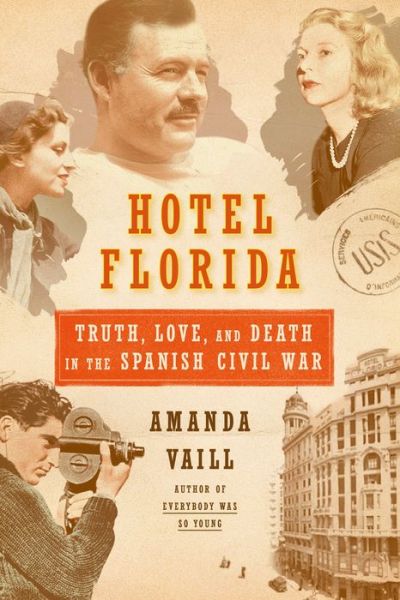
Teaser Tuesdays: Hotel Florida by Amanda Vaill

Teaser Tuesdays is a weekly bookish meme, hosted by MizB of Should Be Reading.

hotel florida

I am, of course, enjoying immersion in the beautifully composed Hotel Florida, a history of six individuals in the Spanish Civil War.

“THE PICTURE WAS BEYOND PRAISE AND SO WAS YOUR ATTITUDE,” wired Scott Fitzgerald after the screening he saw, at which Hemingway had spoken about la causa and the loss of Lukács and Heilbrun. Fitzgerald sensed in his old and now distant friend an attachment to the film project, and to the war in Spain itself, that had “something almost religious about it.” As so often, he saw Hemingway more clearly than Hemingway saw himself.

I appreciate the larger truth in these lines about the relationship between Fitzgerald (who doesn’t much play into this story) and Hemingway (who is one of its stars).

Also, I am thrilled to note just a handful of pages later an extended excerpt from Goethe’s poem, Der Erlkönig, which I memorized in its entirety for my German class in high school. (In German.) That was fun.

This quotation comes from an uncorrected advance proof and is subject to change.

The Rebellion of Miss Lucy Ann Lobdell by William Klaber

rebellion lucy annI am absolutely charmed by Lucy Ann Lobdell.

The backstory to this novel is an attractive little plot in itself. Journalist moves into an old farmhouse in upstate New York. Years later, he sits down with a local historian and hears the story of Lucy Ann Lobdell, who inhabited the area and is even linked to journalist’s own farmhouse. The aging local historian has searched and searched for Lucy’s memoir but never found it; he is now too tired to pursue her story further, but hands over his significant research to the younger journalist to follow. Journalist is likewise unable to find the memoir; but sensing the power in Lucy’s story, he writes it in novel form instead. And here it is.

Backtrack a little over 100 years. Lucy Ann Lobdell has had a difficult youth, and is entirely frustrated by the lack of options for women in the mid-1800’s, especially a young woman like herself with a daughter and whose no-good husband has run off on her. She runs away from home, leaving her daughter behind with her disapproving family, to put on men’s clothing and seek work as a man. Lucy works as a man can work (earning what a man can earn – and this references a problem that is somewhat ameliorated, but not solved, today) and lives independently – choosing her own company, holding her own hours, answering to no one. And thus she learns how much she has gained, and vows not to return to womanhood, where she will be manhandled, abused, underpaid, and never allowed to make her own choices. She dreams of having her daughter join her own day in her new life, but worries over what form that might take. What might she, as Joseph Lobdell (a name borrowed from her grandfather), be to the young Helen? Not a father; an uncle, perhaps?

Klaber’s novel, told in Joseph’s own first person voice, follows him as he works different jobs in different towns, moving around, facing various challenges. He’ll repeatedly be found out. He will eventually marry a woman named Marie – not the first with whom he’s had a romantic connection, but the first who has known his secret. Marie will accompany him through some of his roughest times, when he suffers from some form of mental illness. Of course, his conservative contemporaries will ascribe this to his sexuality, sexual preference, sexual identity – none of which terms were available to Joseph in the late 1800’s.

Here you see that I have switched pronouns; I’d like to note the brief statement that author Klaber makes, that “just which of the modern labels of sexual orientation or gender should be applied to the historic Lucy is something I will leave for others.” He notes that he honors Lucy/Joseph’s person journey. This strikes me as an appropriate stance for him to take. Such labels are fluid, and as none were open to “the historic Lucy,” I think we should take her as she presents herself. Of course, Klaber’s presentation of her or him are not her or his own; but we take what we have.

It’s easy to see what a an easy character Lucy can be to commiserate with. She is high-spirited, refuses to accept society’s limitations on her sex, and instead demands more. Her struggles are very sympathetic; not that it’s easy today, to figure out one’s sexual identity or sexuality, but how much more difficult in her time, with no role models or examples of what she might be. (Klaber cites one historian who claims the first use of “lesbian” in its current meaning was in reference to Lucy.) A theme running through her life, as told here, is the question of the extent to which she is a woman, or a man; only late in life she will come across the writings of Margaret Fuller, who proposes that we are all on a continuum between the two. Naturally Lucy/Joseph appreciates this concept.

We would like to know a little more accurately what happened to the historic Lucy/Joseph. Lacking that option, I’m glad Klaber chose to share with us as he could. He does invent dialogue, and it’s not clear to me how much of this might have come from the historical record. So as always with historical fiction, take a grain of salt. But her story is told feelingly. And as you know, I always have a weakness for women in history fighting uphill battles; her obscurity makes her rather more interesting still.

I’m glad I accepted this copy for review.


Rating: 7 wolves.

Full disclosure: I received my copy of this book from a publicist in exchange for my honest review.

book beginnings on Friday: The Remedy: Robert Koch, Arthur Conan Doyle, and the Quest to Cure Tuberculosis by Thomas Goetz

Thanks to Rose City Reader for hosting this meme. To participate, share the first line or two of the book you are currently reading and, if you feel so moved, let us know what your first impressions were based on that first line.

remedy

I have an awesome new book to tease you with today. I hope the title alone begins to interest; it did me. The first paragraph sets the stage:

In train after train, consumptives filled the passenger cars, their hacks and coughs competing with steam whistles and screaming brakes as the engines came to a halt in Potsdamer Platz. They came to Berlin without any sense of where to go or what to do once they arrived. And they kept coming, for days, weeks, and months. It must have struck Berliners as a sort of zombie pilgrimage: here were the walking dead of Europe, all suddenly flocking to their city in search of something – some fantastic substance that did not yet officially exist.

Not out til early April, so stay tuned for my review til then. But for now: I am quite impressed with the writing (my favorite: accessible, engaging, nonfiction science), and the fascinating story of the race towards a cure for tuberculosis, including Arthur Conan Doyle’s rather surprising role in it.

This quotation comes from an uncorrected advance proof and is subject to change.

A Burnable Book by Bruce Holsinger

A medieval scholar takes a fictional turn in 14th-century London, in a story full of murder, literature, politics and intrigue.

burnable book

A young prostitute watches horrified from the bushes as a woman is beaten to death–then looks down at the book in her hands, placed there by the victim moments before. A London “fixer” and minor poet named Gower is asked by his friend Geoffrey Chaucer to track a missing book. The court surrounding the new and untested King Richard II worries over the new games of playing cards and a book rumored to contain a series of verses circulating London regarding the deaths of kings past and present. This one book that troubles bawdyhouse prostitutes, the royal court, bureaucrats, poets and criminals holds potentially great consequences for England’s future. It is treasonous, a “burnable book.”

Bruce Holsinger, a prolific and respected medieval scholar, turns his hand to fiction with A Burnable Book. His academic background makes him well suited to render diverse settings in 14th-century London, from the Southwark stews to the grand halls of Westminster. The young woman murdered outside the city walls is only the first victim, and Gower is not the only one searching for the book in question, for scruples are scarce when the stakes are so high: England’s royal command itself is under threat. Murder mystery, political intrigue and the engaging world of Chaucer’s London are brought to life with a cast of complex, sympathetic characters who are far removed from and yet also familiar to our modern world. Holsinger’s expertise with medieval times is put to good use in a thriller filled with suspense and literary taste.


This review originally ran in the February 25, 2014 issue of Shelf Awareness for Readers. To subscribe, click here, and you’ll receive two issues per week of book reviews and other bookish fun!


Rating: 7 quatrains.

did not finish: Gone Girl by Gillian Flynn (audio)

gone girlI couldn’t do it, friends. This is a very well-known and much-loved novel of the last few years, and the word on the street is DON’T READ ANYTHING ABOUT IT before you read it! So I will say very little. Repeat: this is a spoiler-free, very short review.

There is a mystery. I did not read far enough to solve it. I am not very bothered by this. The reason I put it down so easily was: I didn’t like the characters. Possibly this is part of the trickiness of the book somehow; this book is famously tricky (I believe there is something about an unreliable narrator? but there are two narrators? I don’t know). But for me, the big failure was that I didn’t like these people so I couldn’t care about them enough to keep reading (listening) through the fact that they annoyed me very much. That’s all.

My audio version read by Julia Whelan and Kirby Heyborne was fine. They read the characters as obnoxious people, which seems to have been right on point, so I guess they did their jobs.

No rating; I only made it about 1/5 of the way through, so I’ll leave it at that.

Teaser Tuesdays: The Drunken Botanist by Amy Stewart


drunken botanist

Teaser Tuesdays is a weekly bookish meme, hosted by MizB of Should Be Reading.

I have only just begun this audiobook but have very high hopes that it will follow A Garden of Marvels beautifully. Booze & botany, where can we go wrong? The Drunken Botanist: The Plants That Create the World’s Great Drinks makes perfect sense to me. In her introductory pages, Amy Stewart writes:

If you’re a gardener, I hope this book inspires a cocktail party. If you’re a bartender, I hope you’re persuaded to put up a greenhouse, or at least plant a window box.

I think that puts it very well and succinctly, and I’m on board.