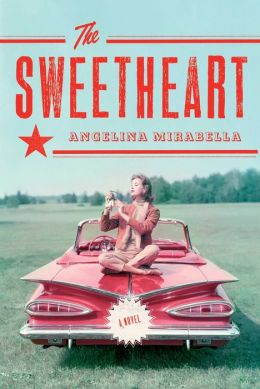
book beginnings on Friday: The Sweetheart by Angelina Mirabella

Thanks to Rose City Reader for hosting this meme. To participate, share the first line or two of the book you are currently reading and, if you feel so moved, let us know what your first impressions were based on that first line.

sweetheart
Two beginnings today from a new novel about which I know little. The Prologue begins:

The Turnip and I have a history.

Many decades ago, when he was a little boy and his folks were newly split, my sister left him with our parents and came to Memphis to live with me for a short while. It was only two months and just the medicine she needed, quite frankly, but he has held it against me ever since.

It’s intriguing, if not particularly revealing. (It actually took me a few paragraphs to figure out where we were and what we were up to.)

And chapter 1:

You want to be somebody else. You don’t know who this person might be; all you know is that she should be confident, beautiful, beloved.

More clear, at least, and the second person is somewhat unusual. I shall proceed…

This quotation comes from an uncorrected advance proof and is subject to change.

For a Love of His People: The Photography of Horace Poolaw by Nancy Marie Mithlo and the Smithsonian Institution

Arresting images of his community, taken by a Kiowa photographer, enriched by commentary.

for love

Horace Poolaw (1906-1984), a Kiowa Indian from Oklahoma, was an avid photographer who never made a living from that passion. For a Love of His People: The Photography of Horace Poolaw is the first major collection of his work, and serves as companion to a 2014 exhibition under the same name at the National Museum of the American Indian in New York City. Poolaw’s own photographs of his family and community, many never before published, are accompanied by related artwork in a collection of more than 150 images; these striking, vibrant images are not the only appealing aspect of this beautiful book. Essays and interviews by scholars, natives and non-natives, artists and activists and Poolaw’s family put his work in artistic, political and historical context, and portray him as documentarian of his time, place and people. These diverse contributors express Poolaw’s intention to preserve his piece of the 20th century, and complement the richness of his vivid work.


This review originally ran in the November 28, 2014 gift issue of Shelf Awareness for Readers. To subscribe, click here, and you’ll receive two issues per week of book reviews and other bookish fun!


Rating: 6 feathers.

Great Bear Wild: Dispatches from a Northern Rainforest by Ian McAllister

Beautiful photographs of the Great Bear Rainforest, at risk on the west coast of Canada.

great bear
Great Bear Wild: Dispatches from a Northern Rainforest is an impassioned plea for the conservation of the Great Bear Rainforest in British Columbia, photographed and written by Ian McAllister (“talk to anyone in the Great Bear about wildlife and eventually Ian’s name will come up,” writes Robert F. Kennedy, Jr., in the foreword). This distinctive coastal region is threatened by pipelines, oil tankers and liquefied-natural-gas transport; environmental groups and First Nation people are coming together in the fight to protect the enormous biodiversity, cultural heritage and immense beauty at stake.

McAllister, an accomplished photographer and longtime resident of the Great Bear, has local connections and a deep understanding of the issues at hand. Readers can flip through his work solely for the breathtaking photographs–of bat stars, spirit bears, sea wolves, salmon and many other remarkable creatures–but this accomplished collection also begs to be consumed chapter by chapter, for its ardent, beautifully written, informative prose.


This review originally ran in the November 28, 2014 gift issue of Shelf Awareness for Readers. To subscribe, click here, and you’ll receive two issues per week of book reviews and other bookish fun!


Rating: 9 herring eggs.

Teaser Tuesdays: God Loves Haiti by Dimitry Elias Léger

Teaser Tuesdays is a weekly bookish meme, hosted by MizB of Should Be Reading.

haiti

God Loves Haiti is a novel set in the 2010 earthquake suffered by that country, and is peopled by some striking characters – for example, the one in these lines:

…The moment, this dream-concretizing climax, felt ephemeral. Like she was about to wake up where she was born, in a roofless orphanage, naked, afraid, hungry, but pugnacious.

There is shock value to learning her roots, yes, but I love that string of adjectives for more than its shock value: how about that pugnacity, hm? Stay tuned.

This quotation comes from an uncorrected advance proof and is subject to change.

Ships, Clocks, and Stars: The Quest for Longitude by Richard Dunn and Rebekah Higgitt

The historic quest for naval navigation measurements, heavily illustrated and enlightening.

ships

For the tercentenary of Britain’s Longitude Act of 1714, the Royal Museums Greenwich offers an exhibition and accompanying book, Ships, Clocks, and Stars: The Quest for Longitude. For centuries, longitude, which locates a place on the Earth on an east-west basis, was impossible to track at sea, posing not only economic but safety challenges. This issue was eventually solved in the 1700s, largely by British scientists and philosophers, including astronomers, inventors and clockmakers. The story of quest for a solution–first define the question, then ascertain a reliable way to determine longitude while out in the open ocean, then build reliable and consistent tools–is one of innovation, cooperation and competition, as well as science. Richard Dunn and Rebekah Higgitt, both researchers and museum curators, relate the quest for longitude in accessible prose, complementing the text with more than 150 images, maps and artwork. While the ample notes will be welcomed by academic readers, the intriguing and varied illustrations and lively subject matter–a first-class adventure tale–will entertain anyone who dreams of travel and exploration.


This review originally ran in the November 28, 2014 gift issue of Shelf Awareness for Readers. To subscribe, click here, and you’ll receive two issues per week of book reviews and other bookish fun!


Rating: 6 degrees.

book beginnings on Friday: The Conversation: A Revolutionary Plan for End-of-Life Care by Angelo E. Volandes, M.D.

Thanks to Rose City Reader for hosting this meme. To participate, share the first line or two of the book you are currently reading and, if you feel so moved, let us know what your first impressions were based on that first line.

conversationThe Conversation focuses on a subject near and dear to me, after a little time spent in a hospital setting myself – although never in the position held by this author, a medical doctor.

It was a blustery March morning at the crack of dawn, and my medical team was refueling with ample cups of coffee in the hospital cafeteria before reviewing our list of patients. Just as I took a scalding sip, the overhead speaker blared.

“Cold Blue, Greenberg Five! Code Blue, Greenberg Five!”

I like that these opening lines really grab our attention. Shocking, perhaps? But also a realistic way to get into his head, I’d wager.

This quotation comes from an uncorrected advance proof and is subject to change.

Maus I, A Survivor’s Tale: My Father Bleeds History by Art Spiegelman

mausI have heard about this book for years, and am glad I finally picked it up.

Art Spiegelman’s father was a survivor of Auschwitz. Subtitled (excellently) “My Father Bleeds History,” this book tells the elder Spiegelman’s story, as told to Art, complete with the dialog between father and son that constitutes Art’s research. The action therefore switches back and forth between late-twentieth-century New York City and 1930’s Poland. The father-and-son interview portions are humorous, although with a sad note: Vladek Spiegelman is unhappily married following the suicide of his first wife (Art’s mother), Anja. The flashback parts are, naturally, disturbing, as they tell the story of Polish Jews as Nazi Germany pushed into Poland.

There is also a love story, that of Anja and Vladek, and the family story of Art and Vladek, father and son, getting to know one another and setting boundaries (as in the question of calling in the middle of the night about fixing downspouts). As Art himself laments, Vladek makes for quite a stereotypical – or racist – image of an older Jewish man: he is stingy with his money, manipulates his son using guilt, and speaks in a broken English dialect that I found quite charming, actually. But the story itself is killer, of course. There is a part II, and why do I not already have it here in my hands?

I am no connoisseur of comic (or cartoon?) art (I don’t even know what to call it). I will say that the art is fine, good: lots of black, easy to read (remarkably easy to read – I don’t do many graphic novels, and this one flew by). Spiegelman plays with symbols by making Jews mice, the Nazis cats, and non-Jewish Poles pigs. When the Jews try to blend in with Polish society after they have been removed, they wear pig masks over their mouse faces.

I was reminded of Alison Bechdel, most obviously because of the graphic format, yes, but it doesn’t stop there: Are You My Mother? also dealt with a parent, and framed the parent’s story with the interview process (and the familial tensions that came with it). That framing, that in-and-out of the story by way of the interviews, was familiar, and it’s a technique I like.

I have a feeling that there is quite a bit here to be studied from a more academic angle. I raced through this read in a quick evening, and it probably deserves more time & attention, but I need guidance. Happily, I have not only Maus II to look forward to, but MetaMaus (if I can find it?) with background material. Stay tuned.

Any graphic format fans out there? What have you enjoyed?


Rating: 9 chandeliers.

Maximum Shelf author interview: Cecilia Ekbäck

Following Monday’s review of Wolf Winter, here’s Cecilia Ekbäck: The Impact of Place.


Cecilia Ekbäck was born in Sweden, in a small northern town. Her parents come from Lapland. Ekbäck now lives in Calgary with her husband and twin daughters, “returning home” to the landscape and the characters of her childhood in her writing. Wolf Winter is her first novel.

ekbackWhat background–literary or personal–led you to this subject matter?

A wolf winter is a very cold, very bitter winter. But in Sweden, it is also the period in life when you’re faced with your mortality, when you realize that you’re alone–an illness, or the loss of a loved one or something like that, when you come face to face with death, and feel very lonely. Where you have to face sides of yourself that you didn’t know that you had, that you like less, or things that you haven’t dealt with. I wrote this book after my own wolf winter, which was when my dad passed, from cancer. He was my best friend. That was the time when I had to do a lot of soul-searching, when I had to do a lot of thinking through what I wanted to do with the rest of my life and what I was going to do with the enormous space that he left after himself. The book sort of came out of that. I wanted to take a number of characters and have them walk through their wolf winter, if you like, both literally, with the cold and the winter and the snow and the hunger and so on, but also emotionally.

The book switches perspectives slightly between several characters. What led you to that strategy?

Society in those days was very compartmentalized, so I knew that I wanted the main character to be a woman. When we read history, there’s so little about women. I wanted to write women back into that period. And I felt you had to have a few different views to get access, for example, to the church. Maija was always there; and then I felt that her character did not let her easily get involved in the more emotional or spiritual side of Blackåsen, so I let her daughter do that. And then I felt that we needed the priest to get access to the church and to the crown.

Was there a character you felt closest to?

Well… I like them all. But I like Maija and the priest very, very much. Frederika felt… a little bit close to home. I grew up in a very religious environment, and I just felt she came a little bit close to home, so I liked her less! But I was very, very fond of the priest and of Maija.

Are there heroes and villains in this story?

I think there are more strengths and weaknesses. You could say that there are certainly villains. But I guess what I wanted them to be was thoroughly human. So nobody, I don’t think, is straight out one way or straight out another. I wanted to work more with strengths and weaknesses of each character.

What kind of research did you do to evoke 1700s’ Sweden?

I read lots. I’m not a historian, and I get uncomfortable when people say this is a historical novel, because I know that I don’t have my education in that field–I have a terrible memory, and very poor attention to detail. It’s a story set in the past, is how I think about it.

I read everything I could find. In northern Sweden, very often when a town celebrates 200 years or 300 years, they publish a book. Those books are only locally published, and they give the history of the place and lots of anecdotes and so on. I worked a lot with books like that. Then, one of the most important things I did was interviews with my grandmother, her sister and their friends. Even though the story happened way earlier, Lapland didn’t actually change that much until after the Second World War. My grandmother used to say they lived like people had lived in all times. And then, one day to another, they went from shoes that they had made themselves to buying high-heeled shoes in the shop. It was a shock to everyone. It was like when falls a meter of snow and you wake up and you go out and you think, this is not my world! I recognize certain things, but not many others…. So, I spoke a lot to them about the practical details, how they cooked, how they shepherded goats, how the cold was, how the houses were, and I imagined that a lot of it wouldn’t have been that different. Because a lot of this sort of knowledge was passed down through generations–the way you did laundry, the way you worked with nature and so on. So that was really, really important for the practical life of the settlers. And I spoke to a lot of priests, but that was more to understand the faith of the state church as was in that time.

I wrote this story four times. The first time it was set in 1985, and it was really much more of a family saga. I was writing it to try and understand where we came from and why we were a certain way and why we were religious, why we didn’t speak of certain things, why we were frightened of certain things, and so on. And the second time it was set in, if I remember correctly, 1865. And then I wrote it set in the early 1800s, and then, finally, in 1717. And every time I wrote it I thought yes, but this is not where it starts, this is not the beginning. And the further I went back, the more I felt that 1717 was a great year, because the early 1700s was when the settlers began to arrive to Lapland, for various reasons. That particular year was a year when Sweden was at its peak. Sweden was a great power, but it was crumbling. The king had warred abroad for his whole life, and he had just returned to Sweden, and we were warring on several fronts and there was no more money and so many people had died in the years of war…. I thought that added something, that crumbling sense, where things change for the characters regardless of which social class they belonged to. I thought that was a good setting for them and for this story. It’s where the story felt comfortable. We’re so influenced by place, in the largest sense of the word; not just nature and climate, but political history and socially what’s going on and so on. I wanted a place that would have an impact on them, whether they were close to it or further away.

What did you feel upon completing your first novel for publication? What are you working on next?

It’s a bizarre thing, publishing your book. You’ve lived with it for so long and it’s so close to you. The delight is that others read it and talk about it, and they’ve seen things in it or found things in it that they feel are valuable, and then I feel elated. But the publication of it actually frightened me more than it made me happy. When I found out that I had actually sold the book, I went to my best friend and I cried. I said, I don’t want to be published! And he said, you’re insane. But that’s what I did. And then I called my husband and said I thought I had a brain tumor. Those are the two things I did.

Now I’m working on the second book, which is a very, very loose sequel. It’s set 130 years later, at Blackåsen, and so the mountain is the same and the supposed curse is the same, but the characters and the dilemma they face are completely different. I have found it easier in a way and harder in others, to write the second one. Easier in that I have more of a writing process. And also easier because I wrote it in so many different centuries that a lot of the research I’d already done. But harder in the sense that it’s much more real: it’s actually going to be a book! It’s not just a story for me any longer. And I find that makes it harder.


This interview originally ran on November 25, 2014 as a Shelf Awareness special issue. To subscribe, click here, and you’ll receive two issues per week of book reviews and other bookish fun!

Teaser Tuesdays: Publishing by Gail Godwin

Teaser Tuesdays is a weekly bookish meme, hosted by MizB of Should Be Reading.

publishing

The plentifully published Gail Godwin looks back on her career in Publishing. She is charming and humorous as well as moving; and I think these lines begin to express that.

“What kind of editor would you like to work with?” was Robert Gottlieb’s first question to me in his office, and I replied rather pompously, “Well, it will have to be someone who appreciates great literature,” then burst into sobs.

and several paragraphs later,

…on that late 1970 December day, he waited out my sobs and then said kindly, in response to my Great Literature stipulation, “Well, Gail, I’m afraid that’s going to be me.”

Lest you think her, well, obnoxiously pompous, I assure you she had reasons to be crying that day. And this description of these events is, I think, sweetly funny. I do recommend her.

This quotation comes from an uncorrected advance proof and is subject to change.

Maximum Shelf: Wolf Winter by Cecilia Ekbäck

Maximum Shelf is the weekly Shelf Awareness feature focusing on an upcoming title we love and believe will be a great handselling opportunity for booksellers everywhere. The features are written by our editors and reviewers and the publisher has helped support the issue.

This review was published by Shelf Awareness on November 25, 2014.


wolf winter
“It’s the kind of winter that will remind us we are mortal. Mortal and alone.”

In 1717, the Swedish Laplands are home to indigenous nomadic Laplanders and a mere sprinkling of Christian settlers. A new family has just arrived, fleeing an enigmatic unpleasantness in their native Finland, to take over a vacant homestead on the shoulder of beautiful but harsh Blackåsen Mountain. Frederika is 14, Dorotea six; their mother, Maija, is strong and resourceful, while their father, Paavo, is so crippled by vaguely defined fears that he seems to disappear even in the ever-present light of summer. In the opening pages of Cecilia Ekbäck’s debut novel, Wolf Winter, the girls discover a dead body on the mountain: a man, with his torso torn open. Maija rushes to the scene and is told by other settlers he was killed by wolves, or a bear. But the cut is long and clean, nothing has fed upon the corpse, and she wonders. She picks up a small item off the ground nearby.

The settlers do not live close to one another; it requires a purposeful hike to visit with a neighbor. Nonetheless, there is a priest in the village–a place generally vacant, where the settlers gather for Christmas and several weeks after, as required by the King–under whose purview a murder might fall. Just as Maija feels compelled to investigate the death of a man she never knew, the priest has his own orders, and his own secrets as well.

In the autumn, as the days in this far northern land shorten, Paavo leaves to find work far away. Maija capably runs her remaining household, and frustrates her neighbors, who feel that a woman should not speak at meetings. Frederika is haunted by the dead man she and her sister found. She begins to discover certain strengths, or powers, taught by her great-grandmother. Is she being haunted, or is she calling the dead? Frederika seeks guidance from the Laplanders, who used to commune with the spirits, but they have been (nominally) converted to Christianity by the Swedish king. And the priest remains a figure of mystery: Why investigate the death on Blackåsen Mountain? What is he hiding? While always told in third person, the perspective shifts subtly, between that of Maija, Frederika and the priest.

As winter falls, there is a palpable feeling of danger on the mountain and in the scattered, tenuous community. Paavo does not write home, the cold intensifies, food is scarce. Maija feels a continuing urge to solve the mystery of the murdered man on Blackåsen, which makes her no friends, and the priest clearly has motives of his own. War looms in the background, frostbite in the foreground. Maija cannot be sure which of the Swedish settlers she might be able to trust; each time she turns to a new acquaintance, she receives a cold shoulder or an alarming intuition. Even her daughter Frederika feels unreachably distant in their tiny, draughty house. Both Frederika and Maija attempt alliances with the nomadic Laplanders who move through their lives, but each gets less than she’d hoped. And Dorotea, seemingly too small to engage in adult machinations, is in danger from the obvious as well as the most surprising and sinister of threats.

Wolf Winter‘s scope is enormous. Maija struggles to keep her family afloat; struggles for autonomy and reason in a community ruled by secrets, fear and corruption; and seeks a voice as a woman in her own fate. Several levels of organization push and pull against one another: the household, the loose network of homesteads, the village which is only inhabited in darkest winter, the church and state, the King’s decrees and the wars he engages in–all will eventually supply tension in a story set on a sparsely populated and apparently cursed mountain.

Ekbäck imbues her tale with a sense of foreboding from the very start, and her austere writing matches the landscape: occasionally colorful but often in muted shades of gray, stark, cold and unforgiving. The range of topics touched upon–women’s place in society, isolation and community, political corruption, family, the power of superstition and fear–is daunting, but Ekbäck never attempts too much. Instead, the questions her characters ask themselves do the work of the novel’s examinations. Frederika struggles with her ability to see things that others do not; Maija resists such a possibility, to keep a grip on her family’s survival; and the priest strains to maintain the appearance of well-being.

The strengths of Wolf Winter clearly begin in its atmosphere, masterfully chilling with its literal weather–particularly a deadly snowstorm–as well as the isolation and withdrawal practiced by almost every character. Ekbäck’s pacing is expert as well, tension building as the snow rises and the settlers gather together. The characters’ secrets are many, and are revealed slowly throughout, up to the final pages. Even the characters more sparingly described are engaging; the central characters are deeply, thoroughly captivating. In the end, multiple faceted mysteries add to the allure of a debut novel that is both frigidly unnerving and wise, and ultimately satisfying in its resolution.


Rating: 7 toes.

Come back Wednesday for my interview with Ekbäck.