Brian Doyle at Chuckanut Radio Hour

You will of course remember my glowing review of Brian Doyle’s most recent novel, Martin Marten, which remains the best book of 2015 to date (and may well make it through: I rarely award more than one *10* in a year). The same week that that review published over at Shelf Awareness (and my teaser posted here), he came to my little city to speak at a local event, the Chuckanut Radio Hour.

The Chuckanut Radio Hour is edited and aired on local radio a few times afters its live production, and it costs $5 per person (plus fees, naturally) to be part of that live audience. My parents and I went to see this edition, because Brian Doyle! I hadn’t been before (my parents had). The show describes itself as

…a radio variety show that began in January 2007. Each Chuckanut Radio Hour features a guest author and includes guest musicians, performance poet Kevin Murphy, Cascadia Weekly columnist Alan Rhodes, an episode of “The Bellingham Bean” serial radio comedy, and some groaner jokes by hosts Chuck & Dee Robinson and announcer Rich Donnelly.

(Chuck and Dee are the owners of Village Books, our local top-shelf independent bookstore.) I have wholesale stolen that quotation because it’s quite accurate, although in this edition we missed Alan Rhodes and instead took an extra musical number by guest artists 3-Oh. The band was good, and funny, with covers and originals; the spoken-word/poetry was good; “The Bellingham Bean” was quite funny (and guest-starred the versatile Brian Doyle to boot). The hosts’ jokes were, yes, groaners. But of course we were there for the author. Brian Doyle turns out to be a falling-down fine comedian in his own right, who knew? Also a very good storyteller, although that is less surprising. He didn’t really need an interviewer – just a microphone and a stage, and free rein. He monologues quite cheerfully, energetically, happily, and oh so funnily. He then continued this performance after the show was wrapped up, as we lined up to get our books signed (did I cheat by having him sign my galley?) and talk with him: the line was long because Doyle was so generous with his time and attentions, and I am grateful.

That’s two very good author-talk experiences in a row. If you get a chance to see Brian Doyle live, do! And for now, go get yourself a copy of the new Martin Marten: it’s outstanding and unique. And join me in investigating his earlier work, too, which includes two novels (The Plover and Mink River) as well as a bunch of essays. Here’s to local theatre etc.!

Teaser Tuesdays: The Secret Place by Tana French

Teaser Tuesdays is a weekly bookish meme, hosted by MizB of Should Be Reading.

It’s astonishing how long it’s taking me to listen to this book, isn’t it?* It’s certainly astonishing to me; and let me say that it’s no fault of The Secret Place itself, which is as wonderful as any of Tana French’s novels. (I’ll wait to rank it til I’ve finished, of course.) I’ve already teased you with it once, but here we are again.

secret

Today I’ll share with you a few lines spoken from Frank Mackey (who we remember from The Likeness and Faithful Place) to Detective Stephen Moran.

“Always fuck with people’s expectations, Sunshine. It’s good for their circulation.”

Good advice from Mackey, I’m sure. Keep that in mind, kids. And stick around: one day I will finish this book and review it for you.


*If you’re curious, my lifestyle is much changed these days, now that I don’t have a day job. I no longer have a lengthy commute during which to listen to audiobooks. I am clearly not spending nearly enough time in the gym or doing housework, either. I’m loving the new life; but it’s skewing me much more towards print and away from the audio. Bear with me.

coffee helps me read and write

Realizing the obvious: as a creative person, I have good days and bad ones. When I get discouraged, I get very discouraged, and feel unable to do the writing & editing I know I need to do; I want to give it all up. As my friend Liz says, though, some days we just need to lie fallow (and give ourselves permission to do so).

I don’t want to dwell on that negative side today, though: I want to talk about the other days, the hyperproductive ones, when I can write 3 book reviews, do an author interview, schedule 4 blog posts and finish an essay I’d been working on. That happens sometimes, too! And you know what those productive days have in common? Coffee.

Shelf Awareness shared with me the other day an article called 12 Literary Coffee Mugs All Book Nerds Need in Their Lives. I am tickled by the concept, naturally. Go ahead, click the link, and see the bookish, readerly coffee mugs on offer there. I have made my own collection, though, and naturally think mine are a better set of choices: readerly and writerly as well.

a nod to the librarian stereotype

a nod to the librarian stereotype

a little humor - and truth

a little humor – and truth

a Sugar reference

a Sugar reference

often, but falsely, attributed to Hemingway: never mind, it sounds like him

a gift from my parents, from the Library of Congress

a gift from my parents, from the Library of Congress

What about you, dear readers? Coffee or tea? In what mug? Does it matter?

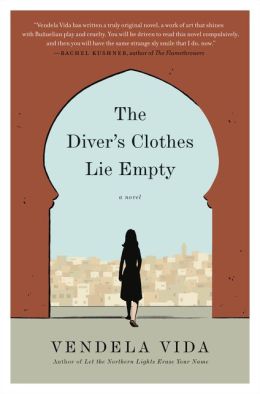
book beginnings on Friday: The Diver’s Clothes Lie Empty by Vendela Vida

Thanks to Rose City Reader for hosting this meme. To participate, share the first line or two of the book you are currently reading and, if you feel so moved, let us know what your first impressions were based on that first line.

diver's clothes

I have you for today a most interesting new novel, which begins thusly:

When you find your seat you glance at the businessman sitting next to you and decide he’s almost handsome. This is the second leg of your trip from Miami to Casablanca, and the distance traveled already has muted the horror of the last two months.

I love that a lot is given away in these lines, and many mysteries are presented and left unsolved as well. Note also the unusual second-person voice: you are the star of this story, m’dear. Stay tuned.

This quotation comes from an uncorrected advance proof and is subject to change.

God Help the Child by Toni Morrison

Toni Morrison brings a keen perception and lyrical voice to the veiled but lasting effects of childhood trauma.

god help

Toni Morrison (Home), winner of a Pulitzer and a Nobel Prize in Literature, satisfies her fans with a searing, lyrical story about the power of childhood trauma.

God Help the Child centers on a woman who has left behind the “dumb countryfied name” Lula Ann to become Bride, “with nothing anybody needs to say before or after that one memorable syllable,” a successful California career woman with her own cosmetics line but who wears no makeup. Her mother was a light-skinned, “high yellow” woman dismayed by and unable to love her blue-black daughter, but Bride grows up to repossess her skin tone and every other aspect of her beauty.

From a childhood marked by rejection and terrible crimes, Bride remakes herself as an object of attraction and a financial success, but as the novel opens, she faces dual blows: her mysterious live-in boyfriend, Booker, leaves, and a prisoner is paroled with whom she shares an old bond. God Help the Child reveals these complicated paths in alternating perspectives, most frequently Bride’s first-person voice but also that of her friend Brooklyn; her mother (who taught Lula Ann to call her Sweetness, rather than Mama or anything else that would tie them too closely together); the new parolee; and a child Bride meets along the way. Eventually, after several oblique glances, Booker himself comes fully into sight, but his perspective is told only in the third person, as Bride goes looking for answers and Lula Ann threatens to reemerge.

Even Morrison’s minor characters are complex, intriguing people deserving of closer inspection, and as Bride’s journey acquires a momentum of its own, the magnetism of her troubles pulls the reader along. She suffers the coldness of both her parents, a harrowing court case, an assault, a car accident and a fire; but it is the traumas of her childhood that most torment Bride, and, as becomes apparent, the same is true for Booker. In the end, healing comes in a surprising form.

Beautifully composed in a variety of distinct voices and covering a range of family concerns, God Help the Child employs a hint of magical realism and explores issues of race and women’s lives familiar to fans of Morrison’s fiction. The story of Bride’s life and trials is sensual, both delicate and strong, poetic and heavy with sex, love and pain, exemplifying a revered author’s unfailing talent.


This review originally ran as a *starred review* in the April 20, 2015 issue of Shelf Awareness for the Book Trade. To subscribe, click here.


Rating: 7 earrings.

Maximum Shelf author interview: Erika Swyler

Following Monday’s review of The Book of Speculation, here’s Erika Swyler: Writing, Binding and the Bath.


Erika Swyler is a graduate of New York University. Her short fiction has appeared in WomenArts Quarterly Journal, Litro, Anderbo.com and elsewhere. Her writing is featured in the anthology Colonial Comics, and her work as a playwright has received note from the Jane Chambers Award. Born and raised on Long Island’s North Shore, Swyler learned to swim before she could walk, and happily spent all her money at traveling carnivals. She blogs and has a baking Tumblr, ieatbutter, with a following of 60,000. Swyler recently moved from Brooklyn back to her hometown, which inspired the setting of The Book of Speculation, her debut novel.
swylerYou presented your manuscript in a highly unusual way. How did that work, and what possessed you?

The plot hinges on the idea that a particular old book is such a fascinating object that it could consume someone’s life. It felt very important to create that experience for a person reading my manuscript. It was a simple thought: if they connected with the manuscript as an object, it would pave the way for connecting with the story. I had next to zero experience in bookmaking when I decided to bind and age the manuscripts. I might have balked if I’d known from the start how much of my life the project would devour.

Possessed is the right word. While revising, I spent months experimenting, testing stains and hunting down the right material for the cover. I tried other binding methods, but they were either too time intensive, or spectacular failures. Japanese stab stitching was fast, and a great way to make a binding stand out. Production took about a month and a half, with binding being the fastest part. Aging books takes time–drying time. It took two days for a book to cure after being rasped and stained, and another day for gilding. For the better part of a summer my dining room was a mess of drying paper, dust from abused tarot cards, rasps and gold ink. My friends thought I’d lost my mind. I probably had, to a degree, but I’d already sunk a good part of my life into writing the book and I felt it deserved every possible advantage I could give it. If nothing else came of it, I’d at least have an art object. I made 16 manuscripts in all. I held on to two copies.

What were the most and least fun parts of writing this book, or bookmaking?

The worst bookmaking moment was when my favorite drill bit snapped and took a piece of my thumb with it. That was an angry day in the dining room bookbindery. The most fun part? I got to make books! Waxing linen thread is really satisfying. It smells delicious and there’s a meditative quality to it. I also got to learn a new skill. I’m happiest when I’m learning.

Trying to evenly balance a dual narrative was the hardest part of writing. The easiest thing a reader can say about a dual narrative is that they prefer one part over the other. It was my mission to make sure that both narratives were treated equally. The whole story had to have a chance. I’d read the narratives together, then separately, then together, and then pull them apart once more. For every one read of a draft a writer might typically do, I’d read anywhere from two to four. The most fun part of writing it? Any scene involving terrible weather. There’s some truly awful weather in this book and it was always a joy to write. Bad weather allows you room for scenery chewing.

How much of this story is rooted in history?

I did a good amount of research, particularly for the 1790s portion. I really wanted to know how circus came to America, and what it looked like before P.T. Barnum cast his shadow. I found this little window of time shortly after the Revolutionary War where circus was just beginning to pop up. It was the perfect space to let Peabody and his menagerie breathe. I also think when you’re playing with the fantastic, it’s helpful to have grounding elements. The Wallendas, Philip Astley, the Joneses, John Bill Ricketts and Mr. Spinacuta are actual figures in circus history. That said, Peabody and his menagerie are entirely imaginary.

Librarians are awesome, aren’t they?

Yes! Librarians are flat-out wonderful. Nothing’s better than a person who doesn’t bat an eye when peppered with questions about curse tablets, circus accidents, tide tables, and if there’s any way around a paywall on an article. I may have done that to several librarians. Yes, I know, search engines. Search engines are like opening a fire hydrant. Librarians are far better at helping you find what you’re after, even when you don’t quite know what that is.

You’re from Long Island. What of your childhood is in Simon’s?

Napawset is a shameless amalgam of small towns where grew up. It’s an interesting place that makes you desperate to leave it, while simultaneously wondering why anyone would ever want to go. As for Simon’s childhood, I spent a good deal of mine on the beach with my sister. Thankfully, our relationship is better than Simon and Enola’s. We played on the rocks, cooked out on the beach and made ourselves nuisances to the adults around us–like kids. Also, when you grow up on a shore, there’s always this odd need to check on the water, to see what it’s up to. I think my gift to Simon was that the water was always up to something.

Where does an idea like this come from? Was it born to you whole, or were you working to flesh it out all the way through?

The idea is rooted in that moment we’ve all had when we stare at our families and think, “Where did you people come from?” That’s Simon’s narrative, this very practical question. His story also came from wondering about the houses that actually are sliding into the Long Island Sound, who lives in them, and how they got to that point. It was something I had to work out because it began with questions more than characters. The 1790s portion came to me almost fully formed, in about thirty seconds, while taking a bath. I saw Peabody, Amos, Evangeline, the entire menagerie, and how it connected to Simon all at once. It was a seriously great bath.


This interview originally ran on April 15, 2015 as a Shelf Awareness special issue. To subscribe, click here, and you’ll receive two issues per week of book reviews and other bookish fun!

Teaser Tuesdays: The Savage Professor by Robert Roper

Teaser Tuesdays is a weekly bookish meme, hosted by MizB of Should Be Reading.

savage

On just the opening pages, a characterization of person via his books. How could I pass this one by?

Inside, a scouth of books, as the Scotsman said. Some that had been with him since the beginning, since before he went to St. Paul’s, where he had been a subsidy boy, a scholar on the foundation. Books bought as a lonely Bohemian maths grind at LSE, where had gone instead of Cambridge, for “political” reasons. Plain paperbound books in French, bought at outdoor stands along the Seine, as they ought to have been. A solid selection of the approved high-lit product of the last forty years, books spoken of in the pages of the Guardian, the Times Literary Supplement, Les Temps Modernes. Mystery novels by the hundreds, by the thousands. Oodles of sci-fi, and pornography, an eclectic sampling, still consulted sometimes in the dead of night, with the left hand. Math texts read for brain tuning. The full epidemiological monty, of course, everything in any way relevant to his own lines of study plus all others, everything ever attempted by his busy generation, in special nine-foot-tall shelves of stained cherrywood.

Outstanding, isn’t it? We’ve only just met this character, and now look at what all we know about him, solely by what he stocks on his bookshelves. A whole personal history. We readers are not new to the concept, of course, but it’s nice to see it written out like this. And this is just the beginning!

This quotation comes from an uncorrected advance proof and is subject to change.

Maximum Shelf: The Book of Speculation by Erika Swyler

Maximum Shelf is the weekly Shelf Awareness feature focusing on an upcoming title we love and believe will be a great handselling opportunity for booksellers everywhere. The features are written by our editors and reviewers and the publisher has helped support the issue.

This review was published by Shelf Awareness on April 15, 2015.


book of speculation

Erika Swyler’s debut novel, The Book of Speculation, opens on a precipice: Simon Watson’s house teeters, ready to tumble into the sea. “The Long Island Sound is peppered with the remains of homes and lifetimes, all ground to sand in its greedy maw. It is a hunger.”

Simon is precariously employed as a librarian, and thus lacks the funds to shore up his family home, from which his family is gone: his mother drowned, his father dead from grief, and his sister, Enola, departed, making her life with a traveling carnival. These days, Simon’s community is composed largely of the next-door neighbor, Frank, a longtime friend of Simon’s parents; and Frank’s daughter, Alice, a library colleague and a reliable constant in Simon’s life.

Enola rarely visits, but happens to be on her way home just when Simon receives a strangely apt package in the mail: an antiquarian book dealer, a stranger, has sent him a very old book which he believes has ties to Simon’s family history. The bookseller, Martin Churchwarry, bought it as part of a lot at auction, purely on speculation. It is the log book of Peabody’s Portable Magic and Miracles, a traveling circus in the 1790s, and contains the name of Simon’s grandmother. A librarian with archival experience, Simon is ready to treasure this unexpected gift on several levels, but puzzled by the family connection. Still, it draws him in, and by the time Enola arrives, he is thoroughly absorbed. She is unimpressed with his studies, while her obsession with her own tarot cards seems to be growing.

Simon reads and researches the names he encounters in Peabody’s book, calling into service his librarian friends and Martin Churchwarry himself, with whom a strangely easy friendship is established. These efforts yield a disturbing pattern. Simon already knew his mother was a “mermaid”: she could hold her breath for many minutes at a time, a trick she taught to her children. This skill notwithstanding, she drowned herself on a 24th of July. Simon did not know, however, that she came from a line of circus-performing mermaids, all drawn to the water, and that they all died by drowning on the 24th of July. In mid-July, as Enola, acting strangely, returns to their home by the sea, Simon fears that time is running out if he hopes to solve this puzzle and save his sister.

Meanwhile, the events of the past simultaneously engage the reader, as chapters alternate between Simon’s time and that of Peabody’s menagerie. A mystical Russian tarot card reader, an avuncular business-minded circus boss and other colorful characters populate the parallel thread of The Book of Speculation. But in Peabody’s world, it is Amos, a mute bastard who plays the “Wild Boy,” who will most capture the reader’s imagination and compassion.

The strengths of Swyler’s novel are many. The atmosphere of storm-tossed Long Island, with a house that threatens to dive into the sea, is at once fully, realistically wrought and fanciful: Is there a curse? Simon pursues the secrets of his family as his life literally falls apart around him, floor, ceiling, foundation and memories crumbling. Likewise, Peabody’s peripatetic enterprise evokes the promised “magic and miracles,” as well as more prosaic hazards. Each chapter is in itself a small departure into a fantastic, engrossing world. Imagery of woods and animals, small towns and family dynamics are finely drawn; everywhere is the water that frames both stories, from the Long Island Sound that menaces Simon’s home and those he loves to the rivers and streams alongside which Peabody travels. Indeed, if this story has a soundtrack, it is the gurgling waters that promise both succor and ruin to the mermaids’ line.

The Book of Speculation is driven both by character and by plot, as the reader aches for the vulnerable Wild Boy in Peabody’s circus and roots for the crooked romances of Simon’s time, and wonders, as the story develops, whom to trust. To round out an eccentric cast, Enola brings home a boyfriend from the circus who is covered in tattoos and possesses an electrifying special talent, and Simon explores new ground with Alice, the girl next door. Each of the men and women from both timelines proves multi-faceted and compelling. The overall effect is captivating, as Swyler’s delightful, mesmerizing prose keeps the story tripping playfully along through both light and dark moments. As Simon pursues the loose ends and they tie oddly together, Swyler keeps the pressure and the pacing on, as her characters struggle to make connections.

The meandering plot offers many charms: likable, quirky librarians; circus menageries and freak shows; love stories; tarot cards and trickery; mysticism; family secrets; and prickly sibling love–all accompanied by the author’s illustrations. [Swyler also painstakingly hand-bound, gilded and aged her manuscript submissions, in imitation of the old book in her story.] In short, The Book of Speculation, like the book at its center, promises to grasp the reader with a supernatural force and not let go.


Rating: 8 horseshoe crabs.

Come back Wednesday for my interview with Swyler.

class: Foundations of Creative Nonfiction – B

I took a class from Creative Nonfiction this spring, for 10 weeks from January through March. Foundations of Creative Nonfiction is taught in two sections, A and B, and the difference is in the readings assigned, so that neither is a prereq; rather, it’s basically an opportunity to expand into 20 weeks by taking both, and get more reading-and-discussing out of it. Also, presumably, different instructors. My instructor for this section was Meghan O’Gieblyn.

Let’s see, how to begin? Like many online classes, this one involved reading 3-5 short pieces per week and commenting on them in discussion forums. Meghan posted her written lectures (3-5 pages) for each week, as well as two examples of the writing form in question, and often a few more optional readings. My classmates and I were to post a comment on the week’s readings, and reply to one another’s comments as well. Then there were writing assignments: short, optional ones, and three longer (3,500 word) pieces. These, too, the instructor as well as my classmates responded to.

Now, I got my master’s degree almost entirely through this very format. The difference here is that my classmates and I are here even more by choice: we paid for this class, and it gets us nowhere in terms of a degree or class credit; it’s purely for personal enrichment. (If any of my classmates got a pay raise or a new job out of this, I didn’t hear of it.) If anything, one might expect the discussion to be slightly elevated over my (rather disappointing) graduate school experience. And… I guess it was, a little, but the drawbacks were the same. For one thing, I think online discussions are unavoidably more stilted than live, in-person ones. There’s little chance to speak off the cuff in an online forum; there’s a chance for editing and deleting. Some classmates cited technical difficulties interrupting their comments, too. It’s always rewarding to hear from other human beings about anything you’re reading, writing, or otherwise interesting, so that benefit was present. But I remain unsold on the digital format: if real people are available, in person, in real life, I think they will always be preferable.

I did get a lot out of this class, of course. I got a lot of readings and lectures (all of which I’ve saved for future reference). I got feedback on several short and the three long writing pieces I did. I gained only a little help with the concept of getting my work properly published; but that still feels awfully remote anyway. And to be fair, if it felt closer, the opportunity was present to ask those questions.

Instructor Meghan was excellent: responsive, kind, and full of specific, detailed criticism and advice. Overall, the class may not have been utterly world-changing, but it was worth the time, although I think an in-person class would be better. And if you consider CNF for an online class like this, I’d highly recommend Meghan.

Inside the O’Briens by Lisa Genova

Family dynamics after a diagnosis of Huntington’s disease, exquisitely portrayed with poignancy and tenderness.

inside

In her fourth novel, Inside the O’Briens, Lisa Genova (Still Alice) introduces a traditional Irish Catholic family who have to cope with a neurological disease.

Over several years, Joe O’Brien, a proud, hardworking Boston cop, has been increasingly irritable and quick to anger, and has trouble concentrating on his paperwork. He starts stumbling and dropping things; there are murmurs of drink or drugs. When they finally see a doctor, the O’Briens learn about Huntington’s disease, an inherited neurodegenerative disease that over the course of 10 to 20 years will rob Joe of his ability to move, speak and eat on his own. It’s been causing his short temper and confusion. And there’s a 50-50 chance that each of his children has it.

Each of these young adults has a decision to make: they can be tested for the gene marker that predicts Huntington’s or they can live with uncertainty. The eldest has been trying to conceive; a baby would be at risk, too.

Sympathetic, absorbing, multifaceted characters compel the reader’s compassion. While Genova’s background in neuroscience allows her to portray medical issues accurately, the heart of the O’Briens’ story is human: how each member of the family copes with the news of Joe’s pending mortality; whether each child chooses to be tested; how knowing or not knowing guides how they live their lives. Their insular Irish Catholic community is likewise evoked with sensitivity and precision.

Poignant and painful, warm and redemptive, Inside the O’Briens displays Genova’s established strengths in bringing neuroscience to the lay reader, and portraying the power of love.


This review originally ran in the April 14, 2015 issue of Shelf Awareness for Readers. To subscribe, click here, and you’ll receive two issues per week of book reviews and other bookish fun!


Rating: 8 sippy cups.