
author interview: Fernanda Santos

photo: Nick Oza

photo: Nick Oza

Fernanda Santos covers Arizona and New Mexico as the Phoenix bureau chief for the New York Times. Her experience as a journalist is broad, crossing two continents, several languages and a range of subjects. Her first book, The Fire Line (Flatiron Books), is about the deadly 2013 Yarnell Hill, Ariz., wildfire that killed 19 members of the firefighting team the Granite Mountain Hotshots. My review is here.

How was writing this book different from newspaper work?

I wanted to write a book because I couldn’t answer the questions that I wanted answered in newspaper stories. I knew that somebody would write about this fire, and I would have tortured myself for the rest of my life for not having had the courage to write it. I called a colleague in New York, and he said, look at every chapter as a story. Can you write a 4,000-, 5,000-word story? And I said yes, I can write that. He said they just all have to connect in the end. And it seemed so simple.

On one hand, it was that simple. But on the other hand, it’s very different than writing a newspaper story. I had complete control over it. In newspapers, the editors get hold of your text and shape it, or send it back to you and ask for more of this or that, because they want to drive a specific point. With the book, I kept waiting for the moment when the editors would get my chapters and start telling me where to go and what to do next, and it never came. When I was halfway through, I sent it to Colin Dickerman, my editor at Flatiron. I didn’t even know if I’d written something that resembled a book. And he said, there’s a lot of great material here, great reporting, but it’s a little confusing. Why don’t you do an outline? And I thought, oh! I guess that would help! With the outline, everything was easier. I set deadlines for each chapter. I only had a certain amount of book leave, and I didn’t want to jeopardize the job that I really love. So I assigned myself these stories, like my friend told me, and pursued the deadlines as if an editor was there to enforce them. And all of a sudden it flowed, just naturally evolved from one chapter to the next. A lot of the skills I used were developed over those years writing newspaper stories.

How did you gain access to these men’s families, and their trust?

I approached it very differently than I would if I were to just write a story about the deaths. I was not looking for a quote, or a quick couple of lines to throw in a story to define a character. I really wanted to understand who these men were, and I figured the best way to do that was if I got to meet their families. I had a friend in common with the wife of Andrew Ashcraft. I asked this friend to reach out to her, and we met. Then she referred me to her mother-in-law, who was close to another mother, who was close to another family, and the word started to get around. I guess they liked me. They said I had a lot of patience, and I was very interested in learning their stories.

I wrote letters to other families. I explained what the book was about, why I wanted to talk to them, and I said that although I had their addresses, I had not gone knocking on their doors because I didn’t want to add to their anguish. I wanted to leave them in control. I wanted them to reach out to me, and say if, when and where. And before I realized it, I had met everybody.

I also went to the fire academy in Prescott, where a lot of the Hotshots trained, and some of them taught; one of them, Eric Marsh, helped found the academy. I did the basic training, and then another course, and I’m actually going back to a third. I wanted to understand the world they inhabited, because wildland firefighting is a very small world, very tight. Once I went through the academy I could understand better what former members of the crew and families of the men had told me.

fire lineI love that you explore so many facets of this story: firefighting techniques, the history of fire management in the United States, the science of weather forecasting.

I realized early on I had to explain three things. Readers had to understand what wildland fire is, what it is like to fight a wildfire. They had to understand the very specific conditions of the vegetation in that part of the state, which obviously connects to the bigger issues of the drying of the west, climate change, the warming of the planet. And they needed to understand the characteristics of the storm that hit the fire, that hooked the flames and turned them around on the men. So I spent a lot of time in the National Weather Service office here in Phoenix, and the office in Flagstaff. I hung out with meteorologists, asking questions. They referred me to some texts. And I had two very thick fire policy books that I read, which were very helpful. I met several times with the author of those books, Stephen Pyne. In fact, he read my manuscript to make sure I didn’t embarrass myself.

It was in some ways a relief, when the emotional side of things became hard to deal with–you know, spending six hours with a widow, talking about a husband and a life that in many ways resemble my own. These guys were younger than my husband, but we like to do a lot of the same things these guys liked to do with their wives; we have a child, a lot of them had kids–so you understand the broad outlines of a life at home. Emotionally, that is very hard. There were times that I really looked forward to sitting down with a meteorologist and talking about science. It gave me a break, and recharged me so I could go back and sit down with another family for hours and talk about whatever they wanted to talk about. My husband says that I report with my heart first, which is why sometimes I come home a total wreck. I hope that’s what comes through.

Was it easy to return to your work for the Times?

It was not easy. I went from an environment where I was in complete control, and I took the story as far as I wanted to take it, to an environment where I have limits to the stories I write, the amount of time I can spend, even the way I write them. I remember telling my editor after one frustrating story, how is that I can write a book and I can’t write a story? And he said you can write both, but you can’t write a story as if you are writing a book.

I miss my book. It’s very weird, but I miss the intimate connection that I had with that story.

This was very rewarding, then.

It’s interesting. I’m from Brazil. I came here as an adult, I’d never written a story in English, I went to graduate school, I’ve been at the Times 10 years, and now I’ve written a book about wildfires. A very American story, in some ways. It was such an empowering experience for me, as a person. We know all the conventions, the boxes people try to fit us into. You’re a woman, you’re an immigrant, you’re a Latina; therefore you’re expected to know about immigrants, Latinos, parenting. Not about firefighters, a real man’s world. Because English is not my first language, how dare I write a book? Those were the things in my head. What are you thinking? Why did you get yourself into this? I had all these battles with myself, and I obviously overcame them, because I wrote the book. To me, that was such a priceless experience. My daughter is six, and I’ve been talking to her about what people say you can and can’t do, what girls can’t do. And in Latin culture we’re very respectful to authority. So I’m telling her, sometimes you have to break the rules. Sometimes you have to try something that people think you’re never going to be able to do, so you can prove to them that you can. It really taught me a lot about how far I can go.


This interview originally ran in the May 10, 2016 issue of Shelf Awareness for Readers. To subscribe, click here, and you’ll receive two issues per week of book reviews and other bookish news.

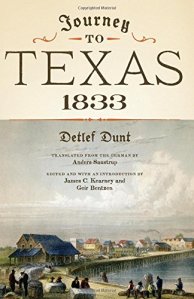
Journey to Texas, 1833 by Detlef Dunt, trans. by Anders Saustrup, ed. by James C. Kearney & Geir Bentzen

Detlef Thomas Friedrich Jordt was born in the Holstein region of Germany in 1793, and in 1833 immigrated to Texas. He was motivated by a letter from an earlier immigrant, Friedrich Ernst. Although the two were not acquainted, the letter had circulated widely in the region, with an explicit message: that others should join Ernst in a land of promise and opportunity. Jordt’s own experience led him to publish in 1834 a book titled Reise nach Texas, under the pseudonym Detlef Dunt. The first English translation of this travelogue/travel guide was published in 2015 as Journey to Texas, 1833.

This is a varied and informative compilation, including not only Jordt’s original text but significant supplementary material. A translation of Reise nach Texas was found among the papers of the late Anders Saustrup, a recognized scholar of German immigration to Texas. James C. Kearney and Geir Bentzen then took on the project. Their introduction covers Jordt’s family history; the social, political and economic circumstances in Germany that pushed so many to emigrate; the significance of the Ernst letter; and commentary on Jordt’s writing. The translation of Reise nach Texas makes up a little more than half of the volume…

This is just a stub: my full review of Journey to Texas was published in the Spring 2016 issue of Concho River Review. You can subscribe or purchase a single issue by clicking that link.

I’d just like to add that this was an extra fun read for me personally, because I know quite well the area that’s covered in these pages. For many years my parents owned a ranch just a few miles from where Dunt/Jordt is believed to be buried. It felt a little like coming home.


Rating: 6 small towns I used to ride my bike through.

Maximum Shelf author interview: Steven Rowley

Following yesterday’s review of Lily and the Octopus, here’s Steven Rowley: On Obstacles and Octopuses.


Steven Rowley is from Portland, Maine, and is a graduate of Emerson College. He has worked as a freelance writer, newspaper columnist and screenwriter, and lives in Los Angeles with his boyfriend and their dog. He is @mrstevenrowley on Instagram and Twitter. Lily and the Octopus is his first novel.

How autobiographical is this story?

photo: Malina Saval

photo: Malina Saval

There’s no way to deny that it’s partly autobiographical. I did have a dog, named Lily, and when she passed away I went into a funk. The depth of grief I felt took me completely by surprise. After about six months or so feeling completely blocked, not just in writing but in life, I sat down to do what writers often do, which is try to put pen to paper and work their way out of a tough spot. Thematically and emotionally it was autobiographical, but as I kept writing, the character and the plot became more fiction. It got weird, certainly, along the way, but I thought, the story can get as weird as it wants to on the surface as long as I stick to the mission of adhering to absolute emotional honesty.

It sounds like you did the writing as a part of healing.

Oh, it was hugely cathartic. Absolutely. Although it’s largely on the surface about a man and his dog, I see the story more about a character who’s stuck in life. Sometimes our biggest obstacles are those that we make up, that we imagine, or if they’re not entirely imagined, that we exaggerate. So it’s really a story about what it takes to get unblocked and power your way though.

Did you know that that was the story before you were writing it?

It’s interesting. I come from a background in screenwriting, and with screenwriting you have the plot much more laid out in advance. And this was something I was approaching from more of an emotional standpoint, looking to examine themes of grief and depression–I hate to harp on those because the book is, hopefully, not without its humor as well. I was surprised where the story took me because I was so focused on the emotion of it. There’s a big set piece near the end that came completely by surprise.

Why on earth an octopus?

Well, I did have a dog that suffered from something that looked a bit like there was a small octopus on her head. But beyond that, I wanted something as different as possible. What’s most different from a dog that’s covered in fur, that’s basically all spine (since she’s a dachshund) than an invertebrate who’s sort of slimy and hairless and lives in the sea? I liked playing with that dichotomy, that they were as different as different can be. On top of that, I have an enormous respect for octopuses (my editor and I have gone over this time and time, and the plural of octopus is octopuses). They’re so smart, and according to scientists they’re playful, can use simple tools and they learn and adapt as they go. And that’s what I needed, a cunning antagonist. Because the main character learns more about the octopus throughout the story as it unfolds, I needed a villain who would learn and adapt as well, continue to know how to needle our narrator. So, that is an octopus. And I do carry some guilt about villainizing them in any way, because they’re really magnificent creatures. Please everyone, don’t hate the octopus. Just the particular one in this story.


How was writing a novel different from your previous work as a screenwriter?

Screenwriting is a collaborative art. Many people help to bring a screenplay to life as a film, and many times it’s not the writer’s original intent that makes it to the screen. On top of that, when you’re writing a screenplay you’re writing a blueprint, it’s not in and of itself the final product. I had in my mind that I wanted to try a novel someday, so that if nothing else I could point to something bound and finished and say, this is what I do.

A screenwriter’s job is to make the internal external. All emotion and feelings are expressed through action and dialog. In this book, I wanted to luxuriate in themes and feelings. The book is very internal; there’s a very limited number of characters. The narrator has one friend, one sibling, one parent and one therapist, and that’s it. He’s sort of removed from humanity, which is why he has such a powerful relationship with his dog. I really wanted to take the time and explore what was going on inside of his head, and when you’re exploring depression it’s often internal like that. So it just seemed that a novel or prose was the right medium for this story.

Your journey to publication was unusual. Congratulations, by the way.

Thank you! When I finished the manuscript, I was very proud of it as a piece of writing, but I saw it as so deeply personal, and to be perfectly honest I was also worried that it was perhaps a little weird. Self-publishing was also attractive to me because, coming from film, I didn’t want too many other voices trying to tell me it can’t be an octopus, it should be an alligator, or whatnot. My boyfriend recommended I hire an independent freelance editor, so I found a woman named Molly Pisani and she and I worked on the book together. I paid her and I never expected to hear from her again. I went about doing what writers looking to self-publish do. I hired a typesetter, looked at ISBN numbers and how to market the book and sell it, all these things, and out of the blue I got a phone call from Molly about three months later. She said, “I can’t stop thinking about your book. I know a woman who works at Simon & Schuster who I think might respond to it in the same way that I did. Do you mind if I send it?” I said no, I certainly don’t mind, but I was so far down the line toward self-publishing that I really didn’t think anything would come of it. And she did say that it could take her friend a month or two to look at it. That was on a Friday, and on Monday morning I woke up to a call from Simon & Schuster, from the woman who is now my editor, Karyn Marcus. It really happened that quickly.

What’s next?

Everyone is asking, will it be a screenplay or novel? And I have to say that publishing is being incredibly kind to me right now. Working on Lily with my editor, she gave me a note once and said, “…but I defer to your creative vision.” And I almost fell out of my chair! Because in 10 or 12 years really giving it a go as a screenwriter, I had never heard those words from a producer or a studio executive. As a writer, that’s kind of addictive. So for many reasons, my next project, which I’m working on right now, is a follow-up novel. I’ve been really fortunate with this publishing deal, which has allowed me to leave my day job, and I’m focusing on writing full time now. I’m excited.


This interview originally ran on May 9, 2016 as a Shelf Awareness special issue. To subscribe, click here, and you’ll receive two issues per week of book reviews and other bookish fun!

Maximum Shelf: Lily and the Octopus by Steven Rowley

Maximum Shelf is the weekly Shelf Awareness feature focusing on an upcoming title we love and believe will be a great handselling opportunity for booksellers everywhere. The features are written by our editors and reviewers and the publisher has helped support the issue.

This review was published by Shelf Awareness on May 9, 2016.


Steven Rowley’s first novel, Lily and the Octopus, is a startling, scintillating experience, both funny and emotionally wrenching: a story that shatters all expectations.

lily and the octopus

In the opening lines, narrator Ted Flask introduces his contented home life with his domestic partner, an aging dachshund named Lily. They live in Los Angeles, where Ted works from home, and they are comfortable in their routines: pizza on Sundays, Monopoly on Fridays, talking about cute boys on Thursdays. They have inside jokes, holiday traditions, and an idyllic story of love at first sight. Lily holds up her end of conversations, although as a dog she is of course distractible, and her memory can be short. Her voice is just as we expect a dog to sound. As a puppy (in flashbacks, as in the scene of their first meeting), her breathless enthusiasm comes out in all caps and exclamation points: “IT’S! A! GREAT! TIME! TO! BE! ALIVE!”

As the novel unfolds and Ted fills out as a character, though, it becomes clear that his life is not necessarily well-rounded. He has a therapist he dislikes; he finds her dim-witted, and in his head runs all her advice past his ideal, imaginary therapist. He has panic attacks. His career has stalled. A long-term relationship, ended 18 months ago, continues to haunt him; recent attempts at dating have gone poorly. Until Lily, he worried that he was unable to open up, unable to love. In Ted’s favor, he has a superlative human best friend named Trent, who always comes when called and brings Valium. And, crucially, Ted has Lily. She is the best thing in his disordered and inwardly-turned life.

Those first sentences introducing Lily also introduce the octopus. A new addition to their household, he has a death grip on Lily’s head, and he’s not going anywhere. Like Lily, the octopus talks. Ted wants him to leave, but the octopus will not let Lily go. She begins to have seizures. She weakens.

Ted dreams of an octopusectomy. The vet offers chemotherapy, radiation and surgery, but is not optimistic about Lily’s chances. Ted tries to involve her in the decision-making, but Lily is a dog: her attention span is limited (oh look, red ball!) and, anyway, at 12-and-a-half human years, she has been feeling a little run-down. She rarely speaks in caps anymore. Ted was warned by a vet that, as Lily aged, she would begin to exhibit what he called Enclosed World Syndrome; that is, her perceived world and realm of interest would shrink. It is true, her walks have gotten shorter. Of course, Ted himself has the same malady. As the octopus’s tentacles tighten around Lily’s precious small head, Ted realizes he has a battle on his hands.

It is easy to fear that the market for books about beloved dogs may be flooded, but this one does something new. Lily and the Octopus is its own beast, and the reader is not the same person at the end as at the beginning. In many ways this is the story of Steven Rowley’s life in all its emotional truth, if not in specific, literal details. Ted and Lily’s Los Angeles is a thoroughly realistic setting, but a few elements–most obviously the talking octopus–offer boggling departures. By relying on metaphor, Rowley creates a fantasy world with touches of magical realism, somehow both more affecting and more comforting than reality.

Lily and the Octopus comes with the trappings of humor, canine antics, strong characters and profound emotions. Rowley, who is also a screenwriter, peppers the story with Cate Blanchett, Ryans Gosling and Reynolds, Bradleys Cooper and Milton. Equally prominent are the literary references: Kipling’s jungle, Auden’s “Funeral Blues,” and a reading list to prepare for an octopus hunt: Hemingway, Melville, Patrick O’Brian. The book opens in the spirit of a fun read, but the tone quickly deepens to a sadder and a more intense experience. Ted and Lily’s story centers around relationships: love and life partnership, the nature of commitment and of loss, and what it looks like to fight for one’s friends. As Ted battles the octopus and tries to shore up his darling, he ends up examining every aspect of his own life, his own shortcomings and the strengths he discovers in himself, almost by surprise. His journey, then, is not only about a man and his dog but about breaking out of life’s stalemates. This introspection and interior aspect to the novel is only one of the depths that make it both more than another story about a beloved dog, and more than a whimsical work of fantasy–although it is a superb example of both.

Lily and the Octopus is literary and raw, and relentlessly heartfelt. Questions of who and how we love are at its center and, vitally, the question of how we part. Imaginative, ever-astonishing, suspenseful and wise, Rowley’s surprising novel is thoroughly gut-wrenching, but well worth the pain. With a winning dog at its robust heart, no reader could ask for more.


Rating: 9 moments with the red ball.

Come back tomorrow for my interview with Rowley.

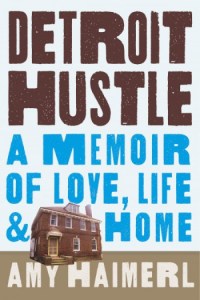
Detroit Hustle: A Memoir of Life, Love, and Home by Amy Haimerl

This memoir of home renovation in Detroit delves into much more, including the importance of place, the meaning of urban revival and the building of lives and loves.

detroit hustle

Journalist Amy Haimerl and her husband, Karl, loved their Red Hook neighborhood in Brooklyn, N.Y., but were facing rising costs and considering relocating. Friends and family were surprised by their choice of famously struggling Detroit, Mich., but they fell in love with a 1914 Georgian Revival (lacking heat, electricity, plumbing, windows and much more), and took the plunge. The house they named Matilda cost them $35,000 to purchase–and exponentially more in renovations.

Detroit Hustle is Haimerl’s memoir of rebuilding Matilda and building her marriage to Karl in parallel. But it is also a musing on what it means for a girl from a working-class family in rural Colorado to move through Mississippi and New York to arrive in the gritty and disparaged city of Detroit. Five weeks after they buy, Detroit declares bankruptcy. Amy covers the court proceedings for Crain’s Detroit Business while researching her new city and its history. Her study of the city yields complexities and contradictions, a portrait of proud residents and the difficulties of gentrification.

Haimerl is thoughtful and reflective about her relationship to place and to the intricacies of Detroit’s past and future; quirky, funny and loving about her marriage; and by turns vexed and inspired by the process of home renovation. Her vivid personality pairs well with the rich, colorful, troubled city she loves. Detroit Hustle is a remarkable memoir spanning home repair, political and culture geographies, and the choices we make for the people, places and things we love.


This review originally ran in the May 6, 2016 issue of Shelf Awareness for Readers. To subscribe, click here, and you’ll receive two issues per week of book reviews and other bookish news.


Rating: 8 dentils.

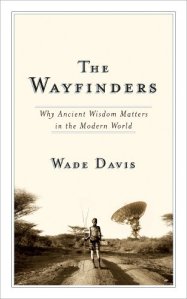
(guest) book beginnings on Friday: The Wayfinders: Why Ancient Wisdom Matters in the Modern World by Wade Davis, from Pops

Thanks to Rose City Reader for hosting this meme. To participate, share the first line or two of the book you are currently reading and, if you feel so moved, let us know what your first impressions were based on that first line.

Pops has a book beginning he felt moved to share.

Here’s Wade Davis’s The Wayfinders (2009). Both the first sentence and first paragraph (only two sentences!) strike me as exceptional, especially for non-fiction. With this, we not only get a glimpse of the author’s subject & writing style, but also the way he works & perceives. Opening this book I had only spare awareness of his theme, but my appetite was already whetted; with this beginning my cup of expectations runneth over!

wayfinders

Wade Davis is an anthropologist & ethnobotanist. This book publishes in entirety a series of 5 lectures he delivered in 2009 in short sequence (1 month) for a prominent regular program on CBC Radio out of Toronto (CBC Massey Lectures.) That is a unique medium today, both as spoken-word and audio-only; I wonder if that had any influence on his dense & evocative style. I would need to read one of his other books to find out!

One of the intense pleasures of travel is the opportunity to live amongst peoples who have not forgotten the old ways, who still feel their past in the wind, touch it in stones polished by rain, taste it in the bitter leaves of plants. Just to know that, in the Amazon, Jaguar shaman still journey beyond the Milky Way, that myths of the Inuit elders still resonate with meaning, that the Buddhists in Tibet still pursue the breath of the Dharma is to remember the central revelation of anthropology: the idea that the social world in which we live does not exist in some absolute sense, but rather is simply one model of reality, the consequence of one set of intellectual and spiritual choices that our particular cultural lineage made, however successfully, many generations ago.

Well, for what it’s worth, Pops, I enjoyed Davis’s Into the Silence years ago, and credit him with engaging writing, although my memory is dim beyond that, I’m afraid. The concept behind this one does sound interesting to me, too, and the format is an especially intriguing detail. We’ll be looking forward to your review!

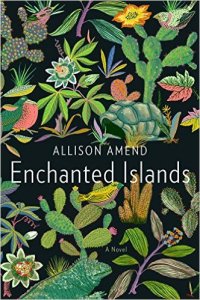
Enchanted Islands by Allison Amend

A woman with a modest past turns unlikely spy in the Galápagos in this evocative fictionalized history.

enchanted islands

Allison Amend’s Enchanted Islands is based on the life of a woman named Frances Conway, who lived with her husband, Ainslie, on the Galápagos Islands for several stretches in the 1930s and ’40s. Aside from her memoirs, which reveal only the day-to-day mechanics of her life, little is known about her. In Amend’s imaginative, richly detailed novel, Frances comes from a large, poor family of Polish Jewish immigrants in Duluth, Minn., where her lifelong friendship with a girl named Rosalie begins. The girls are in many ways opposites: Rosalie is from a relatively well-off family of better-established German immigrants; she is coddled, sexually precocious and selfish. As teenagers, the two run away together to Chicago, where a serious betrayal causes them to part ways.

When they reunite in middle age, Rosalie is married to a wealthy man and has a mansion filled with sweet children. Frances has recently married the tall, handsome, charismatic Ainslie Conway, but it is an arrangement orchestrated by Naval Intelligence, their shared employer. Ainslie is being sent to the Galápagos to keep an eye on suspected German spies, and Franny is part of his cover. The falsehood of their relationship pains Franny, and Ainslie has more secrets than just the nature of his profession. Still, the years on Floreana Island–one of the Islas Encantadas, as the Galápagos were once called–are the happiest of her life.

“You’re not allowed to read this–I’m not even really allowed to write it,” begins Enchanted Islands, Franny’s fictional third memoir. In her own words, she tells her life story with emotional resonance: confusion at Rosalie’s behavior as a teenager, bitterness and jealousy at her cruelties, a quiet if resentful acceptance of an unexciting life, and then exhilaration as she discovers Ainslie and stimulating new work, and rediscovers her old friend Rosalie. The narrative is colorful and sensually bursting, from the wet laundry that dominated her childhood home to the creatures and climate of Floreana, a changeable, isolated place both tropical and desert. These details are engrossing and lush, while the realities of World War II are recalled in dreamier terms; Franny is either far away on the island for much of it, or back at home in San Francisco feeling detached and lost without Ainslie. Her no-nonsense voice–by turns aggrieved, resigned, distraught, clever and wise–is the perfect foil to the fantastical nature of her life.

Amend offers strong, nuanced characters and a potent backdrop. Her prose is lovely without being overbearing, and her dialogue is impeccable, effortlessly evoking the characters’ lovable eccentricities and less lovable faults. With a wide-ranging, adventuresome plot and a humbly engaging protagonist, Enchanted Islands is a gorgeous piece of historical fiction.


This review originally ran in the May 3, 2016 issue of Shelf Awareness for the Book Trade. To subscribe, click here.


Rating: 7 camotes.

Notes from No Man’s Land by Eula Biss

notes from no man's landI am terribly grateful that I got to read this book with a class to help me along. That is, the same class that read Bernard Cooper’s wonderful Maps to Anywhere, about which likewise. I was once in a book club, not for very long, which I wished would go much more deeply and intellectually into very serious books. My father said back then, “it sounds like what you really want is a graduate school classroom.” I see now that he was right. This is “just” an undergraduate class, but a good one.

Notes from No Man’s Land is an essay collection that I think is most obviously about race in the United States, but it is about much more than that, too. The writer is a white woman (albeit one from a remarkably diverse family, not at all a white family), and in writing about race she takes on the voice of “the other,” always a nearly impossible thing to do sensitively, smartly and with authority, but she does it.

Like Maps to Anywhere, this is also a masterpiece of organization; we could pick apart the ordering and titling of Biss’s essays in several ways and still not be through with all she’s done here. The first and last (or next-to-last, depending on interpretation) essays are fragmented contemplations of apparently disparate subjects, that wrap this collection up intelligently. If I had to choose one word to characterize Biss, the writer, as I’ve come to know her on these pages, I would choose “smart.”

The language is poetry, too. Every word choice was considered and weighed. The connecting images are so many and complex that I can hardly begin to see how many levels this book might be read upon. Oh, and she works heavily with a sense of place: what else could I ask for? I will share a few lines, several pages apart:

I fell asleep to the distant sound of drums, which I was not always entirely sure was the distant sound of drums. Rain, blood in the body, explosions in the quarry, and frogs are all drums.

I know now that I left home and I left the drums but I didn’t leave home and I didn’t leave the drums. Sewer plates, jackhammers, subway trains, cars on the bridge, and basketballs are all drums.

And just as a sample (not to bore you), I’ll share a little of the analysis I wrote for class of Biss’s opening essay, “Time and Distance Overcome.”

I appreciated both the braided form, and all the white space.

There are three sections separated by a centered line. The longest single paragraph is about half a page long (wraps pages 5-6, about the sabotage against telephone poles that took place in Sioux Falls, SD and Oshkosh, WI). Mostly the paragraphs are just a few sentences long; five contain just one sentence each. These short, punctuated passages feel almost staccato, almost list-like. This works well for the subject matter, which begins benignly but quickly turns dark.

Biss begins with Bell’s invention of the telephone, and the reader has one expectation for the meaning of “time and distance overcome,” the title which tops this first page, where the telephone is introduced. The first section of the essay moves smoothly from telephones to telephone poles, and the resistance early telephone poles encountered. After that first break, though, the lynchings begin coming fast and thick, in short sentences that echo the choppy effect of Biss’s short, double-returned paragraphs. The first lines of this second section read:

“In 1898, in Lake Cormorant, Mississippi, a black man was hanged from a telephone pole. And in Weir City, Kansas. And in Brookhaven, Mississippi. And in Tulsa, Oklahoma, where the hanged man was riddled with bullets. In Danville, Illinois…”

This jarring delivery emphasizes the nasty jolt of the sentences’ content. Likewise, the direct leap into the new subject – no transition – increases the reader’s shock. Lynchings are shocking: this is appropriate. The short sentences and feeling of litany continues, from lynchings through race riots and from the South to the North, making clear a general rather than geographically specific trend.

The final, shortest section, at just half a page, mirrors the work of Notes from No Man’s Land as a whole. That is, it turns back around to an earlier time, Biss’s childhood, family history, and innocent view of telephone poles; there are no lynchings in this section, but there is reference: “Nothing is innocent.” Then there are the telephone poles in Nebraska that, after a heavy rain, grew small leafy branches. This image prefaces “All Apologies,” the concluding essay of the book which echoes this one in form, and concerns itself with regret, apology, the duality of responsibility/guilt, and what is owed. There is a small measure of hope in those green branches.

The most obvious thread or theme that holds this essay together is the telephone pole; the reader is prompted by the cover image. But the less obvious, more sinister themes are those that hold the book together: race relations, the complexities of varied perspectives. “The world was not waiting for the telephone.” “Even now it is an impossible idea, that we are all connected, all of us.” “But nothing, I would like to think, remains unrepentant.”

I think Biss’s opening essay shapes in miniature the work of her entire book; presages the final essay, which so nicely wraps up by recalling the opening; and uses form to emphasize subject matter. It’s an extraordinary essay in these layers of function, and I’m so glad to have her “Notes” to shed some light into her process.

I am impressed throughout with what Biss is confident enough to leave out, or point obliquely towards. I think it must take a lot of courage and self-trust (or is it trust in her reader?) to leave such subtlety on the page and not direct my gaze. “You can get it or not, all the same to me,” she seems to be saying.

This is the kind of work I very much want to study, forever.


Rating: 10 circles.

birth/place project launch at Defining Place

A few weeks ago I asked for your help with a project. That project has now gone live: I’m calling it birth/place, and you can visit it here. I want to thank those of you who have offered to contribute, and I invite the rest of you to do so. Also, of course, you are invited to follow birth/place at that link. New images go up every Tuesday morning, so you’ll get just one ping a week (unlike the five-day schedule I keep here).

defining place
I’m having a fabulous time exploring place, and I just hope some others out there find it as fascinating a conceptual journey as I do. Thanks as always for reading, friends.

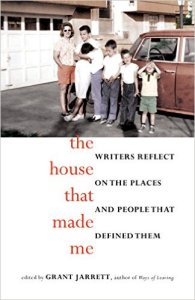
The House That Made Me: Writers Reflect on the Places and People that Defined Them edited by Grant Jarrett

Carefully curated essays take on the concept of home from varied points of view.

house made me

The House That Made Me collects essays by 19 writers reflecting on their childhood homes (or whichever home each writer has found most influential). Editor Grant Jarrett developed the idea for this anthology while contemplating his own first address via Google Earth, and he directs the contributors to that software. While the majority of essays hew close to Jarrett’s initial notion, some also riff on the concept: Roy Kesey considers those who view our homes from above, including birds, spies, angels, gods, astronauts and children climbing on roofs, as he once did.

The resulting assembly of voices offers a range of approaches and backgrounds: Kris Radish’s nostalgia for an idyllic rural community; Patricia Jabbeh Wesley’s attempts at home-building in Liberia just before civil war erupted; and the juxtaposition of Pamela Erens’s privileged upbringing on the lake in Chicago and Jeffery Renard Allen’s difficult one in that same city’s Southside. Justine Musk writes of the possibility that “a person has two homes: the place where you were born (literally, not metaphorically), and the place that fits your soul.” As she works to leave her small Canadian hometown for Los Angeles: “It’s that sense of not-belonging that can become, slowly and over time, its own kind of belonging.” While each essay is a worthy and thought-provoking piece of craft, the true achievement is in the sum of these parts, a chorus of diverse experiences that work together to define “home” in all of its possibilities.


This review originally ran in the April 22, 2016 issue of Shelf Awareness for Readers. To subscribe, click here, and you’ll receive two issues per week of book reviews and other bookish news.


Rating: 8 parachutes, for its matching my personal obsessions, these days.