Jesus Out to Sea by James Lee Burke (audio)

Disclosure: James Lee Burke has said some nice things about me. I appreciate that, deeply. But he couldn’t buy my good review that way. Not all of his books are equally excellent. This one is excellent.


jesus-out-to-seaOn our drive south, Husband and I listened to this collection of James Lee Burke short stories on audio. I found it deeply powerful. The stories range widely: geographically, they are set in Gulf Coast south Texas, Louisiana and Mississippi, and Montana. In time, they are set in the 1940s and 50s through 2005’s Hurricane Katrina. Protagonists are oil rig workers, children, jazz musicians and retired professors of literature and creative writing. What they all have in common, though–characters and stories both–is their focus on society’s outcasts and castaways, the downtrodden and unlucky, the poor; and on the evil that lurks in the hearts of men (and women). In other words: classic James Lee Burke.

The opening story, “Winter Light,” stars a retired academic who opposes hunters and doesn’t let them on his land. His refusal to back down in this and other just causes* precipitates ugly events. “The Village” is a short, stream-of-consciousness first-person narrative by a military man involved in a massacre in Vietnam. Its style, if not its tone, is different enough from the Burke I know to startle me; I am impressed. “The Night Johnny Ace Died” tracks musicians through love triangles and organized crime in 1950s Louisiana. “Water People” sees base conflicts and suppressed traumas among Gulf Coast oil drill workers in the same era. “Texas City, 1947” references a real-life major catastrophe of that year (look it up), but that big event is only one piece of a puzzle starring an abused child and a number of sad and sordid crimes, as well as a sympathetic nun who (sadly) Husband didn’t find terribly realistic. My impression from hearing these stories read aloud is that this was one of the longer ones. If that’s incorrect, at least it was one of the more impactful for me, and contained lots of familiar geographic markers.

“Mist” featured a young woman attending AA meetings and trying to be sober. Her past traumas include the death of her husband in Iraq and events during Hurricane Katrina that go unnamed for most of the story. I suppose this is a personal reaction, but I found the particular uglinesses of this story harder than most of the others. But beautifully done, and not exploitative.

“A Season of Regret” reprises the opening story: a different retired academic on his own chunk of land makes a stand for a different set of just issues. I enjoyed the new version of a familiar concept. These are two different characters and two different sets of challenges, but the emotional tone is the same. Next come a trio of stories told by the same narrator, a child named Charlie growing up in 1950s Houston. These have their higher and lower moments in terms of holding interest, but I found the characters–Charlie, his best friend Nick, Charlie’s father, and the family of neighborhood bullies–compelling. And there’s nothing like hearing the specific history of my hometown extracted and mulled upon in its details: it feels like coming home.

The final, titular story is the clear tour de force of this collection, in my opinion. “Jesus Out to Sea” is narrated by a man from New Orleans, who grew up on Magazine Street with two best friends who were brothers. The three go to Vietnam; one is broken by the experience and ends up a gangster; the narrator and the other brother become modestly accomplished jazz musicians who decline into hard drug use before the gangster helps them get clean. The story culminates with a storm that need not be named. While Burke’s writing throughout this collection is as lyrical, startling and shockingly beautiful as ever, this story showcases those talents the best, in its repeated use of bougainvilleas as the blood of Christ, or the blood of any of us, among other things. This story is music and poetry and oh, the tragedy. I admit to being especially affected by Katrina stories. But this one evokes all the unnecessary pain and wrongness of it, as well as the simple natural forces that those of us from hurricane country are familiar with, and the ways in which this storm was different. As we listened to “Jesus Out to Sea,” Husband was driving south across Utah, and we missed a turn by 20 miles or so because our navigator (ahem) was so distracted. It’s powerful stuff, this.

Sharing a book with Husband is a rare treat for me, so I want to give voice to some of his reactions. Overall, he gave this collection a 7, and complained of abrupt endings that didn’t wrap everything up neatly: he wanted to understand clearly what happened to everybody, which is a privilege not always afforded. He wanted a little more justice, to see revenge gained. But we know we don’t always get that from Burke.

He loved the nostalgia of hearing about places and cultural and historical markers we know intimately, though, and I have long found this to be one of the easiest ways to win a reader’s heart: shared landmarks, especially geographic ones (at least for those of us tied to place), and especially little-known ones, so we feel like we’re in on a secret. The classic example in this case was the Alabama Ice House, where young Charlie goes to fetch his dad home for dinner in the 1950s, and where they sometimes get hot dogs: Husband said, “they still serve hot dogs there!” excitedly, and I shared his enthusiasm for a place we know and love. For Husband (not for me), one young protagonist’s experiences in Catholic school also rang a bell.

Husband struggled to find certain details of some stories realistic. But my reaction was very different. I guess I’m more inclined to trust Burke to know better than I do how some things work; or to trust that some unrevealed detail could explain the unlikely event. In the case of a famous gangster showing an interest in learning yo-yo tricks from a couple of kids–maybe I was just too charmed by the whimsical and oh-so-human oddity to complain. Husband did praise the descriptions and scenes overall, said he could visualize what was described; and I think what he’s referring to is the fullness of sensory detail, the evocation of fully-formed worlds.

I also want to mention the repeated images and phrases that showed up in this collection. Several characters, when startled or distracted, looked as if flashbulbs had just gone off in their faces. Several suffer from noises in their heads that recall the thropping of helicopter blades or the banging of people trapped in their attics in rising water. Husband noticed these, too, and again we had different reactions. I have the impression that some of these come from a Burke habit, a way of seeing and describing things. Others–the thropping of the helicopter in a troubled character’s head–I think might serve as a wise and artful linking device. These stories are held together in several ways: the attention they pay to underclasses and injustices, a way of looking at the world, and a sense of the Louisiana Gulf Coast as the center of a personal world. They are also held together by poetry, bloody bougainvilleas, the smell of fish spawning, and torment; and if that torment recurs as a series of thumping sounds, it only helps us follow Burke’s special genius.


Rating: 8 bougainvilleas.

*For the record, whatever your position on hunting, I think this character has a right to control his own property.

Oxford American, issue 91: Georgia Music Issue (winter 2015)

When I bought this magazine (I think it was at Elliot Bay in Seattle), my thinking went like this: lit mags; Oxford American for sure; ooh, this one has a cd; ooh, Southern music; sold. (The cover indicates that this is a “Southern music” issue. I was slow to find the Georgia-specific bit, but not disappointed.) I don’t know if it was before or after I bought it that I found the Drive-by Truckers track on the cd, but either way. I already owned this track, naturally!, but it was a good sign.

ox-am-winter-15It took me many months to get around to opening this slick cover, but I always knew I was in for a treat. The first content is a write-up of the 25-track cd: a few paragraphs for each, introducing (or reviewing) artist & song, and its place in Georgia music history. I put on the cd (see major digression below) and was blown away, over and over. Just to show how things circle back: track 3 is Larry Jon Wilson’s “Ohoopee River Bottomland,” recorded in the making of Heartworn Highways. When Husband and I saw the movie, this was one of the tracks we came away remembering. And now, thanks to Oxford American, we own that one, too.

Digression: I got into a little debate recently with Husband and Mom about the word ‘album.’ As my memory has it, they both maintained that ‘album’ refers rightly to a vinyl record, and that we misuse it for compact discs (or whatever) in the same way that we say we ‘dial’ and ‘hang up’ telephones that no longer do such things. I argued that ‘album’ refers to a collection of works, put into an order and released as a single piece, and that it correctly refers to vinyl, cds, cassette tapes, or what-have-you. (For what it’s worth, Merriam-Webster and the Google base page agree with me.) At any rate, this discussion had me thinking about how an ‘album’ (in whatever form) used to be reliably received in the way it was released: you played a record straight through, the songs in their intended order, and the same with a cassette tape. With a cd, you could skip, go straight to the hit single you wanted. And now, in the era of iTunes (which is, at least, what Husband and I use), we dump the cd into the program and put it into a mass shuffle. These days I rarely listen to an album as a single unit with all its tracks in order. I reliably skip the ‘secret songs’ (remember those?) because all that silence makes no sense out of context; so I hit ‘forward.’ What place does a concept album even have in this medium? Of course, I realize there are folks out there who listen to music in all sorts of ways: some remain loyal to vinyl, some to cassette tapes, some to Pandora or even (I guess?) FM radio. But for me, when I opened this magazine and put this album on – in order – it was a revelation, an important reminder to take an album as it comes to me before hitting ‘shuffle all.’ (Digression complete.)

The point is that this musical collection and accompanying text was an extra-special treat and an education for me. Happily, as I post this, you can still buy this issue of the mag – and its included cd – here. DO IT. And enjoy the work of James Brown, the Truckers, OutKast, Otis Redding, Ma Rainey, Gram Parsons, Indigo Girls, Elf Power, the Allman Brothers, and more. Killer Mike’s untitled track 8 is one I really like.


I was so overcome by admiration for this album and the careful storytelling that came with it, that I took a little break before entering the rest of the magazine. In all, it took me a full week to read; but it was a week of enjoyable, thoughtful moments.

The whole issue is devoted exclusively to Georgia music, and I found this immersion really stimulating. I learned a lot more about the artists featured on that cd (and went back for another listen with better context), and about so many more. Blind Willie McTell, Johnny Mercer, Black Tusk, Hermon Hitson, Benjamin, the Rock*A*Teens, Little Richard, Beverly “Guitar” Watkins, Bessie Jones, Dave Prater, Fiddlin’ John Carson, Ray Stevens, Fletcher Henderson, the Dungeon Family, Sharon Jones, the story of Cabbagetown (referenced in the great Truckers’ song, “The Living Bubba”), and the collecting and archival work of Lance and April Ledbetter: the list goes on. I learned more about Killer Mike, listened to some more tracks, and ordered some albums. Kiese Laymon’s “Da Art of Storytellin’ (A Prequel)” hit me hard, both as a piece of communication and information, and as a piece of art. It took me a minute to figure out where I’d read this essay before: it also appears in The Fire This Time. I may have benefited from two readings, and you will too. Of course I can’t fail to mention the essay written by Patterson Hood (of the Drive-by Truckers) about Vic Chesnutt. Patterson never fails to impress, whether writing words to music or words on the page.

I even loved several of the included poems (always a little harder for me, as you know): particularly A.E. Stallings’s “The Summer Archivist” and Chelsea Rathburn’s “Elegy for an Accordian.” (The latter is spelled that way in this issue, which is not the typical spelling of ‘accordion,’ but is this an artistic vision, or a sic?)

I wasn’t always thrilled with the design decision to sometimes start the next article one column over, on the same page, from the end of the last; I felt that this distracted from the firm feeling of finish I wanted, that moment of pausing to reflect. For example, Elyssa East’s “Nudie and the Cosmic American” about Gram Parsons and Nudie Cohn ends on page 39 and, I felt, deserved a full top, but instead flows right into Greg Reish’s article about the Skillet Lickers.

There is no arguing with the breadth and immensity of this issue’s content. I’m amazed at the range of experts, and the music of their voices in writing. I had to stop and consider several insights and thoughtful issues. Take these lines about the ways in which physical infrastructure and environmental racism have impacted a music scene.

Today, there is little to be found of Atlanta’s colorful r&b scene. The construction of three interstate freeways in the late 1960s permanently splintered many of the city’s thriving black neighborhoods, which were further decimated by the construction of Atlanta-Fulton County Stadium, the Georgia Dome, and Turner Field. Mercedes-Benz Stadium–future home of the Falcons–has cut off access to downtown Atlanta via Martin Luther King Jr. Boulevard from the west side, which is predominantly populated by African Americans. You can still walk by the Royal Peacock on Auburn Avenue, with its vintage marquees, though the historic venue is merely a shell of its former self.

(from “With All Their Heart and Soul” by Brian Poust)

Simply put, again, I learned a lot. And the writing was, if not always then nearly always, extraordinary.

But I’m supposed to be reading these lit journals, at least in part, to study their forms and contents from an artistic perspective, and not only enjoying the reading experience. Obviously, when I forget to read as a writer, the work is effective. This was thought-provoking and beautifully crafted reading. That said, I did notice a few times when the writing got a little uneven. Overall, though, this is a deeply impressive issue of Oxford American, and the first thing I did when I finished reading it cover-to-cover, before writing this, was to buy a two-year subscription. (I am expecting this year’s music issue to come!!) Obviously recommended.


Rating: 9 shape notes.

A Woman on the Edge of Time: A Son Investigates His Trailblazing Mother’s Young Suicide by Jeremy Gavron

The legacy of a mother and her suicide reveals the story of both a woman and a social movement.

woman on the edge

Jeremy Gavron grew up with the faintest of impressions of his mother, who died when he was four years old, in 1965. He didn’t know that her death was a suicide until he was 16, and only decades later did he embark upon an exploration of her life and reasons for ending it. A Woman on the Edge of Time is a record of his examination and tentative conclusions.

Gavron’s mother, Hannah, is a tantalizing character. A talented, magnetic youth, she excelled in acting, equestrian sports and poetry; had an affair with the headmaster of her boarding school; married at 18; earned a doctorate in sociology while raising two young sons; and wrote a feminist text that would be published shortly after her death. In an echo of Sylvia Plath’s suicide two years earlier, she gassed herself in a flat just one street over from Plath’s. And, like Ted Hughes, Gavron’s father all but erased her presence from the lives of her two children.

In chasing this shadowy figure, Gavron corresponds and visits with Hannah’s friends, colleagues and family, and studies letters, diaries and photographs left behind. Along the way, the reader is exposed to English cultural history, particularly in Gavron’s investigations of Hannah’s book The Captive Wife, a qualitative study of young homebound mothers. As he concludes, there can be no thorough comprehension of a suicide or of a mother he doesn’t remember. A Woman on the Edge of Time ends with Gavron’s attempted “narrative verdict,” which though incomplete does offer him some closure.


This review originally ran in the September 23, 2016 issue of Shelf Awareness for Readers. To subscribe, click here, and you’ll receive two issues per week of book reviews and other bookish news.


Rating: 7 gurns.

The Black Panthers: Portraits from an Unfinished Revolution by Bryan Shih and Yohuru Williams

Photos, essays and interviews with rank-and-file Black Panthers “complicate the Panther story in a good way.”

black panthers

With The Black Panthers: Portraits from an Unfinished Revolution, photojournalist Bryan Shih and historian Yohuru Williams seek to tell a nuanced story of the Black Panther Party, one different from the popular conception of gun-wielding “thugs,” chiefly male, in black leather jackets and Afros with the leadership–Huey Newton, Bobby Seale and Eldridge Cleaver–centered in Oakland, Calif.

In pursuit of the rank-and-file perspective, Shih photographs and interviews Panthers or former Panthers, male and female, whose narratives express pride, humility, trauma, frustration and hope. Accompanied by essays solicited from scholars, this collection tells a more complex and sympathetic story. While not uncritical, the authors do champion an interpretation that emphasizes love and service over violence, featuring, for example, party programs like Breakfast for Schoolchildren (in more cities than just Oakland), free busing and ambulance services, free health care clinics and more. Shih’s photographs are striking and expressive, capturing the “humanizing details” he sought.

The Black Panthers is not the complete story: for instance, the “deep misogyny and sexism within the rank and file and leadership” is mentioned but not really addressed. Perhaps there is no complete story–as proven here, the party was made up of diverse members, with varied goals and motivations. Shih and Williams’s objective to expose this multiplicity, and inspire a second look at an energetic but ill-fated cause, is achieved with this intelligent, unapologetic book.


This review originally ran in the September 16, 2016 issue of Shelf Awareness for Readers. To subscribe, click here, and you’ll receive two issues per week of book reviews and other bookish news.


Rating: 8 humanizing details.

two-wheeled thoughts: Carl Sagan

two-wheeled thoughts

We were hunter folk, and we saw hunters and dogs, bears and young women, all manner of things of interest to us. When seventeenth-century European sailors first saw the southern skies they put objects of seventeenth century interest in the heavens – toucans and peacocks, telescopes and microscopes, compasses and the sterns of ships. If the constellations had been named in the twentieth century, I suppose we would see bicycles and refrigerators in the sky, rock-and-roll “stars” and perhaps even mushroom clouds – a new set of human hopes and fears placed among the stars.

–Carl Sagan, Cosmos

Teaser Tuesdays: A Radical Faith: The Assassination of Sister Maura by Eileen Markey

Teaser Tuesdays is a weekly bookish meme, hosted by MizB of Books and a Beat.

Teaser

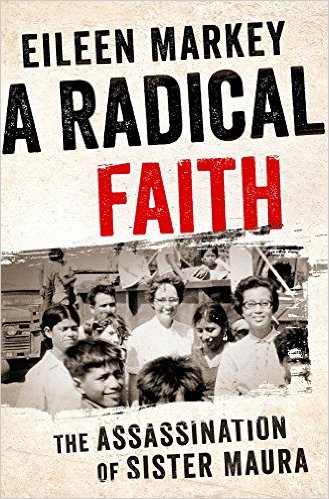
“The 1980 murder of four American women – three of them Catholic nuns – by the US-trained El Savadorian military shocked the American public and set off a decade of debate over Cold War policy in Latin America. The women themselves became symbols and martyrs, short of context and background.” (From the back of the book.) A Radical Faith undertakes the story of one of those four women in particular.

radical-faith

Here are a few lines from the book itself to whet your appetite:

Maura was shocked by the discrepancy between the wealth of the mining company and the poverty of her students. But questioning La Luz wasn’t her job or the job of the priests and nuns. They were in Siuna to instill faith, to cultivate a love of God and obedience to the precepts of the church. And anyway, they would remind themselves, the company provided electricity…

(At this point she is working in Nicaragua, not yet El Salvador.) I chose this teaser because it feels like a turning point for the character of Sister Maura. I’m less than 100 pages in, but I feel like what is coming is an important realization she’s about to have: that it is in fact her job to seek justice on earth for the people she’s traveled south to help. We’ll see if I’m right.

This quotation comes from an uncorrected advance proof and is subject to change.

The Penalty Area by Alain Gillot, trans. by Howard Curtis

When a grumpy soccer coach takes in his 13-year-old nephew, they’re both forced to grow, on and off the field.

penalty area

Quirky and heartwarming, Alain Gillot’s The Penalty Area introduces an eccentric soccer coach who finds unexpected happiness in the oddest places. Vincent Barteau retired from playing professionally after an injury, settling instead for coaching as a way to stay in the game. Coaching children was never the plan, but this job pays well enough. He is a loner, frustrated with the mediocre talent he has to work with. When his estranged sister shows up to deposit her 13-year-old son with him, Vincent is understandably annoyed–until he puts his nephew Léonard on the field and everything changes.

Léonard is a chess prodigy and all-around odd boy. He dislikes soccer for being “too simplistic.” It is only in deciphering plays, percentages and tactics that his exceptional intellect is engaged. Caring for Léonard exposes Vincent to new people and scenarios; the man dislikes change as much as the boy does, but in the new world that opens before them, possibilities abound. Léonard discovers soccer. Vincent discovers family and hope.

The Penalty Area handles material that could easily overindulge in sentiment, but Vincent’s awkward, exasperated approach to life and human flaws admits no foolishness. Howard Curtis translates from the French in occasionally stiff prose, which nonetheless suits the equally stiff narrator. Vincent’s voice offers the novel a disarming vulnerability; Léonard and Vincent’s exploration of new challenges feels fresh and endearing, even humorous. No love of sport is required to feel the genuine emotion pulsing from this story about making connections.


This review originally ran in the September 13, 2016 issue of Shelf Awareness for Readers. To subscribe, click here, and you’ll receive two issues per week of book reviews and other bookish news.


Rating: 7 shots on goal.

personal update: on the road again

This post is a bit belated, I suppose: today is the day that Husband and I hit the road for another cross-country move! It’s been just a hair under two years since we moved from Houston to Bellingham, Washington, and now we are en route to a new home in the sweet little town of New Braunfels, Texas. Two people, two dogs and two bikes (and a big precious sculpture and a tent and sleeping bags and lots of books, etc.) in a truck, southbound.

this is two years ago in a U-Haul. but we probably look something like this. Husband says: "Truck-driving Mama and Dog as her copilot."

this is two years ago in a U-Haul. but we probably look something like this. Husband says: “Truck-driving Mama and Dog as her copilot.”

The great adventure continues, y’all.

More big news: in January I will be entering the low-residency Master of Fine Arts program in Creative Writing at West Virginia Wesleyan College. (Read more about that program here.) This will bring big changes in my life, and is bound to bring some changes here at pagesofjulia. For one thing, I will be cutting my work for Shelf Awareness back drastically, until I get a grasp of what the school workload looks like. It saddens me to loosen ties with the Shelf, who I adore: this is far and away my favorite job I’ve ever had (although I think of the cancer hospital library fondly). It will be important to me to keep doing what work I can for them; but we’ll just have to see what that looks like.

I will almost certainly have to cut back on posting to this blog, too. I don’t yet know what that will look like. Maybe one book review a week would be a safe goal? I can continue with the occasional teaser and book beginning; but I don’t think the 5-day-a-week format will be realistic. I haven’t worked this out yet. If you have thoughts or feelings, I’d love to know them.

In the meantime, you can picture my little family visiting friends in Bend, Oregon; family in Durango, Colorado; doing some mountain biking; visiting some national parks; and moving into a rental home with a big backyard for the dogs. I will breathe deeply, and keep reading.

Posts will continue while I’m on the road, of course, and I’ll see your comments in a timely manner as ever.

Thanks for your support, friends.

The World in Flames: A Black Boyhood in a White Supremacist Doomsday Cult by Jerald Walker

This vivid, immersive memoir describes an innocent childhood in a terrifying religion.

world in flames

The Worldwide Church of God taught that the Great Tribulation would begin in 1972 and end three years later in a river of fire from which only the Chosen Ones would be saved. Jerald Walker grew up with these teachings looming over his head. In 1975, at the predicted end of the world, he would be 11 years old. In The World in Flames, Walker relates his unusual upbringing in Chicago as the sixth child of blind African American parents, in the black wing of a church that preached segregation as well as fire and brimstone.

Except for a brief prologue and epilogue offering a glimpse of the adult Walker, the whole of this fantastical true story is told from a child’s disarming perspective. Jerry is six when his memoir opens in 1970, and his days are filled with fear. Preoccupied with the coming events and concern for a friend who is not Chosen, he struggles to navigate family secrets, severe corporal punishment and a religion based on threats. As narrator, Jerry is matter-of-fact and innocent about the improbability of his home life. This narrative voice renders an incredible story accessible. Perhaps the most heartbreaking detail is Jerry’s guileless devotion to his church.

Walker (Street Shadows) recounts his growth from wide-eyed child to hapless teen, and finally to skeptic, with immediacy and feeling and without offering judgments. His personal history verges on the absurd, but his telling of it is earnest and unadorned, never sensational. The World in Flames is a difficult story simply and gracefully told.


This review originally ran in the September 9, 2016 issue of Shelf Awareness for Readers. To subscribe, click here, and you’ll receive two issues per week of book reviews and other bookish news.


Rating: 7 lines of scripture recited.

Globe On Screen presents The Merchant of Venice (2016)

I went to see Shakespeare’s The Merchant of Venice recently, as part of the Globe On Screen series (similar to NT Live, a live recording of a stage play in London).

merchant-of-venice

I don’t think it’s terribly arguable that this is Shakespeare’s most anti-Semitic play: it centers around Shylock, a Jewish moneylender who agrees to make a loan with “a pound of flesh” as the collateral. He then insists on taking his pound of flesh, even when the principal is offered back to him by the borrower’s friends. A court case ensues in which he is defeated and forced to surrender his wealth and convert to Christianity. This, it is implied, is a just ending. The other side of the plot involves a courtship that ends in (classic Shakespeare) a double wedding and a happily-ever-after for two playful couples. Oh, and a third couple: Shylock’s daughter elopes & converts herself to marry a Christian. Oh happy day.

It is a very fine play, with perfectly pitched wit and humor as well as a few memorable dramatic scenes, perhaps most famously Shylock’s “Hath not a Jew eyes?” speech. And it was beautifully performed, of course, by the Globe’s professional team. And yet… it’s hard to watch the nastiness that is inherent to the play itself. (There is some casual racism, in addition to the anti-Semitism, when the heiress expresses dismay at a suitor’s dark skin, and hopes for no more “of his complexion.”) As is so often the case with Shakespeare–himself a shadowy historical character, if you’ll excuse the pun–we wonder now what exactly he meant: arguments have been made that this play actually intends to draw attention to anti-Semitism so as to work against it. I think of The Taming of the Shrew, a play I read as sneakily feminist rather than the opposite. But The Merchant of Venice feels pretty hateful to me.

As my parents and I recognized, this production highlighted the religious conflict, especially through the physical performance of Shylock’s daughter Jessica, who speaks volumes with her facial expressions; and especially-especially in the final scene. Shakespeare’s text finishes with the lovers’ lighthearted, celebratory lines. But this stage production followed those lines with a painful scene in which Shylock is baptized while his daughter wails and mourns. It made me physically uncomfortable. Finishing on this note, rather than kissy-kissy, drives home the play’s more sober points.

So was Shakespeare merely using the material he knew, speaking in the slurs of his time? Was he a Jew-hater with an ax to grind? Or was he slyly hoping to point out the hypocrisies of anti-Semitism? Shylock is indeed an abused underdog: he lists the crimes committed against him, says he wishes only for fair treatment, points out that charging interest on loans is how he makes a living, and isn’t it his right? In these points he is sympathetic (in the sense that the reader/viewer naturally sympathizes with him). When Antonio defaults on the loan, his insistence on the pound of flesh is increasingly vindictive and unreasonable, especially when the principal loaned is offered to him again, then doubled. I remain unclear on how exactly the default occurs: were they just late getting the money back to him? Anyway. Shylock is less and less a likeable character as he rages on, demanding blood–although he does have a point about what the legal system owes him, and likewise, that he is only handing out the kind of treatment he’s received in the past.

If a Jew wrong a Christian,
what is his humility? Revenge. If a Christian
wrong a Jew, what should his sufferance be by
Christian example? Why, revenge.

Still. Nobody likes him when he waves his knife around.

But then, upon legal defeat, the forced conversion really rankles with me. I was left unsettled by the whole business. The romance is nice, and the comic disguise-and-other-capers business between the lovers is as great as Shakespeare always is when it comes to that stuff. But I can’t sit right with the treatment of the Shylock character. How are we supposed to work with this kind of material today?

I don’t have the answer to that. I give this performance a good rating: it is a good play, well-produced. But it didn’t leave me sighing with pleasure.


Rating: 8 uncomfortable moments.