
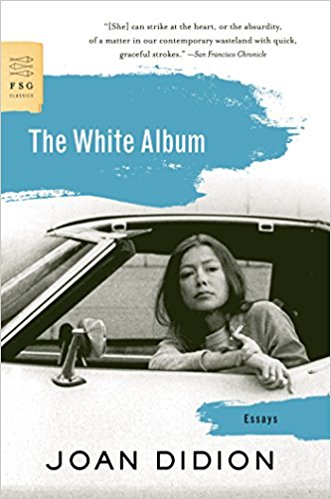
 The essays in this collection range over diverse subjects, but as a whole are concerned with American culture, and the Sixties (as Didion capitalizes). Frequent topics include travel, especially air travel, and crime. She always pays close attention to place.
Some essays have aged better than others, but all display Didion’s close focus, instinct for detail, and precise syntax. She also has a knack for surprising endings; it would be interesting to study her for her endings alone. I think she’s very good at time and place, that is, setting us in a recognizable time and place with cultural markers. (This may be an unexpected comparison, but she reminds me of Stephen King in this way: think about 11/22/63.) My advisor Kim points out that she uses clothing and architecture to great effect, and I think that’s part of it.
I am especially interested in the title essay and “At the Dam.” “The White Album” begins with the memorable line, “We tell ourselves stories in order to live.” [Somewhere I have a list of such assertions–that narrative is life–and I think the late, great Brian Doyle figures heavily on it. I wish I had a transcript of an interview he gave onstage for a certain radio show in Bellingham.] This segmented essay, in 37 pages and 15 numbered sections, ranges through the United States (and particularly California) of the Sixties, name-dropping if you will: Huey Newton, Jim Morrison, Janis Joplin, Charles Manson, and more, linking these cultural markers with Didion’s own personal experiences. “At the Dam” is a mere five paragraphs long, but offers an incisive study of a place, the Hoover Dam: its history, its engineering, its cultural relevance, its place in a larger physical and metaphysical world. It makes one of those surprising shifts in scope at the end that gives it a profundity, as if the Hoover Dam needed emphasis.
I’ll be reading more Didion. She is an impressive and craft-y essayist, in that her work feels both crafted–put together–and naturally occurring. She is a master of detail and cultural markers. I’ve got a lot to learn from her, and she is an easy, enjoyable read, to boot.
Filed under: book reviews | Tagged: creative nonfiction, essays, nonfiction, WVWC MFA reading list | 5 Comments »