Hamilton soundtrack

I don’t usually review music around here, but I’m making an exception for this double-album soundtrack because a) it’s a preview of the actual musical I’ll get to see in about a month’s time (squeal!), and b) it’s highly narrative, so it feels like it belongs.
We’ve all by now heard about the musical Hamilton by Lin-Manuel Miranda, right? Based on the biography Alexander Hamilton by Ron Chernow (which I may need to read next). I had heard of it, but hadn’t paid much attention until I heard Miranda interviewed on my favorite podcast, Another Round (rest in peace). (That episode is here.) Once I started paying attention, I knew I had to see it. So I got tickets! to go with my friend Jacinda (talented author of Saint Monkey) next month in Louisville, and we can’t wait. (Sadly, I will not see Miranda perform, himself, but I will trust that they’ve chosen a good replacement.) My parents recently saw it performed in San Francisco (still waiting on their guest review[s]!), and my mother sent me this soundtrack.

And it’s phenomenal. The music is impressive in itself – that is, as music, you want to lean it, turn it up, nod along with the beat. There is such a full story communicated in its lyrics – all of which are perfectly legible, rare enough with any genre of music. I can immediately hear that Hamilton’s life was full of drama and inspiration, and I can imagine Miranda reading Chernow’s book and being captured by the wild true story of one man’s experience in and out of American politics. That he took that story and put it into varied and captivating song… is another inspiration in itself. I can hardly believe people are this talented.

My impression is that the entire play is available in these songs – leave it to be seen how true that is, but this double-album is quite a complete narrative in itself. It has everything: compelling, dramatic story; catchy beats; wildly crisp, awesome, technical execution; feeling, voice, and talent. I am deeply excited to see it live.

I’ve listened to the whole thing exactly two times through before writing this review, but of course I’ll be going back through it over and over before the show. So far, my favorite tracks include the introductory opener, “Alexander Hamilton,” and the following “Aaron Burr, Sir,” in which Hamilton meets this central character; the pairing “Helpless” and “Satisfied,” which offer parallel love stories with two Schuyler sisters; and the Cabinet Battles, #1 and #2, which are rap battle versions of the stand-offs between Hamilton and Thomas Jefferson. This is so exciting! This is how you get the kids (and me) excited about history. I’ve written before about the importance of interdisciplinary studies; I think rap-battle-meets-history-lesson might be the best yet. Also the “Ten Duel Commandments,” and “The Reynolds Pamphlet” for its sheer drama, and the final two numbers, “The World Was Wide Enough” and “Who Lives, Who Dies, Who Tells Your Story.” And, well, I love every track.

I also appreciate the threads that tie these songs together: for example, the repeated refrains of helpless and satisfied (in regards to Hamilton’s love life and ambition). I admire the narrative artistry of the song “Satisfied,” in which we rewind to see a scene and story just told in the previous track, from a very different point of view. This is some fine storycrafting.

I’m afraid of going in circles now – or of creating expectations that are too high to satisfy for the live show. So I’ll stop with this high praise.


Rating: 9 shots.

movie: Hillbilly (2019)

Disclosure: I am a degree or two removed, socially, from some of the folks involved with the making of this film.


I just think no matter where anybody’s from, if they’re honest with themselves they’re gonna have a love/hate relationship with where they’re from.

–Jason Howard

I found Hillbilly deeply moving, beautiful, and appreciated the diversity of people it put in front of the camera.

I heard about this film from several sources at once, all of them sympathetic, and some of them personally connected; the above quotation (which you know resonated with me so strongly) comes from Jason Howard, who’s been guest faculty at WVWC during my tenure as a student there. His husband Silas House is an executive producer. So I came in with a positive preconception, and it was rewarded. I was surprised (but perhaps shouldn’t have been) to see the negative reviews on Amazon; the “top reviews” were all critical of its political stance (“this is a liberal agenda documentary be forewarned”). Well, fair. I think the film’s perspective was clear from the start. As I watched, I kept thinking of confirmation bias and where we all start out from when we enter a project like this, either as creator or viewer/consumer. My politics align with those of Ashley York, co-director and narrator/”face” of the film, in many or most ways. I appreciated what she’s done here. Those with different politics are likely to appreciate the film less. As much as I loved watching it, I was left kind of sad, too, that we can’t do more real listening to each other.

Not for lack of trying on Ashley’s part. Within the narrative of the film, she introduces herself as an Appalachian native from Kentucky who now lives in Los Angeles. As the 2016 presidential election draws near, she realizes how far apart her pro-Hillary politics are from those of her pro-Trump relations, chiefly her Granny Shelby. So she travels home to talk to Shelby and others, hear their side. I am so glad somebody’s trying to do that work; little enough of it seems to be happening. Ashley is respectful and listens quietly as her family explains why they support Trump. There was not the dialog here that one might wish for, but maybe Ashley was shooting for some level of journalistic neutrality? A separate issue… Speaking of issues, there wasn’t really any discussion of issues or stances, or the gap between Trump’s talk (coal! jobs! economy!) and his concrete plans for action. In the end, this film is less about politics than it is about culture.

I empathize with Ashley’s experience some, especially when she points out how difficult it is to hear a majority-progressive community throw Trump supporters out in one homogeneous basket, in their thinking. This is especially difficult when you come from a place where you’ve rubbed shoulders with some of the people in that basket, and know them as individuals. “They” are no more homogeneous than “we” are. Her uncle tells the story of serving in the military and being ridiculed and rejected by his fellow service members – it was worst in California, he tells her, “no offense” – and he chokes up, saying that he never found the brotherhood he’d sought. I don’t care if you hate his politics, that’s a sad moment. I don’t think “we” liberals gain anything by making fun of people we don’t agree with.

A good chunk of the movie deals with media portrayals of Appalachians. Deliverance makes an appearance, of course. Ashley visits with Billy Redden, who played Lonnie, the younger, hillbilly half of the “Dueling Banjos” scene. He works at Wal-Mart; he got paid $500 for his part in the movie; he hopes to make it to California one day. That Appalachians or hillbillies have gotten a bum deal with Hollywood, there is no question. The rest of us, somebody in the film suggested (I’m sorry I can’t say who), get to feel better about ourselves by making fun of “them.” There’s also some treatment of the history of the region, including the fact that when big business saw how much money there was to be made by extractive industries (coal, for one), it was convenient to evolve from treating hillbillies with gentle contempt, to viewing them as sinister and depraved: people from whom we should definitely take things away.

As a summing-up of a region, its history, its culture(s), and its current contradictions, Hillbilly does a neat job; it is necessarily incomplete, but what do you want from an 85-minute film? I’m so glad that it put people of color and queer people at center, too (and discussed the strange portrayal of Appalachia as white when in fact it’s quite diverse, skin-tone-wise). Any time we sum up any place, we’re going to resort to generalizations that can range from inadequate to damaging. Considering these truths, I think this movie does as good a job as it could have. If that sounds like faint praise, I don’t mean it that way. I’m just trying to acknowledge the inherent shortcomings of the form, and of any attempt to portray a place with more than, I don’t know, a couple dozen people in it.

Hillbilly gives us Election Night 2016 again, “live,” as it were, and I found it painful all over again. Silas House and Jason Howard speak with some emotion about their feelings – Silas seems to feel betrayed – he has spent his life defending his people (I paraphrase) and (he implies) they have failed to defend him with their votes. He turns to Jason: “You always say you love Appalachia. You don’t feel it loves you.” Jason replies with the line at the top of this review: “I just think no matter where anybody’s from, if they’re honest with themselves they’re gonna have a love/hate relationship with where they’re from.”

I just wanted to repeat that because I find it so true. Thank you, Jason, and everyone involved with this film.


Rating: 8 questions.

guest review: Bellingham Theatre Guild presents Silent Sky (2019), from Pops

From Pops, and from the Bellingham Theatre Guild, which I miss.

In its 90th year, the Guild does a great job with Silent Sky, a 2015 play by Lauren Gunderson in San Francisco, “an Arts meets Activism writer… currently recognized as America’s most produced living playwright”; she has written many about unappreciated women in history.

It was very well done here by a cast of five; great dialogue well-played, and engaging characters to tell this story of Henrietta Leavitt, who worked as a menial-labor type ‘computer’ for a famous astronomer before making the groundbreaking discovery of ‘Leavitt’s Law’ (circa 1910) that provided “a way to accurately measure distances on an inter-galactic scale” and ultimately allowed Hubble to describe an expanding universe.

It’s hard to tell if they are getting better and better, or we are just appreciating them more. It seems to me that good play-selection is a key thing.

Play selection is a huge deal, I’m sure. You also just seem to have very fine actors (and presumably directors and other behind-the-scenes decision makers), though. My failed attempt at enjoying community theatre in Asheville recently showed me what well-meaning but just poor acting can do for a play: not much good. As Egan said at that event, Bellingham attracts artists, right? Count yourself lucky! I would have enjoyed this one, I think.

writers in video (audio)

A few links for you today that came from my parents.

My mother sent this recording of a Bellingham local Whatcom Reads program, in which Timothy Egan discusses his book The Big Burn: Teddy Roosevelt and the Fire that Saved America (and, in Q&A, a few more – remember Mom reviewed The Worst Hard Time for us). I really enjoyed listening to this one (thanks Mom for the tip that the visual part was not entirely necessary), and I am reminded that I need to try some Egan one day – he sounds in the vein of Jon Krakauer and Erik Larson, who were among the first writers I recognized as creative nonfiction and as something I loved. While I really enjoyed it, I also took exception a few times to some of Egan’s comments: his chauvinism about geography, for example, and his statement that “Indians all have creation narratives,” as if to imply that his/our own culture doesn’t have creation narratives. (I guess it’s only a creation narrative if somebody else believes it, and what *I* believe is just truth?) (Also, any time you say “all the [ethnic group] do such-and-such” you’re probably on thin ice.) These quibbles were not fatal for my appreciation, and if anything indicate that I was engaging. One of these days I will read some Egan…

And, my father sent this episode of Oregon State University’s About Words, featuring Ben Goldfarb about his book Eager: The Surprising, Secret Life of Beavers and Why They Matter. Pops appreciates beavers; we have a mutual friend (and friend to Goldfarb, apparently) named Rob Rich who is a beaver fan and advocate, and writer; and I have been seeing a lot of beavers these last few weeks on my travels. But this short video (very short, after an hour-plus with Tim Egan) is less about the beavers and more about the imperative to write, among other things.

So, a little extra to add to your listening queue! [That’s a tip: although YouTube videos, I did not watch but only listened to both clips, which was fine (visuals were just background). I signed up for a free 30-day trial of YouTube Premium, which allowed me to download these videos for offline viewing/listening.]

Thanks, Mom and Pops!

2018: A Year in Review

Note: I’m out of pocket during my final residency period at school. I love your comments! But it may take me several days or a week or more to respond.


Happy New Year, friends! Last week you saw my best of the year post, and here we are today with another traditional annual post. (You can see my past years in review here: 2017; 2016; 2015; 2014; 2013; 2012; 2011.)


In 2018, I read a mere 66 books (about on track with last year at 70). This feels like so few! compared to years in which I did more than twice that many. But school, man. It’s hard to do all that reading when I’m schooling as hard as I can too!

Here are the rest of the stats. Of the books I read this year:

  • 70% were nonfiction , 30% fiction. (Last year I read 76% nonfiction.)
  • 53% were written by female authors (50% last year); 41% were by men (40% last year), with the remainder being collections by multiple authors, or variously unidentifiable, or “other.” I am pleased with this subtle shift.
  • I normally analyze the novels I read by genre, but that fiction category is getting slim enough that these numbers get a little less interesting. This year, more than half the fiction I read I categorized as “misc” (plus a handful of short story collections, historical fiction, and thrillers).
  • I listened to a single audiobook this year, and it was a reread. Last year, none. Audiobooks used to be such a big part of my reading life, but again, school. 2019 will be different, though! Especially with all the driving.
  • 49% of my reading this year was assigned for school, which, again, goes toward explaining everything else I see here. There’s a change, though, from last year when 70% of my reading was school! Hm. Progress?
  • I purchased 64% of the books I read, and was sent the rest for review (mostly by the Shelf). This is another change, since I used to take books out from the library and receive them as gifts. I’ve more recently been living in a place without great library service, though, and I have mostly nixed the book gifts! So kind, but so many books and so little time (and space)!

The two years of my MFA program, then, have been rather alike: a much smaller volume of reading than I was accustomed to, and unsurprisingly, largely driven by school. The coming year will be one of great change, though. I expect to be reading more; to be choosing what I get to read (!); and to be reviewing more for Shelf Awareness, for which I am eternally grateful. (For one thing, my new life on the road makes it quite a bit harder for them to get me the galleys I need, and I am so very pleased and humbled that they’re willing to work with me on this.) I expect to be listening to more audiobooks. In many ways, I don’t know what to expect, but I’m so looking forward to it.

Thanks for continuing this journey with me, friends and followers. Here’s to an amazing reading year to come.

What was 2018 like for you as readers? What do you hope the new year holds?

best of 2018: year’s end

Note: I’m out of pocket during my final residency period at school. I love your comments! But it may take me several days or a week or more to respond.


My year-in-review post will be up next week, as usual. But first, also as usual, I want to share the list of my favorite things I read this year. (You can see past years’ best-of lists at this tag.) None of these were audiobooks, but a few were new releases, so I’ve marked those with *.

These three books and one essay got a rating of 10.

And while I gave rather a lot of 9’s this year, I’ve chosen my favorites (from today’s perspective, at least) for you here, for a shorter list.

Bonus: Shelf Awareness’s Best Books of the Year is available at that link, and includes two that I had the good luck to review (Everything Under* and Convenience Store Woman*).

Hooray for good books always! What are some of the best things you read this year?

Come back next week to see a further breakdown of my reading habits in 2018.

traveling

Happy holidays, y’all, and a reminder that I am off and traveling for school – for the last time, my fifth and final residency. I’ll be back in Texas the second week of January, to pick up my dog and my van and carry on down the road. And let you back in on my readings. Again, I’m super fortunate to keep my job reviewing for Shelf Awareness, so you’ll continue seeing those posts. And who knows what else the future holds!

As usual, I’ve got posts scheduled for you in my absence, but comment response time may be a bit slower than normal while I’m away. In fact, there may be a slower new-normal, as I live in a van from here on! Also as usual, thanks for your patience. I hope you have a lovely holiday season & a hopeful new year.

Main Street Theatre presents Miss Bennet: Christmas at Pemberley (2018)

My lovely Houston friends – the same ones who rented Rent for us – took me to see the sweetest play at Main Street Theatre. Miss Bennet: Christmas at Pemberley is, of course, a sequel to Pride and Prejudice. It takes place at Pemberley after Elizabeth and Mr. Darcy, and Jane and Mr. Bingley, have been married a few years. Jane is pregnant; Lydia is still married (not entirely happily) to Mr. Wickham; and Mary and Kitty are still at home. The entire family is now converging on Pemberley, along with an unexpected guest or two: Mr. Darcy’s unpleasant Aunt de Bourgh has just died, and a distant cousin Arthur de Bourgh will be arriving for Christmas as well, having just inherited.

The Miss Bennet of the title here is Mary, the middle sister, whose life has begun to chafe. She loves to read, study, and practice her pianoforte. No one she knows understands her interest in a life of the mind; and while she loves traveling between the pages of books, she aches for a wider-traveled life in the real world, too. At Pemberley, amidst the giddy happinesses and dramas of her sisters, she wishes for more. And more may be in the cards for her just now, to start the new year…

Romantic? Sweet? Rather predictable? All of these things, yes, but so enjoyable. It’s clever and funny and plays at my emotions adeptly. I think it’s really saying something to tell you that while I saw each plot move, more or less, coming, I was still on the edge of my seat, because I had such sympathy for each character. What can I say. Buying into fictional plots might be a specialty of mine.

I loved every bit of this evening. The clever references to Austen’s original (including the genius line about “a truth universally acknowledged, that a single woman in possession of a good fortune…”), the heartfelt acting, the sweetly familiar setting and simple, charming set. I believe Main Street Theatre qualifies as amateur theatre, but it was very professional. Mary’s piano playing was no small accomplishment in itself; no one broke or stumbled over a line for the whole thing; it was excellent all around. Overall, I think this production accomplished everything intended by the play (by Lauren Gunderson and Margot Melcon). It made appropriate reference to the inspired original and made playful use of my emotions. It was at every turn sweet, and (the idea goes) ’tis the season for sweetness. Here’s to the latest Miss Bennet.


Rating: 7 books with blue covers.

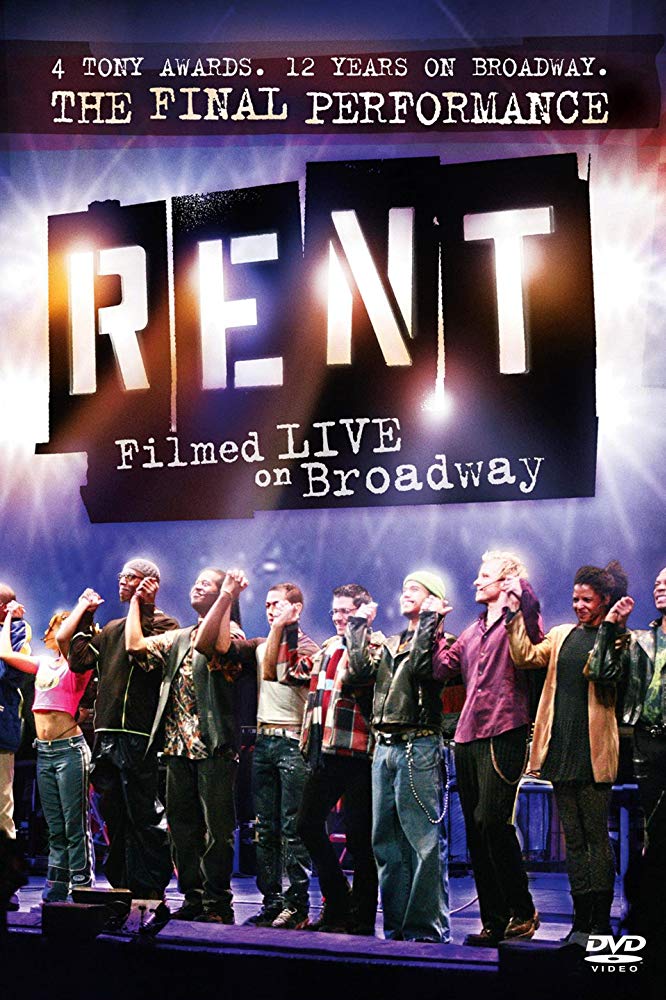
movie: Rent: Filmed Live on Broadway (2008)

I first saw Rent when I was in high school. My dad and I traveled to New York City to investigate that city among a few others where we thought I might go to college. He got us tickets to see Rent at the Nederlander Theatre on Broadway. I already knew that I loved musical theatre at that time, but this production really changed something for me. It was the first time that I cried at a stage production or at any piece of art other than a book. The subject matter felt especially meaningful and timely for me, as I had friends still discovering their sexuality and coming out to their parents. It was an event that resonated. I immediately bought the soundtrack and it still makes me cry today, twenty years later.

The friends I am visiting with now expressed an interest, and so we rented this version: a live taping of the final performance of the Broadway production, after a twelve-year run. The actors are almost entirely different (every major role was filled by a different actor in this version, from the one I saw). And I guess I had really invested in the first cast; but I have to say, this one was admirably close to the original, so even someone like me was able to be open to the new. Most cast members were very close in physical details as well as in talent; I was able to settle into this production and feel at home.

It’s still everything I remember, after all these years. Musical theatre does tend toward the theatrical (go figure) expression of emotions, but for the few moments of somewhat self-conscious hand-wringing that I might skip, there is such raw power… and the singing and dancing is amazing. I still find this play to be full of all the love, drama, angst, grief, rage, and passion I found there in the first place. It made me cry, again.

As a production, too, I think it works well – that is, both as a stage production (filmed live, with audience and applause) and as a cinecast. Unlike The Wiz and more like National Theatre Live, the camera angles varied and moved around, working for perspective and providing close-ups as appropriate. I don’t recall noticing that the cinematography in itself was extraordinary (as I often do with NT Live), but it was plenty serviceable. Since the chance to see Broadway’s version of Rent has passed, I’d strongly recommend this version.

It’s interesting to think about the extent to which an experience like this is about that original experience. I was probably 16 years old (maybe 17, but I think 16) sitting in the upper rows of the Nederlander Theatre, far from the stage. The words and lyrics and music and dramatic portrayals, the singing and dancing and kissing, took me so powerfully. I’ll never forget; I’ll also never have the same experience again, but every time I hear a song from Rent or see another production (even the 2005 movie, which I remember finding a disappointment), it refers to that original experience just enough to tap into some of those emotions. Still gets me.

In contrast, I have a friend and fellow writer who strongly dislikes Rent. He calls it a singing telegram to AIDS. Dave’s a few years younger than me, and I believe has never seen it live. I’d like to dismiss his opinion on these counts, but think I should give him a little more credit than that. Dave’s also a gay man, and some part of me feels I should defer to his opinion as being a part of a certain demographic – the play is about the AIDS crisis and has more queer characters than cis-het ones. (Another part of me knows that my own opinion & tastes remain worthwhile here.) At any rate I find it interesting, since I respect Dave’s approach to art and we often share interests and tastes. I wonder if he had gotten to see the play live at age 16 how it would have affected him… Then again, maybe the concern is that this is too serious an issue to get all song-and-dance about. That would be a position worth considering.

Local issues aside, Rent remains an important part of my personal understanding of art and value. I’m still hooked. Keep singing.


Rating: 8 samples that won’t delay, for its value in my personal mythology.

my favorite craft books

As we approach the time of year when I usually do lists, I was inspired to add this one, when a dear friend from my MFA program asked me for craft book recommendations in particular. (Abby is usually a fiction writer but is entering her cross-genre semester in nonfiction, so a special emphasis there.) Another dear friend from my MFA program, Okey, used to enjoy this blog and said he especially looked here for craft recommendations. (We lost Okey after this past summer’s residency, unexpectedly, and we are all still reeling. If you haven’t already, please consider this scholarship in his name. It’s a great cause in the name of diversity and inclusivity.)

So. Here’s a list in two tiers, followed by a link to all the craft books I’ve read. Keep in mind that these are the books that have worked best for me, and your mileage may vary. I put a * next to the ones for nonfiction in particular, for Abby and for anyone else who may be interested.

Very favorites, in no particular order:

Well loved, in no particular order:

And, click here to see all books with this tag, which will include titles not listed here.

Thanks for stopping by, as always. Was this list helpful for you? Is there another list you’d like to see me work on? (In the past I’ve done movies, children’s books, audio favorites, science books, LGBTQ…) Let me know, and maybe I’ll put one together!