remarkable bits from Pilgrim at Tinker Creek

Correct: we are still not done with Annie Dillard. I may have to make her a tag as I have done for Abbey and Hemingway. (…Haven Kimmel, Norman Maclean…)

EDIT: here we are.

On top of my reviews, I felt the need to share some of my favorite lines and passages with just a few notes. Enjoy.

There are seven or eight categories of phenomena in the world that are worth talking about, and one of them is the weather.

One wonders very much what else would make her list!!

I want to think about trees. Trees have a curious relationship to the subject of the present moment. There are many created things in the universe that outlive us, that outlive the sun, even, but I can’t think about them. I live with trees. There are creatures under our feet, creatures that live over our heads, but trees live quite convincingly in the same filament of air we inhabit, and in addition, they extend impressively in both directions, up and down, shearing rock and fanning air, doing their real business just out of reach. A blind man’s idea of hugeness is a tree. They have their sturdy bodies and special skills; they garner fresh water; they abide. This sycamore above me, below me, by Tinker Creek, is a case in point; the sight of it crowds my brain with an assortment of diverting thoughts, all as present to me as these slivers of pressure from grass on my elbow’s skin.

I loved this because I, too, love trees; and this is a well-articulated (but still rather charmingly airy, too) explanation why. Also, I enjoy Dillard’s use of the semi-colon, my personal favorite punctuation mark. (Yes. I’m a librarian and a reader and writer. I have a favorite punctuation mark.)

My God, I look at the creek. It is the answer to Merton’s prayer, “Give us time!” It never stops. If I seek the senses and skill of children, the information of a thousand books, the innocence of puppies, even the insights of my own city past, I do so only, solely, and entirely that I might look well at the creek.

“It never stops.” Golly, I hope she’s right. Climate change has us receiving too much rain here and not enough rain there; the forests are burning; the glaciers are melting; I fear the creeks are stopping (and starting up elsewhere). But in 1974, I can understand this thinking.

I suspect that the real moral thinkers end up, wherever they may start, in botany.

This, too, is charming: a nerdy confirmation of the power of trees and other green things (and non-green things as well).

John Cowper Powys said, “We have no reason for denying to the world of plants a certain slow, dim, vague, large, leisurely semi-consciousness.” He may not be right, but I like his adjectives. The patch of bluets in the grass may not be long on brains, but they might be, at least in a very small way, awake.

Who is Dillard to say that he may not be right? Goodness, with all the time travel and metaphoric “patting the puppy” she gushes and coos, why not let trees have a certain semi-consciousness? And those complaints aside, does anyone else hear the Ents walking through those lines? Lovely.

All the green in the planted world consists of these whole, rounded chloroplasts wending their ways in water. If you analyze a molecule of chlorophyll itself, what you get is one hundred thirty-six atoms of hydrogen, carbon, oxygen, and nitrogen arranged in an exact and complex relationship around a central ring. At the ring’s center is a single atom of magnesium. Now: If you remove the atom of magnesium and in its exact place put an atom of iron, you get a molecule of hemoglobin. The iron atom combines with all the other atoms to make red blood, the streaming red dots in the goldfish’s tail.

And that blows my mind: a scientific, tiny-scale, real-life confirmation, like a metaphor but grounded in reality on the molecular level, of our intricate connection as living, breathing, animal things to living, breathing green things. I love that.

pagesofjulia now ad-free

Just a quick note to say that I finally spent the money to keep this blog ad-free. I’m sorry about the ads, y’all! WordPress says that they use the ads to keep afloat, which I understand, but I found them annoying (as I’m sure you did, too). I should have done this sooner, but I never see them – I guess because I’m logged in? so they ran below my radar for quite a while. My apologies. From now on, they tell me, my own $$ will keep WordPress afloat and you can read pagesofjulia in all its unadulterated bookishness, and nobody will tell you what to buy. Thank you.

Yale lectures on Hemingway, Fitzgerald and Faulkner by Wai Chee Dimock: lectures 17-25; conclusions

(See my first two reviews: lectures 1-7 and lectures 8-16.)

First I’d like to share another example of something that I wished to debate with this professor. The discussion below contains spoilers regarding For Whom the Bell Tolls, which is probably my very favorite book ever ever (possibly competing with The Odyssey and The Jungle), so if you haven’t read it, you might skip this part of my review.


Spoiler begins

At about 32 minutes into lecture 19 (“For Whom the Bell Tolls,” Part IV), regarding the scene late in the novel when Robert Jordan’s leg is broken and Pablo is going to lead his small band onward without him:

The symmetry here is between Robert having a broken leg and Pablo having much head. He is the brainy one. This is the ultimate rewriting of the power dynamics in For Whom the Bell Tolls. We’ve been going along with the assumption that it’s the person with the knowledge and the technology, the person with the knowledge of the world, the person that speaks several languages, we’ve been going under the assumption that that person is going to be on top, that the future belongs to him. The ultimate irony of this novel is that in fact this is the person who’s going to lose out, who’s going to have no future at all.

While I see her point about the disruption of power between the educated, foreign-empowered Robert and the rather much maligned and dissipated Pablo, I couldn’t disagree more about the disruption of the reader’s expectations. I realize I can only speak for myself, but I think I can find some Hemingway to back up my impressions.

When I read this book for the first time (in a beach camp in the little town of Sayulita, Nayarit, Mexico), I had a strong sense of foreboding about Robert’s fate, and indeed, the fate of Pablo, Pilar, and the rest. Robert’s daydreaming of his life together with Maria in other times and places – in Paris, in the United States, as the wife of a professor entertaining undergraduate students – has a tone of wistfulness, as if Robert suspects this will not come to pass. He likewise daydreams about suicide – his father’s, and the avoidance of his own – and is increasingly pessimistic about the fate of this band of guerrillas. The end of El Sordo has an air of doom about it, which reflects further than those who die on the hilltop; the odds are admittedly against a little guerrilla group in these mountains. When I read this book without knowledge of the ending, I felt sure that Robert and Maria wouldn’t make it out of these hills together and alive; I suspected Robert’s demise specifically, and worried for the rest of them as well. And while I know this is just one person’s reading, I think there’s evidence that Hemingway directed me toward these suspicions. So I’m not sure Dimock has grasped it when she says she’s turned all our expectations on their head. Hemingway has disrupted the power dynamic, yes, but intentionally and with foreshadowing; I’d argue that one of the messages of this novel lies in his statement on war and the value of military technologies, in the way that Dimock shows, but he didn’t surprise us with it so much as build us steadily towards this ending.


Spoiler ends

I am arguing with Dimock here not because I think she’s unintelligent or anything, but because I enjoy debating literature I love. I just wish I could be there and ask my questions and make my points, engage the prof and my classmates. In other words, I would like to be back in school again. What else is new.

I both enjoyed very much, and was very frustrated (see above) by Dimock’s study of For Whom the Bell Tolls. I think this is natural. Next we studied Tender is the Night, which I reacted to similarly but less strongly; that’s a book I’ve read, though not recently, and I feel less strongly about it than I do FWTBT; it might be my least favorite Fitzgerald (I thought The Last Tycoon, for example, was better), but ho hum. And then there was Light in August, the only Faulkner I’ve read, and if you read my two reviews of that, you know I’m settling in as not a Faulkner fan. So, the final question of this semester of Hemingway, Fitzgerald and Faulkner: for me personally, did this class help me understand and enjoy Faulkner, or make me want to read more of him? And to that, a resounding “no.” I am discouraged by Dimock’s repeated confession that he is difficult, makes little or no sense, that she often does not understand what he’s up to. I was turned off by the other two works discussed in this course, and the final four lectures on Light in August shed precious little (wait for it…) light.

I now want to go back to school and study more literature; and I want to avoid William Faulkner from here on out. Those of you who enjoy him are welcome to your enjoyment and I’m happy for you. I’ll be over here.

As for Wai Chee Dimock’s course: I think she fails to articulate her thoughts sometimes; also, I disagree with some of them, but respectfully. I would certainly be happy to take courses from her if I were going back to school. As for this course via iTunes U, however, I give the combination of Dimock’s speaking style and the poor audio recording quality a C-, at best. However, I listened to all 25 lectures at ~50 minutes apiece. If you’re interested, they’re out there, and for that I’m grateful. We’ll see if I have any success with iTunes U in the future.

Yale lectures on Hemingway, Fitzgerald and Faulkner by Wai Chee Dimock: lectures 8-16

Well, compared to my earlier review of lectures 1-7, I confess I’m a little less enthused with this second set of lectures. (By the way, for clarity’s sake, I downloaded all 25 lectures at once with no indicated break. These breaks for review purposes are random and my own.) I continue to find some audio issues – volume variations, breathiness, background noise – distracting and a little frustrating; I can better understand other users’ complaints as I go on and as this annoyance builds. And I have decided I do not want to read any more Faulkner. It’s not encouraging to have this professor repeatedly confirm that he is difficult; and what I’m learning about the two studied works I haven’t read (The Sound and the Fury, As I Lay Dying) is not motivating. I am perplexed by Dimock’s characterization of As I Lay Dying as “Faulkner’s version of To Have and Have Not” (this is at 15:00 or 14:55 of lecture 16, if you want to hear more). I confess listening to Dimock acknowledge Faulkner’s esoteric nature, combined with being thrilled to hear Hemingway discussed, is only serving to cement me further in my feelings about these two men. And that’s not really the purpose of academia, is it! I wish I could attend this class with classmates and participate in the study sections she refers to; I’d love to write papers as assigned and get feedback on them; maybe one day I’ll still go back to school and do these things, but for now, listening to these lectures is… still worthwhile, but sometimes frustrating. I hear things I don’t agree with, or need further explained, and there’s no platform for that. I could criticize and pick apart Dimock’s thoughts here, but it doesn’t feel entirely fair. I’d feel much better about doing it in the format intended: class discussion. Besides that, it’s difficult to articulate my arguments for you here, in front of this keyboard, after having listened to the lectures while driving my car and thus not taking adequate notes! These are the limitations of “study” under these terms as a busy professional. I’m still listening. But part of what I’m getting out of these lectures is just more regret that I’m not a full-time grad student!

I will choose one concept to argue here. It struck me hard enough that I made a note and went back to listen to this quick bit at home so I could share with you.

This is in lecture 16, covering For Whom the Bell Tolls (for the record, my favorite Hemingway novel). Dimock reads briefly from a conversation between Robert Jordan and Anselmo (whose name, inexplicably, she pronounces more like Ensalmo; it drives me nuts) in which Anselmo says of the gypsies,

To them it is not a sin to kill outside the tribe. They deny this but it is true.

Dimock comments.

Usually, for most of us, the injunction is against killing, period, right? So there’s just no qualifying after that… [but for the gypsies] outside your tribe you’re free to kill anyone. That’s an incredible charge to level against the gypsies.

She continues on to argue that this accusation, that gypsies lack some moral rectitude that the rest of us possess, is a statement that Anselmo is making about the gypsies’ inferiority; she goes on to discuss Robert Jordan’s apparent ignorance of Spanish culture & history based on a comment that he makes about the Moors. Well, I’m not so sure that Robert Jordan is all that ignorant, but that’s another argument. I think Dimock missed a key piece of irony in that statement about gypsies killing outside their tribe. What struck me about Dimock’s response was her dismissively clear-cut understanding of “our” rules about killing: “the injunction is again killing, period.” First of all, the groups that Anselmo and Robert Jordan belong to (the Abraham Lincoln brigade; guerrillas; Spanish republicans) certainly don’t have a universal injunction against killing people: they kill fascists, don’t they? In other words, depending on how you define one’s tribe, they also feel that it’s permissible or justifiable to kill outside the tribe. Or let’s take this a step further: nowhere does Anselmo, or Dimock, note that it’s okay or not okay to kill humans outside one’s tribe. No, she states that “for most of us, the injunction is against killing, period.” This couldn’t be further from the truth. People kill sentient beings by the billion: to eat them, to take their habitats, as collateral damage during our search for fossil fuels, on and on. To take a more modern approach, we as a society not only kill all nonhuman things as a matter of course and without a second thought; we also seem to accept under certain circumstances that it’s justifiable, at the very least, to kill nonwhites, or non-Americans, or non-Christians; in the post-9/11 United States, there was (is) a certain acceptance of our right to kill Muslims or brown people who live in certain countries! Now, Hemingway didn’t live to see 9/11, but this brand of ethnocentrism is not unique to my generation’s experience. I believe that Hemingway, unlike Dimock – and likely Robert Jordan too – saw and intended the irony in Anselmo’s statement about gypsies killing outside the tribe. It’s all a matter of how you define one’s tribe. Dimock herself pointed out in an earlier lecture that Hemingway’s work is simply dripping, saturated, with irony. I think she missed a fine example here.

Yale lectures on Hemingway, Fitzgerald and Faulkner by Wai Chee Dimock: lectures 1-7

This is a series of 25 lectures – a semester course, presumably – available on iTunes U here. The description provided says…

This course examines major works by Hemingway, Fitzgerald, and Faulkner, exploring their interconnections on three analytic scales: the macro history of the United States and the world; the formal and stylistic innovations of modernism; and the small details of sensory input and psychic life.

Some of the user comments/reviews on iTunes U accuse Professor Dimock of being difficult to understand; I’d like to speak to that first. These are not ideal audio recordings, it’s true. She’s a little faint, as if the mike was not pinned to her lapel but in the room somewhere (students coughing and rustling are audible); or maybe sometimes she has it too close to her mouth, and we get unnecessary breathiness. I had to crank my volume way up, and Dimock has some (natural, I think) variations of volume that had me making adjustments and occasionally jumping when she speaks up. And she does have an accent. And she does use “ums” and pauses; but again, I think most of us do. While she is not the most articulate, professional speaker I’ve ever encountered, I think she’s plenty fair for a college professor. (They don’t get to be professors by being professional speakers, kids, in case you didn’t know.) And the recording quality is partly to blame for the minor difficulties I had understanding these lectures. All that said, I found it entirely possible to turn up the volume, concentrate, and receive what Dimock had to say; and it was well worth it.

Now on to the content.

In the early episodes, I can’t say that Dimock presented any ideas that were wholly new to me. Here’s where I’ll take some credit for having read at least a little Faulkner, a medium-sized chunk of Fitzgerald, and most of Hemingway (repeatedly), and read similar proportions of biographical material on each, and studied literary criticism in the past. However, I haven’t tried to think in such academic interpretive terms in some time, and this warming up (if you will) of that part of my brain was useful and welcome. It felt really good to think in academic terms again.

I have to say that I couldn’t get on board with all of Dimock’s concepts. For example, her conflation of the “vagueness” of The Great Gatsby (that was, I believe, Maxwell Perkins’s word) with her “counterrealism” of same is problematic to me. I think you could be vague in your portrayal of realism, and I think you could be precise and use clear outlines in representing counterrealism; so I don’t think it works to substitute the one for the other. In addition, I’m 90% confident that in discussing Hemingway’s short story Indian Camp, she first asserts that childbirth is a manmade event (because it takes a man’s action to bring it on, of course) rather than a natural one; and then later comes around and asserts that it is as natural as rain (which I am much closer to agreeing with than the first assertion, by the way). I don’t always agree with her concepts, then, and I don’t always think that she is all that consistent or puts her arguments together all that well. However, all that aside, I’ve really enjoyed having these parts of my brain stretched out again, and I would very much enjoy being in this class to argue these points with her. So my disagreements and criticisms wouldn’t have me pulling out of this class, in other words, and I won’t stop listening now, either.

One big hope I had for these lectures was that they would help me to work my way through my difficulties with Faulkner. In that respect, they’ve been moderately successful. On the one hand, I am vindicated by Dimock’s saying that The Sound and the Fury is really difficult to understand! Now, I began that book at one point, years ago, and I don’t think I made it 15 pages; but already things are illuminated. So perhaps, as I suspected, Faulkner would become comprehensible to me if I had a good teacher looking over my shoulder and consulting page-by-page. I still don’t think I’m going to try The Sound and the Fury again anytime soon. But I look forward to hearing about my recent read, Light in August.

Perhaps unsurprisingly, the sections on Hemingway so far haven’t given me anything I didn’t know. I suspect I’m fairly well-informed, for an amateur, on that subject.

So in a nutshell, I’m feeling stimulated and am enjoying these lectures very much so far, and will be continuing through all 25.

two striking paragraphs from Young Men and Fire

A cloudburst was already waiting to challenge us at the top of the ridge. From the bottom of Meriwether Canyon we could both see and hear it making preparations for a joust with us. As we tried not to fall backwards to where we started in the canyon, we could hear the storm rumble and paw the ground. When we neared the top, it tried to beat us back by splintering shafts of lightning on gigantic rocks. There was a lone tree near the top, only one, and in case we had any foolish ideas of taking refuge under it a bolt of lightning took aim and split it apart; it went down as if it had been hit by a battle-ax. Trying to reach the rocks, we were held motionless and vertical in our tracks by the wind. Only when the wind lessened for a moment could we move – then we fell forward. With the lessening of the wind the rain became cold and even heavier and forced us to retreat from the battlefield on top. The rain fell on us like a fortified wall falling. By the time we reached the bottom of Meriwether, we were shivering and demoralized and my brother-in-law probably already had pneumonia.

All this was like a demonstration arranged to let us know that Mann Gulch had power over earth, air, and water, as well as fire. As the wind continued to lessen, the rain increased and fell straight down. It was solid now everywhere. It knocked out the motor in our borrowed boat, and we couldn’t get it started again; after a while we didn’t try anymore, and it took several hours to pole and paddle our way back to Hilger Landing. My brother-in-law was seriously sick before we got there; he would never go back to Mann Gulch. So for some time Mann Gulch was mine alone, if I wanted it, and for some time I left it to the elements. I turned to the archives because I knew they would be dry and no wind would be there and the air would be the same air the stacks had been built around and nothing but a book or two had been moved since. The signs would demand “Silence” and even the silence would be musty, and for a time anything musty had an appeal.


I am seriously tempted to leave this passage to stand alone. Below I will make a few notes toward a closer reading of it; but feel free to skip my little words and reread Maclean and go on with your day.


Or, if you want my thoughts:

Here Maclean relates his first attempt to visit Mann Gulch, scene of the decades-old tragedy he wants to write a book about. It is a geographically remote and wild area, not easily reached. He refers several times in Young Men and Fire and in his related notes and letters (in The Norman Maclean Reader) to the “truculent universe,” reluctant to give up its secrets regarding these events. This first visit to the spot itself clearly informs his feeling of the universe’s truculence. Perhaps, he thinks, the archives will be more revealing. (As it turns out, they weren’t, especially.)

These paragraphs are both easy to read, and dense with description. You can feel the weather beating through your computer screen, can’t you? Look at the action verbs, the militarism, the agency attributed to the inanimate storm. It is waiting to challenge; preparing to joust; it rumbles and paws the ground. It tries to beat us back; it takes aim and disabuses us of foolish ideas. The top of the gulch is a battlefield; rain was like a fortified wall falling.

There is comedy: when the wind stopped we were able to move again – we fell forward. (Can you see the slapstick even in this dramatic moment? Does it make you smile?)

All of this was a demonstration – and note Maclean’s reference to the concept behind the title of this book, the elemental forces of earth, air, water, fire (and young men).

In this round of battle, Maclean concedes that the Gulch has won; he retreats to the archives, where the librarians among us are amused and charmed by the air the stacks had been built around, and the appeal of mustiness after such a run-in with the wild outdoors.


I again encourage you to read this amazing book.

Liz’s Pinterest from The Son

I once wrote about how I keep a piece of scratch paper as a bookmark, one sheet dedicated to each book, for keeping notes: page numbers for referral or quotation, words to look up, thoughts that belong in my review. My coworker (who has contributed to this blog several times), Liz, read that post, and says she thought it a great system. Now, lately, Liz has been telling me about reading The Son, by Philipp Meyer. Set in the American southwest, The New York Times calls it a “multigenerational family saga spanning the years from 1836 to 2012,” one of those “greatest of historical novels… we come to feel both the distance of the past and our own likely complicity in the sins of a former age, had we been a part of it.” (High praise!) Apparently Liz has been making a number of notes on historical terms and references that she needed to look up – and she’s gone a step well beyond my vocabulary lessons, and created a visual collection of those notes on Pinterest.

I’m not on Pinterest at this time – too many things to keep up with! – but it’s an attractive way to see what she’s learning… what do you think? Anybody else have any Pinterest pages based on books out there? (Silly question, I know! Do share!)

Krinkle

Last night, just goofing around, I asked Husband to name three authors I love. [If you’re not a regular reader, I will tell you that Husband is a NONreader. I am such a reader that you’d think he’d pick up a little; you be the judge.] I thought this would be a funny exercise. He piped up immediately with “Papa!” which was the easy one; we have a Hemingway shrine in the living room, and we’ve traveled together to Key West and visited couchthe Hemingway House there. He stumbled on the second one. I’ve been reading a lot of Haven Kimmel lately, but he’s had trouble learning her name; I had shown him the cover of my latest read, Kimmel’s She Got Up Off the Couch, not 20 minutes earlier. So, for a second author I love, he guesses “Krinkle.” Really? That’s your new nickname, Haven Kimmel. He slays me, really.

For the third one he cried for mercy, which is really pathetic, gonefriends. But I told him to think of books that HE has read – and these are very few – and he came up with both Lee Child and James Lee Burke, so I’ll give credit for those. He missed Michael Connelly – who he has also read – as well as the obvious choice, Edward Abbey. Maybe I’ll try again in three months and see if he’s paying attention. And while we’re on the subject, congratulations, Husband, for finishing a book! He’s been flying a lot lately and recently finished Child’s Gone Tomorrow, which makes for about 4 books now completed in our 5 years of marriage. I’m so proud. [If you’re keeping track, they are The Old Man and the Sea by Hemingway, Void Moon by Connelly, and I think now two Childs. Guess who influences his reading.]

Now back to my Krinkle book.


EDIT: Husband wants to be clear that he is thinking of Henry Krinkle, apparently the alias of the main character in the movie Taxi Driver, which, no, I haven’t seen. So we can call Kimmel, more properly, Henrietta Krinkle. I wonder if she has had a stranger nickname. She’s a good candidate, of course.

long weekend

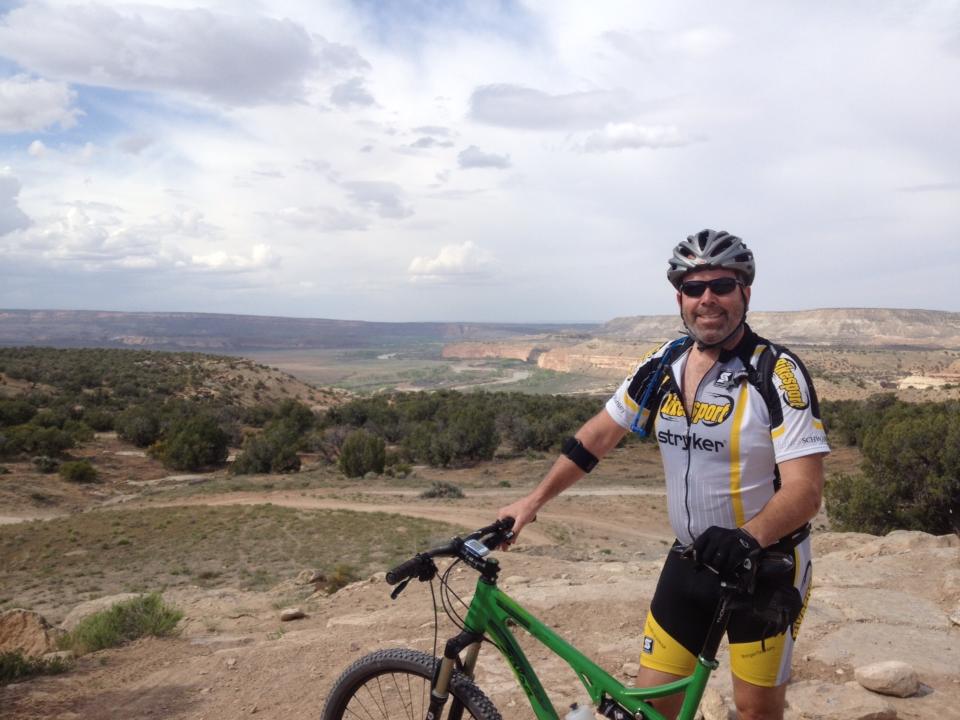
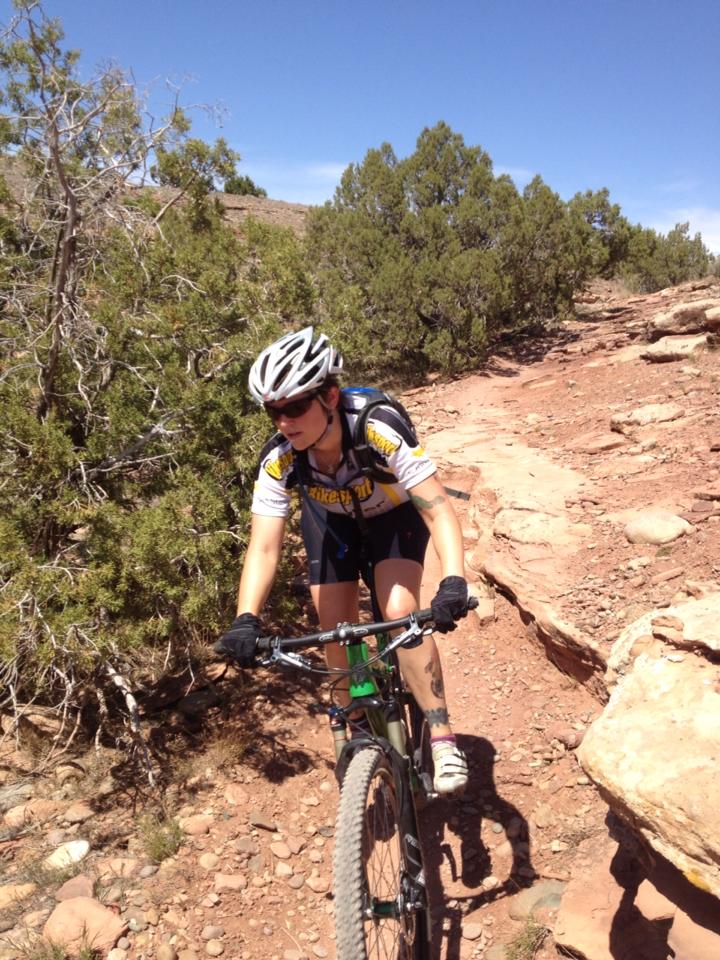
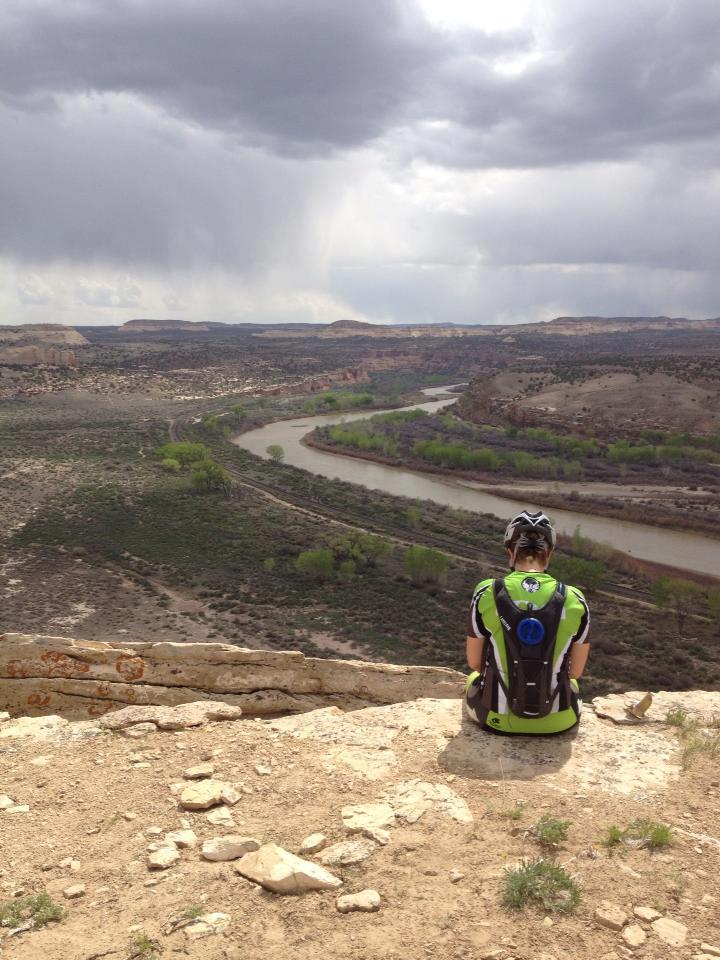
To celebrate our five-year wedding anniversary, both our birthdays, and Cinco de Mayo, Husband and I spent a 4-day weekend in and around Fruita, Colorado, doing stuff like this, this and this:
943306_10201062229306789_1774384214_n
944566_10201051113628904_538245173_n
934628_10201070277387986_1341583516_n
And in between, we did this:
197821_10201070257347485_641106476_n
Ahhh. Lovely. 🙂

hypothetical travels: Fruita, Colorado

Over the weekend, and today, Husband and I may be riding some of the trails mentioned in this magazine article… maybe in a place that looks something like this…


As we depart Houston, the weather’s looking pretty grand!
943453_10201031339254557_187866890_n