author interview: Ridley Pearson

Ridley Pearson is the author of more than two dozen novels, including The Red Room, Choke Point and The Risk Agent, plus the Walt Fleming and Lou Boldt crime series and many books for young readers. He lives with his wife and two daughters in St. Louis, Mo., and Hailey, Idaho. White Bone is the fourth novel in his Risk Agent series.

Pearson at Solio wildlife sanctuary: “Time and time again I was a matter of 15 yards from these rhinos.”


White Bone’s plot centers on elephant poaching in Kenya. How did this issue come to your attention?

I heard a statistic about elephants, and it really shocked me. In 2014, the first real decent study documented that 100,000 African elephants had been killed in three years. One of every 12 African elephants had been killed by a poacher in 2011. Three-quarters of local elephant populations are declining. In nine years, there would be no more wild elephants in Africa.

Then I met Mikey and Tanya Carr-Hartley, who run a four-generation-old guiding service in Kenya. Eventually I went, under their care, to Kenya to do interviews and see the country and dig into the poaching, and my hair was blown back.

I interviewed 24 people over the course of three and a half weeks, and 23 of them in some way lied to me. These were very trustworthy sources, including our own (U.S.) State Department. Finally, my last interview was an activist lawyer, and we went through my interviews and she told me point by point who had fabricated what. My jaw dropped. There I’d been digging into this to help everyone, and in some way or another everyone had manipulated the truth.

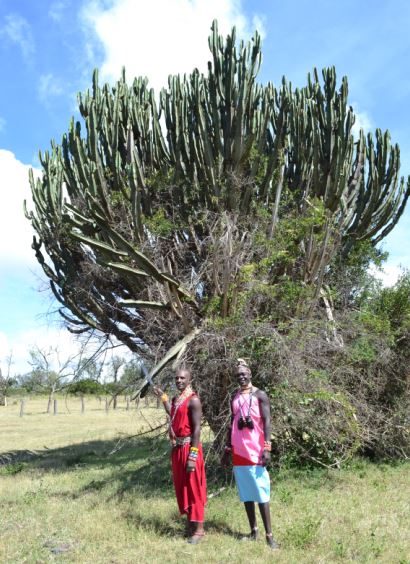
“My guides Ole and Charcoal.”


It was eye-opening, and dangerous. I was in Nairobi when there was a terrorist blast that killed 18 people. I was at a lodge when poachers killed a rhino 300 yards away from me while I slept. There’s a scene in the book where Grace runs into these herdsman, and they try to rape her. Those were two guys I ran into when one of my guides had to go get a vehicle and I was left–by my own choice–and within 10 minutes I ran into these guys, and they did not like me. It was 20 or 30 minutes of, oh boy, all he has to do is lift that spear and I’m going down.

Is there a point at which research makes it harder to write fiction?

My approach is “faction.” My charge is to suspend your disbelief, and I think it works best if I put more fact in than fiction. I do a lot of research. I learned about a guy who was investigating poaching and was a pilot over Mt. Kenya, and his plane happened to go down. A lot of people think that plane was sabotaged; it’s never been proven. I told that story, where a guy was killed in the bush who had been investigating. I just made it a little more palpable and believable for the reader.

Were you searching for John Knox and Grace Chu’s next case, or was this something you needed to write about first, and they were the best fit?

The latter. I just wondered if I could put Knox and Chu into Africa, and what that would look like.

“Ole showed me every plant that could kill you, every root that could heal you: it was unbelievable. I based all that information with Grace off my days with Ole.”


I’ve written 51 books. And I haven’t done this for probably 20 years, but I actually wrote the entire book and put it aside and started over. I just wasn’t buying my own story. It wasn’t lighting me up. And it wasn’t the story my editor (Christine Pepe at Putnam, who’s just one of the greatest editors who’s ever lived) wanted. So I stepped back and thought: What am I doing wrong here? I’ve always wanted to do a book about a person out in the wild with nothing. I’m an Eagle Scout, so I’ve gone through some of this in my own teens. When Ole, my guide, told me that a white person wouldn’t last 24 hours in the bush, I said, well, how could I last 24 hours in the bush? He showed me every plant that could kill you, every root that could heal you. It was unbelievable. I based all that information with Grace off my days with Ole.

How did you handle characterization?

I felt a great depth of participation with Grace because of her circumstances. I think this is the book where readers of the series will go, “Oh, that’s the Grace I’ve been waiting for.” I learned a lot about her. She has a lot of stick-to-it-iveness that I really wasn’t sure about. She’s an accountant by trade, but she went through the Chinese army training, and had some short-lived intelligence experience. So I always sensed that she had this potential. This book was her chance to be out on her own, investigating something that’s a little more money-oriented than pure fieldwork, and then it ends up Fieldwork with a capital F. In previous books you never really got in with Grace and felt her, and were afraid or proud or achieving with her.

The challenge is not to put everything in. In my fieldwork, there were some amazing moments. I had an encounter with one of the people who had lied to me. On the very last night I was there, he came up to me at a party and said, “Hey, listen. I’m terribly sorry about how I played that when we were at Solio.” And I said “Yeah, so am I!” But at least he was man enough at the end to come up and say, “Sorry I just lied to your face.” That was a very emotional moment for me. And you can’t get them all in.

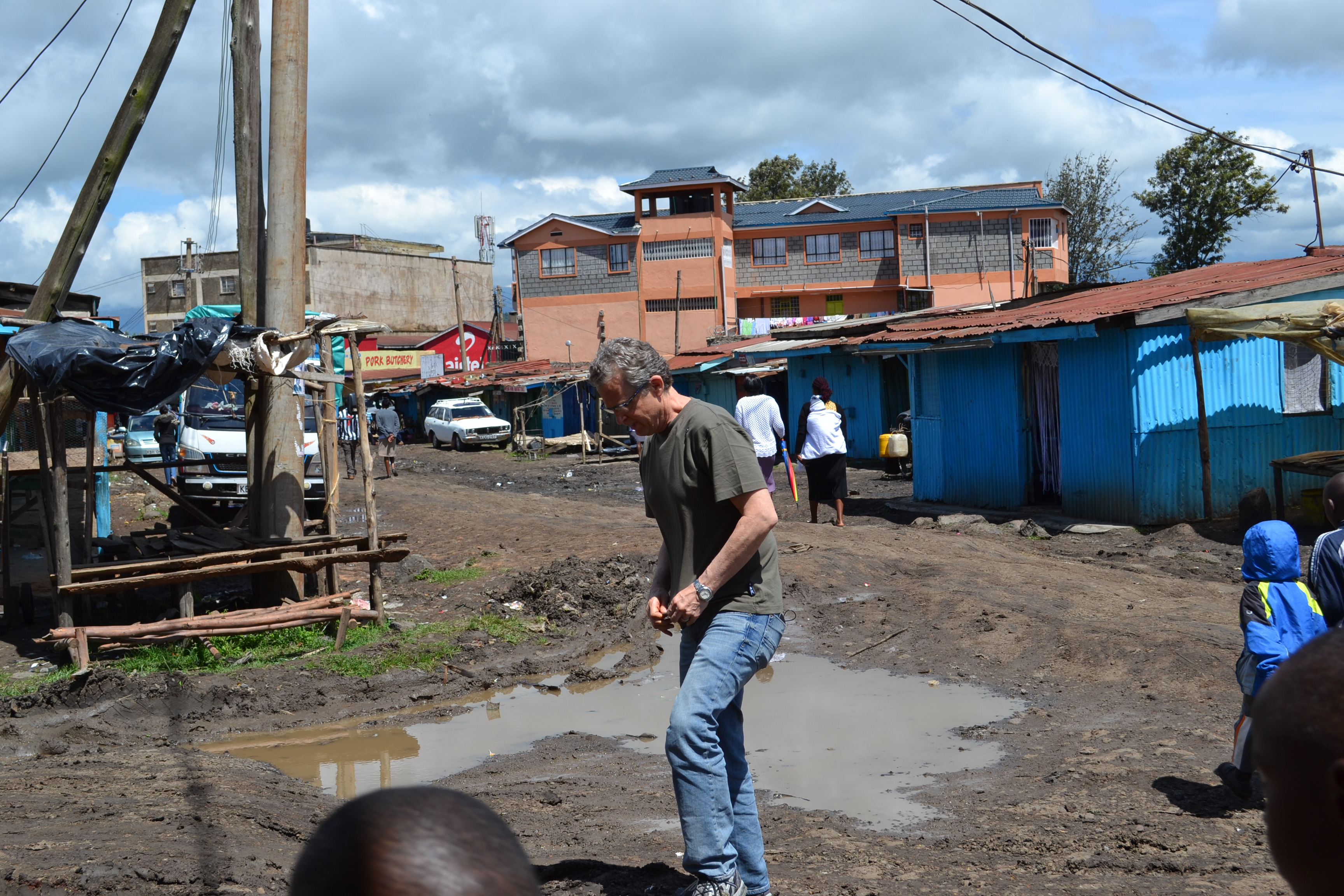
“This is me in what they call a ‘nice’ town near Solio Lodge.”


You regularly write realistically about violence, depravity and corruption. Is this emotionally difficult?

I think you pay for it.

Every day for two years as I wrote this book, these images hung in my head. These stupid idiots come in with automatic weapons on ATVs, they massacre the elephants, they chainsaw their faces off for the tusks, and they’re gone in 15 minutes. For all the dark that Grace and Knox went through, those are the images that haunted me. When you’re there and you see these animals, just how majestic they are–it’s absolutely despicable.

I want to route some of the money from the book there, and get some people at the end of the book to say, “I’ll send $10 to them”–it doesn’t have to be $100,000. It’s just bizarre to me that this is going on, and none of our grandkids will see elephants except in a reserve or in a zoo. An elephant is being killed every 15 minutes, and has been since I started this and long before I started this.

That was the darkness I lived with. Everything else was manufactured. I’ve done a lot of research over 30 years. I’ve been inside the mind of a lot of devious criminals. I’ve spent time in prisons for the criminally insane. I’ve interviewed forensic psychiatrists who have themselves interviewed 140 mass murderers. I’ll say, this is what my guy did, who is he? And we’ll be eating dinner, and the stuff they describe stops me from eating. So there is darkness. And I pay for it.


This interview originally ran in the July 29, 2016 issue of Shelf Awareness for Readers. To subscribe, click here, and you’ll receive two issues per week of book reviews and other bookish news.

author interview: Allison Amend

photo: Stephanie Pommez

photo: Stephanie Pommez


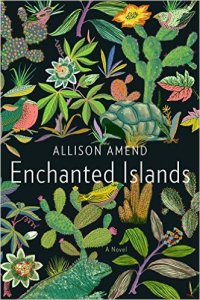
Allison Amend, a graduate of the Iowa Writer’s Workshop, is the author of the novels A Nearly Perfect Copy and Stations West, which was a finalist for the 2011 Sami Rohr Prize for Jewish Literature and the Oklahoma Book Award. She is also the author of the Independent Publisher’s Award-winning story collection Things That Pass for Love. She lives in New York City, where she teaches creative writing. Her latest novel is Enchanted Islands, based on the life of Frances Conway, who lived with her husband, Ainslie, on the Galápagos Islands for several stretches in the 1930s and ’40s. My review is here.

When did you discover Frances Conway, and what about her spoke to you? Did you know you needed to tell this story when you first encountered her?

I discovered Frances through her memoirs. I originally wanted to write about the series of strange disappearances on the Galápagos island of Floreana, but some of the descendants of the people involved are still alive, and Dayna Goldfine and Dan Geller were making a documentary about it, and I felt I wanted more freedom to imagine characters. It was in that period of research, though, that I read Frances’s memoirs and immediately fell in love with her voice. She is funny and witty, self-deprecating and actually a talented writer. This was a voice I wanted to attempt to emulate.

What also struck me about her two books is what they didn’t say. She was 50-year-old woman married to a man more than 10 years her junior, and in her middle age they decided to go to a deserted island? There was some larger story that she wasn’t talking about. It was in the space between the lines that my interest in the story grew.

I had written a full draft of the novel before I went to do research. Frances never mentions in her memoirs that Ainslie has a drinking problem, but I wrote that into the novel. Later, I spoke to the son of someone who knew the couple, who said that the Conways had come to Floreana in part so he could dry out. There are traces of honesty even when we try to hide them.

Have you ever been to the Galápagos?

Yes. My parents took me and my brother when I was just out of high school. It was an amazing trip. During that time I read Floreana, Margret Wittmer’s account of the strange goings-on on the island, and I became fascinated with the human history of the islands.

I returned to do research in February 2015 and found the islands much changed. Land-based tourism is in full effect, and the population of the islands has exploded. I saw many more Ecuadoreans taking advantage of their natural park. It’s wonderful that the islands have become accessible to those who are non-wealthy, but the increased traffic stresses the islands.

Every superlative everyone has uttered about the utter awesomeness of the Galápagos is true. I urge everyone reading this to visit this spot before tourist degradation destroys it.

enchanted islandsWhere is the line between fact and fiction? How firm is it? How important is it to you?

Ehhh, line-schmine. I like to say that fiction dwells in the possible, not the probable. Is it possible that Frances and her husband were spying for the U.S. government? Unlikely. But it does seem clear that Ainslie wrote an anonymous feasibility report for the U.S. Navy, and it is rather strange that a mismatched middle-aged couple would play Swiss Family Robinson on a strategically placed island full of Germans just before World War II, so who knows?

If there had been more historical records about Frances and Ainslie, I might have felt more compunction about inventing their lives, but the dearth of facts seemed to me to be a green light.

How much research did you do, and do you find that part of the process enjoyable?

I love to do research, and all of my books have been research-intense. It is one of the most enjoyable parts of writing for me. This may be because I get to procrastinate and call it writing.

I did try to complete a working draft before I started researching so that I would be sure to focus on creating characters rather than writing a Forrest Gump-like series of important events.

I did a lot of my research on the internet, unsurprisingly. There is a fantastic resource on the human history of the islands compiled by John Woram: www.galapagos.to, which has nearly all the historical documents that exist on the islands. I also did a lot of reading on spying tradecraft in the 1930s, and the role of the Pacific and the Panama Canal in the Second World War. Then there was all that research on Chicago during the turn of the century and San Francisco in the periods between the wars. Oh, and I went to the Roosevelt library and the Allan Hancock collection at the University of Southern California.

I read Frances’s memoirs several times, because I wanted her voice in my head. For a while I considered weaving in parts of her memoir, but I decided that would be more of a gimmick than an asset to the novel, so I tried to put the book out of my head and just write from my memory of her voice.

There comes a time, though, when research starts to inhibit imagination instead of spark it, and then it’s time to put the research away and just write.

Do you have a favorite character or one you feel closest to?

Well, obviously I spent four years or so with Frances, so I feel like I know her (or my fictionalized version of her) very well. But I have sympathy and fondness for all the characters in the novel.

In what ways is this book different from your previous work?

All of my books are different from each other. One of my biggest pleasures in writing is to try something new–it keeps the writing exciting and challenging. After my last historical novel, I swore I would never write another… but the pull of this story was just too great.

Enchanted Islands was a challenge because I was writing in first person for the first time in a novel. And I was writing from a voice that already existed. I didn’t have to match it, but I wanted to be true to its spirit. I was also challenging myself to write a tightly plotted novel, with spies and violence and action. From someone who comes from a literary fiction, character-driven background, highlighting plot is like getting a horse to walk backwards.


This interview originally ran in the June 3, 2016 issue of Shelf Awareness for Readers. To subscribe, click here, and you’ll receive two issues per week of book reviews and other bookish news.

author interview: Fernanda Santos

photo: Nick Oza

photo: Nick Oza

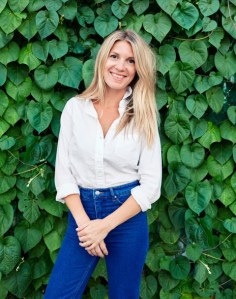
Fernanda Santos covers Arizona and New Mexico as the Phoenix bureau chief for the New York Times. Her experience as a journalist is broad, crossing two continents, several languages and a range of subjects. Her first book, The Fire Line (Flatiron Books), is about the deadly 2013 Yarnell Hill, Ariz., wildfire that killed 19 members of the firefighting team the Granite Mountain Hotshots. My review is here.

How was writing this book different from newspaper work?

I wanted to write a book because I couldn’t answer the questions that I wanted answered in newspaper stories. I knew that somebody would write about this fire, and I would have tortured myself for the rest of my life for not having had the courage to write it. I called a colleague in New York, and he said, look at every chapter as a story. Can you write a 4,000-, 5,000-word story? And I said yes, I can write that. He said they just all have to connect in the end. And it seemed so simple.

On one hand, it was that simple. But on the other hand, it’s very different than writing a newspaper story. I had complete control over it. In newspapers, the editors get hold of your text and shape it, or send it back to you and ask for more of this or that, because they want to drive a specific point. With the book, I kept waiting for the moment when the editors would get my chapters and start telling me where to go and what to do next, and it never came. When I was halfway through, I sent it to Colin Dickerman, my editor at Flatiron. I didn’t even know if I’d written something that resembled a book. And he said, there’s a lot of great material here, great reporting, but it’s a little confusing. Why don’t you do an outline? And I thought, oh! I guess that would help! With the outline, everything was easier. I set deadlines for each chapter. I only had a certain amount of book leave, and I didn’t want to jeopardize the job that I really love. So I assigned myself these stories, like my friend told me, and pursued the deadlines as if an editor was there to enforce them. And all of a sudden it flowed, just naturally evolved from one chapter to the next. A lot of the skills I used were developed over those years writing newspaper stories.

How did you gain access to these men’s families, and their trust?

I approached it very differently than I would if I were to just write a story about the deaths. I was not looking for a quote, or a quick couple of lines to throw in a story to define a character. I really wanted to understand who these men were, and I figured the best way to do that was if I got to meet their families. I had a friend in common with the wife of Andrew Ashcraft. I asked this friend to reach out to her, and we met. Then she referred me to her mother-in-law, who was close to another mother, who was close to another family, and the word started to get around. I guess they liked me. They said I had a lot of patience, and I was very interested in learning their stories.

I wrote letters to other families. I explained what the book was about, why I wanted to talk to them, and I said that although I had their addresses, I had not gone knocking on their doors because I didn’t want to add to their anguish. I wanted to leave them in control. I wanted them to reach out to me, and say if, when and where. And before I realized it, I had met everybody.

I also went to the fire academy in Prescott, where a lot of the Hotshots trained, and some of them taught; one of them, Eric Marsh, helped found the academy. I did the basic training, and then another course, and I’m actually going back to a third. I wanted to understand the world they inhabited, because wildland firefighting is a very small world, very tight. Once I went through the academy I could understand better what former members of the crew and families of the men had told me.

fire lineI love that you explore so many facets of this story: firefighting techniques, the history of fire management in the United States, the science of weather forecasting.
I realized early on I had to explain three things. Readers had to understand what wildland fire is, what it is like to fight a wildfire. They had to understand the very specific conditions of the vegetation in that part of the state, which obviously connects to the bigger issues of the drying of the west, climate change, the warming of the planet. And they needed to understand the characteristics of the storm that hit the fire, that hooked the flames and turned them around on the men. So I spent a lot of time in the National Weather Service office here in Phoenix, and the office in Flagstaff. I hung out with meteorologists, asking questions. They referred me to some texts. And I had two very thick fire policy books that I read, which were very helpful. I met several times with the author of those books, Stephen Pyne. In fact, he read my manuscript to make sure I didn’t embarrass myself.

It was in some ways a relief, when the emotional side of things became hard to deal with–you know, spending six hours with a widow, talking about a husband and a life that in many ways resemble my own. These guys were younger than my husband, but we like to do a lot of the same things these guys liked to do with their wives; we have a child, a lot of them had kids–so you understand the broad outlines of a life at home. Emotionally, that is very hard. There were times that I really looked forward to sitting down with a meteorologist and talking about science. It gave me a break, and recharged me so I could go back and sit down with another family for hours and talk about whatever they wanted to talk about. My husband says that I report with my heart first, which is why sometimes I come home a total wreck. I hope that’s what comes through.

Was it easy to return to your work for the Times?

It was not easy. I went from an environment where I was in complete control, and I took the story as far as I wanted to take it, to an environment where I have limits to the stories I write, the amount of time I can spend, even the way I write them. I remember telling my editor after one frustrating story, how is that I can write a book and I can’t write a story? And he said you can write both, but you can’t write a story as if you are writing a book.

I miss my book. It’s very weird, but I miss the intimate connection that I had with that story.

This was very rewarding, then.

It’s interesting. I’m from Brazil. I came here as an adult, I’d never written a story in English, I went to graduate school, I’ve been at the Times 10 years, and now I’ve written a book about wildfires. A very American story, in some ways. It was such an empowering experience for me, as a person. We know all the conventions, the boxes people try to fit us into. You’re a woman, you’re an immigrant, you’re a Latina; therefore you’re expected to know about immigrants, Latinos, parenting. Not about firefighters, a real man’s world. Because English is not my first language, how dare I write a book? Those were the things in my head. What are you thinking? Why did you get yourself into this? I had all these battles with myself, and I obviously overcame them, because I wrote the book. To me, that was such a priceless experience. My daughter is six, and I’ve been talking to her about what people say you can and can’t do, what girls can’t do. And in Latin culture we’re very respectful to authority. So I’m telling her, sometimes you have to break the rules. Sometimes you have to try something that people think you’re never going to be able to do, so you can prove to them that you can. It really taught me a lot about how far I can go.


This interview originally ran in the May 10, 2016 issue of Shelf Awareness for Readers. To subscribe, click here, and you’ll receive two issues per week of book reviews and other bookish news.

Maximum Shelf author interview: Steven Rowley

Following yesterday’s review of Lily and the Octopus, here’s Steven Rowley: On Obstacles and Octopuses.


Steven Rowley is from Portland, Maine, and is a graduate of Emerson College. He has worked as a freelance writer, newspaper columnist and screenwriter, and lives in Los Angeles with his boyfriend and their dog. He is @mrstevenrowley on Instagram and Twitter. Lily and the Octopus is his first novel.

How autobiographical is this story?

photo: Malina Saval

photo: Malina Saval

There’s no way to deny that it’s partly autobiographical. I did have a dog, named Lily, and when she passed away I went into a funk. The depth of grief I felt took me completely by surprise. After about six months or so feeling completely blocked, not just in writing but in life, I sat down to do what writers often do, which is try to put pen to paper and work their way out of a tough spot. Thematically and emotionally it was autobiographical, but as I kept writing, the character and the plot became more fiction. It got weird, certainly, along the way, but I thought, the story can get as weird as it wants to on the surface as long as I stick to the mission of adhering to absolute emotional honesty.

It sounds like you did the writing as a part of healing.

Oh, it was hugely cathartic. Absolutely. Although it’s largely on the surface about a man and his dog, I see the story more about a character who’s stuck in life. Sometimes our biggest obstacles are those that we make up, that we imagine, or if they’re not entirely imagined, that we exaggerate. So it’s really a story about what it takes to get unblocked and power your way though.

Did you know that that was the story before you were writing it?

It’s interesting. I come from a background in screenwriting, and with screenwriting you have the plot much more laid out in advance. And this was something I was approaching from more of an emotional standpoint, looking to examine themes of grief and depression–I hate to harp on those because the book is, hopefully, not without its humor as well. I was surprised where the story took me because I was so focused on the emotion of it. There’s a big set piece near the end that came completely by surprise.

Why on earth an octopus?

Well, I did have a dog that suffered from something that looked a bit like there was a small octopus on her head. But beyond that, I wanted something as different as possible. What’s most different from a dog that’s covered in fur, that’s basically all spine (since she’s a dachshund) than an invertebrate who’s sort of slimy and hairless and lives in the sea? I liked playing with that dichotomy, that they were as different as different can be. On top of that, I have an enormous respect for octopuses (my editor and I have gone over this time and time, and the plural of octopus is octopuses). They’re so smart, and according to scientists they’re playful, can use simple tools and they learn and adapt as they go. And that’s what I needed, a cunning antagonist. Because the main character learns more about the octopus throughout the story as it unfolds, I needed a villain who would learn and adapt as well, continue to know how to needle our narrator. So, that is an octopus. And I do carry some guilt about villainizing them in any way, because they’re really magnificent creatures. Please everyone, don’t hate the octopus. Just the particular one in this story.


How was writing a novel different from your previous work as a screenwriter?

Screenwriting is a collaborative art. Many people help to bring a screenplay to life as a film, and many times it’s not the writer’s original intent that makes it to the screen. On top of that, when you’re writing a screenplay you’re writing a blueprint, it’s not in and of itself the final product. I had in my mind that I wanted to try a novel someday, so that if nothing else I could point to something bound and finished and say, this is what I do.

A screenwriter’s job is to make the internal external. All emotion and feelings are expressed through action and dialog. In this book, I wanted to luxuriate in themes and feelings. The book is very internal; there’s a very limited number of characters. The narrator has one friend, one sibling, one parent and one therapist, and that’s it. He’s sort of removed from humanity, which is why he has such a powerful relationship with his dog. I really wanted to take the time and explore what was going on inside of his head, and when you’re exploring depression it’s often internal like that. So it just seemed that a novel or prose was the right medium for this story.

Your journey to publication was unusual. Congratulations, by the way.

Thank you! When I finished the manuscript, I was very proud of it as a piece of writing, but I saw it as so deeply personal, and to be perfectly honest I was also worried that it was perhaps a little weird. Self-publishing was also attractive to me because, coming from film, I didn’t want too many other voices trying to tell me it can’t be an octopus, it should be an alligator, or whatnot. My boyfriend recommended I hire an independent freelance editor, so I found a woman named Molly Pisani and she and I worked on the book together. I paid her and I never expected to hear from her again. I went about doing what writers looking to self-publish do. I hired a typesetter, looked at ISBN numbers and how to market the book and sell it, all these things, and out of the blue I got a phone call from Molly about three months later. She said, “I can’t stop thinking about your book. I know a woman who works at Simon & Schuster who I think might respond to it in the same way that I did. Do you mind if I send it?” I said no, I certainly don’t mind, but I was so far down the line toward self-publishing that I really didn’t think anything would come of it. And she did say that it could take her friend a month or two to look at it. That was on a Friday, and on Monday morning I woke up to a call from Simon & Schuster, from the woman who is now my editor, Karyn Marcus. It really happened that quickly.

What’s next?

Everyone is asking, will it be a screenplay or novel? And I have to say that publishing is being incredibly kind to me right now. Working on Lily with my editor, she gave me a note once and said, “…but I defer to your creative vision.” And I almost fell out of my chair! Because in 10 or 12 years really giving it a go as a screenwriter, I had never heard those words from a producer or a studio executive. As a writer, that’s kind of addictive. So for many reasons, my next project, which I’m working on right now, is a follow-up novel. I’ve been really fortunate with this publishing deal, which has allowed me to leave my day job, and I’m focusing on writing full time now. I’m excited.


This interview originally ran on May 9, 2016 as a Shelf Awareness special issue. To subscribe, click here, and you’ll receive two issues per week of book reviews and other bookish fun!

Maximum Shelf author interview: Dan Vyleta

Following yesterday’s review of Smoke, here’s Dan Vyleta: In Dialogue with the Manuscript.


Dan Vyleta is the son of Czech refugees who moved to Germany in the late 1960s. He holds a Ph.D. in history from King’s College, Cambridge. Vyleta is the author of three previous novels: Pavel & I, The Quiet Twin and The Crooked Maid. An inveterate migrant, he has lived in Germany, Canada, the United States and the United Kingdom. When not reading or writing novels, Vyleta watches cop shows or listens to CDs from his embarrassingly large collection of jazz albums. He currently resides in Stratford-upon-Avon, in England.

vyletaYou employ many voices and events. Was this your plan from the beginning?

I’m not a great planner, if I’m honest. I always feel as if you write from the gut and you edit with your brain. It felt right to give people their own voice, let people speak–because it’s a novel about the state of your soul, I suppose. Everybody’s wrestling with this phenomenon that nobody can quite make sense of. The entire society works in a certain way because of it but it’s never been explained, it’s just there. And then, because this is also a novel about class, about different parts of society interacting, I had to find voices more peripheral to the action to give interesting counterpoints. The more I think about it, I think of the structure as quite dramatic, i.e., like a theater play, where occasionally somebody will come out from the chorus and stand there dazzled by the light and start talking at the audience. I think it was a dialogue between the manuscript and myself: things I wanted to do and things that the manuscript responded to. And that’s how a novel is shaped, you push forward and you listen into your own work and it gives you guidance and an architecture emerges out of that.

What makes a good hero, or a good villain?

For both the answer is complexity. Evil comes in many shades. It has to be complex. We have to feel the human being in there, we have to have some level of sympathy. We can fear them, but–there’s something quite attractive about villainy, isn’t there? The villain has to work on you emotionally on a whole range of notes, rather than just hitting the base notes over and over again with a fist. There has to be movement, so we realize there is a thinking person behind this, who is reacting and evolving and changing. And very often there’s a tragedy, since most people don’t grow up thinking, when I grow old I want to be a villain. I think as a writer it’s quite simple: you have to love the people you write, and all the more so if they are your main protagonists. It’s hard to love people who don’t have warts. You love them for the flaws as much as for what they can do. You love them both for the things you recognize of yourself in them and for the things you admire or wish you had. This is a strange refraction. What I admire in the three heroes of the book is courage, in very different keys. One is very… leading with his chin, as it were; one has the courage of emotional honesty, almost a courage of tenderness; and the third, in some ways my favorite, has the courage to change, to actually think differently, which is about the most difficult thing in life, you know.

Do you create those elements consciously, or does it come naturally?

I think anything you try to put in consciously feels off. It’s funny. Obviously you think about your book, and obviously you have plans for it, and hopes. I take reams and reams of notes, often including bits of dialogue or monologue that will never show in the book but which tell me something about the character. But the moment something simply has to happen in a mechanical sense, the page kind of dies. The page becomes an instrument to deliver that prearranged piece. And I think the beauty of writing is that you as a writer are in the position of the reader–each sentence can surprise you. Of course you think about plot and you’re aware of certain plot twists or elements, but the precise rhythm or emotional tone of it–it’s always good if there’s something in it where you think, wow, that’s how it worked out? That’s kind of sad, or very untoward, or funnier than I thought it would be.

In what ways is Smoke like and unlike your previous novels?

I’ve been asking myself that question, and I don’t have a good answer. My first three novels are all historically set, as is this, although in the middle of the 20th century. I feel as if, in this book, I’m writing unchained. When friends ask me what I’m writing I say, it’s like a Foucauldian children’s book for adults [laughs]. What does that even mean? On the one hand it’s more conceptual than anything I’ve written, about how we are trained to function well in society and what it would mean not to function well, and how we differentiate between who’s worthy and who’s unworthy. On the other hand, and this is what I mean by unleashed, it’s channeling this sheer joy for narrative that I remember in reading as a child. A sheer hunger for just turning the next page, which I really admire in the best of children’s literature. I have been thinking of Dickens a lot because this is a 19th-century novel partially set in London. Great Expectations is essentially a children’s book for adults, I think. Its entire engine, the way it drives forward, its tenderness, is very close to a children’s book, but the things that it explores are very adult indeed.

As a physical symbol, why smoke?

As Dickens points out, based on 19th-century medical theory, there must be particles of disease rising out of poor quarters of town where lots of people suffer physical ailments. If we could only see them, we would be scared, and it would be even worse if we saw their moral ailments. That, coupled to Dickens’s emphasis on fog and soot flying through the air, as it did in London in the 19th century, suggested the smoke to me initially. But the more I thought about it, I thought, well, it’s versatile. It’s undeniable, it’s immediate, it leaves a stain, it can’t be suppressed. It correlates with our own suspicions. You know, quite recently and suddenly cigarette smoke has become a sinister marker. You can’t have a hero in a film smoke anymore, right? It has dangerous implications. You can do it ironically if you set it in the ’60s. So that was part of it. And once I realized that the point wasn’t just that smoke marks sin or desire or vice, but that it was infectious, that it was something that could crawl into you, possess you, it became clear to me that smoke is really the perfect metaphor. You can walk through it like a mist, you can inhale it, you’ll feel it on your skin, it’ll be in your hair. And there’s a kind of analogy to sweat, right? Your every pore can be suffused with it. There may be moments where smoke pours out of your eyelids, finds its way around your fingernails. There’s this sort of visual power to it that I love.


This interview originally ran on February 24, 2016 as a Shelf Awareness special issue. To subscribe, click here, and you’ll receive two issues per week of book reviews and other bookish fun!

Maximum Shelf author interview: Molly Prentiss

Following yesterday’s review of Tuesday Nights in 1980, here’s Molly Prentiss: Painting a World.


Molly Prentiss was born and raised in Santa Cruz, Calif. She has been a Writer in Residence at Workspace at the Lower Manhattan Cultural Council, at the Vermont Studio Center and at the Blue Mountain Center, and she was chosen as an Emerging Writer Fellow by the Aspen Writers Foundation. She holds an MFA in creative writing from the California College of the Arts, and currently lives, writes and walks around in Brooklyn, N.Y. Tuesday Nights in 1980 (Scout Press) is her first novel.

photo: Elizabeth Leitzell

photo: Elizabeth Leitzell


Do you have experience within the New York art scene?

It was mostly done by research. Most of my friends are artists or writers, but not in 1980. I went to graduate school at an art school, so I have been around a lot of visual artists, and my fiancé is a visual artist. Conversations with them often influenced the projects and pieces I referenced throughout my book. I go to a lot of gallery openings in the Lower East Side and SoHo with those friends. But I wouldn’t say I’m an expert of any kind. A lot of it was googling and reading books at the Strand and some trips to the New York Public Library.

What about synesthesia? You portray James’s sensations so vividly.

I don’t have synesthesia, and I don’t know anyone very well who has it. But I do think there are elements of synesthesia that exist within a lot of creative people’s brains. I feel I have really strong associations: with days of the week having a certain color, for example, although I don’t actually see those colors. Words pop into my head when I think of a certain smell or color. I often used my own associations to create James’s. I was enthralled by the idea of synesthesia and I did tons of research on it. I read a particularly great book called Wednesday Is Indigo Blue. It includes charts made by people that have synesthesia, where they describe the exact color of every letter in the alphabet, or they talk about every date on the calendar and what it smells like. They see sparks or flashes before their eyes. They talk about it as if it’s a screen in front of their eyes. They know it’s their synesthesia at work, they know it’s not “real” to the outside world. It was a really fascinating thing to look into, and I especially loved working with language surrounding James’s synesthesia. It’s my favorite way to write, to link one thing to another sort of haphazardly, but also in a way that feels organic.

Your choices of subject and setting are exact and evocative. What brought you to this intersection?

You know, the novel has taken many forms throughout the last seven years. Many of them included much longer time periods, and more characters. An original draft had a very different central character, but then I started writing about his mother, and then I started writing about his mother’s brother, who became Raul Engales, and a lot of that character’s action ended up happening to Raul. But that shifted the timeline backwards a bit, to the late ’70s, early ’80s. And I realized that when I struck on that time period, something started happening. I found I was really interested in lingering there. And the same thing happened with the place setting. In previous drafts, large sections took place in Argentina, and eventually my agent (who I worked closely with to edit the book) and I talked about centralizing it in New York. That was the place where the book really came alive, where the action was really happening, and I could render it the most clearly, because I live here and have had such New York experiences and can speak to that the best. So both of those things happened organically. And the location and the time period ended up becoming central pillars of the book, but I didn’t set off with starting to write a book in the ’80s, specifically. I rooted the book in the characters first and the specific position in time and in place came later.

There was a ton of evolution. James in particular was always a thorn in the side of the book. He used to be a side character. In the beginning he didn’t have synesthesia, and in another version he was going blind. I had to learn how to plot the book, move it forward and give it narrative drive, and I used James for that purpose a lot. He became a central character around which the book really revolves. So there’ve been many shifts in dynamics throughout the book, and ways that the plot and the characters have morphed in order to give the story more heft, or more direction, and those are things that I had to teach myself along the way, how to make the story link up and tighten up and push forward.

In a cast of such weird and interesting people, do you have a favorite, or one you most identify with?

It’s hard. I really like Arlene, who is a side character, but she makes me laugh, just thinking about her. I like her relationship with Raul, which is simultaneously motherly and in some way romantic. I think she’s sort of romantically interested in him. She’s also sort of his mentor, and I like that relationship a lot. I ended up loving James, but he was so hard to write that at some points I really hated him. But in the end he wound up softer, more relatable and kinder than in the beginning.

What were the best and worst parts of those seven years spent writing your first novel?

There were many changes, probably just as many ups as downs, and many exciting parts within the actual writing. There are times when you’re inside of a novel when something clicks, and you can feel it just working, bringing everything into place, and those moments are so thrilling. That’s why you do the rest of the hard work. In terms of pitching the book to agents and selling it and all that, there were some crazy ups and downs. I queried my agent something like two years before I signed with her, and we finally signed and then worked together for three more years, so that was a super-long and arduous process. She was so great, and so helpful, but I would often leave her office in tears because she would have me reworking whole sections, and replotting, and there was a lot of grunt work and overhauls that were really difficult. But on the whole it was really great, to learn how to write the book.

What’s next?

Well, I’m working on my second novel. I’m just in the beginning stages of brainstorming and conceptualizing. The full story is to be determined, but it’s rooted in the way that I grew up, in Northern California in the 1970s, in a community living situation. It will have elements of that, totally fictional of course.


This interview originally ran on February 10, 2016 as a Shelf Awareness special issue. To subscribe, click here, and you’ll receive two issues per week of book reviews and other bookish fun!

Maximum Shelf author interview: Diane Les Becquets

Following yesterday’s review of Breaking Wild, here’s Diane Les Becquets: The Wilderness Within.


Diane Les Becquets is from Nashville, Tenn., and holds degrees from Auburn University and the University of Southern Maine. She has taught writing workshops across the country, and is now a professor at Southern New Hampshire University. In addition, she has worked as a medical journalist, an archeology assistant, a marketing consultant, a sand and gravel dispatcher, a copywriter and a lifeguard. She is a competitive archer, and enjoys bicycling, snowshoeing, snowmobiling, backpacking, competing in sprint triathlons and hiking in the woods with her Labrador, Lacey. Before moving to New Hampshire she lived in a small ranching town in northwestern Colorado for almost 14 years, raising her three sons. Prior to Breaking Wild, Les Becquets published three young adult novels: The Stones of Mourning Creek, Love, Cajun Style and Season of Ice.

Where did the plot concept come from? Did it have to be set in northwestern Colorado?

photo: Nathaniel Boesch

photo: Nathaniel Boesch


I love this question because it triggers so many unforgettable moments from the years I lived in Colorado. The idea for the plot first came to me one evening when I was bow hunting alone. I had ventured into an area called Cyclone Pass, way off the grid, and was bugling back and forth with an elk, following him deeper and deeper into the terrain. The land was steep and littered with deadfall. But then the sky darkened; dusk had passed, and I knew it was too late to take a shot. However, what I also realized was that I was lost. I had gotten so caught up in the adrenaline rush of the hunt that I had failed to keep track of my bearings. The cloud cover was thick, the temperatures cold, and rain began to fall. I went for my headlamp in my backpack, but soon discovered that either the batteries were dead or the bulb had burned out. Not only did I not have a cell phone with me (not even sure I owned one at that time), this was an area where there was no cell signal. Four or five hours later, I found my way back to the trail, and eventually was at my truck. On the drive home that night, I began to imagine a story about a female bow hunter who goes missing. I thought about what that could mean about her life metaphorically. I was at an impasse in my own life, and oftentimes I had that sinking feeling of being lost, of feeling totally confused at which direction to take. I still have the note a friend wrote to me during that time: Within yourself you hold the compass. Together we will choose the direction. The geography of Breaking Wild is a metaphor for these women’s lives.

I chose northwestern Colorado for several reasons. First, this was an area I had called home for almost 14 years, where I had raised my three sons. The land and the people of this part of the state are very distinct from other areas. In many ways this is the last of the true West. It is an area I have tremendous fondness for. But also, geographically, this area is fascinating. It contains what archeologists and geologists refer to as the “edge effect,” where the Great Plains meets the High Desert and the Rocky Mountains. The result is dramatic, with rock formations and crevasses and magnificent storms and winds. Breaking Wild is situated in the Canyon Pintada District, terrain that is not only rich in geological formations, but also in Native American artifacts. There are over 300 archeological sites in this expanse of land. To be immersed in that kind of spiritual geography–very simply, there is nothing like it.

What makes for a compelling protagonist?

This is a difficult question, and I don’t think there is one answer. For me, the protagonists whom I am the most compelled by are those characters whom I care about. They become real to me, as do their stories. My life becomes larger because they are in it. Their lives, their stories, who they are, inspire me in both big and small ways. No longer does the protagonist exist simply as a persona on a page, but the reading experience becomes personal; it becomes a relationship. Once that relationship has been established, I’m going to become completely invested in what happens to her, especially when I know she has something at risk. Have you ever found yourself reading a book or watching a film and praying for the character, literally sending up a little prayer, and then catching yourself and saying, “Wait a minute. What am I doing? This isn’t real”? I am guilty of this quite often and that is an enormous compliment to the artist.

I love the way you switch between Amy Raye’s and Pru’s perspectives. Why is only one of these written in the first person?

This is a question I’ll have to answer in retrospect, as it wasn’t a conscious decision. I believe Pru would be the most similar to me, and perhaps that is why her story is told in first person. But in retrospect, I can also say that Pru is a cause-and-effect person, which makes a first-person account all that more accessible. I felt as if I could inhabit Pru and write what she saw and understood. Amy Raye is much more complicated. I wrote to understand her. I was the observer as I was writing her story.

Do you have a favorite of your two female leads?

Because I identify the most with Pru, because I felt as though I already knew her story before I wrote it, I think Amy Raye would have to be my favorite. She was the fresh, new character for me to get to know. She’s completely flawed and vulnerable and unlikable in so many ways, and yet I am the most compelled by her because I want to know why she is the way she is. I remember my dean once telling me, “We admire a perfect woman. We love an imperfect one.” Amy Raye is so completely imperfect, so completely risky, that I adore her.

How was writing for adults different from your young adult novels?

I never thought of myself as a young adult writer. I simply wrote the stories that came to me. However, I believe the age of each of the protagonists had to do with different situations in my life, places where I was stuck emotionally. The novels were a way for me to work through those places and emerge on new ground. I used to tell people I wrote Love, Cajun Style while I was going through my divorce because I couldn’t afford therapy at the time; I wanted to write something funny because I wanted to make myself laugh. I wanted to feel better. Breaking Wild was a completely different experience for me. I wrote the majority of the novel after emerging from a long space of grief after the death of my husband. It was with this novel that something broke free. The process became a way of being, imaginative and prayerful, rather than a means to work through something and get to someplace else.

What’s next?

I spent this past spring in Montana and Washington conducting physical research for my next novel. As with Breaking Wild, it will be a story of psychological intrigue and suspense. It is also a love story, told from the point of view of a shy, yet strong, female character–a conservationist working in the wilderness, who in her 30s falls in love for the first time. Once again, I find myself intoxicated with the experience. I have so many more stories to write. It is the freest I have ever felt.


This interview originally ran on December 9, 2015 as a Shelf Awareness special issue. To subscribe, click here, and you’ll receive two issues per week of book reviews and other bookish fun!

Maximum Shelf author interview: Ruth Wariner

Following Friday’s review of The Sound of Gravel, here’s Ruth Wariner: Finding a Voice.


Ruth Wariner was 15 years old when she left the polygamist Mormon colony where she grew up in Chihuahua, Mexico, and took her siblings with her to California. She raised her three youngest sisters while earning her GED and putting herself through college and then graduate school, eventually becoming a high school Spanish teacher. She now lives in Portland, Ore., where she remains close to her siblings and is happily married. The Sound of Gravel is her first book.

wariner
When did you know you wanted to write this story? How long did it take?

There was one specific moment when I realized I needed to write my story. It was late May in 1995, and I was 23 years old. My three youngest sisters, Elena, Leah and Holly, who were 12, 10 and eight at the time, and I were living in Grants Pass, Oregon, and eating a lunch that we’d ordered from the dollar menu at Burger King. We were sitting there when out of the blue, Leah asked, “So what happened to our mom anyway?” I was stunned by the question and suddenly realized that I had never told my sisters the story of where we came from.

That was when I began thinking about writing my memoir. But I was in college, and had full responsibility of my sisters. I was working a part-time job with barely enough time to do my homework. After I finished graduate school a few years later and started teaching, I began taking memoir and creative nonfiction writing classes after work. By then my sisters had grown and moved out of my apartment, but still, I wanted them to know who our mother was–or at least to know her as I had known her. I wanted them to know where we had come from and why we had to run away and grow up without parents.

Once I was ready to sit down and actually start writing The Sound of Gravel, it took me almost five years to finish. I couldn’t spend more than a few hours a day writing and often had to step away for a break, especially when I wrote about my most painful memories. There were times when it took me a few days to get back to finishing a disturbing scene.

Why did your story need telling, other than for your sisters?

My reasons for writing have always been very personal: I wanted to share my memories with my siblings–for their own healing and to help them understand the life we left behind. The more I wrote, the more I recognized my own need to process those most heartbreaking parts of my life and to express how I felt about those moments. It’s never been my intention to promote a particular cause or belief system, nor is it my intention to disparage any readers’ own beliefs or religion.

This retelling was painful. What made that process worthwhile?

The story was definitely a hard one to tell, but it has been an incredibly healing journey. Some of my memories bothered me more than I had expected them to. I hadn’t thought about my younger sister Meri in years, but when I wrote the scenes with her in them, I did so through tears.

Revisiting my mother’s life and writing about her in detail was also amazingly cathartic. Looking at photographs of her and remembering the way she smelled, the sound of her voice, the way she combed her hair, the way she smiled and the light freckles on her skin brought her back to me in a very raw and real way. Being able to think about her choices from a more adult perspective also helped. As I’ve grown and reflected on my own life and my relationship to the world, I realize my mom didn’t have a lot of self-love and self-acceptance. She chose a life and a belief system that reflected how she felt about herself.

Even though I know I’ll have to talk about my childhood in the coming months, I feel like I left so much of my past on those pages, which has made it easier for me to talk about. I’m grateful for the opportunity to share my experience. Writing this book also ended up being a process of self-discovery and personal healing. I feel like I found a voice I honestly didn’t know I had. I needed to recognize for myself that my life, my experience and what I had to say about it matters. This was especially important for me after growing up in a large, chaotic household where I really wasn’t heard.

You’re narrating the audiobook yourself. How has that project played out?

I actually just finished recording the audio book yesterday. I hadn’t considered reading myself but the Macmillan team felt that because the memoir is written in such a personal way, it needed to be read and recorded in my voice. The idea of reading it aloud to people really frightened and intimidated me, and I was so nervous that I broke out into hives the day before I started recording! When I finally sat down in the tall chair in front of the microphone with a digital version of my book in front of me, my throat became dry and tight, and my voice trembled. But after reading a few paragraphs and taking a few deep breaths, I felt more relaxed and was able to get into the flow of a natural reading pace. I ended up spending three full days in the studio with a fantastic recording team, and even though it was really hard, emotional work, and even though I felt completely out of my comfort zone, I’m so grateful to have had the opportunity to record my book and feel that it will be more powerful for listeners.

You’ve shared many personal details. Did you choose to withhold any?

I chose to leave out some details of my siblings’ experience in the Colony because their stories really aren’t mine to tell. I only wanted to share the details of their lives in relation to how they intertwined with my own. But when it came to my story, I honestly didn’t hold anything back. I have nothing to hide.

What do you want people to know about you that’s not in your book?

I’m still really close to my siblings on my mother’s side. All of us except for Matt, who is still a committed member of my dad’s church, live in the Pacific Northwest. We spend every holiday together and are a strong support system for each other. Growing up in the kind of poverty we did made our bond with each other stronger; we just didn’t have enough stuff (electronics, cable TV, computers, etc.) to distract us from each other. Growing up without parents also secured and strengthened our bond, and I am incredibly grateful that we were able to stay together through very challenging situations. For me, it’s important that my readers know this because in spite of our troubled childhood, there has been so much goodness and joy that has grown and blossomed. We grew stronger than our circumstances.


This interview originally ran on November 19, 2015 as a Shelf Awareness special issue. To subscribe, click here, and you’ll receive two issues per week of book reviews and other bookish fun!

Maximum Shelf author interview: Paul R. Ehrlich

Following Thursday’s review of The Annihilation of Nature, here’s Paul Ehrlich: Stories of Extinction.


Paul R. Ehrlich is the Bing Professor of Population Studies and the president of the Center for Conservation Biology at Stanford University. Among his more than 40 books are The Population Bomb and Human Natures: Genes, Cultures, and the Human Prospect. He is one of three authors of The Annihilation of Nature, along with Gerardo Ceballos, one of the world’s leading ecologists and a professor at the Institute of Ecology at National Autonomous University of Mexico (UNAM), and Anne H. Ehrlich, a senior research scientist emeritus at Stanford University. Anne Ehrlich is the coauthor of Extinction: The Causes and Consequences of the Disappearance of Species and The Dominant Animal: Human Evolution and the Environment. Ceballos is the author of Mammals of Mexico and Diversity of Mexican Fauna.

ehrlich
What is meant in your subtitle by the phrase “human extinction”?

There’s not the slightest question in anybody’s mind of why we’re facing an extinction crisis, both of populations and of species, and that’s human activities. It’s not extinction of humans, it’s humans forcing birds and mammals to extinction.

How does the three-author cooperative process work?

First of all, Gerardo’s first language is Spanish, mine is bad English and Anne’s is excellent English. Usually Gerardo, or I, or Anne will sketch out a chapter, depending on where our expertise lies. I will edit it the first time around and ask Gerardo to explain some things–his English is excellent, by the way; no one has any trouble understanding him or understanding what he writes–but it’s not colloquial enough in places. Then Anne goes through and replaces all my split infinitives and stuff like that. It’s really an ongoing process. Gerardo is more in charge of the photographs in this particular book–he’s a wonderful photographer on his own, he’s published many books of photographs. We all have students and others who’ve helped us. None of us publishes anything in areas that are even slightly controversial without having a lot of colleagues go over it, and of course we had that done for this book, too.

Anne Ehrlich

Anne Ehrlich


The cooperative writing process is three equal parts. The effort is equal, but we all have somewhat different talents and do somewhat different things.

Who is your target audience for this book?

Our target audience is intelligent people who read books. It’s not highly technical, but it’s not dumbed down in any way. We hope to make it both an attractive book and one that’s good reading. The whole idea is to introduce people to what we’re losing. The average person on Wall Street has never seen a natural ecosystem or, say, the animals on the plains of Africa, and can’t really picture what’s going on. We hope to get people to picture what we’re losing and get them to do something about it.

What does “climate disruption” mean, and why use that phrase rather than the more familiar “climate change”?

Gerardo Ceballos

Gerardo Ceballos


We adopted that phrase from the one used by Obama’s science adviser John Holdren, who’s a close friend of ours. He pointed out that it isn’t just warming–that we are changing the entire climate. Things like the frequency of hideous storms are going to increase, and not every place may get warmer: some places may get cooler. “Disruption” is more accurate than “global warming,” and even “climate change” doesn’t carry the implication of speed. We know the climate has always changed, and most people, certainly the people who will read this book, would know that there were ice ages and things like that. So one of the big issues that’s highlighted by using “climate disruption” is that the change is rapid. Getting older does not disrupt your life, but if you get married or divorced, that’s disruptive. That’s the main reason for using “disruption.”

Presumably many endangered species of birds and mammals didn’t fit into this book. How did you choose which species to discuss?

We chose the ones, first of all, that we know best. One of the problems, covered by a paper I was just involved in that got a lot of publicity, is trying to figure out whether or not we can prove beyond a shadow of a doubt that we’re experiencing a mass extinction. One issue is that there are not enough biologists to track all the species we think may be endangered or, in fact, gone. For this book we wanted a good variety of birds and mammals–the organisms most people relate to and certainly the ones we know most about in these terms. For instance, I’ve spent a lot of my life working with butterflies, but there are very few butterfly populations where we know enough about what’s happening to say anything statistical about the rate of extinction. But birds and mammals we know. We know which ones we know interesting stories about, and there are a wide variety of them in a wide variety of circumstances. So this isn’t an attempt to analyze what’s happening to all birds and mammals, but rather to take a bunch of interesting examples and tie them into why it really counts.

What about animal species beyond birds and mammals, and extending into plants–what is the scope of mass extinction relative to the story told in your book?

The scope of the mass extinction is vast, but population extinctions are the absolutely critical thing. There are a whole series of reasons not to wipe out the only other living things we know about in the universe: one, of course, is just that they’re interesting, fascinating and beautiful, but many people would consider it more important that they’re working parts of our life-support systems. The importance of population extinctions is easily illustrated. If we could somehow miraculously preserve one population of every species on the planet, just one, permanently, we would lose no species diversity–but we’d all be dead in a few weeks, because we utterly depend on having lots of populations to provide us with what are called ecosystem or natural services. For example, honeybees are involved in producing something like $18 billion of agricultural produce in the United States–critical to giving us a much more varied and nutritious diet. If they all died out, we’d be in deep trouble, even though they could persist in, say, Italy and Africa and we would not have lost a species, but we would have lost a vast number of populations. And population extinctions necessarily go on at a much higher rate than species extinctions, because no species goes extinct until every one of its populations has been driven to extinction.

The stories that we tell in this book make up maybe 5% of the relatively well-known stories of species extinctions. But there are many more: for instance, we didn’t look at most of the so-called threatened species, the ones that the International Union of Conservation of Nature considers to be in great danger but they’re not sure exactly how much. In other words, we’ve taken the ones where we know a lot about the endangerment, we know a lot about the distribution, and where they have really interesting stories. If you look at mouse lemurs in Madagascar, we’ve discovered that there are many more different ones than people thought 25 years ago. I think it went from something like two species to 12. That also means that it added substantial endangerment. If there were only two species, the chances of losing either one were relatively small. When we discover there are really 12, all of a sudden there’s more endangerment. But the danger there is the same as the danger everywhere–destruction of habitat is the main thing–so it wouldn’t be interesting to tell the stories of 12 mouse lemurs. We felt it was better to find the most interesting stories to tell.


This interview originally ran on September 23, 2015 as a Shelf Awareness special issue. To subscribe, click here, and you’ll receive two issues per week of book reviews and other bookish fun!


Author photos: Gerardo Ceballos courtesy Instituto de Ecología, UNAM; Anne Ehrlich by Anne Hammersky; Paul Ehrlich courtesy of the author.

author interview: John Norris

John Norris is a senior fellow at the Center for American Progress in Washington, D.C. He has a graduate degree in public administration and has served in senior roles in government, international institutions and nonprofits, including with the United Nations, the State Department and the International Crisis Group. Norris has written for the Atlantic, the Washington Post, Foreign Policy and many other publications. He is the author of The Disaster Gypsies, a memoir of his work in the field of emergency relief, and Collision Course: NATO, Russia and Kosovo. His new book is Mary McGrory: The First Queen of Journalism.

photo: Rebecca Hale

photo: Rebecca Hale

When did you first learn about Mary McGrory, and when did you know you would write a book about her?

I knew Mary personally a little bit. I was working in the State Department [during the Clinton administration] and she would call to pick my brains some. I also, like so many others, got dragooned into volunteering at St. Ann’s [Infant and Maternity Home] and helping out with the Christmas and St. Patrick’s Day parties. I got invited to a couple of social gatherings at her house, so I got to experience both her organizing touch and her parties and bad cooking. At one party, Roger Mudd and I were in charge of fixing drinks for people. I was pretty young and fairly new to Washington, so the idea of serving cocktails with a legendary CBS anchorman was something. But at one point we looked and the ginger ale had gone quite bad. There was kind of a mossy substance growing on top of it. And Roger Mudd turned to me and said, you have to tell Mary. And I said, I’m not going to tell Mary! You tell Mary! So we argued like 5th graders about it… and then we decided we would just tell everybody there was no ginger ale.

But as I got to know Mary, I appreciated that there was a really good story there. It was kind of a Horatio Alger story, of somebody who worked her way up from not an awful lot to be very successful in what she did, but also that she had a fabulous, unique flair. After she had died, I started thinking about doing the book and poked around; it was probably about five years ago that I really began in earnest. It was much harder than I thought it would be to write, in some ways.

How long did that process take, from conception to a finished manuscript?

About five years. I’ve got three little kids–the oldest is seven and the youngest is a year old–so I was busy with them. I had just finished working in Nepal with my wife. And this was kind of a busman’s holiday, because I’ve got a full-time job that doesn’t deal with Mary McGrory or journalism particularly, as an international affairs expert. So there were a lot of competing challenges to juggle at the same time. I just chewed away on it, and by the time I’d sorted out a publisher, I had a finished book.

What were the research and writing phases like, and how did they play together?

You know, I imagine this is an experience that a lot of people have when they take on a biography or a historical project. At first, I was terrified that I wouldn’t have enough material, that it would seem thin. And then suddenly I woke up one day and said, I’ve got way too many words, I’ve got way too much, how do I condense all this down and make sense of it?

It was very helpful that Mary donated her papers to the Library of Congress. There are 164 boxes of her material there: notebooks, articles, clippings and correspondence. Her family was quite good about sharing some other things they hadn’t given to the library. I’d love to be one of those writers who, in a fit of passion, starts at sundown and hands the manuscript over as the sun comes up. But I nibbled away, stringing together passages, and the research and writing mixed together.

One of the really interesting things for me, having never written a biography, was being able to find data points, putting together three or four different things and then suddenly finding that there was a really interesting story there once you lined up all the dates and characters. My research style was to create a monstrously large chronology. I took everything in chronological order–interesting stuff from the columns, interesting stuff from interviews–and it started to make much more sense for me. For example, there had been a Time magazine profile on her not long after the Army-McCarthy hearings, and she got a ton of correspondence. But it was only after I had lined up some dates that I realized she had gotten four book offers from major publishers on the same day. She had never mentioned this to anybody, and nobody would have ever remarked or known it, without actually looking at her correspondence in a chronological fashion and jotting it down. Finding those kind of hidden nuggets was maybe the most rewarding part.

You seamlessly tie in the narrative of United States political history with the narrative of Mary’s life.

As I was writing, I realized at some point that there were three books that I was trying to do at the same time. One was a history of Mary as a person, which obviously was the core that I really needed to get right. Second was a big swath of contemporary American history that I needed to weave in. And then the third strand was, what does this say about journalism? What does it say about women in journalism, and how that’s evolved, and in some cases how it’s not evolved a whole lot?

What part of Mary’s story do you most identify with?

It would be easy to say that she wrote beautifully but it didn’t come easy to her, she fretted and noodled and kept revising and rewriting and redoing her work. The other lesson that she really carried for me was, there weren’t a lot of people who had faith in Mary. But she put her head down and kept at it. Even though she did have a big breakthrough with Army-McCarthy, she really had been toiling in near obscurity, wanting to cover politics for a long time by that point, and being politely but firmly being told no by a lot of people. But she kept at it, and she got a couple of stories, and when she had her chance, she really took it. I think that the persistence side of the story is one that is encouraging for any writer.

At the start of the book, it feels like you take an impartial outsider’s perspective, but by the end, it feels more intimately connected to Mary’s story. Was this intentional?

That’s an interesting question. I think that part of that might be because I knew her later in life, and I got to talk to her contemporaries and people who had been around her. Interviewing them was an advantage for the later material. Writing about her childhood and those early parts, that probably always feels more removed in some ways. But I think it’s also that you gain steam as you begin to explore a person and get to know them.

What in your background as a writer and as a political actor prepared you to tell this story well?

A couple different things. I’ve got three sisters, a strong-willed mother, a feisty wife and two very independent-minded young daughters, so that side of things certainly prepared me well. I’ve always been a bit of a political junkie. I write politics, I think it’s interesting, and I understand people who think it’s interesting, even when it’s a guilty pleasure, whether that’s Donald Trump or anything else. There are times when it is a noble calling, and then there are other times when it’s like watching an entertaining car crash. I think that ability to talk about politics, and understand people who think and write about politics, served me well both in trying to decode Mary and in interacting with her fellow reporters and other people I interviewed as part of the research.

Getting to talk with the people in Mary’s life was a great pleasure, just sitting down and talking to people and puzzling it through. You know, they say about fiction, and I think it’s equally true of nonfiction, that you want to pick characters that you’re not going to get bored with or tired of or angry at by the end of a project, and I never did with this one. I still have a bunch of questions I would love to ask her if I had a chance. It’s been a great ride.


This review originally ran in the September 22, 2015 issue of Shelf Awareness for Readers. To subscribe, click here, and you’ll receive two issues per week of book reviews and other bookish news.