

West by Carys Davies

A mule breeder heads west to search out a mythic beast while his daughter struggles quietly at home in this tale of fantasy, hope and risk.
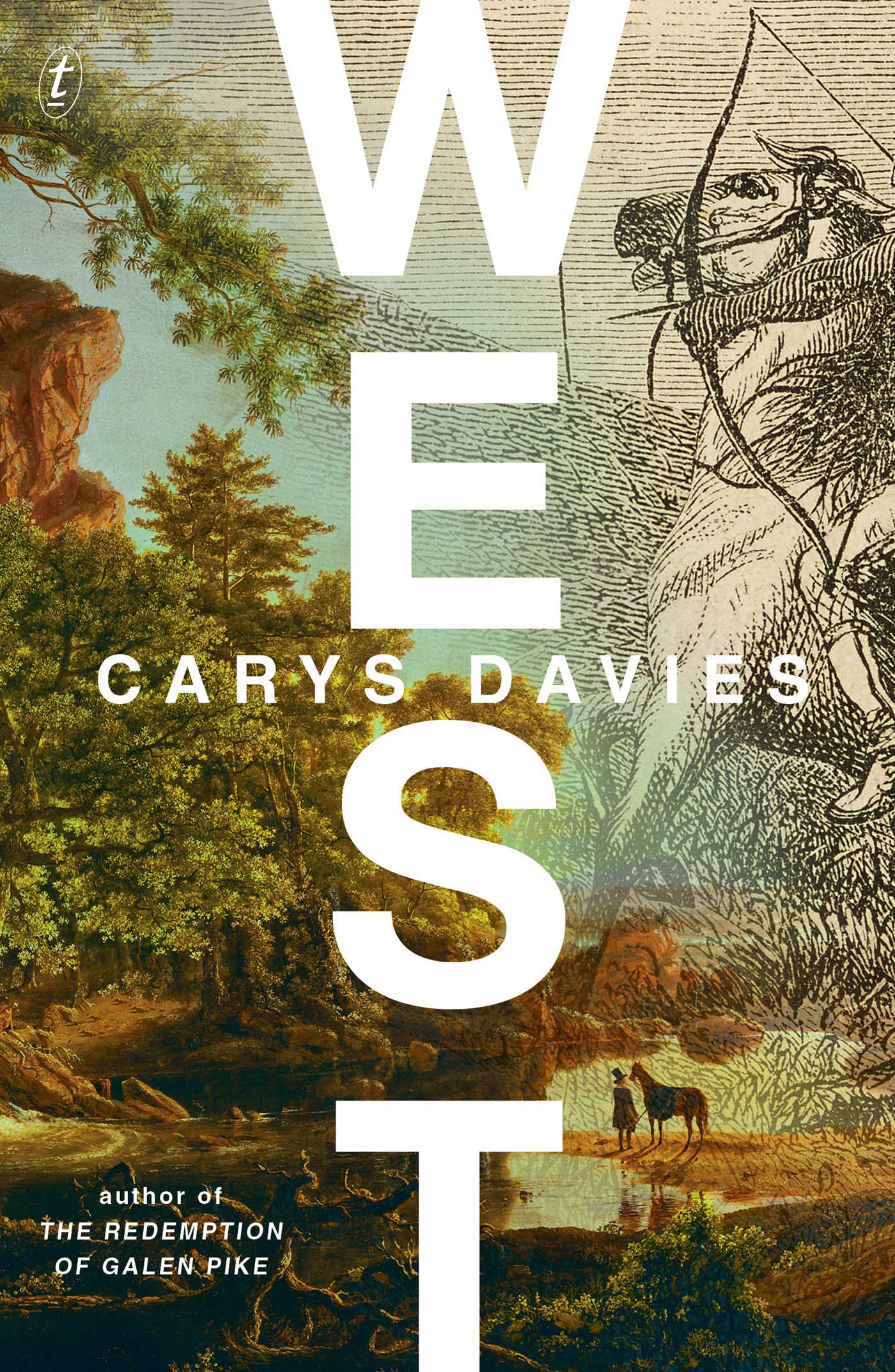
In the newspaper, Cy Bellman reads of bones pulled from the Kentucky mud–enormous, ancient bones, belonging to some mythic creature taller than the tallest trees. Grieving his lost wife, he is now transported: he all but stops eating and sleeping, too disturbed to give his full attention to his work as a breeder of mules, or to his 10-year-old daughter, Bess. He can’t help but go in search of the beasts that have so captured his imagination, and leaves Bess and their small farm in rural Pennsylvania in the care of his hard-edged sister, Julie, with the occasional help of an odd neighbor, Elmer. With some weapons, trinkets for trade and a new stovepipe hat, Bellman travels west, toward the wild frontier.

West is Carys Davies’s first novel (though she’s published two short story collections, The Redemption of Galen Pike and Some New Ambush), and it is an epic tale of early 19th-century adventure in a small package. With fewer than 200 pages, its scale is nonetheless mighty, conjuring both history and fable. Davies’s simple, conversational prose stays out of the way of her gripping plot.

Julie and the town’s citizens think Bellman a fool at best. Bess, however, adores her father, and is heartbroken to be left alone with no books or pleasures, only a motley bunch of mules; her dead mother’s gold ring is hidden away by her unloving aunt. In her father’s absence, she makes up charms for his good luck: “if she made it from the pump to the house without slopping a drop of water over the lip of the bucket, it meant he was in good health.” She takes long walks with her favorite mule, until Elmer’s awkward attentions to the deserted household become too alarming, and she shuts herself up inside.

Meanwhile, Bellman wanders the wild countryside, farther and farther south and west, first alone and then with an unlucky Shawnee boy named Old Woman from a Distance for his guide. Bellman’s dreams of the enormous creatures grow vivid, and then less so, as his distance and time away from home increase. He promised Bess he would be gone two years at the most, but as her 12th birthday approaches, his grip on both his promise and his quest look doubtful.

West is a novel about family commitments, small-town agitations and the irresistible, fanatic pull of the unknown. Bellman is either enchanted or suffering a good old-fashioned midlife crisis. Davies writes of small fates: hopeful young Bess, bitter Julie, the enigma of slovenly Elmer, and Old Woman from a Distance, with a troubled past of his own.

This quick, compelling read will please lovers of historical fiction, legendary quests and stories of humble familial devotion. It may prove as hard for Bellman to find happiness at home as to find the monstrous “animal incognitum” he seeks. Readers, however, are the richer for his efforts.


This review originally ran in the April 3, 2018 issue of Shelf Awareness for the Book Trade. To subscribe, click here.


Rating: 7 incognita.

guest review and more: Strong Inside: Perry Wallace and the Collision of Race and Sports in the South by Andrew Maraniss, from Pops

About three years ago, I reviewed Strong Inside. My father just got around to reading the galley copy I gave him when I was done with it, and he left the following as a comment on that post. I thought it deserved better billing, here.

I am so glad you left me this book so I would eventually read it, now three years later.

I was in high school becoming obsessed with basketball around the time Wallace became the first black athlete in the SEC. He played basketball for Vanderbilt, a university that would later accept my application although I attended elsewhere. I was entirely unaware of Wallace at the time, but I knew most of the prominent players and teams that comprised Wallace’s sports world. I was also ignorant of the more significant social struggle that defined his life, which despite other proximities I learned largely in retrospect; that’s an education that continues today with the help of narratives like this one.

His story is iconic in so many ways, and it is a gift that Maraniss discerned this and spent eight years preparing to tell it: Wallace was a boy raised amidst Nashville’s version of the civil rights movement, with maturity enough to see beyond his social place, and beyond just sports, to recognize potential both in higher education and his prospect as a pioneer during a nation’s essential historical moment.

The result is singular insight into the civil rights movement, from the intimate perspective of a special person at very specific time and place. As such, this book reminds us how capricious history can be as it consists of stories we choose to preserve and honor. Thousands of people contributed to this era’s history; few are as compelling and admirable as Perry Wallace, from start to finish–or as thoughtfully captured as Maraniss has done here. One must wonder, how many other such strands of history go missing?

That’s perhaps the saddest part of this tale, how many important stories go overlooked.

One more bit, on that very last thought, a quote from the book describing Wallace’s thoughts upon finally being fully accepted at Vanderbilt 40 years later:

Here he stood, achieving closure in a joyful setting, when in so many cases throughout history, African Americans who had accomplished significant things had ultimately been cut down in tragic ways.

In an email to me, Pops offered a more personal series of reflections, and permission to share here.

During the summer of 1968 my parents arranged for me and a friend to drive a Jeep wagon from Houston to New England for a relocating family. At a very immature 17, I found it an amazing and daunting challenge of independence at the time, and still. We chose a route through the deep south with no clue as to events or risks; I have no idea why, or why no one counseled us about this. So we passed south of Perry Wallace, but – more significant and relevant – the chasm between our paths was immense.

We passed through DC in late June soon after the Poor People’s Campaign had been forcefully evicted from their Resurrection City shanty town (3000 people) on the National Mall after more than a month, a time that included heavy rainstorms that resulted in a muddy morass. MLK had been killed in April during preparations; RFK was killed during the occupation and his funeral procession passed through Resurrection City en route to Arlington Cemetery. When we drove through, we marveled at the filthy desolation on the Mall, and kept on going.

A particularly nostalgic and tragic anecdote (of so many!) was the page-long excerpt in Strong Inside from RFK’s speech at VU, less than 3 months before he was killed. One never hears such hopeful and ambitious expressions of American idealism today, from anyone; but I remember that naive 1960s legacy, which we were trying to build on in the early 70s.

Sports references – so many! I wonder if you recognized the name Harry Edwards, the radical sports leader described in the book; he was very influential amongst prominent athletes like Alcindor (Kareem Abdul Jabbar) and later Bill Walton, well into the 70s.

I remember the 1966 story when the all-black team from tiny Texas Western (now UTEP) beat Kentucky to be national champs in El Paso (!!) – such a stunning sign of things to come.

A major star from my Houston Memorial HS was Jerry Kroll, who from 1967 helped lead (with Mike Maloy) the Davidson teams mentioned in the book, so I knew of Davidson and followed their success at the time, as did Wallace. I knew most of the prominent player names Wallace crossed paths with: Rick Mount, Charlie Scott, Dan Issel, Bob Lanier, Pete Maravich, Calvin Murphy (you know that one!). Wallace was mentored later by famous 76ers coach Jack Ramsey.

The University of Houston had strong teams then, especially with Elvin Hayes; in January 1968 the “Game of the Century” had UH facing Alcindor’s UCLA team (both undefeated) in the first ever college basketball game on national TV, and the first basketball in the Astrodome. It held up to the hype, I followed it closely, and UH won by 2 in a great game. I wished I had gone, but imagine trying to watch a game way out there in the center of the Dome!

A larger iconic moment was the Mexico City Olympics later that year, with Smith and Carlos raising black-fisted gloves in the awards ceremony; a very powerful moment with the whole world watching, and again I was paying attention because of the confluence of sports and cultural political events.

He couldn’t stop, sending more links and notes, but I couldn’t help but pass these on as well. It’s a fine example of how reading can open up into contemplations of all the parts of life. He says, “you know how these things accumulate when you nuzzle into a subject.”

I’m sending on this essay about the Poor People’s Campaign only because it overlaps with my recalled 1968 history (see photo below) – a history in focus now with a year’s worth of 50-year anniversaries.

photo credit – click to enlarge

Also: The Atlantic has a whole series on King, including this essay from Jesmyn Ward about her family’s legacy of poverty and why she is raising her own kids back home in Mississippi.

David J. & Janice L. Frent / Corbis / Getty, from here

Also, another in that series: Rev Barber (of North Carolina Moral Mondays fame) reminds us that King’s ‘three evils’ (racism, poverty and war) are still very immediate, and are now four (environmental decline.)

Also, my anecdote: as MLK’s multi-racial poverty campaign was ramping up, he was referencing in part The Other America, a classic still on my shelf authored by an American ‘democratic socialist’ in 1962.

Plenty of reading there for today, friends.

Thanks, Pops.

Family Trouble: Memoirists on the Hazards and Rewards of Revealing Family ed. by Joy Castro

Family Trouble is a delightful collection about the challenges of writing nonfiction about family. I loved the wide range here: of experiences related by these established (published) writers; of the advice they have to offer; and in the writers, themselves, who are of diverse ethnicities and backgrounds, sexualities, gender expressions, and life experiences. Editor Castro contributes a pure-gold introduction, which incorporates quotations and references to all her contributors but also manages to offer her own perspective. I was on page 7–yes, in the introduction–when I found my first epiphany.

Essays are sorted into sections by outlook or strategy: “Drawing Lines,” “The Right to Speak,” “Filling the Silence,” “Conversations of Hope.” I have read some of the contributors before: Paul Lisicky, Alison Bechdel, Robin Hemley, Dinty W. Moore, Richard Hoffman, Sue William Silverman (and have attended classes with Karen Salyer McElmurry). Others I knew by reputation: Susan Olding, Susan Ito, Sandra Scofield, Lorraine M. López, and more. I did have favorites, sure, but I emphasize, I most appreciated the interplay, the sum of parts: these diverse voices and perspectives playing off each other. The anecdotes from experiences are valuable (and often entertaining or humorous, although there is much pain here, too). The writing is lovely. It’s a hell of a collection.

Here are a few of my most treasured lessons.

“Good writing must do two things,” contends Vivian Gornick in The Situation and the Story: The Art of Personal Narrative (2001). “It must be alive on the page, and it must persuade the reader that the writer is on a voyage of discovery.” Writing The Truth Book, I truly was on a genuine voyage of discovery, and these two driving questions* helped shape the memoir, guiding my choices about what to disclose and what to omit. If an incident, detail, or family story contributed in some way to the answering of one or both of those questions, then it went onto the page. If it didn’t, I didn’t even draft it.

From Castro’s introduction; and she mentions the *two driving questions earlier in the paragraph, but I submit that they don’t even matter here, for the purpose of the lesson she offers. I’ll try and recapture it: the memoirist must be driven to tell a story in pursuit of discovery or of answering a question or questions. The issue of whether to include certain material (which, I’ve said elsewhere, is a central issue in crafting memoir) then becomes simply an issue of whether it pursues the main question(s), the desired discovery. …This assumes that we know why we’re writing, and I don’t, always. Sometimes I just want to write a thing, without knowing what the burning issue is. So this becomes a multipart problem: figuring out why a story needs writing (what’s the burning question?), and then mindfully allowing that question to sort what needs inclusion and what does not.

This seems, now that I’ve thought it out, plenty obvious. But I had to get there, and Castro helped.

I also really appreciated the concept that the idea of family stories exists on a spectrum, with the immediately, intimately personal (individual) on one end, and a global human community on the other. From Aaron Raz Link:

A writer working with family materials stands in a liminal space where my story meets your story, meets the reader’s story, and becomes our story. Before I became a writer, I was a historian working in public museums. As a result, I see that family assembles our individual stories together to become the fabric we call culture and history. This process gives each of us some sense of belonging to a larger world.

Richard Hoffman’s first memoir helped put the man who raped him in childhood away in prison, and therefore offers a particularly stark example of personal or family stories having larger ramifications. He contributes to the same idea:

The trouble with the view put forth in dozens of books about family “dysfunction,” some of them interesting and helpful, is that it tries to understand the family without its community, without its culture and class, without its history and the relation of that history to–well, History.

Somehow, I feel like this relates back to some comments I made near the end of this post, about interdisciplinarity. Seeing the connections feels like some of the most important learning we can do, ever.

I loved that some essays took different forms, like Susan Olding’s contribution, “Mama’s Voices,” with its stop/play/fast-forward organization, involving tape recordings. I appreciated the far-reaching context and concerns of Faith Adiele’s “Writing the Black Family Home.” And I enjoyed and marveled at Ariel Gore’s “The Part I Can’t Tell You,” in which she does tell us. Or does she?

Much to be admired, and probably of interest to a fan of memoir as well as a hopeful writer of same.


Rating: 8 mournful duets about two people who never should have broken up.

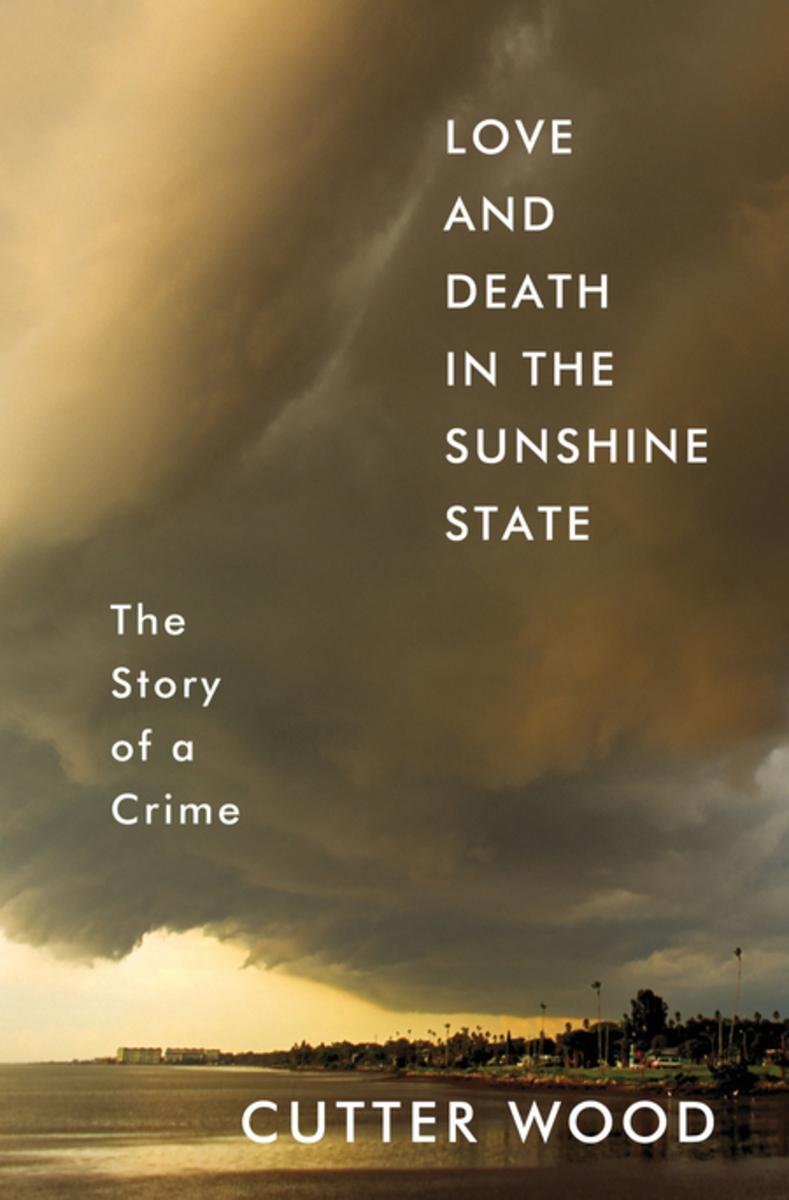
Love and Death in the Sunshine State by Cutter Wood

In Florida, a stolen car, a missing woman and a conflagration draw a writer from out of town to ruminate on the darker side of human relationships in this thoughtful melding of true crime, memoir and speculation.

As Love and Death in the Sunshine State opens, Cutter Wood has just graduated from college and is on a family vacation to the island of Anna Maria, near Tampa Bay, Fla. Afterward, he returns home to wait tables, expecting never to think of the place again–until he finds out about a fire at his Anna Maria motel.

A woman named Sabine Musil-Buehler, co-owner of the motel, has been missing for several weeks. Her car is recovered, with blood on its seats and a stranger behind the wheel. Police name three persons of interest: Sabine’s husband, her boyfriend and the man who stole the car.

Wood is fascinated. He is drawn back to Anna Maria. As he enters graduate school and begins a romantic relationship, which stales and sours, he pulls apart the relationship that might have killed Sabine. Love and Death in the Sunshine State, Wood’s debut, is a memoir of post-college ennui; an investigation into a likely murder; an exploration of the light and dark sides of human connection; and an imaginative account of what might have happened to Sabine. Wood blurs genre boundaries, eventually offering a hybrid form that best suits his mind’s wanderings.

He visits with the principal characters and neighbors, and the man most people think killed Sabine. Her boyfriend Bill is in prison on a parole violation; he corresponds with Wood, as he once courted Sabine through the mail and on weekly furloughs. About that courtship, Wood writes, “There is something holy in a friendship born like this in letters.” His own correspondence is less satisfying. “I knew that Bill had lied to me, but I knew, too, that even if he’d told me everything he remembered, it would hardly answer all the questions I had.” This approaches the heart of the book: the question of truth versus fact, of what is unknowable.

Along the way, Wood profiles a handful of characters. Sabine is a German immigrant seeking sunny days and a hospitality career. Bill is an ex-con seeking support and comfort. These protagonists are joined by Sabine’s husband, her coworkers at the hotel, Wood’s girlfriend and others. And the narrator: a young man seeking art and love, frustrated by the “vanishingly small increments” through which love can turn to “if not cruelty, some precursor of that emotion.”

Wood deserves credit for a narrative voice that prizes honesty over flattery, or self-flattery. His book is essentially an examination, not only of Sabine and of her murderer’s emotions and motivations, but of the narrator himself, of universal human flaws. It is an often lovely evocation of place and culture: the gritty, small-town life of Anna Maria, its beautiful backdrop and trivial treacheries. His writing style starts out a little overblown, but soon settles into a meditative tone appropriate to his subject. In the end, Love and Death is a memorable, thought-provoking work of true crime and imagination.


This review originally ran in the March 27, 2018 issue of Shelf Awareness for the Book Trade. To subscribe, click here.


Rating: 7 shoes.

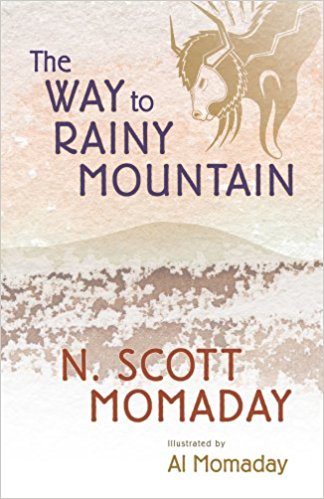
The Way to Rainy Mountain by N. Scott Momaday, illus. by Al Momaday

I was first told these stories by my father when I was a child. I do not know how long they had existed before I heard them. They seem to proceed from a place of origin as old as the earth.

A short book, recommended to me by Kim Dana Kupperman as a way of considering an oral tradition. N. Scott Momaday is a Kiowa Indian, born in Oklahoma but raised on reservations in the southwest. He travels home to Rainy Mountain in Oklahoma to visit his grandmother’s grave, and this book reflects his journey as well as the original one the Kiowas made, from Yellowstone through the Black Hills, and south to the Wichita Mountains. This book is a record of the legends, the orally passed-down traditional narrative of a tribe and a culture now passed on. It is told in three voices. The first is the ancestral voice of the oral tradition (“the voice of my father,” Al Momaday, who also illustrates the book); the second, a historical commentary; and the third, Momaday’s own voice “of personal reminiscence.” Each short section separates these voices from each other visually:

It is a spare, slim book, under 100 pages and with lots of white space as in the spread above, and with illustrations to space things out further. It is therefore just a sketching (no pun intended) of a history, and somehow this feels right, since as Momaday points out, “the golden age of the Kiowas had been short-lived, ninety or a hundred years, say, from about 1740. The culture would persist for a while in decline, until about 1875, but then it would be gone…” His ability to piece these stories together is a rare one, and the record is necessarily scanty. But the scraps that we do have here are wise and hold a certain dignity.

They also hold a sense of place. I loved lines like, “Houses are like sentinels in the plain, old keepers of the weather watch.” It somehow makes sense to me that Momaday would have so much to say about a place he feels tied to without actually inhabiting; that it’s an ancestral belonging.

Once in his life a man ought to concentrate his mind upon the remembered earth, I believe. He ought to give himself up to a particular landscape in his experience, to look at it from as many angles as he can, to wonder about it, to dwell upon it. He ought to imagine that he touches it with his hands at every season and listens to the sounds that are made upon it. He ought to imagine the creatures there and all the faintest motions of the wind. He ought to recollect the glare of noon and all the colors of the dawn and dusk.

In terms of the oral tradition, I noticed that the storytelling style in those parts was simple, and often involved shifts that we are unaccustomed to in the written stories; but when read aloud, they sound more like the way we still tell stories today. “Bad women are thrown away. Once there was a handsome young man…”

Simply told, easy to read, but thoughtful and thought-provoking, and a way into stories that we don’t have much access to. As Momaday writes himself in the preface to this edition, twenty-five years after the first: “One should not be surprised, I suppose, that it has remained vital, and immediate, for that is the nature of story. And this is particularly true of the oral tradition, which exists in a dimension of timelessness.”


Rating: 7 black-eared horses.

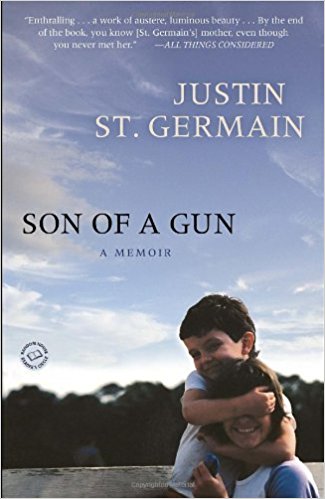
Son of a Gun by Justin St. Germain

Justin St. Germain’s Son of a Gun is a compelling, heart-breaking piece of personal narrative, and it is told beautifully, with restraint and with artistry and structure. The first observation is one any reader might make; the second is the more subtle observation of a reader looking for writing tricks. This is a book that works beautifully on both levels.

The narrator was raised by a complicated woman named Debbie. She was a soldier, a strong woman who made impulsive decisions and charged ahead, took care of herself and her two sons through all kinds of hardship; she had poor judgment in choosing romantic partners, was married five times with many relationships in between, for which she was harshly judged in turn. When Justin was 20, she was murdered by her most recent husband, Ray, a former cop with the requisite mustache and mirrored sunglasses. Until then, Justin had thought Ray the most harmless one of the bunch.

This memoir is the story of Justin’s mother’s death: his shock and grief, his anger, the violent end of Debbie and, later, of Ray. It ranges between these individual instances of gun violence and others, personal and societal, as Justin visits with Debbie’s former partners, goes shopping at a gun show, and cycles back over and over again to Tombstone. Oh, did I leave that part out? Justin and his brother Josh were raised in Tombstone, Arizona, a town whose very existence depends on the legends of Wild West shoot-outs.

I appreciate St. Germain’s title, because it reinvents an old and meaningless saying in a fresh new way: making the point that he is indeed a son of a gun, of a gun culture that engineered his mother’s demise. I also appreciate the way he handled his own character, the narrator, in a spare way that acknowledges (for example) the problematic way in which the 20-year-old reacts to his mother’s murder. He does not always behave well, but who would?

It’s a hell of a sad story, one that recalls my recent read Love and Death in the Sunshine State by Cutter Wood (review to come), and A Woman on the Edge of Time. It’s a hell of a story, in the first place, and at the same time, tragically, nothing out of the ordinary: a 2017 CDC report concluded that nearly half of female homicide victims are killed by a current or former intimate partner. St. Germain does deal with this larger context, although his primary concern (understandably) remains personal.

A hell of a story, but also artfully told. I often think that creative writing, the kind I’m studying, has two parts: an interesting story, and the artful telling of it. A book can become successful, can please or entertain and sell, with either one or the other of those elements, but the best books have both a good story and a good telling. One of the key features of this book, I think, is the narrative restraint. Anytime a writer handles a story this close to home and this fraught–emotional, violent, graphic–it’s difficult to keep a calm perspective, and yet not be cold and distant. St. Germain walks that line. Another strength is the weaving in of the external, if you will, theme material: the history of Wyatt Earp and the shootout at the O.K. Corral (which St. Germain informs us actually took place “in a vacant lot to the north, between a back alley and what is now the highway. But try putting that on a T-shirt”). This is a classic gift to the writer from the universe: that he was brought up in Tombstone, that Tombstone and Wyatt Earp and the O.K. offer such a backdrop for his story and his reflections on it. This braided-in information is almost too perfect for his story; but this is why we say fact is stranger than fiction. It allows a very neat context for the narrator to think about not only his personal tragedy, but the larger cultural implications.

I was riveted as I read this book, all the way through in a day, because this story has momentum, suspense and crafted pacing. I was heartbroken for the characters, and struck by St. Germain’s gestures at the larger world. It’s a very fine book.


Rating: 8 arcane alphanumerics.

Draft No. 4: On the Writing Process by John McPhee

Strong words, but I’m going to say it: I think this is the most enjoyable craft book I have read. Strunk & White and Stephen King are very good but McPhee wins it.

Eight essays about writing, previously published in The New Yorker and only one of them previously collected (“but to a far greater extent [it] belongs here”). McPhee is funny, self-deprecating, practical, and wise. He tells stories! I love the anecdotes, such as the one that begins “Frame of Reference,” and makes the point that a reference must always be chosen with an audience in mind. (Greta Garbo will not be meaningful to kids born after 2000; Britney Spears will not be meaningful to my grandmother.) He gives good, down-to-earth writing advice, unsurprising, as this skill has been honed by decades of teaching experience. McPhee’s students populate these essays, too, some of them bumbling and some of them accomplished, and all of them treated gently. He relates tales of interviews that went easily (Woody Allen) and less easily (Jackie Gleason). The tone, McPhee’s writing voice, is exceptionable. I find him just quintessentially likeable. He is funny, humble, and instantly recognizable.

“Progression” is about linkages, and fits nicely with the following essay, “Structure,” on that topic. “Editors & Publisher” is something of a series of profiles of those McPhee has worked with, with some advice and wisdom about how the work works. “Elicitation” is about interviews (those great stories), both anecdote and how-to. “Frame of Reference,” with all its details from life and history and McPhee’s writing and reading, was one of the most enjoyable essays for me. “Checkpoints” is about fact-checkers, again with such an engaging proportion of fascinating story and practicality. “Draft No. 4” is about the writing process and the writing life: how drafting works, and how to hopefully retain sanity. “Omission” is about brevity, and cutting, and allows McPhee to finish both this essay and the book with a humorous line spoken by General Eisenhower: this is a writer who knows how to pick a quotation and let it stand.

McPhee gave me some things to ponder: his astonishing method of finding a structure first and them a subject to fit it; his method of note-taking and outlining; his drafting. And I will cherish forever one-liners like, “If you kill a widow, you pick up a whole line” (not about homicide at all, but about “greening,” a topic after my own heart). I will keep this book handy for both its solid advice and its entertainment value. I’ll be recommending it to everyone I know; and I can’t wait to read more McPhee.


Rating: 9 mustaches.

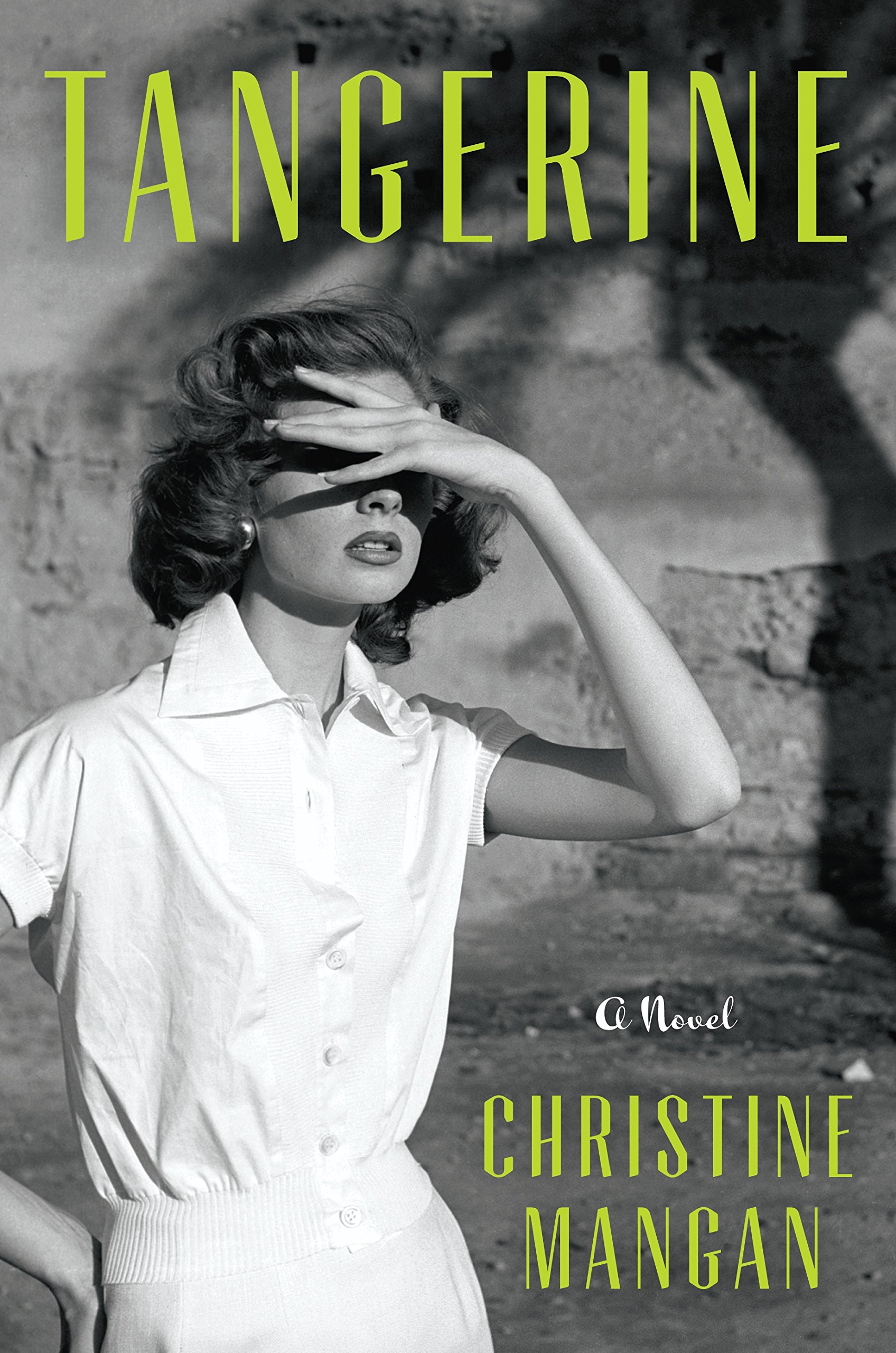
Tangerine by Christine Mangan

Former college roommates reunite in Morocco, with enigmatic tensions and references to a troubled past.

Christine Mangan’s first novel, Tangerine, offers suspense and lingering questions in a drama centered on the post-college relationship between two young women recently relocated to Morocco.

Lucy Mason and Alice Shipley were roommates at Bennington College in Vermont. They came from quite different circumstances: Alice was a well-off British orphan, whose guardian Aunt Maude is serious but somewhat unfeeling in her role. Lucy was a scholarship student, also an orphan, and this similarity is part of what led the pair to bond. They were terribly close in college–until the accident.

In Tangerine‘s opening pages, Alice has moved to Tangier with her new husband, John. He loves the city, its cacophony of sights and smells, its colorful crowds, jazz clubs and ubiquitous hot mint tea. Alice is not so sure. She hasn’t left their apartment in weeks, maybe months, when Lucy turns up on the stoop. By contrast, a local tells Lucy almost immediately upon her arrival: “You are a Tangierine now,” pronounced like the fruit, and highlighting the rich, fragrant foreignness of the backdrop to this drama.

In alternating chapters, the reader encounters past and present through Lucy’s and Alice’s respective perspectives. An epilogue and prologue, with unnamed narrators, offer more mystery. John is a shifting but mostly unsympathetic character. The two women’s accounts of past events differ only slightly, at first. But as the novel unfolds, it becomes complicated. Lucy’s devotion is perhaps a bit too intense. Alice’s agoraphobia is variously attributed to her parents’ death, or to a more sinister cause. Eventually, their memories of their shared past diverge enough that the question can no longer be ignored. Is this gaslighting? Mental illness? Surreality? Are these the simple mistakes of memory or is there a more ominous force at work?

In an atmosphere of shimmering heat, multiple languages and layers of history and mythology, two young women are bound together–although the reader must wait to find out if it is by a trick of fate or someone’s purposeful actions. While there is money at issue–Alice’s trust fund–the real risks are more significant. As this expertly paced novel rushes toward its finale, the question of whose reality is to be trusted becomes a question of sanity, or even of life and death.

Tangerine is a novel of intrigue and shifting perspectives, starring two ultimately unreliable narrators. Its appeal lies in the lush, sensual setting; the metered release of information about the shadowy past; and especially in untangling the twisted mystery of the present. Suspense fans will be well satisfied.


This review originally ran in the March 8, 2018 issue of Shelf Awareness for the Book Trade. To subscribe, click here.


Rating: 7 scalding hot glasses of mint tea.

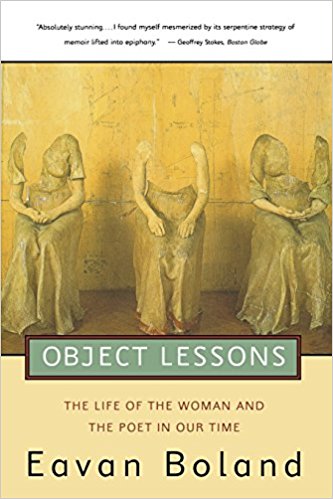
Object Lessons by Eavan Boland

I recall studying a poem in high school by Eavan Boland titled “The Black Lace Fan My Mother Gave Me.” As I approached this semester’s critical essay, one of the talented faculty in my program, Diane Gilliam, recommended this work of prose, for my topic on objects. Diane’s words, to the best of my memory, were, “Every woman artist needs to read this book.” I’m so glad I did; especially when I got to page 231, where “The Black Lace Fan My Mother Gave Me” makes an appearance, as the only poem of her own that Boland chooses to feature. Synchronicity.

Object Lessons is an examination of the conflict Boland has experienced between her self as poet and her self as woman, with the overlay of Irishness on it all. She leaves Ireland at age five, to a London that largely rejects her kind, to return to her home country in her teens and to study poetry at Trinity in Dublin, a charged literary atmosphere. It takes some time for this young person, still discovering herself as a woman, a sexual creature, and a person of a nation, not to mention as a poet, to see the holes in the legacy she has inherited: there is no place for her in this history. “It was not exactly or even chiefly that the recurrences of my world–a child’s face, the dial of a washing machine–were absent from the tradition [of the poet’s life], although they were. It was not even so much that I was a woman. It was that being a woman, I had entered into a life for which poetry has no name.” Names are important. “Every art is inscribed with them. Every life depends on them.” Further, about the poet-versus-woman tension: “For anyone who is drawn into either of these lives, the pressure is there to betray the other: to disown or simplify, to resolve an inherent tension by making a false design from the ethical capabilities of one life or the visionary possibilities of the other.”

Over the course of this book, she lays out the problems she found and her own best efforts at solving them, a job she acknowledges is unfinished. But she hopes that a book like this helps future women poets, by giving them a starting point, something else to point to. Heartbreakingly, by contrast, she relates that the first woman poet she knew of as a young woman was Sylvia Plath, and that name she knew first as a suicide, not a poet at all.

I was also very interested in the way this memoir started: with the missing, imagined, scantily sketched biography of her grandmother. The narrator explores the history, the meager records of the woman; she imagines; and she travels to view a grave and a hospital. It’s a lovely study, the story of someone absent, and a consideration of what we get from an ancestor we can’t really know.

Boland has plenty of good thoughts about place, sense of place, and nation as aspect of our selves and our writing selves. She makes much of the Irish poetic tradition to conflate the feminine and the national. Her musings can get pretty cerebral and abstract, so this memoir took some slow, thoughtful reading; but I think it’s worth the time. Also, I am very interested in Boland’s assertion that she structured the book like a poem: “in turnings and returnings.” I have more thinking to do.


Rating: 7 high heels tipped with steel.

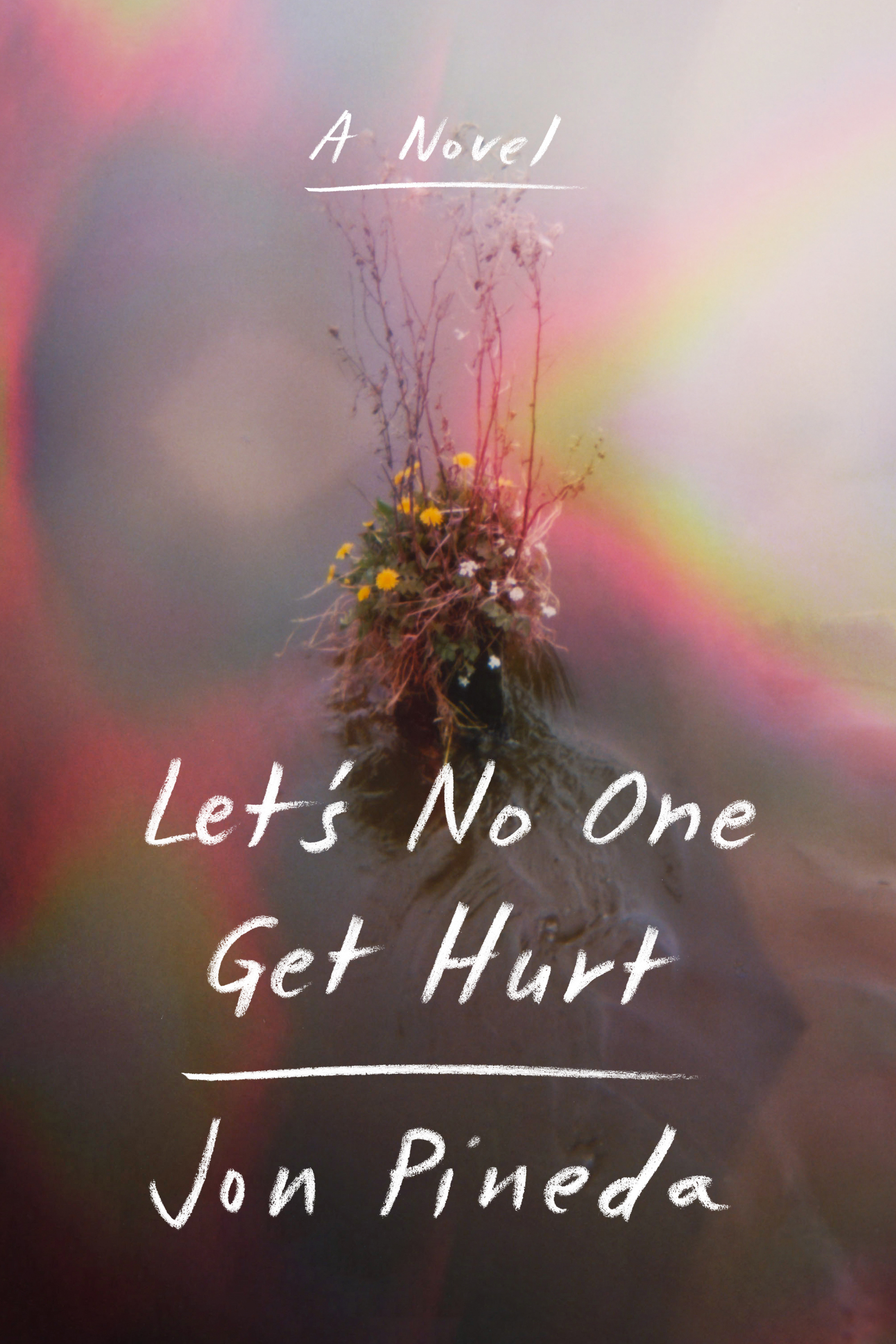
Let’s No One Get Hurt by Jon Pineda

A teenaged squatter with a poet’s heart and a stolen fly-fishing rod struggles to map her own way.

“I know I’m not a woman yet. But I’m also not a girl. I’m a poem no one will ever translate.” With Let’s No One Get Hurt, Jon Pineda (Apology) offers a wild, yearning, strong-willed protagonist and a novel with both tenderness and violence at its core.

“In a few months, I’ll be sixteen, but my body doesn’t know it.” Pearl’s father says she’s 15 going on 50. She lives in an abandoned boathouse with her father and two other adult men. Dox and Fritter are father and son, and Dox remembers Pearl’s mother, from before. Now, they form a family of sorts, subsisting on catfish and crayfish from the river, mushrooms and wild rice from the woods and building scraps from the wealthy subdivision nearby.

Pearl has made new acquaintances: the upper-class boys who live in the development surrounding the golf course near her makeshift home. They drive tricked-out golf carts and shoot their daddies’ fancy shotguns for fun, filming it all for the Internet where they hope to go viral. One of them takes a special interest in her, playing his father’s wealth against her household’s tenuous living. Pearl’s coming-of-age and her troubled liaison with these boys define the novel’s timeline. As she grows up, her old dog, Marianne Moore, prepares to die. (If her father had his way, Pearl would do the right thing and shoot her already.) A former poetry professor who named the dog after one of his favorite subjects, her father also suffers from increasingly poor health. Fritter paints a never-ending mural of pitch black and Dox noodles on his cigar-box guitar.

Pearl’s mother was a scholar who said that “poems were never finished, that they were only abandoned.” Pearl likes to think that maybe all abandoned things are poems. She lives in an abandoned place; maybe she lives inside a poem. As a narrative voice, she fights the urge to see poetry in images and to describe her world lyrically: “I hate that I even see them as wings. They’re just napkins.”

Let’s No One Get Hurt is about race (most pointedly when Pearl unintentionally crashes a Civil War reenactment with Fritter, a dreadlocked, 300-pound black man) as well as class. It is about families and how they hurt and help one another, the mysteries of Pearl’s mother and of the rich boys’ everyday cruelties. “The river waits for me, and that’s all that matters.” As a river-based adventure of difficult adolescence, Let’s No One Get Hurt inevitably recalls Adventures of Huckleberry Finn, as well as Bonnie Jo Campbell’s female-centered Once Upon a River. Pineda’s writing is thick with the lush warmth of the American South and the harshness of a life scavenged out-of-doors, and his teenaged girl’s perspective is spot-on. This novel of exploration, exploitation and the poetry in it all will stun readers of all kinds, especially those who appreciate strong characters and tough choices.


This review originally ran in the March 1, 2018 issue of Shelf Awareness for the Book Trade. To subscribe, click here.


Rating: 8 blue cats.