This Shining Life by Harriet Kline

A family struggles to honor the loss of one of their own and a remarkable boy works to solve the puzzle of the meaning of life in this poignant, loving debut novel.

Harriet Kline’s This Shining Life opens with a brief prologue: a happy family, a joyful party at sunset. Then the tone shifts. “My dad died. He gave everyone a present before he died. He gave me a pair of binoculars. They smell of books that haven’t been read for a very long time.” This is the voice of Ollie, a boy with certain gifts (sudoku, puzzles, literal meanings) and challenges (socks, hugs, turns of phrase). As the novel considers the death of Ollie’s dad from various points of view and at different points in time, Ollie’s chapters will always begin the same way. “My dad died.”

Ollie’s dad, Rich, was spontaneous, fun-loving, kind and a great lover of cheese. He was a devoted husband to Ollie’s mom, Ruth. Ruth’s sister, Nessa, originally set them up; she and Rich had been best friends since college. Ruth suffers from depression, like their abrasive, troubled mother, Angran; Nessa believes in charging in and grasping life in a firm grip, consequences be damned. Rich’s parents, Gerald and Marjorie, are starched and proper where Angran is bohemian (Gerald says it as if it’s a dirty word) and brusque. They are a motley crew, but all devoted to Rich. In this engrossing story of grief, love and mix-ups, Ollie fixates on the puzzle he believes his father has left him, in the presents he left behind. Because of something Rich said, Ollie believes these gifts hold the secret to what it means to be alive. “I want to do that puzzle now. I want to feel happy like he did. All I have to do is get the answers right.” Time jumps around, so that Rich is dead and alive again, as Ollie attempts to track the gifts Rich has sent to his loved ones and discern their hidden meaning.

In a novel about grief and love and continuing on, these characters are heartbreakingly flawed: Nessa’s pushiness, Angran’s rudeness, Gerald’s blustering into dementia. Shifting perspectives do the essential good of enforcing empathy even in the face of quite bad behaviors. As Ollie single-mindedly pursues the solution to his father’s puzzle, the adults around him seem too caught up in their own struggles to aid him; will they rally in time?

This Shining Life is attuned to the importance of setting, including natural spaces like the waterfalls that dominate this family’s neighborhood, and the deep potential significance of objects, like those fraught gifts that Rich gives. It is a sad story, of course, but also joyful, in the style of Rich delightedly offering cheese at his final party. It proposes that grief and love are inextricable, and that there may be light even in pain.


This review originally ran in the May 27, 2021 issue of Shelf Awareness for the Book Trade. To subscribe, click here.


Rating: 8 threads.

Exit Strategy by Martha Wells

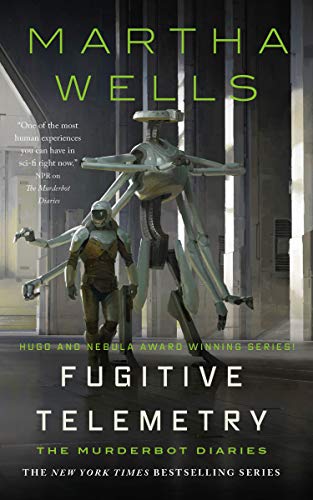
Book four of the Murderbot Diaries is proceeding pretty much as I’d hoped. We’ve got some returning serial characters, and further development of the idea that bots are people, too. Check out that blurb from the front cover: “One of the most humane portraits of a nonhuman I’ve ever read” (from Annalee Newitz). I wholly agree, and think that that’s one of the great victories of this series. Murderbot is drily funny, self-deprecating, sarcastic, deeply feeling and resistant to the truths of its own emotional self, and who among us hasn’t wished we were a little more stoic, a time or two?

[Side note: something new has just occurred to me. I think Murderbot and Reacher have a few things in common. Both try to mind their own business, but both are helpless to resist helping dumb humans in need, even as they feel exasperation about it. Both have superhuman abilities, not only in physical fighting but in quick calculations on the fly and strategic thinking. (Only Murderbot has a good explanation for these qualities.) Both have a tendency to be delightfully deadpan. Both try to slip out into the night when things get wrapped up. They’re both sort of knights-errant, preferring not to hurt innocent bystanders but reasonably quick to upgrade (downgrade?) a person’s status to hostile as situations develop. These are qualities I appreciate, and I think there’s a definite parallel here that helps explain my love for both rogue elements.]

“Ship’s drones gathered to watch me, confused as to why I was going out the wrong door and beeping sadly about it.” Even the drones are given emotions: confused, sad. The idea of humanizing the nonhuman feels like a helpful step in rehumanizing each other, too. These books star a murderbot who is not human though it has ‘organic parts,’ and who is not legally recognized as a person in most of the worlds it travels in, but it has human friends from a world where bots and human/bot constructs are legally recognized. Can it even see itself living in this new way? In the midst of a fight to the death, our protagonist offers a deadly CombatBot the option to be free from outside control. “…dodging projectiles, it was hard to come up with a decent argument for free will. I’m not sure it would have worked on me, before my mass murder incident. I didn’t know what I wanted (I still didn’t know what I wanted) and when you’re told what to do every second of your existence, change is terrifying.” These are weighty questions, and Murderbot is an excellent guide to them: snarky, hard-shelled, but soft and melty on the inside.

I continue to love the thread in which Murderbot is an entertainment media addict, too. Aside from being unexpected and hilarious, as it was from the outset, it also offers opportunities to think about its future career options (recall I just recently noted its wisdom in critiquing narratives), as well as how stories and characters speak to us, and what they can stand in for. Here, a human friend asks Murderbot what the media does for it, why it loves its favorite show so much (that’s The Rise and Fall of Sanctuary Moon, which I sincerely hope will appear as a spinoff someday). This allows it to think about its own possible personhood, and empathy. There is a lot going on in this series of slim scifi novellas, a lot of reach. I am increasingly excited about the progress to come. (I am also feeling pleased with some of my own predictions.)

I hope Martha Wells is off somewhere writing more Murderbot right now. I expect to get through the last two books soon.


Rating: 8 hard currency cards.

Cleaning the Gold by Karin Slaughter and Lee Child

Another quickie from Reacher, somewhere in the short story/novella range, this time from Lee Child working with Karin Slaughter, who I’ve never read but obviously I know the name. An introductory Authors’ Note tells us that the authors have been friends for decades, and that their contributions to this story are merged “so you won’t necessarily know who wrote what.” Cleaning the Gold involves the head-to-head meeting of the authors’ respective serial stars: Will Trent of the Georgia Bureau of Investigation and Jack Reacher, retired Army MP. The former is new to me, but I like him.

In a nutshell, and with a mild spoiler, both these men are sent undercover to the United States Bullion Depository at Fort Knox, for different reasons. Reacher’s there to catch somebody on the inside, in a crime I won’t name here. Trent is there to catch Reacher. They both have to do some figuring-out, and they have to figure each other out, too.

Like “The Christmas Scorpion,” this is a satisfying enough short story, but not a perfect one – neither Child nor the Slaughter/Child team is on par with Hemingway or du Maupassant in terms of the deft, poetic turn of masterful short fiction. It’s fine. Both leads get cute and pithy lines and the scenes that convey their characters; there is a fight scene or two. In close third person, chapters alternate their points of view, and it’s fun to see each man from his counterpoint’s perspective. There are a few layers of mystery, which is always neat, but it might be a hair ambitious for a story of this length (listed at 144 pages, but only about 100 of that is Cleaning the Gold; the rest is a preview of a then-forthcoming novel by Slaughter). It ends with an loose thread that is not entirely typical of Child’s work; he’ll leave an opening for the next installment, but not an actual loose end. I wasn’t crazy about that in the finish; I think we could have used a bit more closure, which might have helped with the neatness of the short-story-as-genre. And I do think the story would have tolerated losing that last layer of mystery.

I faltered on the very first page, too, with two details that felt very atypical of Child/Reacher. (Despite the authors’ assurances, I did feel that I could tell who was who, at least here.) I cannot imagine Reacher ever noting that “the temperature outside had already passed the boiling point” unless it were literally true, which (Google tells me) has never been recorded on earth. He’s pretty pedantic like that. Then, Will “watched a bead of perspiration drop from his nose and roll across the floor.” Something about the bead of sweat, itself, as a bead, rolling across the floor bothers me, in terms of physics. (Reading Reacher makes me extra pedantic, too?) On the other hand, a judicious number of jokes (two) about the place being “guarded like Fort Knox” went over well with this reader. And a single reference to Tom Cruise and the most unbelievable scenes in action movies, which I am reading as a joke about his (problematic) role as Reacher in two films to date, went over very well.

Maybe not my favorite thing ever by Child, but a perfectly nice way to spend a little time on my front steps with a beer and a little dog.

Also, the teaser of Slaughter’s next Will Trent novel, The Last Widow, is good.


Rating: 7 gold bars, obviously.

Home Stretch by Graham Norton

This novel of strong bonds, secrets and small-town Irish life is both sweet and horrifying, and completely absorbing.

Home Stretch by Graham Norton (Holding; A Keeper) wends its way from small town to big city, from Ireland to England and the U.S., and back again, tracking family and community. This aching saga begins in 1987, in a small village in Cork, when six young people are in a car wreck on the way home from the beach. Three are killed, one lies comatose and two walk away unscathed–physically, at least. But their lives, and those of everyone in the village of Mullinmore, are changed forever.

The novel follows these characters over the ensuing decades, most centrally Connor Hayes, the social outcast who was inexplicably driving the car when it overturned, and his younger sister, Ellen. Turned out of town by shame, blame and guilt after the tragedy, Connor lives and works in Liverpool, London and New York City, wrestling with his past and self-loathing. “The task of untangling the mess of secrets that he had created seemed so impossible.” Ellen stays in Mullinmore. A chance encounter in a Manhattan gay bar will eventually reconnect Connor to his distant past and see the next generation get another shot at correcting certain mistakes.

Norton rotates the novel’s point of view so that readers see the impact of the car wreck from many angles. The Hayes family suffers Connor’s survival alongside the grief of the families of the dead, two of whom were on the eve of their wedding. But it is that tangled mess of secrets that will most haunt these characters, and readers, as Norton doles them out teasingly into the final pages.

Home Stretch is by turns charming and harrowing as it accesses some of humanity’s darkest moments and impulses, as well as some of the best. That expert balance of comfort and pain is perhaps the most memorable feature of a novel with complex plotting, twists and turns and characters who do not fit easily into likable and unlikable categories. This is a story of the many kinds of love and betrayal that can hold and haunt people, of filial and community ties and the meaning of home. “This is what homecoming meant. Arriving in a place to discover you’re fluent in a language you’d forgotten you ever knew.” Home Stretch is a riveting narrative, a character study, a love letter to a place and a culture, and a moving coming-of-age story.


This review originally ran in the May 21, 2021 issue of Shelf Awareness for the Book Trade. To subscribe, click here.


Rating: 8 pints.

Rogue Protocol by Martha Wells

Book three of the Murderbot Diaries keeps us right on track, and they’re so slim and easy to read, it takes willpower not to binge them. Our murderbot takes on a new name for this adventure, and a new self-designed mission; both of these are outside the normal range for murderbots (or SecUnits, for security units). But our SecUnit is special. In some ways, this episode resembles the last, in Artificial Condition: the murderbot hitches a ride, hoping to quietly take in some shows and maybe a little light reading and be left alone until arrival at the next place where it hopes to do a little research, solve a mystery. But it gets 1. recognized by a bot it didn’t anticipate and 2. tangled up in the plans and lives of a group of humans it regrets feeling something for, and therefore 3. roped into protecting them – like in its old life, but on its own terms.

The pattern here continues to develop an important point: bots and SecUnits are rather closer to being “people” than we are originally led to believe, meaning they have loyalties, feelings, and personalities. This allows for some ideas about liberties, responsibilities, and “human” rights (which in this world may need to apply to some beings that are not strictly human). It also makes me look forward to what is to come. Our murderbot (of the several names, now) will carry on, growing into its own. It will continue to meet more characters that will test its understanding of bots (etc.), and eventually I imagine it will have to redefine that understanding, as I am doing as reader. I can’t wait for more adventures. And I love the murderbot’s sense of humor and irony as much as ever.

Another fun twist in this novella was the murderbot – an avid consumer of serial entertainment shows, remember – forming some opinions about what would and wouldn’t make good entertainment feed narrative. I’d love to see it get into the writers’ room!

This was book three and there are only six; I’m already sad. One of these is a full-length novel, though? That will be fun!


Rating: 7 core samples.

“The Christmas Scorpion” by Lee Child

Very short review for a very short story – I love that I can use my local library to catch up on all the little Reacher snippets I may have missed! This one took just a few minutes to read. Reacher heads south for the winter, by habit, because he doesn’t like the cold. But he finds himself outside Barstow, California in a freak blizzard, and then is quickly sucked into a plot involving a foreign dignitary and a mysterious would-be assassin. It’s a fun Reacher-style puzzle, with building tension and a whodunit, but actual violence is minimal.

Despite the title, this is not a Christmas-themed story, although there is snow.

The short format doesn’t leave room for much development of Reacher or the other players, so I think this one reads best for preexisting fans who know the background – not a great entry point for newcomers, because there’s not enough background. (Short stories are hard. This one relies on the rest of Child’s body of work.) But as a quick hit for the fans? I loved it.


Rating: 7 shadows.

Maximum Shelf: We Are the Brennans by Tracey Lange

Maximum Shelf is the weekly Shelf Awareness feature focusing on an upcoming title we love and believe will be a great handselling opportunity for booksellers everywhere. The features are written by our editors and reviewers and the publisher has helped support the issue.

This review was published by Shelf Awareness on May 12, 2021.


Tracey Lange’s We Are the Brennans is an utterly riveting debut novel of family ties, secrets and the depths of love. Beware the unintended single-sitting read: this magnetic story has the power to draw its reader from cover to cover in one gulp.

The Brennans are an extremely tight-knit Irish American family living in West Manor, N.Y., just north of Manhattan and “leaning upper middle class.” Mickey Brennan is now widowed, but the memory of his wife, Maura, casts a shadow. They have four children. The eldest, Denny, has a large frame and a large personality. He is half owner of a pub called Brennan’s (or Ó’Braonáin’s, in the Gaelic), begun on a loan from Mickey and Maura and very much the family business. Next in age is Sunday, the only child to have left the neighborhood, much to the family’s chagrin. Jackie is her Irish twin, at just 14 months younger: recently in trouble with the law, he’s moved back home to save money and help out. Shane is the youngest, genial and developmentally disabled, around whom all the Brennans rally. And then there is Kale: Denny’s business partner, a neighbor since childhood, an honorary Brennan–and Sunday’s former fiancé. Aunts and cousins cycle through as well; the charismatic Brennans have a large, comfortable household with a strong center of gravity.

As exceptionally close as they are, the Brennans also specialize in secrets. Denny has not been honest with his wife or Kale about the pub’s poor financial situation. Jackie is the only one who knows why Sunday really left town.

Chapters alternate perspective among these characters, chiefly the four siblings but also the other Brennans and Brennan-adjacents. There is an argument to be made for Sunday as main character; she was the glue that held this clan together, and it is her homecoming that sets the novel’s events in motion. But the book’s title points toward the family unit as central; their inextricability is compelling, unique and apparently infallible. Each chapter ends with a line of dialogue that also opens the next chapter, but from a different point of view, which contributes to the momentum that will keep you up all night to finish this book in one go. The effect is nearly cinematic, as if the camera shifts to show the same scene from another angle. This technique also highlights the impact of a deeply bonded family insisting on keeping secrets.

The Brennans are captivating, even hypnotic, for readers as well as for those who enter their orbit in the world of West Manor. In her debut novel, Lange shows a sure hand with characters both flawed and complex: Jackie loves bartending and is a talented painter, although only Sunday supports his art. Kale’s devotion is complete, even when he’s had to navigate the relationship of his best friend (Denny) and his childhood sweetheart (Sunday). Kale’s wife is challenging, but nuanced. Denny’s daughter Molly is sweet and spirited: she embraces her new Aunt Sunday wholly (after sitting her down for a serious talk about the preexisting plan for her to inherit Sunday’s room when Molly turns five). These damaged, fierce, loyal Brennans and their intricate problems will capture readers’ hearts entirely and not let go. Their story has everything: intrigue, crime, heartbreak, therapeutic awakenings and a romance that feels both impossible and inevitable.


Rating: 9 broken glasses.

Come back Wednesday for my interview with Lange.

Honeycomb by Joanne M. Harris, illus. by Charles Vess

Fairy tales for grown-ups, allegories, visions and horrors: these gorgeously illustrated linked stories are guaranteed to transport.

With Honeycomb, the prolific Joanne M. Harris (Chocolat; Peaches for Father Francis), who has written fantasy, historical fiction, suspense, cookbooks and more, offers an enchanting collection of darkly delightful, imaginative fairy tales and parables of the modern world. (These stories began as a series on Twitter.) Illustrator Charles Vess (Stardust; Sandman) brings to life Harris’s Silken Folk, “weavers of glamours, spinners of tales… whom some call the Faërie, and some the First, and some the Keepers of Stories,” in richly detailed images.

In the world of Honeycomb, the Sightless Folk (regular humans) unwittingly often share space with the numerous and diverse Silken. “There are many doors between the worlds of the Faërie and the Folk. Some look like doors; or windows; or books. Some are in Dream; others, in Death.” These 100 stories form a whole that is magical, fanciful, enchanting and occasionally nightmarish. Some center on single-appearance characters, and some characters are revisited, but all belong to the same universe. “Dream is a river that runs through Nine Worlds, and Death is only one of them.” In special moments, “all Worlds were linked, like the cells of an intricate honeycomb, making a pattern that stretched beyond even Death; even Dream,” and the stories are likewise linked cells.

Some act as allegories, as in “The Wolves and the Dogs,” in which the Sheep elect a Wolf to protect them because at least he is honest. In “The Traveller,” the titular character passes quickly by many delights in pursuit of his destination, which turns out less impressive than he’d hoped. “Clockwork” is a horrifying tale in which a husband rebuilds his wife piece by piece. “The Bookworm Princess,” on the other hand, ends with deep satisfaction. There is the Clockwork Princess and the watchmaker’s boy; a girl who travels with a clockwork tiger; and a mistrustful puppeteer who manifests what he fears. A recurring farmyard is packed with colorful animal characters–a troublesome piglet, a petulant pullet–and allegory, Orwellian and otherwise. The connecting character is the Lacewing King, whom readers meet at his birth in “The Midwife” and follow for hundreds of years, as the fate of Worlds hangs in the balance. “There are many different ways to reach the River Dream. One is Sleep; one is Desire; but the greatest of all is Story….”

Completely engrossing, exquisitely inventive, brilliantly illustrated and thought-provoking, Honeycomb is a world, or Worlds, to get lost in. “Some of these tales have stings attached. But then, of course, that’s bees for you.”


This review originally ran in the May 3, 2021 issue of Shelf Awareness for the Book Trade. To subscribe, click here.


Rating: 9 candied cockroaches.

The Travelers by Regina Porter

Looks like I need a new way to talk about novels like this: huge and sweeping in its scope, but in a neat, tidy package, right at 300 pages. The Travelers opens with a Cast of Characters, like a play, which made me a little nervous, and indeed I needed to use it some throughout, although less so in the second half once I got situated. These characters come from a few families over a few generations. Cast of Characters is followed by Time (“from the mid-fifties to the first year of President Obama’s first term”), Settings of Note (Amagansett, Long Island; Buckner County, Georgia; New York; Memphis, Tennessee; Portsmouth, New Hampshire; Brittany, France; Berlin, Germany; and Vietnam”) and Background, which discusses Rosencrantz and Guildenstern Are Dead, which made me still more nervous; what is this book I am entering? But it turned out wonderfully.

Where to begin? Clearly I cannot tell you about all these characters and happenings on several continents over several decades. I’m still not sure how Porter has managed to do it in 300 pages. Among my favorites, though, are definitely Agnes and Eloise, who were lovers as young women in Buckner County, Georgia, but who go on to live long, full, well-traveled lives, while never ceasing to circle each other at least in their minds and at least a little. (“Just because you couldn’t stand someone didn’t mean you no longer loved them.”) The man Agnes marries has an obsession with Rosencrantz and Guildenstern that begins when he is serving in the Vietnam War, and remains ties to a trauma from that time period; his odd relationship to an odd play, and its impact on his and Agnes’s two daughters, was a fascinating through-line for me. There are plotlines that are linked to race, as well as gender and sexuality, another expansive dimension to the novel that I appreciate. I think what I’m most marveling at here is the compression: now that I’m trying to tell you about this book, I’m amazed at how much was in it, at how much American history got slipped into a story about regular people.

It’s absorbing. There are some problematic characters that I still felt for, and some downright entrancing characters (like Eloise, who trains as a pilot in homage to her hero, the real-life Bessie Coleman) who I already miss. The overall impression is spellbinding, really. I like that settings recur, and characters appear and reappear in new arrangements with each other – new relationships. These threads form a weave that help this somewhat sprawling plot and cast to cohere. It could have been too much to keep together, but it makes just enough sense, with the recurring connections. Oh, and photographs: chapters are headed by small black-and-white images, and there are a few more within the text. A ‘photo credits’ section is a great bonus. The images come from true history, while the novel is of course fiction, but they add historical authenticity; so this Black soldier in Vietnam is not the one I’m reading about (because the latter is a fiction), but it adds a layer.

I think I’m going to be thinking about this enormous, deceptively slim novel for a long time.


Rating: 8 pieces of pecan pie.

Artificial Condition by Martha Wells

These Murderbot Diaries are going down way too easily; Martha Wells is not writing quickly enough! Wonderful fun. After book one, All Systems Red, it felt great to see our murderbot again, still addicted to entertainment media and wishing it could just be left alone to take in its favorite shows and not have to communicate with humans. (“I liked humans, I liked watching them on the entertainment feed, where they couldn’t interact with me. Where it was safe. For me and for them.”) There was never such a loveable, socially awkward creature. It’s the genius of this series that this protagonist is not human, but has all the personality and foibles we want in our favorite human characters. “When constructs were first developed, they were originally supposed to have a pre-sentient level of intelligence, like the dumber variety of bot. But you can’t put something as dumb as a hauler bot in charge of security for anything without spending even more money for expensive company-employed human supervisors. So they made us smarter. The anxiety and depression were side effects.” “I wish being a construct made me less irrational than the average human but you may have noticed this is not the case.”

In this installment, the murderbot has its own agenda for the first time ever, arranging for its own travel (only a little bit under false pretenses) and going looking for answers to a mystery it wants solved for its own sake. It runs into trouble when the research transport ship it hitches a ride with turns out to be a bit smarter and more sentient than our hero had bargained on. This is either going to be the murderbot’s first friend or next enemy. Also, to get onto the moon it’s headed for, it needs an employment pass, and so it needs employment, which (again) it’s never arranged for itself. This is how it ends up with another group of humans to care for, which raises some of the same concerns that it did in book one.

Where it took me a little while to get into All Systems Red, this one had me in its grasp from minute one (maybe because I understood the world I was stepping into). I’m smitten. These stories are short, funny, and moving. I want them all.


Rating: 8 facial expressions.