Once More Upon a Time by Roshani Chokshi

Once upon a time, there lived twelve reasonably attractive princesses who, when lined up together, caused such a sight that the world agreed to call them beautiful. And so they were.

Prince Ambrose and Princess Imelda fall in love at her sister’s wedding; her father, being thrifty, asks them to wed the very next day to save on expenses. He gives them a kingdom called Love’s Keep, which will thrive and prosper only as long as its rulers remain in love. Naturally, then, Imelda falls ill; a convenient witch offers to save her life if Ambrose agrees that they will give up their love for each other, thereby damning both Love’s Keep and their marriage. This story begins when Ambrose and Imelda must leave Love’s Keep, that barren land. Before they part ways forever (unclear on why they every wound up together in the first place), a different witch (at least I think it was a different witch?) appears and offers them a quest. The point of the quest is not for them to fall in love again, but stranger things have happened on quests. The estranged king and queen, then, set off through strange lands, to have adventures and meet wild beasts, cannibals, and a horse cloak that thinks it’s a horse. What will they find, and lose?

I am much intrigued by this deceptive little tale, which seems simple on its surface but (as so often!) contains depths. Both prince and princess have some hangups, some baggage, some triggers. Both have put up defensive mechanisms that limit their access to joy and love, and this is not the usual material of prince-and-princess fairy-tale romances, but it is the material of real life. I love that this princess has a trigger about the objects that have been used in her past as a means to exert control, to tie her to the earth. And in a classic miscommunication, her prince’s attempt to use that very mechanism to free her will be misinterpreted – as can happen when we establish less-than-rational associations. There is a question built in throughout as to where love comes from, and whether it can be regained once lost. What is really the obstacle to the success of the relationship and of Love’s Keep? Imelda fears that even in her joy,

This feeling will trap you. There is no freedom in this.

Is love a trap? Can one be safe in love?

Ambrose knew there was no trust in love.

Love made no promise to stay, to put down roots.

Later,

Ambrose knew there was no trust in love.

But there was no love in trusting that truth either.

As ever (and echoing that recent read, Everything, Everything), these things only work if you take a risk that they won’t.

You think it’s lust, but it’s not. It’s bravery. To close distances. To take the raw, beating part of you and hold it up to the light.

A romance, yes, but a far more pragmatic one than fairy tales tend to be. At only 133 pages, it’s an easy and absolutely joyful read. Also, please note that Imelda goes around saving Ambrose’s tail more than vice versa. I’d never heard of Roshani Chokshi but will have to find more.


Rating: 8 apples, naturally.

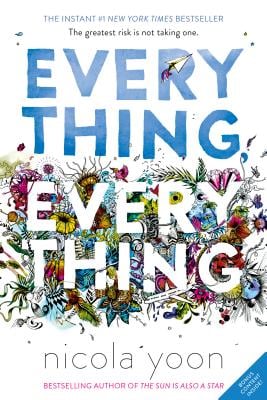
Everything, Everything by Nicola Yoon

After The Sun Is Also a Star I was sold on anything Nicola Yoon. Everything, Everything is her first novel, also a YA romance of star-crossed lovers, heavy on metaphor. I will buy whatever she writes next.

Madeline Whittier is just turning eighteen when we meet her. She lives in an immaculate home, in an entirely white room where “book spines provide the only color” and her best view of the outside world; she hasn’t left the house in seventeen years. She has SCID, or Severe Combined Immunodeficiency, or “bubble baby disease.” Luckily, her mother is a doctor, so she has the best care. She loves her books and goes to school via video calls and the occasional, exhaustively decontaminated visit from her architecture teacher. She has a great relationship with her nurse, Carla, and with her mom; she’s really not unhappy with this life, until a new family moves in next door. Through pantomimes from their windows, and emails, and IMs, Madeline and Olly fall in love.

SCID (a real disease) literalizes several truths about the more universal coming-of-age story. Madeline’s mother wants to protect her, while Madeline begins to chafe at the limitations of that protection. Falling in love involves risk, and necessitates keeping secrets. Throughout this book runs the question of whether love can really kill us or not; for Madeline, perhaps, it literally can. But for Madeline, as for all of us, it is also true that for her to grow into adulthood, she’s going to have to take some risks, and her mother will have to release her grasp a little bit.

The teenaged romance is as enchanted, magical, and absolute as these things really are. Olly is a delightful character, and like the male love interest in The Sun Is Also a Star, he has his own interests and personality to complement Madeline’s. Madeline lives through her books, especially The Little Prince, until her world suddenly grows exponentially larger. Olly is building a fanciful model of the universe on his roof, to escape the trauma of his own home life. They are very sweet with each other, and the whole story is best read in a breathless rush, the way young love happens. Yoon writes lovely, fresh, sparkling prose about universal experiences made specific, detailed, and gorgeous. Her characters are multifaceted and loveable. I feel like I get to disappear into these stories, and I can’t wait for her to write another one.


Rating: 8 rewards.

Maximum Shelf: Vladímír by Julia May Jonas

Maximum Shelf is the weekly Shelf Awareness feature focusing on an upcoming title we love and believe will be a great handselling opportunity for booksellers everywhere. The features are written by our editors and reviewers and the publisher has helped support the issue.

This review was published by Shelf Awareness on October 18, 2021.


Julia May Jonas’s Vladímír is a compelling debut, discomfiting and riveting, and timely in its themes. With dark humor, pathos and sly references to art and literature, this smart, edgy novel challenges assumptions and forces fresh perspectives.

In small-town upstate New York, an unnamed narrator teaches English at a small college. She lives an easy enough life, reading, writing, teaching, exuding “Big Mom Energy” and enjoying the admiration of her students, whose earnest eagerness for improving the world she appreciates. Then a scandal erupts: her husband, John, chair of the English Department, is revealed to have had sexual relationships with a number of his former students. The narrator herself is quick to point out that these all took place before such relationships were explicitly forbidden. She and John had always had an understanding about their extramarital activities. She is surprised to find that her colleagues and students disapprove not only of John but of the narrator as well, and finds herself increasingly resentful: of John, of the academic machine, of her students and of herself.

Into this upheaval comes Vladimir Vladinski, newly hired junior professor and up-and-coming experimental novelist. Vladimir is 20 years or so the narrator’s junior, sexy, flirtatious and married. The narrator is quickly captivated, then obsessed. A two-time novelist with generally disappointing reviews, she has largely turned to literary criticism and book reviews, but now feels inspired to write fiction again. For the first time she feels the work flowing from her effortlessly, and credits Vladimir as her muse. “There was a burning in my body, an extra level of excitement keeping part of me fed and running that required no sustenance. It was longing for the love of Vladimir.” She writes, masturbates and surreptitiously follows Vladimir one day and her beleaguered husband the next, and then even Vladimir’s wife–beautiful, traumatized, a masterful writer herself. Sexual, romantic, literary and workplace jealousies overlap. Things fall apart: John’s hearing (people keep calling it a trial) at the college looms as their already distant and fractured relationship continues to crumble. Their adult daughter moves back home, in dual personal and professional crises of her own, which throws the narrator into new light as a mother. She neglects her work, becoming increasingly reckless until, consumed by her fantasies, she finally commits a shocking act that precipitates a life-changing event for all involved.

That this narrator is a 58-year-old woman is significant, and provides opportunities to consider issues of gender, age, societal and literary expectations and subversions. Her troubled body image provides an undertone from the very first pages, with near-constant references to weight control and her evening skin care regimen. “I prefer to conceal my neck,” she confides, as she compulsively grooms and criticizes her body before each meeting with Vladimir. “A man could always make me feel worse than anything a woman could ever say to me,” she reflects, as she struggles to align her own sexual revolution with the values of her students. Vladímír questions gender and generational tensions, and the intersection of art and morality within the bubble of academia. In the family, household and larger social realms, it addresses every permutation of human relationship and the relationship between power and desire, while also carrying a strong thread of disturbed body image and issues around aging. In other words, this novel is as varied and harried as life.

As a novel so rooted in English departmental affairs should be, Vladímír is also jam-packed with literary references. Vladimir is compared to Jay Gatsby. “Enraged at my vapidity,” the narrator laments, “I forced myself to sit down and read several articles in the latest issue of the New York Review of Books.” Insisting she’s not jealous or bitter about her own novels’ failure to impress, she notes however that “Margaret Atwood wrote exciting books that practically lived inside of a uterus.” Vladimir’s wife says of her own mental health struggles, that her story is “like Nurse Ratched, like Girl, Interrupted, like The Bell F**king Jar.”

Jonas’s narrator has a strong, assured voice, incisively thinking through her decisions and the surrounding issues while simultaneously–and with self-awareness–mucking up her life. The narrator and the novel take on any number of thorny topics. Were the college students who slept with John seizing agency and free love in an empowered, feminist stance? Or were they taken advantage of by an older man with the power structure on his side? What are the pros and cons of an open marriage? Is our cultural hang-up about intergenerational affairs perhaps a little overblown? Some of these questions and perspectives are decidedly uncomfortable, but Jonas consistently pushes those edges, leaning always away from easy answers and toward nuance. Vladímír‘s central characters are rarely likable but they are always captivating; this story harnesses formidable momentum to pull readers through even its most uncomfortable moments. It is a rare victory in a novel to wrestle with such prickly issues and yet be as entertaining as this. Jonas’s prose is clear, forceful and unflinching, and highly sensual: food, drink and sex are ever-present and frankly, complexly evoked.

The narrator writes of Vladimir’s own debut: “The book was funny, clear, awake, vivid. The prose was spare but the voice was not sacrificed in his exact word choice. It felt both like life and beyond life.” The same comments might be made of Vladímír, a clear-eyed treatment of academia and the human condition.


Rating: 7 caipirinhas.

Come back Friday for my interview with Jonas.

Real Life by Brandon Taylor

Real Life centers around Wallace, a biochemistry graduate student in an unnamed Midwestern town. He feels unmoored and isolated despite having a group of “friends” (he’s not sure how true this term really feels) from school; he is one of the only Black people in this town, running from a traumatic past in Alabama. This novel takes place over the course of one weekend, when Wallace (who is gay) hooks up with one of his male friends (who insists he is straight), and tries to navigate this intrusion into his closely protected personal sphere alongside micro- and macroaggressions at work and among the friend group. The title refers to Wallace’s persistent worry that what he is living is somehow not “real life”; he is considering leaving graduate school but doesn’t know where to turn instead.

What gazes up out of the lapping black sea of his anger? What strange dark stones make themselves known to him?

It is a book of few joys, certainly. Rather, Wallace and his friends experiences large and small traumas and frustrations, hurting themselves and each other. It is a book of beauty, though, in its precise, quietly evocative writing and close observations. As Wallace carefully watches the miniscule creatures he breeds and destroys in the university lab, he likewise tracks the moves, desires and motivations of the people around him, from whom he feels removed. His tennis partner has just discovered that his boyfriend is on “that gay app” and may be cheating on him. A female friend is on the rocks with her Tolstoy-studying boyfriend. His colleagues are generally toxic, mildly if not overtly racist, except for the one woman of color, who is horrified that Wallace would consider leaving her there alone.

Gifted is the sweetness meant to make the bitterness of failure palatable–that a person can fail again and again, but it’s all right, because they’re gifted, they’re worth something. That’s what it all tracks back to, isn’t it, Wallace thinks. That if the world has made up its mind about what you have to offer, if the world has decided it wants you, needs you, then it doesn’t matter how many times you mess up. What Wallace wants to know is where the limit is. When is it no longer forgivable to be so terrible? When does the time come when you’ve got to deliver on your gifts?

A friend-of-friends is blatantly racist, and none of the group (all white) will speak up to even the most obviously offensive comments. We get the sense that Wallace would happily quit this scene if he could identify another option in the world.

The most unfair part of it, Wallace thinks, is that when you tell white people that something is racist, they hold it up to the light and try to discern if you are telling the truth. As if they can tell by the grain if something is racist or not, and they always trust their own judgment. It’s unfair because white people have a vested interest in underestimating racism, its amount, its intensity, its shape, its effects. They are the fox in the henhouse.

These characters are compelling and memorable, and the writing is indisputably fine. If there is a final takeaway, perhaps it is that this is real life – all of life is – and that we are all more or less miserable, whether quietly or demonstrably. It’s an admirable book but not a pleasurable one.


Rating: 7 nematodes.

The Everybody Ensemble: Donkeys, Essays, and Other Pandemoniums by Amy Leach

Amy Leach’s signature playful style, joyful humor and wise questioning of the universe delight and fascinate in these 23 essays, her second such collection.

With The Everybody Ensemble: Donkeys, Essays, and Other Pandemoniums, Amy Leach (Things That Are) takes her readers on a playful, rigorous, mind-bending romp through human nature, the natural world, spirituality and more. Her perfectly singular voice sings the most surprising notes in an imaginative blend of silliness and seriousness.

This sophomore collection of 23 essays opens with its title offering, in which the narrator welcomes all 20 quintillion animals to the Everybody Ensemble. How will they be arranged and organized? What songs will they perform? Leach glories in lists of the unlikely, the weird and the underappreciated: “speckled and plain, perfect and imperfect, indigo-feathered, green-skinned, orange-toed, squashed of face, cracked of shell, miniature of heart, young as ducklings, old as hills, everybody raise your sweet and scrapey, bangy, twangy, sundry, snorty voices.” This embrace of enormous, diverse multiplicity serves as appropriate introduction to an ecstatic exploration of “everybodyism.”

Leach employs a huge range of rhetorical devices while retaining a sense of whimsy and plain fun. Her genius perhaps shows best in her selection of the singular, startlingly unexpected detail. Adept as she is at wordplay, Leach’s writing goes much deeper than that, wondering and speculating at larger questions. In “The Wanderer,” she considers how to critique the extravaganza show called Earth, “already in production for five million years now” but unfinished. The artist of this show has strengths (facility and versatility), but “imagination unchecked can result in a mishmash.” If only “we could just establish the genre, whether this is supposed to be comedy or tragedy or romance or what,” we could make sense of the effort. Don’t be misled by her joyful absurdity or wit with words: Leach is deadly serious in her questioning of the cosmos, Earth’s composer and whether “even with all the troubles of our time, maybe it can still be fun to be a frog.”

“O Latitudo” ponders the imagined choice of a supervolcano: to erupt or to self-suppress, “consequently composing a gassy, burpy, muddy Ode to Joy.” “In Lieu of a Walrus” offers a list of writers to whom one might turn when the first-choice interlocuter is unavailable, including Hafiz, Ovid and God. “Green Man” honors the mesquite tree, loved by few, who has been given “the freedom to dig his own disputable way.” “Beasts in the Margins” considers the more incongruous illustrations of 14th-century books of psalms: “Who let the monsters into the psalter?” These and other essays range widely in subject matter but accrue to a meaningful whole. Leach is smart, effervescent, earnest and funny. Her voice is perfectly unmistakable, her themes expansive; her prose glitters. The Everybody Ensemble is a revelation.


This review originally ran in the October 14, 2021 issue of Shelf Awareness for the Book Trade. To subscribe, click here.


Rating: 9 extracommercial tigers.

Yolk by Mary H. K. Choi 

This review from Shelf Awareness prompted me to buy and read this book, and it delivered. I felt fully involved and invested in the lives of Jayne and June Baek, Korean-American sisters born in Seoul and raised in San Antonio, Texas, now living as young adults in New York City. They haven’t been close for years, and now Jayne (our first-person narrator) avoids her sister’s phone calls as she does their mother’s, until June tracks her down on a disastrous third-wheel date and demands they meet. June is very sick. Outwardly, Jayne is the sister with more obvious problems – self-loathing, squalor, harmful sexual practices, generally low functioning as an adult (and some more serious issues that are only gradually revealed). Now that they are sharing increasing challenges, the estranged sisters might just come together again.

As an only child, I have always been fascinated by siblings, whose various dynamics I can only watch from outside, generally with jealousy. One of my favorite things about this novel is its intimate, insider look at the sisters’ relationship, which is troubled (but aren’t they all), love and dislike intertwined with violence and yearning. One of Yolk‘s great strengths overall is immediacy and intimacy, how close we feel to Jayne, in all her messes and flaws. I also really appreciated the writing about place. New York feels right to me, but what do I know; brief sojourns home to San Antonio I am in a better position to judge, and I think Choi (who shares geographical background with her characters) gets it just right. The humid night air and the big skies make me a little homesick, too. The tone of young twenty-somethings dealing with all the madness of life feels pitch-perfect.

Choi includes a brief note at the book’s beginning about some difficult subject matter, acknowledging that she shares some of Jayne’s difficulties and that “for those struggling with body image and food, this story might be emotionally expensive for you.” I had to pause at that phrase, emotionally expensive: I like it. “Sensitivity is a superpower,” Choi instructs us. It is not a novel with an overt message, but I appreciated this one.

I also need to note the loveliness of this hardback book as a physical object: I love the design, the dust jacket, what’s under the dust jacket, and the print on the edges of the pages that continues the image on both dust cover and hardcover. It’s a beautiful piece that feels good in the hand and I’m glad to own it.

Sensitive, funny, raw and often painful – I worried a little early on that I’d taken on something sadder than I needed at this time. But Yolk is a beautiful book about love and hope, too, and with a thread of unlikely romance to it as well. I found it delightful and do recommend.


Rating: 8 glasses of water.

did not finish: The Ecstatic by Victor LaValle

After The Changeling, I thought I was in for anything and everything LaValle, but it turns out he offers a whole range, and it is not all for me. I went 100 pages in (with Nancy Pearl’s slightly misremembered Rule of 50 in mind), out of love for Changeling, but decided to stop there. The Ecstatic reminded me very strongly of A Confederacy of Dunces, which to be fair I read a really long time ago, and itself won a Pulitzer. Both books have won much praise, but all the things are not for all the people, and this one didn’t work for me.

There were some wonderful lines. To begin chapter 1:

They drove a green rented car into central New York State to find me living wild in my apartment. Wearing shattered glasses and my hair a giant cauliflower-shaped afro on my head.

That is an opener to stick with the reader forever, right up there with “It was a queer, sultry summer, the summer they electrocuted the Rosenbergs, and I didn’t know what I was doing in New York.”

They held hands absently, but firm; one set of fingers like kudzu, the other like dirt.

What a delightful image to evoke firm handholding, as a force of nature. And,

My sister and I turned out such heathens I’m surprised we didn’t bubble when baptized.

That one just made me laugh.

But I couldn’t get behind the woes of this protagonist any more than I did Ignatius J. Reilly (sorry). It was sort of interesting but not appealing; I do not always require likeable characters but definitely missed having one here… so I gave up. I’m not done with LaValle, but will be more careful with my next selection.

As ever, your mileage may vary.


No rating for this DNF.

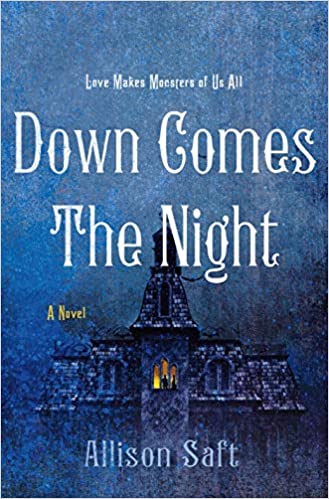
Down Comes the Night by Allison Saft

I found Allison Saft’s Down Comes the Night to be a serviceable YA fantasy/romance, but not the kind of transporting experience (a la TJ Klune) that I’d been hoping for. This one felt more limited to appealing to a YA audience in particular, without the complexity or the writing excellence to bring it into adult readership. It’s not that I disagree with any details from this Shelf review (which convinced me to buy the book), but it never especially wowed me. Good enough. And sorry for the faint praise, but that was my experience.

Wren is the ill-favored bastard niece of the queen of Danu, and a magical healer. Thrown out of royal circles yet again, she takes a chance on an offer from a neighboring lord, to come and heal his favorite servant of a mysterious disease. The servant, however, turns out to be Hal, the most feared magical killer from Danu’s greatest enemy nation. Wren finds herself thrown into intrigue and dangers whose sources she doesn’t quite understand. Meanwhile, as she works to heal Hal for strategic reasons, she finds herself strangely empathetic to this sworn enemy. Is it possible they are more alike than different?

Down Comes the Night has suspense, mystery, romance, fantasy, and some good commentary on war and prejudice. “Maybe the only difference between a monster and a hero was the color of a soldier’s uniform.” “Was it worse for a murderer to hide behind the uniform of a soldier or a gentleman?” Saft’s atmospheric writing is often effective, if a bit heavy-handed. At some point this novel fancies itself a detective story, with our two protagonists teaming up to “investigate” a “case,” but under whose legal system? This part got a bit sloppy, genre-wise, for my tastes, and some of the commentary felt simplistic. Again, perhaps more purely YA than I was looking for. (Does that sell the young adults short? I’m a little out of my realm here.) The romance was satisfying, though.

Final verdict? Easy to read; fine.


Rating: 7 vials.

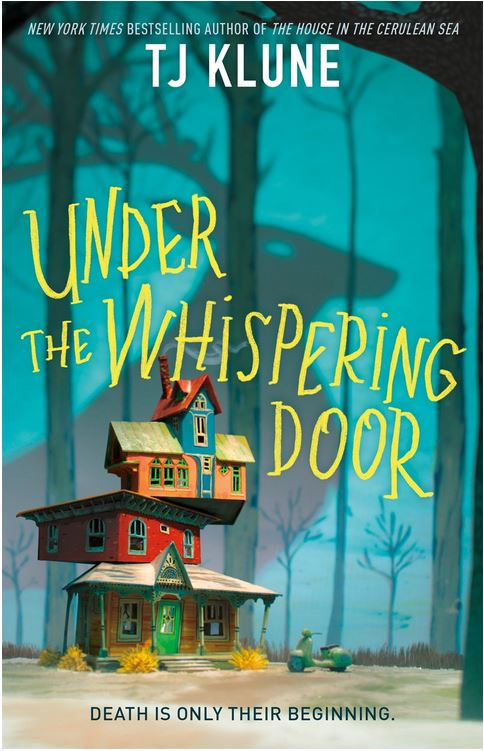
Under the Whispering Door by TJ Klune

TJ Klune is my comfort food reading these days. Under the Whispering Door has all the charm of The House in the Cerulean Sea but a new focus: end of life, death, grief and grieving, and the questions of whether one lived as fully as one might have, and what redemption might be possible. This material has a personal resonance for the author, who lost his partner at an impossibly young age. Despite that heaviness, and the heaviness that we presume, culturally, will accompany these topics, this is still a TJ Klune novel. Death is a new beginning – not one that is all flowers and sunshine, of course; it is accompanied by much pain and trauma, depending on circumstances. But there is hope, even hope for romance, and that romance happens to be between two men, in a beautiful, whimsical, hilariously misfit tea shop that is also a waystation for the recently deceased.

“You’re awfully strange.”

He heard the smile in her voice. “Thank you. That might be the nicest thing you’ve ever said to me. You’re awfully strange too, Wallace Price.”

Where Cerulean featured magical orphans and a socially awkward but well-meaning orphanage inspector, our little built family this time includes a few dead (one a sweet, goofy dog), a few living, and an initially deeply unlikeable lawyer. Three of the five central characters, Klune notes in his Acknowledgements, are people of color, while the author is white, and he emphasizes the important contributions of his sensitivity readers. I found all of these characters delightful, because if there is one thing Klune does well it is delightful, wacky, loveable, flawed characters (even dead people and dogs). Even the comedic villainess here is sort of a joy. As a YA book about death, this is just charming as can be, and I think truly helpful for those suffering a loss; but it is also never saccharine, which is an easy pit to fall into. In short, I am in for wherever Klune wants to take me next, at the juncture of sweetness, fantasy, profundity, inclusivity, wisdom and pure silliness. Strongly recommended.


Rating: 8 cups of tea, obviously.

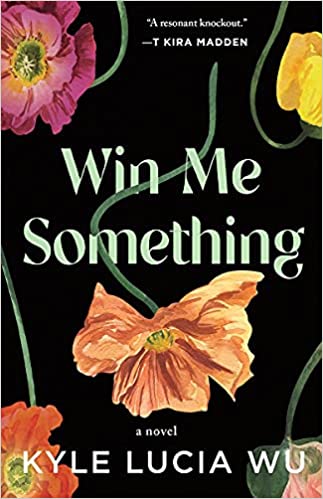
Win Me Something by Kyle Lucia Wu

A young woman must chart her own way, even while quietly craving belonging and home, in this subtle, wise debut.

Kyle Lucia Wu’s first novel, Win Me Something, is a wrenching evocation of yearning in a slim, artful package. The story of Willa Chen, a young woman unmoored in New York City, is defined by liminal spaces and a wish to belong.

In the opening pages, Willa interviews to become a nanny to a wealthy family in Tribeca, even though she can’t quite conceive of what a nanny does. “Maybe I couldn’t imagine these moments because when someone asked about my childhood, my mind clenched and closed like two fists in a pool–fingers squeezing for something to come up with when everything around them was a different kind of matter.”

Willa’s father is a Chinese American immigrant whom she barely knows, her mother a blonde-haired white woman, detached and depressed, who can’t comprehend the microaggressions her daughter faces. Since their divorce when Willa was very young, each has begun a new family, and she feels she belongs to neither. Thus adrift, she enters the Adriens’ household, where she cares for the charming, innocently privileged, nine-year-old Bijou, who studies Mandarin and the violin and cooks coq au vin. Willa feels as unbelonging as ever, but also entranced by the family’s ease, their wealth, their things. “When I looked around their apartment, my veins filled with rushes of want, as if I could see the price tags on everything, as if they would increase my own value.” It’s not that Willa is materialistic, but that she is drawn to the idea of worth suggested by those around her: “I often found myself in friendships with people like this, self-absorbed and sparkling.”

Readers will be engrossed by Willa’s troubled desire to please and her pervasive unease, as she seeks and then deflects the slightest attempt at connection. As she begins to meld into the Adriens’ household, she reconsiders her own childhood and family homes in a series of flashbacks. The subtle racism she encounters is but one thread of Willa’s distress; her estrangement from both of her half-families, and her half-hearted attempts to join the Adriens’, presents a greater challenge on its face, but also stands in for the larger estrangement she feels everywhere she goes, as the in-between spaces of family and race in culture echo each other.

With an eye for just the right detail, Wu offers an understated protagonist, self-defeating but still searching. Win Me Something is a nuanced story of longing, of the paired desires to belong and to strike one’s own path. Willa is a quiet heroine, but unforgettable.


This review originally ran in the September 28, 2021 issue of Shelf Awareness for the Book Trade. To subscribe, click here.


Rating: 7 dresses.