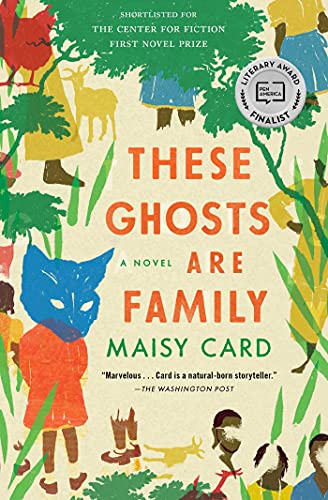
These Ghosts Are Family by Maisie Card

This was a fascinating journey. These Ghosts Are Family follows a family for generations, from slavery in Jamaica, through emancipation and decades of struggle with old class systems, immigration to London and New York, through permutations of relations, including a fresh start with a new identity (or, if you like, identity theft). The timeline jumps around and the focus and point of view shift, so that readers see this extended family at different times and from different perspectives. Issues of class, race and colorism and the relationships between privileged and less privileged classes, including but not limited to enslavement, will be obvious themes; we know that rape and issues of gender arise under these conditions too. The characters are infinitely fascinating. I was not so much expecting the question of supernatural elements: duppies or ghosts and Ol’ Hige, “a Caribbean version of a vampire story.” By the book’s end, I was left reeling with all the possibilities. There is plenty of heaviness: children abused, spouses failing to see eye to eye, parents and children letting each other down. But there are some quietly loving relationships scattered throughout. As I close the final pages, I’m a bit at a loss because there’s so much to consider. (And because we ended with a decidedly weird trio of spooky vampire children living in the woods.)

The book begins with a family tree, which I did refer to throughout. It presented me with a confusion that was answered on the first page. I’m going to spoil that one here because, again, first page of the novel (and it’s also given away on the back of the book and in most blurbs): the aged Stanford Solomon reveals, on his deathbed, that in fact he is (or was) also Abel Paisley, presumed dead some thirty-five years ago, at which point he took the identity of his friend Stanford. “Stanford” has both a wife and daughter and another daughter out of wedlock, all in New York; Abel left behind a wife and two children in Jamaica when he supposedly died. Stanford/Abel’s revelation obviously affects those around him. But I’m going to diverge from the blurbs here, and say that this is not the event around which the book revolves, and by its end, Stanford is by no means the central character. Rather, he is one branch on the family tree that is the book’s center. He’s just one link, and I don’t think he earns the role the blurb says he plays. Rather, I find the book more about larger patterns – slavery, class and race and colorism following slavery, migration and immigration, gender roles, the persistent damages of all these institutions and systems, trauma, and family dynamics. It’s about the multiple generations of this single family, for sure, but their combined story is very much about those larger patterns and systems. There’s nothing preachy or intentional-feeling about this, but the Paisley/Stanford family is inextricable from larger issues. I put Stanford/Abel at its center only in that he opens the book and occurs at the more-or-less center of the family tree as we find it here. The book ends somewhere very different, and that feels right.

In between, the story is told by numerous voices spanning some 200 years. That multiplicity of voices was a great choice for this story. (I have just said the same about a brilliant novel whose review is still forthcoming: Lookout by Christine Byl.) I love the kaleidoscopic or triangulated perspective on events offered by the different views. And for a novel whose focus is so broad – generations of a family across continents, countries, and centuries – it makes sense to move around like this. I guess such a big story told by one voice (with some kind of time-traveling power, I suppose) would be a different kind of accomplishment, and I can imagine it done beautifully, but Card’s choice feels just perfect here. The multiple voices also allow her to give us different dialects, which add to the texture and richness of the whole.

This adventure into these varied lives is expertly done, not always comfortable because of the subject matter, but engrossing and well worth the immersive experience. Card is a talent.


Rating: 7 names.

The Minuscule Mansion of Myra Malone by Audrey Burges

This captivating novel of miniature furniture and big themes braids strong friendships, romance, family ties and the importance of stepping outside of one’s comfort zone.

Audrey Burges’s The Minuscule Mansion of Myra Malone charmingly combines threads of magic, whimsy, romance, grief and loss in a debut novel of great feeling.

Readers first meets 30-something Myra in 2015 in the Arizona mountains, where she lives in the attic of her late grandfather’s cabin. She is regularly visited by her best friend Gwen, who forms Myra’s main link with the outside world–along with the website by which hundreds of thousands of followers know the Mansion, Myra’s life’s work and greatest love. She inherited the large, highly detailed, finely wrought miniature (don’t call it a dollhouse!) from her beloved step-grandmother, Trixie, who, along with Grampa Lou, taught her sewing, woodworking, painting and sculpting. “I know what gemstones look like water and what pen can draw the most convincing chain stitch on a washcloth that’s too small to sew. I can be eclectic or traditional, modern or romantic, and the Mansion absorbs those dreams into its walls.” In flashbacks, the novel also reveals a very young Myra in her loving relationship with Trixie, until the older woman’s tragic death on Myra’s fifth birthday. Other chapters introduce a woman returning to her stately home in Virginia in the 1930s. And in 2015 Virginia, a young man named Alex discovers Myra’s website, “The Minuscule Mansion of Myra Malone,” and the miniature Mansion itself, which is, shockingly, a perfect match to the riverside family estate where he lives alone.

Interspersed with chapters alternating between Arizona and Virginia are short essays that Myra posts on her blog: “I’ll set out with the simplest plans, a minor tweak, and wind up with a choice between full-scale renovations and a shift of perspective. An attitude adjustment or a gut job.” These many threads form a rich portrait of several easy-to-like characters.

Myra still grieves the loss of her Grandpa Lou and especially Trixie, whose skills in making miniatures she honors in continuing to curate the Mansion, painstakingly redecorating room by room. She is a recluse, but the Mansion’s website offers a rare and rich connection to the outside world; her followers view the Mansion as both escape and refuge. Then Myra is threatened with eviction, and her carefully guarded small world tilts. Things begin moving around in Alex’s home and in Myra’s miniature version–piano music emanating from a room without a piano; things that go bump in the night. The keepers of both houses must reassess their relationships to their homes and to the larger world, and it may take more than Gwen’s prodigious business savvy to save the Mansion.

Burges carefully constructs her plot with as much quirkiness and love as any of Myra’s miniatures. With sympathetic characters, high stakes and winning miniature chifforobes, The Minuscule Mansion of Myra Malone is dreamy, sweet and satisfying.


This review originally ran in the November 29, 2022 issue of Shelf Awareness for the Book Trade. To subscribe, click here.


Rating: 8 hairpin legs.

The Ballad of Black Tom by Victor LaValle

People who move to New York always make the same mistake… They come looking for magic, whether evil or good, and nothing will convince them it isn’t here.

The year is 1924, and Charles Thomas Tester wouldn’t call himself a con man; he thinks of himself as an entertainer. He’s not much of a musician, unlike his beloved father, but he knows how to put on the right look and scrape a living where he can. It helps to leave Harlem, where he supports his father and himself in a tenement apartment, and travel to the likes of Red Hook and Flushing. There’s risk there for a Black man, but more to be gained, too. Charles plays off wealthier New Yorkers’ search for magic–until he gets into more than he’d bargained for. In Flatbush he meets a wealthy eccentric named Robert Suydam with ideas about how to change the world. An anxious, sensitive police detective and a burly bully of a private investigator are on the tail of the unlikely allies, Charles and Suydam; between them they will certainly change the shape of the world, in unexpected ways.

The Ballad of Black Tom has magic and race and racism and wishes and love and violence and simple street entertainers’ illusions. There are characters from different walks of life – I love the varieties of ethnic foods available in the Victoria Society. Charles Thomas Tester is both a straightforwardly relatable character – loves his father, just wants a little financial wiggle room – and a dangerous enigma. This book is short, but it casts a spell. Victor LaValle continues to intrigue me. Recall that I loved one book of his and couldn’t finish the next. This one is compelling. I have The Devil in Silver waiting on my shelf. We shall see.

Meanwhile, Black Tom will keep me thinking for a while – not least with its final prophecy.


Rating: 7 pages.

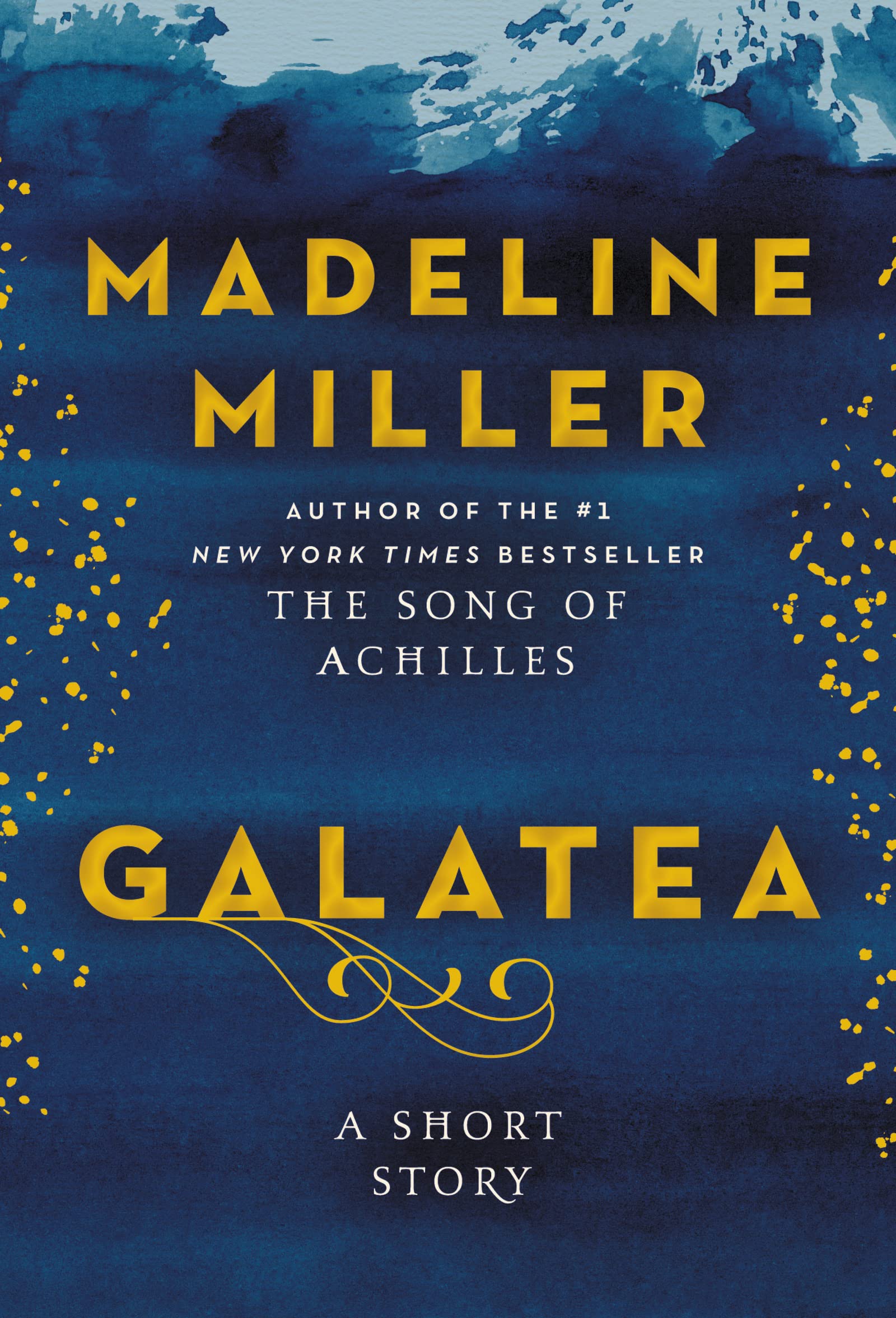
Galatea by Madeline Miller

Although I found Circe less mind-blowing than I did The Song of Achilles, I will still follow Madeline Miller anywhere. I was very excited about this new book, which is labeled as a short story, but packaged as a freestanding little hardback. The story is very short – just 50 pages plus an afterword.

50 little tiny pages

According to Wikipedia, “Galatea is a name popularly applied to the statue carved of ivory by Pygmalion of Cyprus, which then came to life in Greek mythology.” In Ovid’s version of the myth, in Metamorphoses (which Miller indicates is “almost solely” her source for this work), she does not have a name. Pygmalion is a sculptor so horrified by real, live women that he can only be happy with the ivory statue of one he creates for himself, in perfection and perfect, chaste silence; he prays to Venus for her to come alive, and she does, to bear him a child but (in Ovid’s telling) to remain silent and modest. (Delightfully, and disturbingly, in the poem “Pygmalion’s Bride” by Carol Ann Duffy in The World’s Wife, she defeats his sexual advances by pretending to reciprocate them.)

Here, Miller gives us Galatea’s first-person voice from the hospital room where she is institutionalized, imprisoned, on Pygmalion’s orders. He visits in order to fetishize and rape her. Having born him a daughter and seen how limited their child’s life will be with such a domineering, misogynistic father, Galatea has tried to escape him and save her daughter, but so far failed. When he tells her what his latest project is, however, she tries again.

In Miller’s writing, Galatea’s voice is lyrical and grim. “The door closed, and the room swelled around me like a bruise.” She handles her husband’s abuses with an impassive stoicism that reads as strength rather than stoniness, because she feels strongly toward her daughter (and hides well her disgust with Pygmalion). She is brave, clever, and grandly terrible, worth of Greek myth and the empowerment we want for her. This is a brief but powerful triumphant retelling of an upsetting myth. Miller is awesome and I will preorder anything she writes. Go read it now.


Rating: 8 cups of tea.

Gone Missing in Harlem by Karla FC Holloway

This one’s a bit genre-defying. I really enjoyed it. Gone Missing in Harlem looked like a mystery at its outset, but it turned out to be broader than that. Historical fiction, clearly: it’s set in Harlem during the Great Depression, with flashbacks to Carolina (North or South, I’m not sure we ever know), highlighting the Great Migration of Black Americans from the rural South to northern cities. It handles mental health issues in several threads, and the challenges of parenting through traumas and breaking cycles. It ranges widely.

We see the title event in the very first chapter. A young mother, Selma, parks her pram just outside a grocery for a very short time while she pays for some apples; when she comes out, it is discovered that her baby is gone. An uproar immediately ensues. Harlem’s residents are horrified, excited, titillated, and incensed at the lackluster response from the police department: the city is still reeling from the disappearance and death of the Lindbergh baby, and Harlem can easily see the difference in how a poor baby from their community is treated. We do have the city’s first Black policeman on the job (and with a fresh Black cadet in tow), and he is both clever and committed. But weeks and months pass, and Selma’s baby Chloe is not recovered.

One of the things I loved best about this book was the constant shifting of perspective. While I’m fairly certain we never get a first-person point of view, chapters switch focuses in close third person perspectives between a large number of characters: Selma; the police officer; Selma’s brother Percy (aka June Bug); their mother (a central figure), DeLilah, aka Lilah, Mama Lil, or Mrs. Mosby; several members of the wealthy white family Lilah works for; the social-climbing Black woman she works for later; a neighbor down the hall; and others. (The policeman and his apprentice form a delightful Holmes-and-Watson pair – indeed with reference to their famous counterparts – and appreciate libraries, librarians and book research most pleasingly.) This multiplicity of perspectives enriches the narrative like nothing else might have, and help take this story from the (deceptively simple) mystery it might have been to a whole complex tapestry of questions, in the best way. Class is arguably as important as race, and race is complicated by colorism. Several generations address the difficulties of parenting; the complexities of love, fear, and aspiration; and the importance of making a plan. As for that deceptively simple mystery, there is a big surprise near the novel’s end that had me entirely, literally slack-jawed. I did stumble upon a handful of grammatical errors that I wish had been caught in editing, but that’s a small issue (and likely only for a few readers). I’m very impressed at the absorbing story, the wealth of those multiple POVs, and the tender handling of a broad range of issues.


Rating: 7 needles.

Maximum Shelf: Clytemnestra by Costanza Casati

Maximum Shelf is the weekly Shelf Awareness feature focusing on an upcoming title we love and believe will be a great handselling opportunity for booksellers everywhere. The features are written by our editors and reviewers and the publisher has helped support the issue.

This review was published by Shelf Awareness on November 15, 2022.


“Kings are brilliant / mighty / godlike // Queens are deadly / shameless / accursed.” Such has been the literary fate of Clytemnestra–adulteress, wife and murderer of Agamemnon in the Ancient Greek canon. Costanza Casati’s debut, Clytemnestra, is a dynamic retelling of the story of the much-maligned Spartan princess, sister of Helen, queen of Mycenae, mother of Iphigenia, Electra and Orestes (and others). Aeschylus, Homer and Euripides generally portray Clytemnestra in a negative light, but Casati’s reframing–from her title character’s point of view–emphasizes the difficult circumstances that challenged a strong-willed woman in a time and place that did not reward such a quality. Clytemnestra is a masterpiece of justified rage on the protagonist’s part, and a subtly subversive revision of a story many readers know from a different perspective. She will be called ruthless, merciless, “cruel queen and unfaithful wife,” but viewed from another angle, Clytemnestra fights honorably for her own well-being and for that of the people she loves.

The events of Clytemnestra’s life are not much rearranged here. As a princess in the Spartan court, she is trained as a warrior and huntress, surrounded by violence and death even in her privilege to sit in the megaron with her father, King Tyndareus, where they hear the villagers’ requests. This upbringing emphasizes martial training, physical skill, obedience and the ability to suffer. Her first marriage, to Tantalus, was for love and was a meeting of minds, but it ended in murder and betrayal, and with a forced second marriage to the Mycenaean king, Agamemnon, whose brother Menelaus in parallel marries Helen. Clytemnestra’s later lover, the traitor Aegisthus, is a complicated, enigmatic character in his own right. This proud queen, treated as a pawn in political power struggles, wrestles to keep her dignity in the Mycenaean court under the brutalities of her husband, but never loses her sense of herself as a warrior and a survivor. The events of this novel close where Aeschylus’s Agamemnon opens, thereby gifting a complex backstory to a woman often portrayed as villain.

Clytemnestra dips its toes as well into the stories of the queen’s famous family members: her brothers Castor and Polydeuces, boxers and horsebreakers; her sister, Helen, whose legendary beauty led to the Trojan War; her mother, Leda, who was seduced by Zeus in the form of a swan (or was she raped?). Her children include Tantalus’s unnamed infant son; Iphigenia, sacrificed at Aulis to summon wind for the Greek ships on their way to Troy; and Electra and Orestes, whose stories expand only after these pages close. This Clytemnestra is very close and loyal to her siblings; family ties for better and for worse shape her decisions all her life, even at great distances. For instance, meeting a new face, she thinks of her siblings: “Helen would have charmed him with her beauty and subtle cleverness, softening him until he opened like a peach. Castor would have mocked him, pricked him with words like needles, until he talked.” Clytemnestra’s cousin is Penelope, eventually famous as Odysseus’s queen and faithful wife, in marked contrast to the Clytemnestra in traditional representations; here, again, the reader sees a new and complex side of a familiar character, as she is courted by the cunning Ithacan king.

The gods in this version are mere myth, not actors in real events; Clytemnestra, like her mother, is skeptical, even scornful of the gods and their followers. She understands that kings and not queens rule in her world, but she continues to demand the respect she deserves even when it’s unlikely she will get it, and consistently calls out the rapes and attempted rapes that often go unmarked in the courts and villages of both Sparta and Mycenae. This retelling is a deepening of Clytemnestra’s story and her character. Helen, her beloved sister, likewise grows more multifaceted in Casati’s nuanced novel, but the beautiful one is not gifted with physical prowess or the confidence of the fierier Clytemnestra: “Clytemnestra dances for herself; Helen dances for others.” Timandra, one of their younger sisters, is fierce like Clytemnestra, but with a different burden in their strict society. These female leads are glittering, glowering, admirable and sympathetic, and the result will reignite (or ignite) readers’ interest in the stories of ancient Greece and emphasize their relevance in any time.

Clytemnestra is a stunning, standout contribution to the growing genre of modern treatments of the Greek myths. Casati brings both a solid grounding in the canon and imaginative venturing into the inner workings of a woman who has long been famous but little understood. Her writing is gorgeously descriptive and emotive: “She thinks of those white flowers blooming against the rocks of the Ceadas. For years she wondered how they survived down there, among the corpses and darkness. But maybe this is how broken people keep living…. Outside the light is golden. It shines on them as if they were gods.” Casati’s Clytemnestra is modern in her staunch demands for dignity and respect, but believably rooted in ancient times. This is a necessary novel for fans of mythology, strong women, the pushing of boundaries and epic dramas of family, power and love.


Rating: 8 cuts.

Come back Friday for my interview with Casati.

The Last Karankawas by Kimberly Garza

Another very fine one on Liz‘s recommendation.

The Last Karankawas has a lot going for it. And yes, for me personally a significant part of the appeal is personal: it’s set in Galveston, Texas (the beach town nearest my hometown of Houston, so a place where I spent a lot of time growing up), with ventures into the Texas Hill Country (where I lived last in my home state). These familiar locations are really well done (Garza’s bio note says “born in Galveston, raised in Uvalde,” giving her greater cred than my own): detailed, specific, absolutely recognizable. You know I’m a sucker for a strong sense of place in any location, but when that place also feels like home, you can bet this won my heart and gave me some homesickness (also a theme of the novel). So, sense of place and detailed execution of setting are objectives strengths here; my personal connections give me a more subjective love on top of that.

It’s a striking novel, not least in form. It could be considered a novel-in-stories: twelve characters each get chapters in their perspective (some first-person, some close third), plus the first chapter told in that unusual first-person plural “we” voice, by the Filipino-American women of Galveston’s Sacred Heart Catholic Church; one chapter focuses on two characters together. As the following image shows, the story centers on one in particular: Carly Castillo is the heart of the story. (I quibble mildly with this graphic because I think those people who relate to Carly through Jess, or others, should be graphically shown as connecting through those other names. Small issue.) Carly and Jess are the only characters who get more than one chapter’s perspective (and Jess only barely, with a second, very short one). Sometimes the connections back to Carly are tenuous, but they’re there. And the book ends with “A Glossary & Guide for the Uninitiated Traveler” to Galveston, which is a delightful piece of hermit-crab-style formal play, and includes the best definition of “state of Texas” I have ever read – hint: it includes multiple entries, some strikethrough text, “none of the above” and “all of the above.” To return to an earlier point, the evocation of place in all its complications and contradictions is absolutely one of my favorite things in literature.

Carly is born in Galveston to a Filipino immigrant mother and a first-generation Mexican-American father. Both parents leave when she is still small; she is raised by her paternal grandmother. We meet her first when she is a small child through the eyes of the church ladies where her maternal grandmother and mother attended. We know her as a teenager and young adult. Carly and the surrounding, orbiting characters are diverse, appropriate for the setting: Filipino and Mexican immigrants and their descendants, mostly. They work in nursing, in restaurants, on shrimp and oyster boats, or driving buses. They navigate class, race, immigration, family ties and ties to place; many wrestle with the opposing pressures to stay and to leave. The novel’s action comes to a head around 2008’s Hurricane Ike, which is catastrophic for Galveston and life-changing for our characters (and which I remember well in its lesser but still significant effects in Houston). It even visits with Isaac Cline, whom some readers will know from Erik Larson’s book Isaac’s Storm: A Man, a Time, and the Deadliest Hurricane in History. The title refers to the Karankawa Indians who were native to the Texas Gulf Coast region. Yes: there is a lot going on.

It’s a novel with things to say about many themes – class, race, immigration, family, place, community, coping with disaster – but also an emotionally evocative novel about people and relationships. Detail and voice are gorgeously rendered, including the tricks of bilingual culture. It is beautifully done and I won’t forget it anytime soon. Strongly recommend.


Rating: 9 pitches.

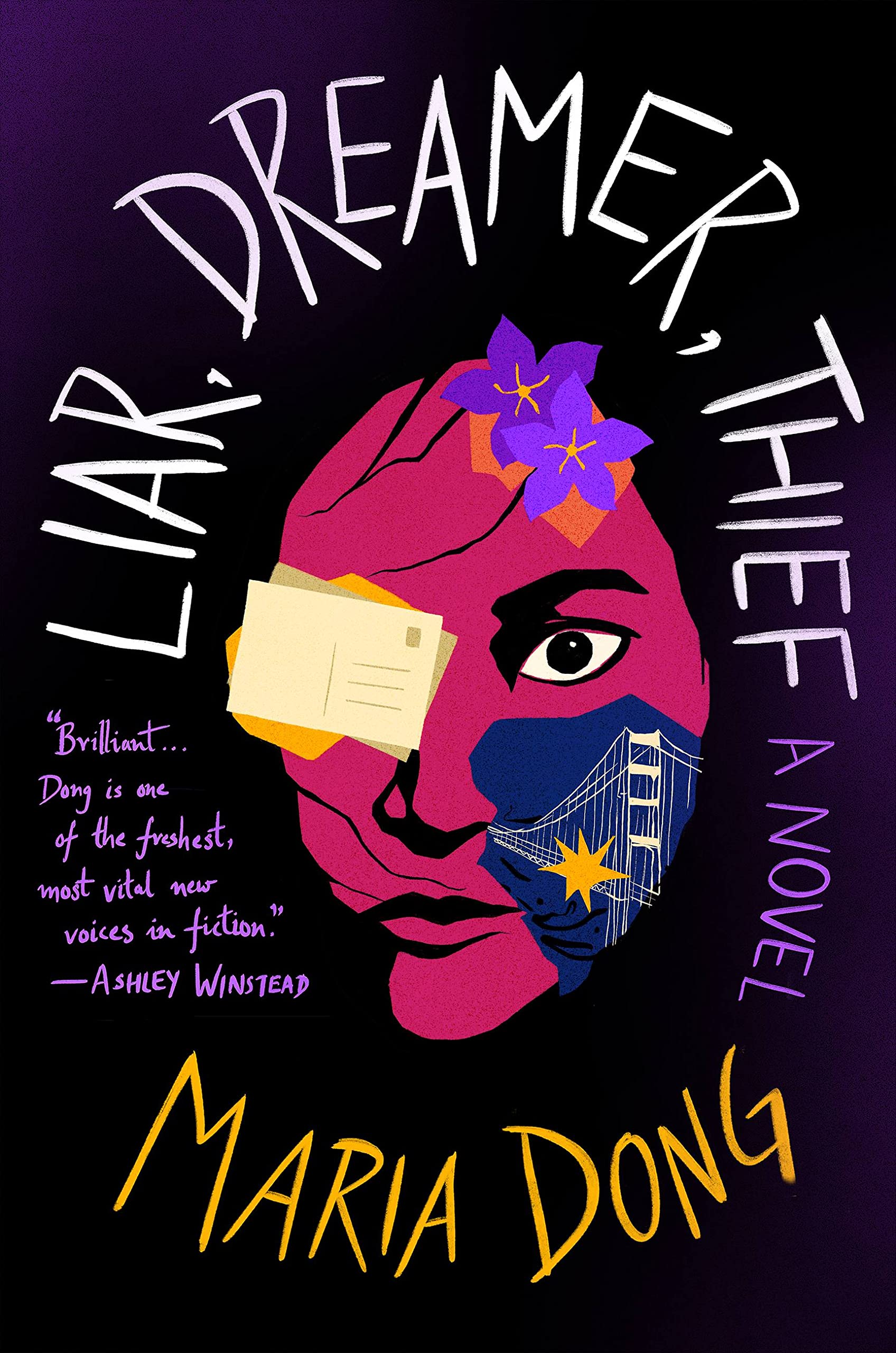
Liar, Dreamer, Thief by Maria Dong

A young woman relies on ritual and fantasy to navigate her daily life–until the real world turns as bizarre as her worst fears.

Maria Dong’s debut novel, Liar, Dreamer, Thief, is a masterfully harrowing adventure for both reader and narrator. Katrina Kim is 24 years old and struggling to keep it together. She’s not great at her temp job at an insurance company; she has no real friends other than her mostly absent roommate; she relies on rituals involving geometry and prime numbers to feel safe from her shapeless, apparently irrational fears; she frequently imagines herself into the magical world of her favorite children’s book or the classical works of music she once performed. She argues that she is not stalking her coworker Kurt, but readers will suspect this may be semantics. She has $45 in her bank account and her parents haven’t spoken to her in years. Readers may assume Katrina is struggling with an undiagnosed mental illness, drawing endekagrams (a star polygon with 11 points) to help her get through the days–until she happens to watch Kurt jump off her favorite bridge, while shouting that it is all her fault.

Liar, Dreamer, Thief is punctuated with geometry lessons (the four stellations of the endekagram) and passages from the fantasy book that provides Katrina with her other, safer-feeling life, emphasizing these coping mechanisms as she embarks on an amateur (and poorly funded) investigation into Kurt’s disappearance. Her barely functional life goes further to pieces. Just as readers begin to worry that this narrator is not only unreliable but completely unstable, the clues shift slightly, and suddenly it appears that some of Katrina’s nastiest and most fantastical fears may be all too real.

This is a completely absorbing novel, both a terrifying whodunit thriller and a heart-wrenching drama about mental health, family, loneliness and moral relativism. Dong’s pacing and revelation of secrets is expert; beware staying up late to finish Katrina’s story in one go (and, perhaps, beware nightmares of the Mirror Man). Katrina makes some cringe-worthy choices while facing challenges both existential and mundane (clocking in on time in the cubical farm); she is an imperfect protagonist but disturbingly accessible, and indomitable even in her lowest moments. Liar, Dreamer, Thief excels at empathy and conveying the frustration of one’s own limitations, as Katrina wonders, “Does everyone in my orbit have a secret tragedy, just crawling underneath the surface?” Its mysteries swell toward a denouement that feels simultaneously unwieldy and inevitable. Probing those secrets may be mortally dangerous–or may be Katrina’s salvation.

This exceptional debut novel showcases relentless momentum, horrors, compassion and an unforgettable protagonist: not to be missed.


This review originally ran in the November 11, 2022 issue of Shelf Awareness for the Book Trade. To subscribe, click here.


Rating: 8 minutes.

H Is for Hawk by Helen Macdonald

Apologies for the very long review that follows, but I just loved this book so much.


Originally published in 2014, H Is for Hawk is a blend of memoir, nature writing and literary musings – a work of creative nonfiction that sounds made for me, in fact. Why did it take me so long? I have heard about this book for all these years but for some reason held off. Maybe it was simply the perversity of resisting reading something that sounds so obviously right. (Why do we do this??) Recently I read something (can’t remember what!) that prompted me to finally get into this book, and I’m sorry it took me so long. This is, indeed, a perfect book for me. It’s likely to wind up the best of the year; I’m putting it alongside Fire Season and Things That Are.

Helen Macdonald is a research fellow at Cambridge University when her father dies suddenly. She has also been a passionate lifelong falconer. One bird she’d never worked with before was the goshawk, a famously difficult bird to train and fly. But after her father’s death – reeling with grief – she feels the need to give this challenge a go. While navigating grief and struggling with her new goshawk, she comes across an old book: T.H. White’s The Goshawk, which she read (along with so many other bird and animal books) as a child, and found fault with then. Revisiting it, she still finds much that troubles her about White’s bungled, amateur efforts with his own gos (he knew a fraction of what Macdonald does when he entered unwisely into the fray), but also finds a kindred in suffering. The book that eventually comes out of this process, H Is for Hawk, is a braid of three threads: the author’s staggering grief at losing her beloved father; her time with the hawk she will eventually call Mabel; and her study of T.H. White’s life, falconry, and philosophies.

She blends these threads beautifully, moving smoothly between them in ways that always feel natural. The woman who is training the hawk is also the woman mourning her father, moving in a dream state through a world that no longer makes sense; in rereading The Goshawk she naturally reflects on her own falconry and her own gos, and on her childhood (when she first read the book) and therefore on her early relationship with her parents, and therefore on her father again – it’s all circular; it’s all linked. Macdonald must also consider the unhappy life of White (whom you may recognize as the author of The Once and Future King and others), a problematic figure in his political leanings, who wrestled with his own sexuality. I’m still describing Macdonald’s subject matter; but the seamless weaving of memoir, grief, falconry, literature, and history is just part of the charm. It’s her writing, and her stark, honest portrayal of the mad human experience, that shines.

It’s an astonishingly crafted book, too. I marveled, for example, at how it opens. Check out the first half of the first paragraph:

Forty-five minutes north-east of Cambridge is a landscape I’ve come to love very much indeed. It’s where wet fen gives way to parched sand. It’s a land of twisted pine trees, burned-out cars, shotgun-peppered road signs and US Air Force bases. There are ghosts here: houses crumble inside numbered blocks of pine forestry. There are spaces built for air-delivered nukes inside grassy tumuli behind twelve-foot fences, tattoo parlours and US Air Force golf courses. In spring it’s a riot of noise: constant plane traffic, gas-guns over pea fields, woodlarks and jet engines. It’s called the Brecklands – the broken lands – and it’s where I ended up that morning, seven years ago, in early spring, on a trip I hadn’t planned at all.

And then the way the first chapter ends, after describing a piece of reindeer moss picked up on that trip.

Three weeks later, it was the reindeer moss I was looking at when my mother called and told me my father was dead.

There’s something very neat and circular about this chapter and how it establishes the interconnection between the natural world, and the narrator’s walk looking for goshawks, with the loss of her father. When I read this first chapter, I had little feeling for the shape of the whole book; I was impressed at the time with what that opening and closing promised, and fulfilled. I felt it was a great start. Now that I’ve finished the book, I can see what a *perfect* opening it was, and the promises it makes and fulfills for the whole.

I feel that Macdonald views and portrays her subjects in fresh and new ways. Her father’s death (by natural causes) she experiences as if it were a violence or a natural disaster, with all the power and senselessness of weather. I appreciate the way she describes Mabel, her own goshawk – and other birds, but especially Mabel – the attention and detail with which she evokes the complications of color and feathers. “Formidable talons, wicked, curved black beak, sleek, café-au-lait front streaked thickly with cocoa-coloured teardrops, looking for all the world like some cappuccino samurai.” Indeed, part of what I loved so much about those opening sentences of the first chapter was the level of detail. She’s concerned as well with class and gender in the world of falconry and beyond; she muses on her awkward childhood (and her dear, tolerant parents), and racism and fascism in both historic and contemporary Britain. The best books, I think, open up like this. Falconry and the loss of a beloved parent lead naturally to British colonial history, and why not?

This is absolutely in part a book about the grieving process, descriptive rather than prescriptive. It reminds me strongly of Didion’s The Year of Magical Thinking, which also conjures the muddy, dreamy, drugged madness of grief. But I felt far closer to Macdonald’s narrator than I ever did to Didion’s. I just like Helen better (sorry, Joan). She successfully defamiliarizes her own world by becoming (it seems) part hawk. Part of the training process involves holing up together, falconer and hawk, in the quiet and the dark, to bond and establish trust; when they must emerge, the narrator finds the outside world as strange as the hawk does. “She watches a woman throwing a ball to her dog on the grass, and I watch too, as baffled by what she’s doing as the hawk is. I stare at traffic lights before I remember what they are. Bicycles are spinning mysteries of glittering metal.” This seems a necessary part of Helen’s grieving, but it nearly breaks her, too. “The day-book that records White’s long, lost battle with Gos is not simply about his hawk,” writes Helen, and we sense that she knows the same is true of her book.

This is a masterpiece of writing about the natural world and the points where the wild and the human are the same. It’s a masterpiece of lovely writing, period. It’s a feeling and singular evocation of grief, which I understand to be experienced differently in each instance. It’s a thoughtful consideration of many intersecting threads about the human experience and history, including some of our thorniest issues. The narrator is hard on herself but also winds up with some healing, and some hopeful outlooks – I could see this being a difficult but finally therapeutic read for someone suffering a great loss. It’s a gorgeous and profound piece of literature, the kind I had to pause frequently (at least after every chapter, sometimes within them – and they’re short chapters generally) to let sink in, to take breaks. It will stick with me for a long time.


Rating: 10 drawings.

Spirits in the Sky: Northern Lights Photography by Paul Zizka

Nature and adventure photographer Paul Zizka offers stunning images and narrative in Spirits in the Sky: Northern Lights Photography. Photos with brief, descriptive captions take center stage. They are accompanied by a few concise sections of text, which provide an overview of what the northern lights (or aurora borealis) are; some of the myths used to explain them; and the stories behind Zizka’s work in capturing these breathtaking images. Wildlife, human models, outdoor sports and self-portraits appear among the images, but it is the wildly colorful lights themselves–in the striking landscapes of Canada, Greenland, Norway, Iceland and the Faroe Islands–that make these photos unforgettable. Spectacular scenery and an elusive natural phenomenon combine in special ways in this gorgeous collection of art photography.


This review originally ran in the November 4, 2022 gift issue of Shelf Awareness for Readers. To subscribe, click here, and you’ll receive two issues per week of book reviews and other bookish fun.


Rating: 7 moments.