Maximum Shelf: Swift River by Essie Chambers

Maximum Shelf is the weekly Shelf Awareness feature focusing on an upcoming title we love and believe will be a great handselling opportunity for booksellers everywhere. The features are written by our editors and reviewers and the publisher has helped support the issue.

This review was published by Shelf Awareness on January 24, 2024.


Swift River tackles an impressively broad range of issues, including race, class, and body image, within the coming-of-age of Diamond Newberry. Essie Chambers’s first novel, building upon her work in film and television (Descendant, 2022), is set in the decaying New England mill town of Swift River, with meditations on place and the effect of a hometown upon generations of lives. Sixteen-year-old Diamond narrates: “This isn’t a mystery or a legend. It’s a story about leaving. It starts with my body. My body is a map of the world.” Her voice is strong, clear, and confident, interspersed with flashbacks to Diamond’s life at age nine, when her father disappeared. These two timelines are eventually joined by letters from a previously unknown aunt and great-aunt, so that the voices of three women over decades triangulate a story of longing, family connections, and growing into oneself.

“Picture my Pop’s sneakers: worn out and mud-caked from gardening, neatly positioned on the riverbank where the grass meets the sand.” This indelible image, published in the newspaper, haunts Diamond as she mourns her lost father. He was the lone man of color in Swift River. “Pop is the only other brown I know. No one else in town has dark skin like ours, not even Ma, which is what makes our family different.”

Years after the sneakers on the riverbank, in the summer of 1987, Diamond’s Ma, of “pure Irish stock,” is unemployed and dependent on pain pills after a traumatic car accident. Mother and daughter live in extreme poverty, and Diamond has dealt with her grief by eating. Diamond and Ma, like many mothers and daughters, have a complex, push-and-pull relationship, mutually dependent and melding love and disdain. By class, by race, by Diamond’s weight–their household is defined by difference. Ma has a plan to finally get a death certificate for the missing Pop (now that the requisite seven years have passed) and collect his insurance. Diamond, at 16, has forged Ma’s signature and signed herself up for driver’s education classes. She seeks escape. Out of the blue, a letter from an Aunt Lena in Woodville, Georgia, disrupts Diamond’s sense of herself and her heritage, and establishes her first link to any family since her beloved Pop disappeared.

As Diamond and Lena exchange letters, a new version of Swift River unfolds. Diamond learns about the past: “Time is folded in half. Black people live here, they call this town home. They are millworkers and cobblers, carpenters and servants. A ‘Negro’ church sits next to a ‘Negro’ schoolhouse; the mill bell carves up their days… clotheslines stretch across yards like flags marking a Black land… In one night, they’re gone. Those were my people.” Aunt Lena also sends Diamond older, preserved letters from Lena’s Aunt Clara, so that three versions of Swift River emerge through the years. Race is at the heart of their stories, an issue Diamond has had little context for until now. As she grows into herself, and rebels against Ma–including learning to drive, a literalization of her need for movement and self-determination–she finds new family and a new version of the world she thought she knew.

Swift River is an ambitious novel. Diamond and Ma struggle with small-town ostracization and class. The history of Swift River, with its firm racial lines and exodus on the night the Black former residents called “The Leaving,” as well as Pop and Diamond’s personal experiences, offers access to a larger history of race in America. Diamond’s choices about her own body, including food, track her sense of agency and self. The gravity of the novel’s themes is leavened by Diamond’s strengths: she is smart, sings beautifully, and takes initiative in her own life against all odds. At driver’s ed, she makes a new friend, Shelly, a hard-edged girl with problems and hopes of her own. Between the many hardships, Chambers imbues the story with warm compassion, gentle humor, and a care and respect for relationships between women: Diamond and Ma, Diamond and Aunt Lena, Clara and her sister Sweetie. “Who is a person without their people?” Other than the significant absence of one man, this is a story about women.

Chambers’s choice of the epistolary format is inspired, as Lena’s and Clara’s voices emphasize the importance of relationships and connection. Their perspectives on Swift River strengthen the significance of place and displacement. Lena writes to Diamond, “Your hometown makes you and breaks you and makes you again. Daddy said that to me. I wonder if that’s how you’ll feel about Swift River if you ever leave it?” The question of whether to stay or to go is at Swift River‘s heart, as Diamond told readers early on: “It’s a story about leaving.”

Featuring strong characters and a strong sense of place, amid numerous social issues and personal challenges, Chambers’s first novel will appeal to a wide audience and stick with its readers long past its stirring final pages.


Rating: 7 newspapers.

Come back Friday for my interview with Chambers.

Maximum Shelf: The Safekeep by Yael van der Wouden

Maximum Shelf is the weekly Shelf Awareness feature focusing on an upcoming title we love and believe will be a great handselling opportunity for booksellers everywhere. The features are written by our editors and reviewers and the publisher has helped support the issue.

This review was published by Shelf Awareness on January 17, 2024.


Yael van der Wouden’s first novel, The Safekeep, explores the rural Dutch landscape in the years following World War II through the life of a lonely, sheltered woman reluctantly forging new bonds. In what is largely a closed-in, personal story with a solitary protagonist, van der Wouden also examines larger issues in the social context of Dutch postwar society.

The story is set in 1961, in a rural Dutch province that has largely recovered from war, on its surface. Isabel has spent her life tucked away in the house where her family relocated from Amsterdam during the war. An uncle found the place for them, and 11-year-old Isabel took up residence with her mother, younger brother Hendrik and elder brother Louis. Eventually, their mother died and the brothers moved away, but Isabel stayed, believing there was nowhere else for her. She keeps the house meticulously, polishing dishes and micromanaging a series of beleaguered maids. “She belonged to the house in the sense that she had nothing else, no other life than the house, but the house, by itself, did not belong to her.” She lunches occasionally with Hendrik, less often with Louis. In her lonely, strictly regimented life, the house is Isabel’s constant, the thing she can control, her greatest comfort.

The Safekeep opens in her garden. While digging out late-season vegetables, Isabel finds a shard of broken ceramic, “Blue flowers along the inch of a rim, the suggestion of a hare’s leg where the crockery had broken. It had once been a plate, which was part of a set–her mother’s favourite…. There was no explanation for the broken piece, for where it had come from and why it had been buried. None of Mother’s plates had ever gone missing.” This beginning offers an early clue that Isabel’s understanding of the house and its contents, of her own personal history, may be flawed.

Further disruptions follow. Hendrik, a steadfast supporter of his solitary sister, nevertheless lives a life she hasn’t come to terms with. He lives with a man; this makes Isabel uncomfortable. Worse, Louis brings yet another young woman, Eva, to a dinner with his siblings. Eva sets Isabel on edge for reasons Isabel does not understand. Additionally, any serious liaison for Louis implies a threat to Isabel, who is permitted to stay in the house only until Louis (its intended inheritor) settles down to start a family. Worse yet, at Louis’s insistence, Eva comes to stay at the house with Isabel while he is on a trip: Isabel is horrified to be made to share her space with a woman she despises.

The tension in the house rises to a nearly unbearable pitch. Isabel habitually suspects her maids of stealing, and now suspects Eva, whose own history is murky, as well. Isabel obsessively inventories china dishes, silverware, and items of décor, counting spoons and watching Eva’s every move. She cleans and displays and relocates the mysterious shard of plate from the garden, imbuing this small object with outsized power. Eva’s presence continues to feel inexplicable. Louis’s return from abroad, to collect Isabel’s unwanted houseguest, is delayed. Tensions continue to build.

Van der Wouden excels in surprises, including changes in tone. The Safekeep remains, almost in its entirety, nearly claustrophobic in its focus on Isabel’s commitment to her family home. “Bound to the house, [Hendrik] said. As if it was a tether and not a shelter. And not her own love, too.” But this tightly bound, insular story of one woman’s struggle finally zooms out, with near dizzying quickness, to engage with larger questions. An old friend of Isabel’s mother is preoccupied with a dish that was given to her “to keep” before the war, by a neighbor who now wants it back. This friend believes it is hers now; the neighbor disagrees. “What does it matter, gifting, keeping? She gave it to me. It was a terrible time. She was gone for years.” As its title hints, van der Wouden’s novel will puzzle over various meanings of safekeeping. Likewise, the sparsely populated story is punctuated by passages of erotic writing that surprise as much by their loveliness as by their departure from the book’s otherwise lonely atmosphere. Not only the story of one family’s struggle or Isabel’s quiet pain, The Safekeep addresses themes of yearning, possession, the difficulties of Dutch recovery from World War II and of same-sex couples’ experiences in a society still regaining its feet.

In the end, like a country recovering from a trauma, Isabel must step outside her space of comfort and familiarity in order to learn and grow. “Isabel tested one [of the frozen canals] with her foot, and found it solid, and then stood on it in wonder: a miracle, she thought, to stand so solidly on what could also engulf you.” Van der Wouden communicates and implies much with a minimalist style that is often quietly, shockingly, beautiful. “The shadows lifted as though they’d only been glimpsed under the hem of a skirt–the lift on an arm, secrets of the body that only unfolded for the night.” The Safekeep is a slow-burning, deceptively austere novel, whose subtle, crafty questions and lovely, lyric style will follow the reader long after its conclusion.


Rating: 8 pears.

Come back Friday for my interview with van der Wouden.

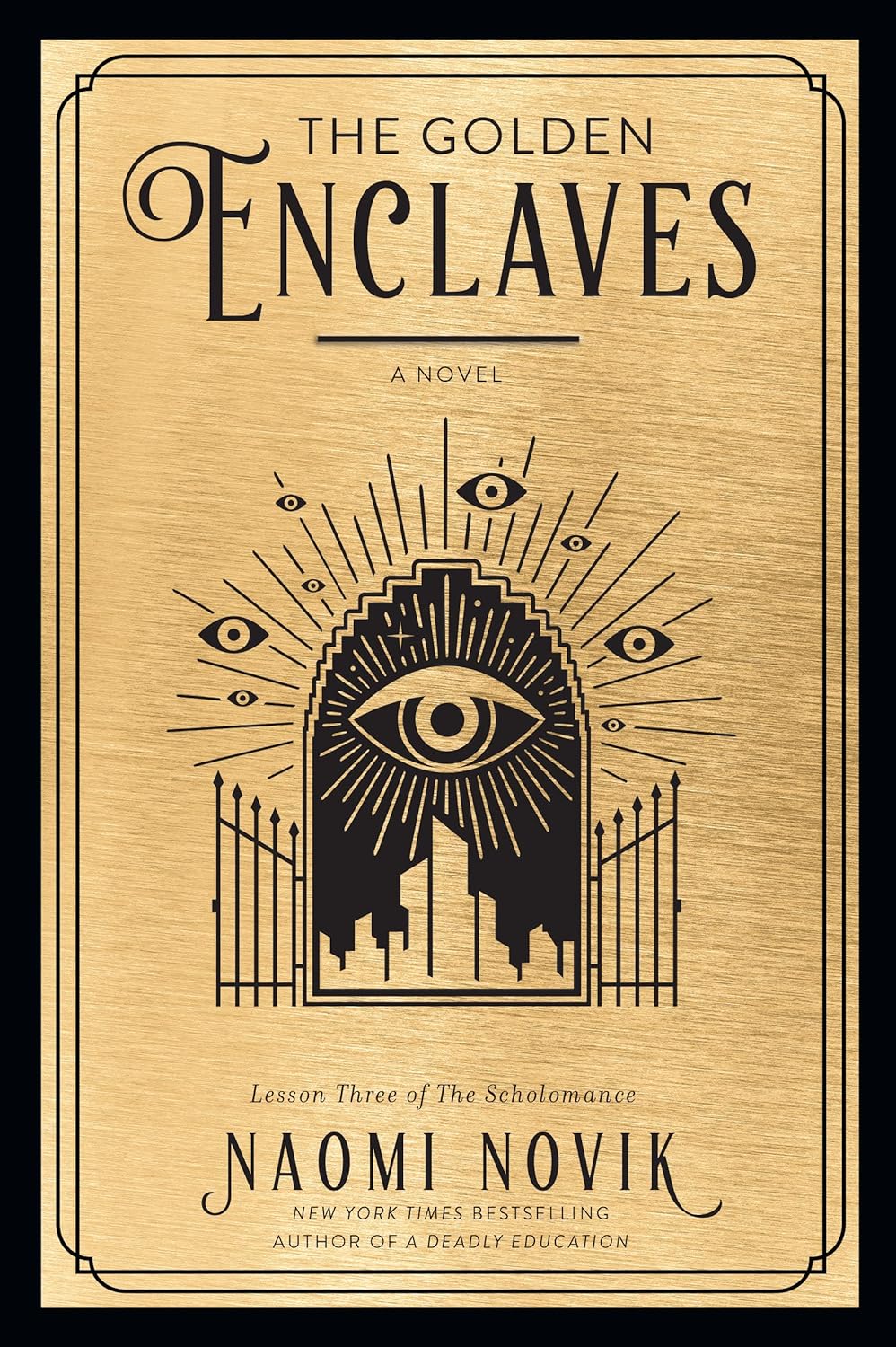
The Golden Enclaves by Naomi Novik

**Spoiler-Free!**

Following A Deadly Education and The Last Graduate, The Golden Enclaves wraps up the Scholomance series. I am very pleased with this conclusion and the whole series. For spoilers’ sake, this review includes practically no plot summary.

As a series finale, The Golden Enclaves takes on a lot, and involves a ton of action, ranging very widely in the ‘true’ geographic world as well as in the void and the magical spaces that populate Novik’s imagined world. A number of characters take great steps; this is indeed a coming-of-age for El, who has graduated from the Scholomance and achieved some real victories, but only to step out into a larger world where the monsters are decided not all neatly taken care of. She’s suffering some losses, not least in realizing the limits of her powers: she is one of the most powerful wizards ever, but there are still limits. We see her take less advantage of the friendships and alliances we’ve seen her form up til now, but also find news ones and/or revive some that have lain dormant.

I love about this whole series that it offers commentary on class divisions and the ethics of who gets to be safe and cared for in the world. Those themes are strengthened here, and complicated. There is a very pointed conflict of interests that she calls a trolley problem, of the highest order; El must face that she cannot (so to speak) save them all, that every choice has a cost. In the face of this frustration, she wavers, considers giving up. We have learned that El is incredibly strong and strong-willed; she doesn’t give up easily. But we have also never seen her tested like this.

I love the characters, including one or two who are still ‘rising’, coming to center stage. I love El herself so dearly; she struggles so hard with this book, even after having accepted help and friendship, and her struggles often yield some good snarky humor and fun amid the pathos. Novik has enormous world-building power, which was evidenced at the series’ start but is still at play here, because our understanding of the world (and El’s understanding of it!) must expand considerably in this book. I’d recommend her to anyone.


Rating: 8 bricks.

Mr. Fox by Helen Oyeyemi

Of the Oyeyemis, this one leans toward the more accessible for me, which is not to say I entirely understood what was going on, but I had a lower rate of whaaat?? than in some cases. I’m still not sure what it is about this author that although she frequently bewilders me I’m still on board.

Mr. Fox is, in most cases, a writer. Mary Foxe is his creation: a fictional character, or a muse, or an imaginary friend. There is also a Mrs. Fox, Daphne, who is married to Mr. Fox in the (if you will) real world; in some versions she is his third wife. She is jealous of Mary Foxe, whose existence is often in some question. There are various iterations of these circumstances throughout the book; it claims to be a novel (it’s right there on the cover!) but I would buy it as a collection of linked stories. Sometimes there are literal foxes. Often there is some reference, if oblique, to fairy tales. I don’t entirely agree with the back-of-book blurb’s description of what happens here, which is interesting. It is possible that one of us is wrong, of course, me or the blurb-writer–likely me, although I’ve seen the other happen!–but I think it’s possible that Oyeyemi has left things a bit up in the air.

I thought we had an organizing principle, briefly, in the idea that Mary was pushing Mr. Fox to do less killing off of his characters, particularly his female characters. (He is not an especially likeable man, and this is one manifestation of something unpleasant about his attitude toward women.)

What you’re doing is building a horrible kind of logic. People read what you write and they say, ‘Yes, he is talking about things that really happen,’ and they keep reading, and it makes sense to them. You’re explaining things that can’t be defended, and the explanations themselves are mad, just bizarre–but you offer them with such confidence. It was because she kept the chain on the door; it was because he needed to let off steam after a hard day’s scraping and bowing at work; it was because she was irritating and stupid; it was because she lied to him, made a fool of him; it was because she had to die, just had to, it makes dramatic sense; it was because ‘nothing is more poetic than the death of a beautiful woman’; it was because of this, it was because of that. It’s obscene to make such things reasonable.

I would have been interested in this guiding principle for the novel, but that is not this novel. It’s only a thread.

I’m going to stop saying much about Oyeyemi’s books. I more or less understood this one and it was an interesting ride. I’ll read another. If you know of a class I could sign up for online to help these books make more sense, I would pay for such a class (no joking).


Rating: 8 fountain pens.

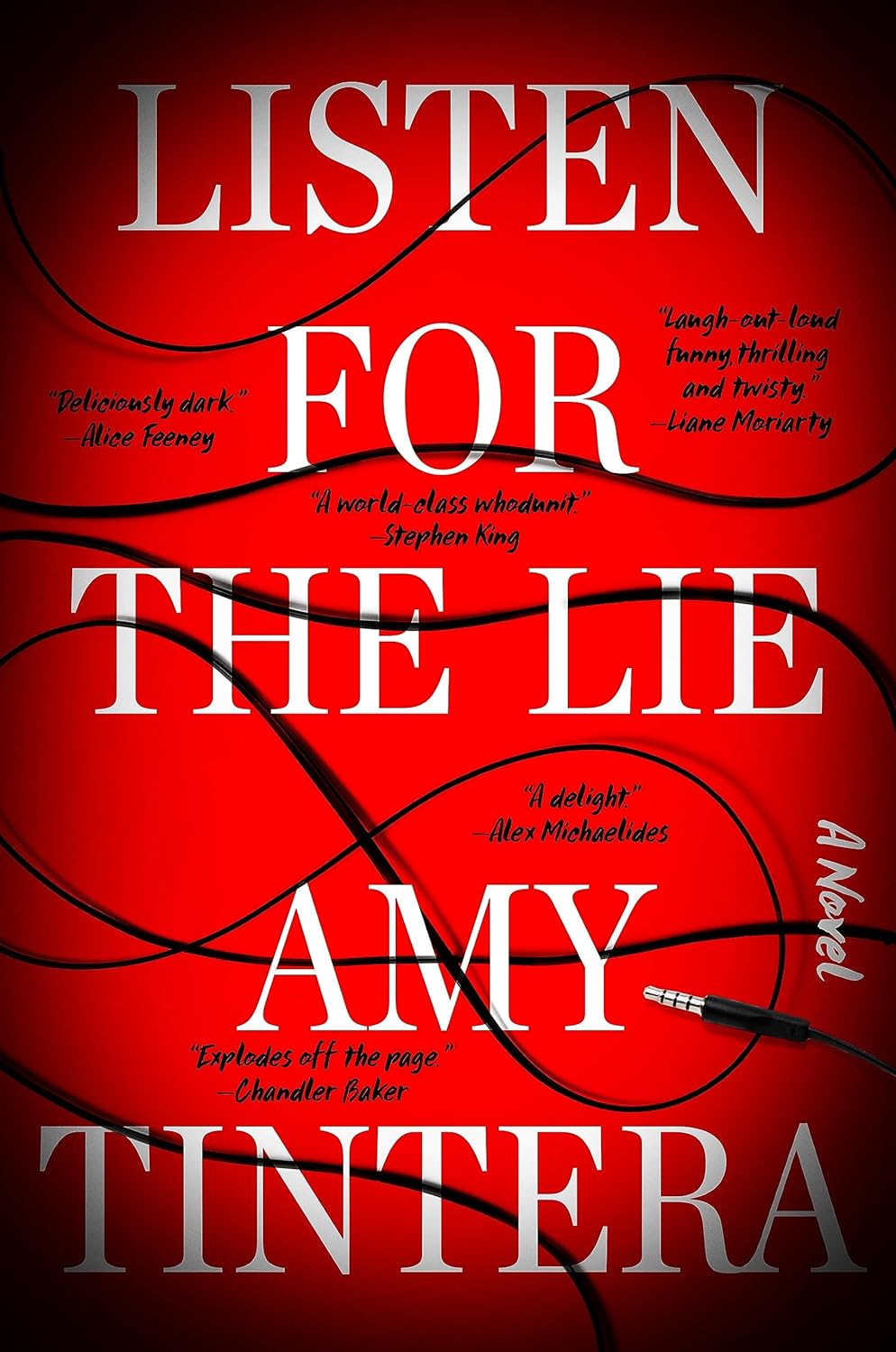
Listen for the Lie by Amy Tintera

Small-town dramas, sharp humor, strong characters, and a touch of romance spice up a genuinely fun mystery.

With Listen for the Lie, Amy Tintera (Reboot; The Q) offers a sexy, compelling mystery as her adult debut. Entertaining characters act out the intrigues of murder and of small-town life, with dark humor, propulsive pacing, and a properly confounding whodunit.

Lucy Chase has been living a not-particularly-successful life in Los Angeles. When the novel opens, she has just been outed by a true-crime podcast as the overwhelmingly favored suspect in the murder of her best friend five years earlier, in the small Texas town where they both grew up. Now that she’s been fired from her job and her boyfriend is trying to break up with her, she lets her grandmother (her last friend and defender in the world, it seems) talk her into coming home for a visit. Back in Plumpton, Tex., she immediately runs into Ben Owens, the true-crime podcaster who’s on his way to ruining her life. He is obnoxiously sexy, and perhaps less out to get her than she’d originally thought, but Lucy’s hometown offers her no comforts.

One morning, after they left a party together, Savvy was discovered dead in the woods, and Lucy was found nearby, walking down a back road, covered in Savvy’s blood, her skin under Savvy’s nails, and her fingermarks bruised into Savvy’s flesh. Lucy had a head injury; she’s never remembered anything about that night. Her then-husband and her parents, along with the rest of the town, were quick to assume her guilt, but there was insufficient evidence to charge her with Savvy’s murder. Lucy decided to move far away, to L.A., and try to start a new life. Not that it was going well, but being back in Plumpton, with everyone staring her down, sure of her guilt, is worse. Lucy is spirited, witty, and bold; if “innocent people don’t make sarcastic comments,” she’s guilty as can be.

Strangely, Ben, the annoyingly attractive podcaster, is the only one to question why everyone in this town (including Lucy herself) was so quick to assume Lucy’s guilt. The circumstantial evidence is damning, but Ben is able, with amateur detective work, to expose enough secrets to complicate the case considerably. Lucy is as surprised as anyone.

The murder suspect’s amnesia throws a wrench in readers’ ability to guess at Tintera’s plot twists. Even as Lucy wrestles with trauma, balancing guardedness with rare vulnerabilities, she and Savvy reveal a real sense of fun. Plumpton is a thoroughly realized setting, complete with neighborhood personalities and an authentic small-town dynamic. Listen for the Lie is quite sexy, compulsively readable, and laugh-out-loud funny, and Tintera has left herself healthy room for a sequel.


This review originally ran in the January 4, 2024 issue of Shelf Awareness for the Book Trade. To subscribe, click here.


Rating: 7 wineries.

Starling House by Alix E. Harrow

I still love Alix Harrow! Starling House has been much anticipated, and I think it fits neatly into her body of work, combining fantasy and whimsy with darkness and grit, as well as romance and a touch of sweet, but not so much that you don’t still feel the hard bite underneath. This protagonist reminds me quite a bit of Chuck Wendig’s Miriam Black; she’s hard-edged and a resolute loner, even though her heart is much softer than she’ll allow. She’s rough and dirty and antisocial, damaged but so strong.

I’m a cheat and a liar, a trickster and a tale-teller, a girl born on the ugly underside of everything. I’m nobody, just like my mother before me.

Her name is Opal. No last name, or whichever one she’s chosen for herself in the moment, like her mother before her. Her mother died when Opal was fifteen, and she’s been parenting her little brother–who was only five–ever since. Jasper is her only priority in life.

I’m a high-school dropout with a part-time job at Tractor Supply, bad teeth, and a brother who deserves better than this dead-end bad-luck bullshit town… People like me have to make two lists: what they need and what they want. You keep the first list short, if you’re smart, and you burn the second one. Mom never got the trick of it–she was always wanting and striving, longing and lusting and craving right up until she wasn’t–but I’m a quick learner. I have one list, with one thing on it, and it keeps me plenty busy.

Jasper is smart and talented, and his debilitating asthma is a bad match for the coal town of Eden, Kentucky. Opal is determined to get him out.

But she is distracted by the magnetic pull of the Starling House, a mysterious old haunted mansion that you can’t see from the road, but this doesn’t stop Opal from dreaming about it. One day she just sort of allows her body to take her there, and she meets its latest enigma of an owner/resident: Arthur Starling, an unkempt, haunted man about her own age. They both know Opal should steer clear of the House, but the House has a consciousness of its own, and once the seal has been cracked–contact made–her life is irrevocably intertwined with Arthur’s, and the House itself, and its weird and inexplicable history. The Starling House, it seems increasingly clear, is all bound up with the town of Eden and the terrible bad luck and sin and crime and hopelessness that Opal wants so badly to free Jasper from.

This is a novel that focuses on place, history, what it means to belong, to stay or to leave, and the meaning of home. Eden’s history includes coal mining, slavery, exploitation, and class divisions. The Starling family has been around for generations, and their role is ever-changing and unclear; the Gravely family has been around just as long, and they are the wealthy coal and power magnates, handing out favors around town or made of pure evil, depending on your perspective. There are a host of other compelling characters, including a loveable motel owner and an even more loveable librarian and a country cop who, again, falls somewhere between doofy and evil. I quite like Jasper, too. Harrow is good with characters, although not all of these are equally well developed.

So, a strong sense of place and a big role for place to play in the narrative. Great characters, with cleverness and snark and grit. And an emphasis on the power of storytelling, and questions about story versus history. “I told myself that writing down somebody else’s story wasn’t as bad as making up my own, the way repeating a lie isn’t as bad as telling one.” “I know that part of the story must be made up, because there’s no such thing as curses or cracks in the world, but maybe that’s all a good ghost story is: a way of handing out consequences to the people who never got them in real life.” “I saw this old map of the Mississippi once. The cartographer drew the river as it actually is, but he also drew all the previous routes and channels the river had taken over the last thousand years. The result was a mess of lines and labels, a tangle of rivers that no longer existed except for the faint scars they left behind. It was difficult to make out the true shape of the river beneath the weight of its own ghosts… That’s how the history of Starling House feels to me now, like a story told so many times the truth is obscured, caught only in slantwise glimpses. Maybe that’s how every history is.”

Finally, at the heart of Starling House is a mystery about power dynamics and the very nature of reality–as well as monsters, imagination, dreams and hopes and hopelessness, family, connections and home, and even romance. It’s a wild ride of a good time. I’m enchanted.


Rating: 8 Ale-8s.

No Son of Mine by Jonathan Corcoran

Disclosure: Jon has taught as guest faculty in my MFA program. I admire his work and he is a dear friend.


Also, I am teasing you about a book that will not be published for months (April 1 of this year, no foolin’), but I’ll repost then to remind you.

Now on to the show.


I found this memoir remarkable. It encompasses much in terms of its time span and the bigger events in the world, and Jon accomplishes something special by being raw and vulnerable, and never self-indulgent. I think the struggles he portrays here will offer something to any reader, because we are all struggling to navigate even the closest of relationships. I am impressed by the writing in terms of that larger storytelling and meaning-making, as well as line by line.

Corcoran grew up in a small town in West Virginia that is just a few minutes’ drive from where I live now. (It’s always a little exciting to read a place written well that you personally know, and I did enjoy that part here. Elkins is not perfect, but I think this author has handled it with respect for both positive and negative qualities.) As a gay kid, he suffered in the town, in the evangelical church his family attended, and in his family itself. He did some secretive explorations of sexuality in West Virginia (not too dissimilar, I think, from those in The Rope Swing, which is however fiction), but did not live as an openly gay man until he left for college at Brown University. Coming from poverty, Brown was both a great accomplishment and a shock: a wider world, but rarified, and Jon was a foreigner to many of his peers and professors there. It’s at Brown that he met Sam.

In his second year at Brown, Jon is in Portland, Maine, with his boyfriend, Sam, meeting Sam’s family for the first time. It’s his twentieth birthday when his mother calls, seething with what she’s discovered. Jon confirms that he is gay. “You are no longer my son,” she says, and she hangs up. This leaves him traumatized, trying to finish college with no financial or emotional or any other kind of support, with no family, and no options, surrounded by Ivy League administrators whose understanding of what all this means is so poor that he is advised to take a year off and travel. His mother spends the next six months calling in the early morning and waking him up to tell him he will die of AIDS or go to hell, or both.

Jon and his mother spend years–fifteen years, the rest of her life–being estranged and trying again, having massive, blow-up fights and years of silence, and abuse and toxicity and cautious attempts at peace and acceptance. Her bad behavior is horribly, shockingly bad. But tangled up with the bad is the fact that this is his mother, his caretaker, whom he has loved, and who still (somewhere, twistedly) loves him, and misses him when they are on the outs. It’s a level of trauma that’s hard to fathom if you haven’t lived it. But as a narrator, he does a good job of describing its effects, including a mistrust of memory and various physical ailments. It also poses some challenges for his relationship with Sam, which will continue until they eventually marry, and into the present.

This is a memoir of trying to reconcile a parent that the narrator loves, his memories of her and of his hometown, with the pain inflicted at the hands of that same person (and place). It’s all a puzzle, to question the causes, to wonder how much forgiveness is due to such a figure. It’s a memoir that is also an assay, both a personal narrative and an exploration of ideas. “…some part of my brain is perpetually trying to explain her actions, to find the root cause for them, and what this really comes dangerously close to is the notion that her actions have an excuse, that if I searched hard and long enough the hurt and pain she caused me can be written away. But she hurt more, a voice says, and I don’t doubt that. So here I am, operating the world’s worst justice system from the recesses of my brain.” “I do not know how to balance all the pain she caused with all the pain she felt.”

There’s a lot to appreciate here, and a lot of wisdom that I think will help just about anybody. Not to say answers, but wise observations about one man’s experience. Most of us are wrestling with difficult, tangled-up relationships where abuse and love meet; many of us are struggling with what to take and what to leave about a family or a place. “I hear her laugh, hear the crinkle of her dyed-blonde hair. I rub her cracked feet, feel her hand on my back. I smell her nicotine fingers. There is her cup of Lipton tea in the little ceramic mug that is white with flowers around the brim. I taste the milky black tea. And I say, I don’t want to lose this all. I don’t want to lose what made me.” There is also some lovely writing here. If the story itself is often difficult, there’s a remarkable amount of grace, beauty, and hope. I think it’s a book for anybody and everybody. Thank you, Jon, for sharing so much in a way that feels both raw and wide-open, and careful and thoughtful. I’m awed.


Rating: 9 paper bags.

The Hunter by Tana French

Tana French is at her best with this character-focused sequel to The Searcher, featuring humor, angst, pathos, and mystery in a tiny Irish village.

In The Hunter, Tana French (The Searcher; The Witch Elm; The Trespasser; and more), building on the success of eight previous novels, delivers the mystery, atmosphere, and feeling her fans have come to expect.

Following the events of The Searcher, French takes her readers back to the tiny Irish townland of Ardnakelty, where former Chicago Police Department detective Cal Hooper has settled to live a quiet, scenic life and repair furniture. He’s already gotten more than he signed up for, including a lovely, levelheaded girlfriend named Lena; a surrogate teenaged daughter, Trey; and a place in the local social circles (and the pub). But when Trey’s long-absent father resurfaces with a get-rich-quick scheme, he threatens the equilibrium of various village relationships, including those Cal holds most dear. The previous novel saw Cal struggle to find his role in a new place; in The Hunter, he knows what he has to lose and, even more importantly, what Trey does.

French is at her best in this novel, showcasing its sharp, scintillating sense of place (Ardnakelty is a character unto itself) and powerful mood of foreboding and that of secrets deeply held. “The overhead bulb isn’t bright enough,” she writes, “and the fringed lampshade gives its light a murky tinge; when the men stay still to listen, it smears deep, tricky shadows into their faces.” Later, she writes: “The mountain is sly. From far off, its low, rounded curves look almost harmless…. It’s a place whose dangers only come into focus when you’re already engaged with them.” This kind of ambience is cut by sudden, surprising bursts of laugh-out-loud humor.

Cal Hooper can be likened to a old western hero, with his staunch personal code; he equally recalls a hard-boiled detective: he’s retired but, despite best efforts, he’s not done investigating. The father-daughter dynamic so delicately established between Cal and Trey–who share no blood and met only two years ago in the previous novel–is heart-wrenching, gorgeously written, and under threat. He trusts her, but she’s “much too young to have something the size of her future in her hands.” Cal and Lena’s relationship is equally engaging, quietly wholesome, and firm. French has never shied away from weighty themes, and here her protagonists wrestle with vulnerability, revenge, and the danger of letting the past determine the future. French masters beautiful descriptions, easy, natural dialogue, a darkly twisting plot, high stakes, and compelling characters. The Hunter is perhaps her finest work–and leaves readers thirsty for more of Cal’s story.


This review originally ran in the December 19, 2023 issue of Shelf Awareness for the Book Trade. To subscribe, click here.


Rating: 9 jars of jam.

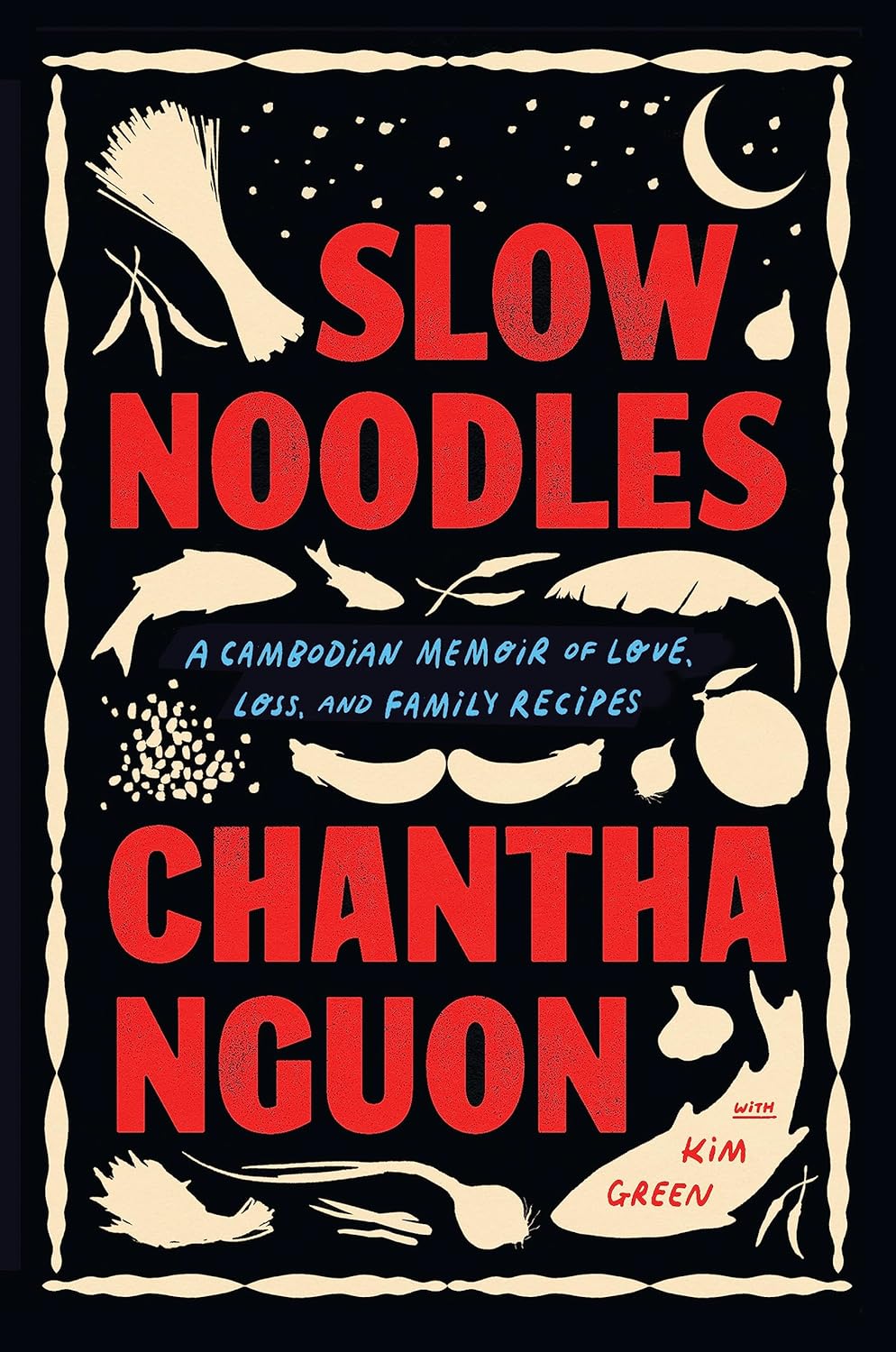
Slow Noodles: A Cambodian Memoir of Love, Loss, and Family Recipes by Chantha Nguon & Kim Green

This memoir of food, family, feminism, and Cambodian history, which includes enticing cookbook-quality recipes, is breathtaking in its emotional resonance and lovely writing.

Slow Noodles: A Cambodian Memoir of Love, Loss, and Family Recipes tells a story that is, by turns, heart-wrenching, inspiring, harrowing, and mouthwatering. Chantha Nguon’s memoir, written with Kim Green, encompasses both world history and an intimate personal account. Nguon, born the youngest child in a comfortable family in Cambodia’s Battambang, had nine years of soft living and good eating before Pol Pot reset time to Year Zero in the 1970s. Moving first to Saigon, where she weathered the end of the Vietnam War, and then escaping as a refugee into Thailand, Nguon gradually lost everyone she loved, ending with her mother’s death when Nguon was 23. She was a food-focused young child with a mother who took cooking very seriously; she became a young refugee in peril of starvation. For Nguon, rationing or missing entirely the most basic of ingredients is not only a literal life-or-death issue but also symbolically life-altering. With the loss of her family and, to some extent, her culture, she views herself as a repository of recipes, culinary knowledge, memories, pain, and strength.

Food metaphors enrich this book, which sparkles with poignant, deeply lovely writing: “The green-fresh fragrance of young rice is as lovely and fleeting as childhood itself.” Nguon’s mother “taught [her] the art of rebelling as quietly as a whisper of silk.” Twenty-two recipes learned from Nguon’s beloved mother, or developed throughout her own accomplished cooking life, are included, with clear instructions and helpful notes on ingredients (and accompanied by a glossary for potentially unfamiliar terms). These are joined by cleverly figurative recipes, such as the recipe for silken rebellion, which begins: “Find the pockets of freedom available to you. Exploit loopholes.”

By the end of the story, Nguon has transformed into an impressive woman, acting as her husband’s equal (a radical concept, encouraged by her quietly rebellious mother) and a fierce advocate for social change. Nguon, who becomes a staunch feminist, eventually undertakes medical and humanitarian work with AIDS patients and sex workers, fights for education and independence for Cambodian women, and with her husband, founds the Stung Treng Women’s Development Center in rural Cambodia.

Nguon’s titular noodles contribute enormous metaphorical meaning. In her childhood household, slow and proper cooking was prioritized (“my mother despised the flavor of shortcuts”). In Thai refugee camps and in the Cambodian jungle, instant noodles became a prized delicacy. And by the memoir’s end, this thoughtful narrator has integrated these experiences, valuing both the careful preparation of fine foods and the stark relief of basic nutrition. Slow Noodles is a rare gem of a story, gorgeously written, humble and stirring, and packed with tempting recipes.


This review originally ran in the December 14, 2023 issue of Shelf Awareness for the Book Trade. To subscribe, click here.


Rating: 9 silk threads.

Heavy: An American Memoir by Kiese Laymon

Kiese Laymon’s Heavy is everything they say it is. I’ll start with some adjectives from Roxane Gay’s front-cover blurb: “astonishing. Difficult. Intense. Layered.” Some books – well-regarded, reviewed by smarter, better-qualified folks than me – are hard to write about. I can only add my voice to the chorus.

I think I’d already begun hearing about Laymon when I read an essay of his in Oxford American, which featured (if I remember) Outkast and his Grandmama. I was impressed then and I knew I needed to read this; I’m just sorry it’s taken me this long.

Laymon comes from Missisippi, raised by his mother and grandmother with infrequent contact with his father. He comes from financial insecurity, and a black* American experience that knows it is wildly insecure in the face of white America. His mother and father are both politically minded, and he has plenty of exposure to questions about race and racial (in)justice, but no exposure to the kinds of questions that bother him from a young age: questions about gender and sexuality and safety, consent, bodies, sexual violence, physical health, eating, economic insecurity, housing discrimination, memory, honesty and lies. He has to pursue these questions himself, and while Heavy is the story of his coming-of-age, it’s much more about figuring out how to interact with some of those questions. Truthfulness, bodies, relationships. How to love responsibly, as he puts it.

*I am following his use of the little-b black here even though that’s a change for me.

I did not want to write to you. I wanted to write a lie. I did not want to write honestly about black lies, black thighs, black loves, black laughs, black foods, black addictions, black stretch marks, black dollars, black words, black abuses, black blues, black belly buttons, black wins, black beens, black bends, black consent, black parents, or black children. I did not want to write about us. I wanted to write an American memoir.

That’s his first paragraph. The book is written in the second person to a specific reader: his mother. The narrator and his mother love each other hard, but there is a lot of harm in their love. The reader gets to see young Kiese grow up, from age eleven or so (it jumps around a bit) to an adult professor earning tenure (in traumatizing fashion) at Vassar College. He keeps his reader up to date on body weight, as he tries to cope with his pain by eating his way up to 319 pounds and then by punishing his body with exercise and anorexia down to 150-something pounds. “I knew, and worried, about how much I weighed and exactly how much money I had every day of my life since I was eleven years old.” The title is not only about body weight, although that’s certainly part of it. It’s about the heaviness of life and responsibility. “To white folk and the police, you will always be huge no matter how skinny you are,” his mother tells him.

I love how carefully he cares about words. His mother pushed him to speak a certain way, to keep him safe: no contractions when talking to white people and police. But he defends the unique language that he and his friends use in school, rebelling in their majority-white eighth grade year by using speech patterns that make sense differently. His mother, an academic, has pushed his writing and revision since childhood, but he’s choosing a different language than the one she pushes. “I realized telling the truth was way different from finding the truth, and finding the truth had everything to do with revisiting and rearranging words. Revisiting and rearranging words didn’t only require vocabulary; it required will, and maybe courage.” WHEW. This book begins and ends with short sections titled respectively ‘Been’ and ‘Bend.’ He writes at the beginning, in ‘Been,’ to his mother: “I am writing a different book to you because books, for better and worse, are how we got here, and I am afraid of speaking any of this to your face.” There’s something powerful in writing down what’s that hard to say.

Heavy is artful, lyric, deathly serious, loving, stark. When Laymon becomes a young professor, he catalogs the ways in which he fails his students, and it’s absolutely raw and horrifying, and therefore brave. (I and most of us have failed worse.) It’s radical, in both senses, and I’m going to have to keep thinking about it. I didn’t do this book justice here. Go read it.


Rating: 8 miles.