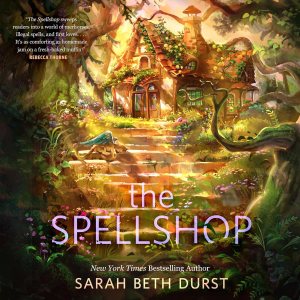
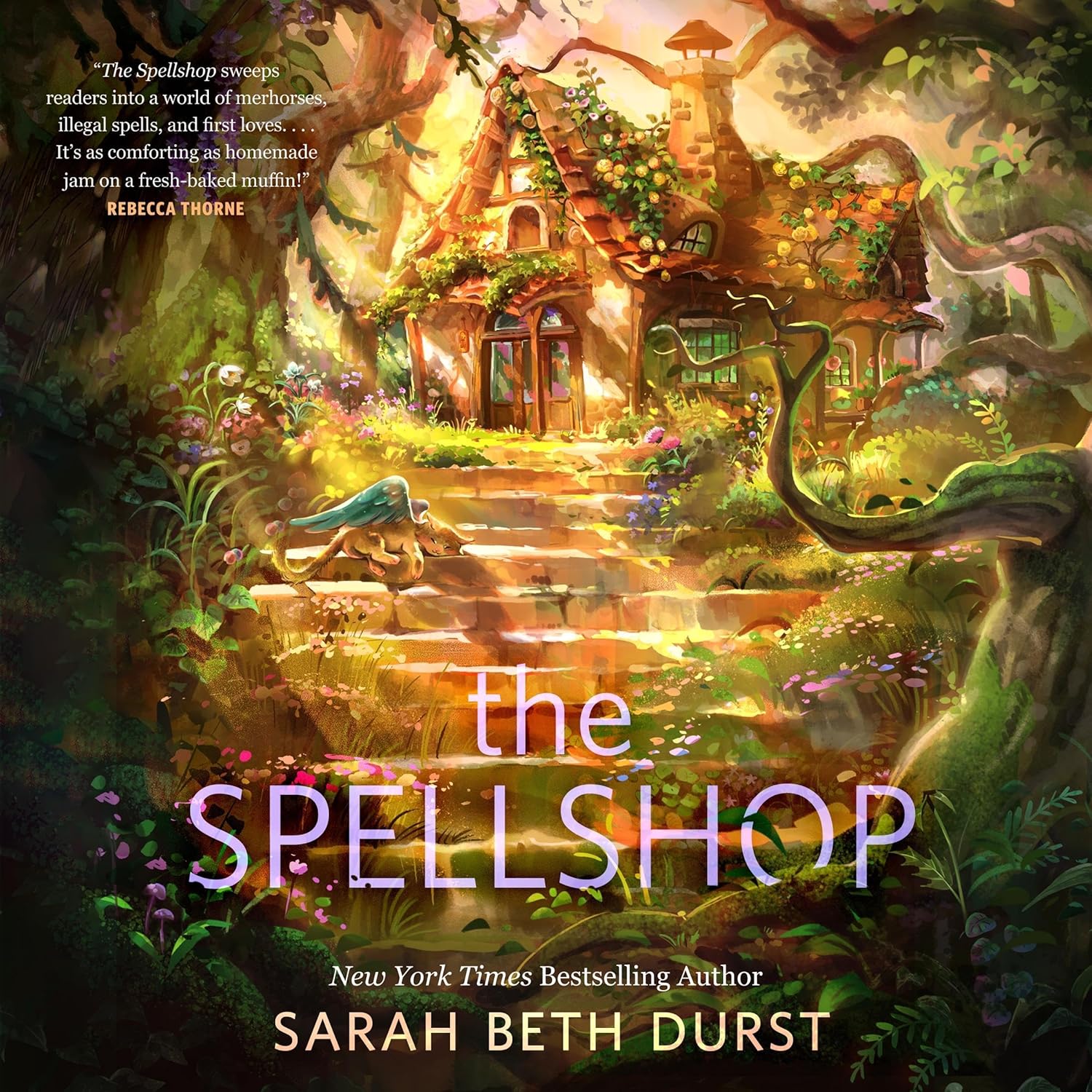
 What a sweet, charming fantasy/romance story about librarians, sentient plants, and the challenges of stepping outside one’s comfort zone. I’m a new fan of Sarah Beth Durst.
We meet Kiela just before she discovers that the library is burning. She’s been sort of lackadaisically sorting books into crates for rescue, not really believing that the rebels would really burn the library – books are sacred! But we quickly escalate through smoke into evacuation: Kiela, eight or so crates of precious spellbooks, and her assistant and best (and only) friend, a sentient spider plant named Caz, load up in a small sailboat and pole out into the imperial city’s canal network and then into the sea. As the city burns, they sail for a place Kiela’s not seen nor thought much about in many years: the island of Caltrey, where she was born and where she lived until her late parents moved the family to the city when she was nine. Kiela and Caz move back into the family’s cottage – not too badly decayed – and immediately face a shortage of both food and funds. They also face a neighbor named Larran, who is handsome, kind, and too friendly for Kiela’s tastes: “We prefer neighborly,” he responds when accused, “but ‘nosy’ is probably just as accurate.” To be clear, Kiela is a total recluse: for years, since her parents died, she’s lived in a corner of the imperial library where she also worked, ordering and receiving her meals without human contact. It’s been an embarrassingly long time since she even talked to another person. And now she is challenged to deal with the inhabitants of Caltrey. Larran is helpful, but Kiela has trouble appreciating this quality, at least at first.
Indeed, at first Kiela feels a little off-putting. Her attitude toward a new acquaintance who’s trying to help is a bit harsher than felt warranted, and I found it strange how unprepared she was to do the simplest things for herself: not knowing how to forage for food or start a fire is one thing, but as an extremely well-read librarian, how has she not at least encountered the concept of survival skills, as in, enough to appreciate how little she knows? But she picks things up quickly. First, she realizes that the island is not quite as idyllic as remembered. The plants and trees are sickly, the springs drying up, the storms worsening, and the merhorses unable to reproduce. (Merhorses are essential to the island’s fisheries, and Larran’s special love: he is a merhorse herder.) Bravely, and not quite legally, she decides to use the knowledge she’s brought to the island. She opens the spellbooks she saved from fire and tries to help. Because remember, this is a magical world: Kiela’s skin and hair are both (naturally) blue. One of her new friends in town has antlers, and another the hindquarters of a horse. The island’s natural rhythms have been thrown off by an imbalance of magic, which is a political issue: the empire’s capitol keeping powers for itself and ceasing to care for its outlying islands like Caltrey. And then there’s Caz, a wonderful character, a wonderful researcher, Kiela’s devoted friend, and possessed of profound anxiety.
Even as I’m writing this review I’m realizing how many facets of this book I found intriguing. I loved the cozy community of Caltrey, both in its flora and fauna and cottages and bakery, and in its community-mindedness – imperfect, as ever we are, but still cozy. I loved the well-built fantasy element, the merhorses and winged cats and purple-swirling storm sky and Caz the spider plant, et al. I did appreciate Kiela’s character, however prickly and hapless she was up front; she has a background of both suffering and neurosis to explain her personality, and best of all, she experiences a real arc of change and growth throughout the book (while retaining, believably, some of her quirks). I loved Larran, and found their trajectory snuggly and loveable, if not complexly plotted. There was a political thread to the story, one that mostly passes Kiela by, at least in her former life: the empire’s power, helping only its urban and upper-class citizenry, what it allows the outer islands to suffer. Even the misapplication of magic that’s led to ever worsening storms is a thinly-clad metaphor for anthropogenic climate change. The politics are not front and center to this story, but I appreciate the sense that Kiela lives in a realistically complicated world, whether she chooses to engage with those parts of it or not – and, realistically, she finds that those elements touch her life and the lives of those she loves, regardless.
This was a really fun, absorbing adventure. I was sad when it ended, and I can’t wait to get my hands on the next related story. For the audio production, I thought narrator Caitlin Davies did a fine job acting and enunciating. I’m all in.
Rating: 8 cinnamon rolls.
Filed under: book reviews | Tagged: audio, cozy, fantasy, romance | 2 Comments »







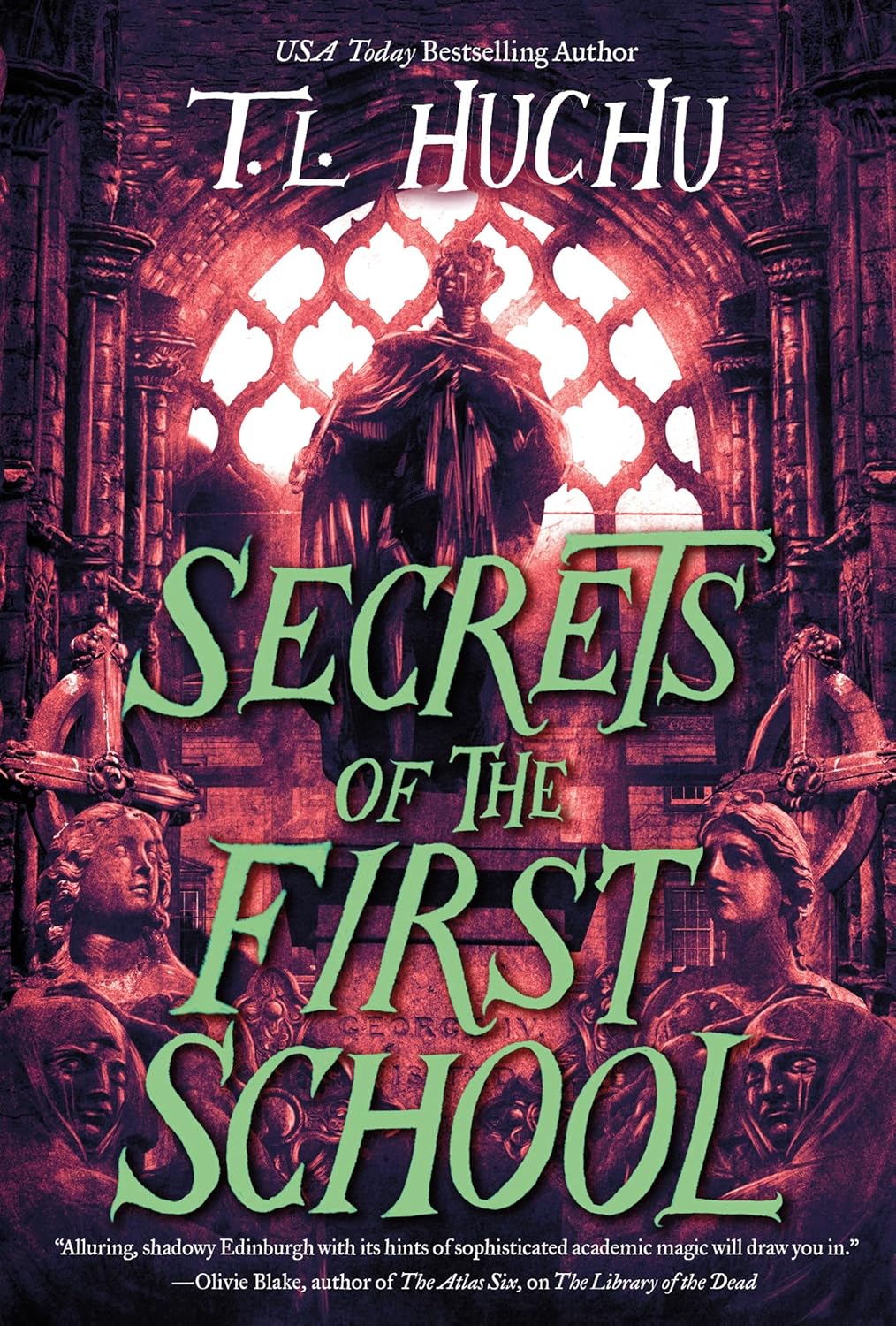 The fifth and final book in Huchu’s Edinburgh Nights series, Secrets of the First School does indeed pull things together and wrap them up neatly (though not overly so). Since The Legacy of Arniston House, Ropa has been through a lot and learned a lot. She continues to evince a teenager’s quick-changing moods and loyalties, but if this is occasionally jarring or even a little irritating, that’s not unlike “real” teenagers, is it. And she’s going through it: the loyalties unto her have taken some jarring turns, too. Avoiding spoilers, I will say we learn some shocking truths about Ropa’s own past, which challenge her relationship with everything and everyone around her.



 pagesofjulia