Summer Solstice by Nina MacLaughlin

Summer is the saturated season. The color floods back in. Each dip is another shot at being reborn, into summer where the world’s blood runs green.
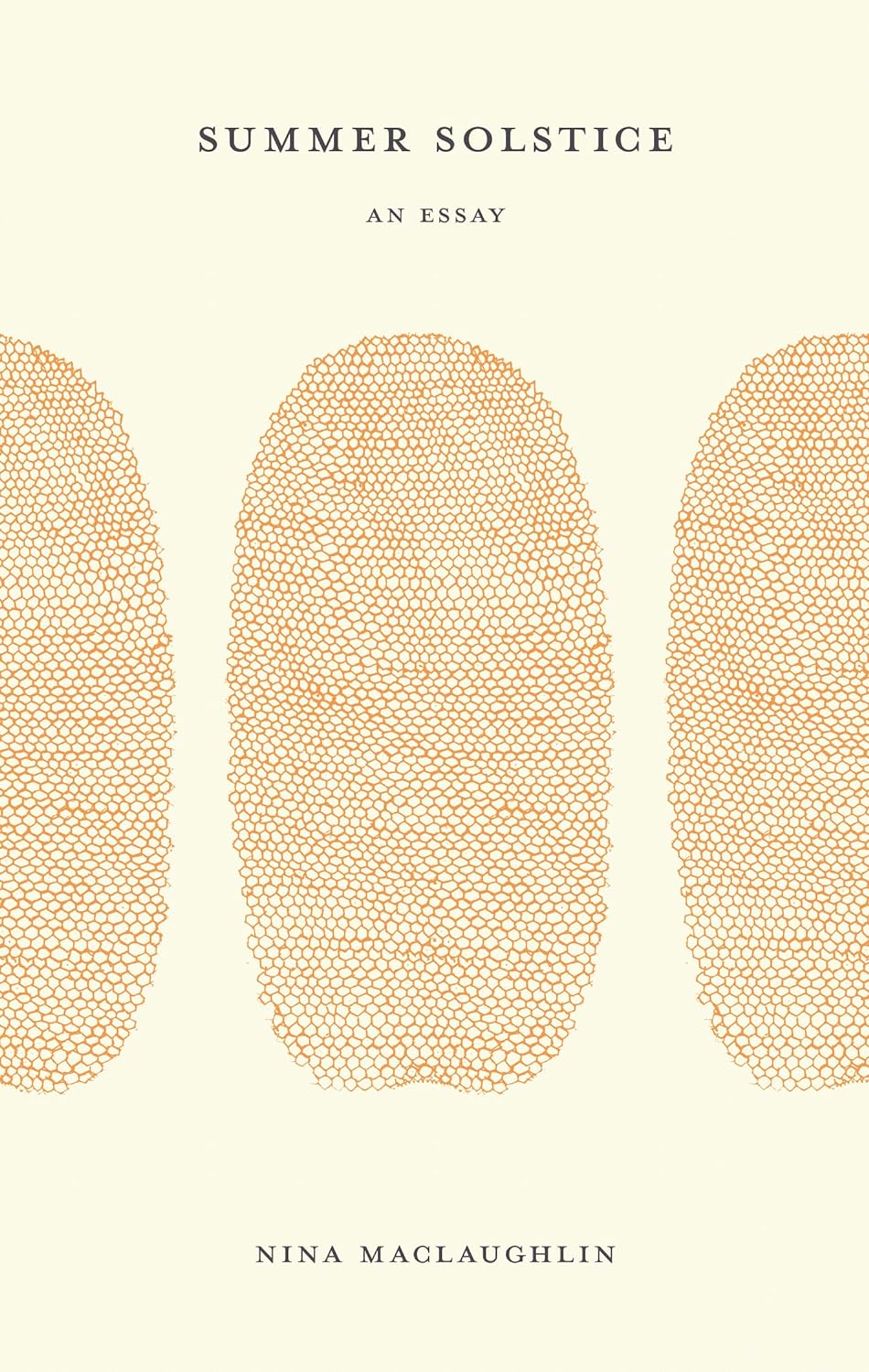
For the summer solstice last night, I had my usual, traditional backyard fire. The traditions – my traditions – are accumulating: this time I had friends and food and drink around the fire as well. And I had a chapter from The Wheel of the Year to read (review forthcoming; it is wonderful), and I had a Nina MacLaughlin essay-book.

Six months ago I read her Winter Solstice, and now the summer one. It is the loveliest kind of homework to wake up and see what timely read I have for the day.

This little book barely clears 50 pages for the essay portion itself: perfectly sized for a same-day read, which is what I did. Now, this means I missed the advice to get up and wash one’s face in the solstice dew at dawn (also admittedly the summer solstice dawn is quite early for me). It is basically a lengthy meditation on summer and its resonances, for MacLaughlin and beyond; she has a number of works cited, mostly other works of literature (poetry, music) to which she refers, as jumping-off points for further musing. This won’t feel like ‘research’ so much in the traditional and dry-sounding way you might be thinking (although it *does* count as research!); more of a mining of other minds and cultural markers for how we think about summer, and midsummer or the solstice in particular. She does begin in early June, building into summer that way. MacLaughlin’s summer involves much swimming and waters, as well as fire, and sweat and sun and shade and fireflies (or lightning bugs) and a few other things we may hold, culturally, in common around here (several mentions are made of hot dogs). At least compared to my memory of Winter Solstice, I think there was less study of other cultural and historical handlings of the event. That could be my memory. Or it could be that Summer predated Winter by several years (ha) and the concept developed a bit in that time. This one does still offer an addendum of “Plant Matter,” featuring a few prominent plants and herbs associated with the summer solstice. I like that part.

I was not entirely surprised, in the Afterword, at MacLaughlin’s confession that she prefers winter. Again, perhaps it was just (or partly) the few years between books, but Winter Solstice felt fuller and richer to me. (Or maybe it was the hot mulled wine that accompanied that one, for this reader.) I am a summer person, myself, but her work on winter enriched that time for me considerably. There is still, here, the sensuality that I appreciated so much.

I would eat up more like this. I wonder if MacLaughlin would do the equinoxes, and maybe samhain and lúnasa and more…


The Rent Collectors: Exploitation, Murder, and Redemption in Immigrant LA by Jesse Katz

Street gangs and street vendors in L.A.’s MacArthur Park, a pair of botched murders, and a number of criminal trials shed light on social ills in this sensitive study.

Jesse Katz (The Opposite Field), longtime Los Angeles journalist, tackles a true story featuring a daunting number of characters and spanning years and tragedies in The Rent Collectors: Exploitation, Murder, and Redemption in Immigrant LA. With admirable clarity and compassion, Katz unravels a complex narrative that has no easy answers.

In the MacArthur Park neighborhood of L.A. in 2007, a teenaged gang member under orders fired five shots at a street vendor, in retaliation for the vendor refusing to pay “rent” to the gang. The intended victim was badly wounded by four bullets; the fifth bullet struck and killed a nearby 23-day-old infant. The shooter, Giovanni Macedo, was in turn the victim of a botched murder attempt at the hands of fellow members of his gang, the Columbia Lil Cycos, as punishment for his error. Giovanni eventually testified and helped put many gang members behind bars, receiving a sentence of 51 years for his crimes.

Katz’s thorough account details Giovanni’s personal and family history; the history of MacArthur Park; the cultural and economic predicament of L.A.’s immigrant street vendors; the background of the Columbia Lil Cycos, the larger 18th Street alliance, and the Mexican Mafia; the lives of Giovanni’s victims; and California’s law enforcement, judicial, and prison systems. It’s a sprawling story, but riveting and propulsive in this telling. The Rent Collectors deftly probes systemic ills. A large population of undocumented immigrant street vendors is squeezed between L.A. enforcement and street gangs: “MacArthur Park strained under the exigencies of that shadow population, a virtually permanent subclass left to invent its own opportunities, to improvise its own survival.”

Giovanni’s family background leaves him with a shortage of options and a desperate desire to belong to something bigger than himself. Immigration, legal, and prison systems fail, frustratingly often, to reward behaviors society deems “good” or to address adequately the “bad.” Giovanni is the protagonist of this story, drawing near a parole hearing at the time of this book’s publication; Katz portrays him with sensitivity and an eye to the complexities that led to his crimes. Giovanni is an imperfect symbol of redemption, but Katz shows that the marginalized teen was at the mercy of inexorable and deeply problematic societal forces. Abstaining from painting heroes or villains, Katz offers instead a plethora of thoughtful, nuanced profiles and a zoomed-out view of immigrant L.A., its street vendors, its gangs, and its intricacies. The result is relentless, multi-faceted, and incisive.


This review originally ran in the May 10, 2024 issue of Shelf Awareness for the Book Trade. To subscribe, click here.


Rating: 7 pairs of earrings.

Maximum Shelf: Creation Lake by Rachel Kushner

Maximum Shelf is the weekly Shelf Awareness feature focusing on an upcoming title we love and believe will be a great handselling opportunity for booksellers everywhere. The features are written by our editors and reviewers and the publisher has helped support the issue.

This review was published by Shelf Awareness on May 8, 2024.


Rachel Kushner (The Flamethrowers, The Mars Room) envelops her readers in an absorbing tale of espionage, philosophy, intrigue, and chaos with her noir fourth novel, Creation Lake.

An unnamed narrator opens these pages with extended quotations from the e-mails of a man named Bruno Lacombe, which she is reading without his knowledge. Bruno’s ideas will form an important thread throughout the novel, although he never appears in the flesh; the epistolary sections offer a perspective on events, a worldview, in juxtaposition to the narrator’s. She begins by reading his e-mails as part of her job, but their meaning will shift. And Bruno’s corporeal absence allows for some question as to his true form.

This narrator, presently using the alias Sadie Smith, is an American woman living in France. A former FBI spy, she was fired after a case she worked as an undercover agent did not bring the trial result the agency desired. Now she performs similar work for shadowy private interests: she takes on a character and infiltrates a group, instigating as well as observing its actions. In the Guyenne region of France, she is to penetrate an organization of anarchist environmental and anti-civilization activists called Le Moulin and learn of their involvement in a recent act of sabotage. The assignment to observe and investigate becomes an assignment to provoke further action, and she may yet be asked for more.

Creation Lake has layers. It is partly a spy novel. “Sadie” gains entry to the Moulinards through her fiancé, Lucien, a wealthy, privileged young man she easily seduced and moved in with following a carefully planned “cold bump” that Lucien thinks was an accidental encounter. She moves through the community she’s been assigned to, playing one character off the other, with readers privy to her inner commentary about both the assigned mission and the personalities of her new acquaintances. Along with her sexual relationship with Lucien (enacted with carefully concealed distaste), she carries on another affair that is more pleasurable but no more honest. She can be funny, cutting, and disarmingly self-critical. Despite holding all the cards–at least in her own view–“Sadie” is not precisely a highly organized personality.

Creation Lake is also in part an exploration of philosophies, as Bruno preaches the virtues and qualities of the Neanderthal and other early relatives and forebears of Homo sapiens. An enigmatic figure, he lives in a cave and extols the virtues of primitivism by e-mail. Kushner’s not-necessarily-reliable narrator brings a certain amount of mystery herself: amoral, even nihilistic, she seemingly cares not a bit about the principles at question in her work, but only about her paycheck and a few simple pleasures. Unmoored by the FBI, she has no leader or cause to follow, barely pausing at collateral violence. Importantly, her role with the Moulinards is that of a sympathetic outsider hired to translate their writings. Rather than a true convert, she is able to ask questions, showing curiosity and a friendly skepticism. This allows her to fully explore the Moulinards’ beliefs, although she is unimpressed by their devotion to principle.

None of these characters is heroic or even especially virtuous; the narrator points out the hypocrisy and self-serving nature of the activists. “Charisma does not originate inside the person called ‘charismatic.’ It comes from the need of others to believe that special people exist.” On the other hand, she may find herself more susceptible to the philosophies of the unseen Bruno than she was equipped for. Bruno apparently writes these e-mails for one audience–the Moulinards–but they will perhaps have their greatest effect on the audience he is apparently unaware of.

With punchy short chapters and bursts of action, the plot builds tension to a boiling point while resisting any convention or formula of the spy novel genre, which it reinvents as much as it inhabits. Kushner’s pacing is inexorable, ratcheting up tensions to propel readers to a surprising ending. Spare, even stark, Creation Lake considers the past and the future of humankind without sentiment, letting the narrator’s unblinking observations stand alone. She is hardworking and apathetic, drinking a bit too much and going through the motions of a job that she has no particularly strong feelings about.

If Kushner’s expansive plot considers no less than the very origin and fate of humanity, “Sadie” considers only her next destination. As focused as she can be on the job at hand, her approach to life is profoundly blurred. Gritty and hard-edged, this is a novel of both cynicism and belief, with a mysterious narrator at its center, adrift but anchoring its plot. There is something dark at work throughout, but Kushner keeps a sense of fun, pleasure, and unexpected humor as well. “Deep down, even if they lack the courage to admit it, inside each person, they know that the world is lawless and chaotic and random.” Taut and propulsive, Creation Lake leaves its readers with plenty to think about once its pages close.


Rating: 7 cans of warm beer.

Come back Friday for my interview with Kushner.

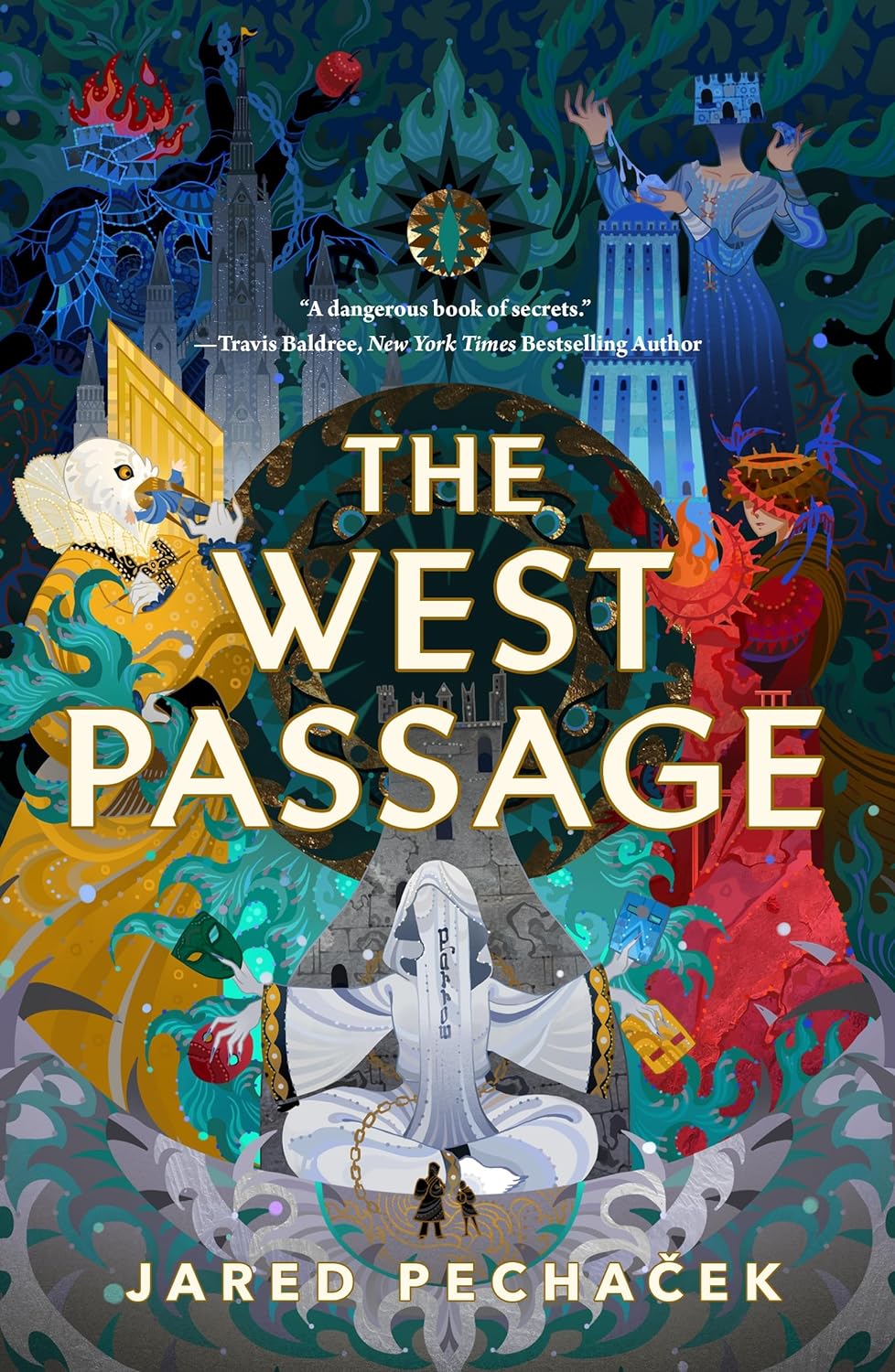
The West Passage by Jared Pechaček

Wildly imaginative world-building, a spellbinding plot, and profoundly weird characters make this fantasy debut a memorable adventure.

The West Passage by Jared Pechaček introduces a marvelously strange cast of characters struggling against outsized forces in a world both reminiscent of medieval Europe and unlike anything readers will recognize.

Pechaček’s teenaged protagonists are Pell, an apprentice to the Mother of Grey, and Kew, apprentice to the Guardian. One has trained in stories, songs, history, and rituals for births and deaths, the other in protection from the Beast. They live in Grey House, one of the five towers in an enormous palace that can take days to cross. Gargantuan, monstrous Ladies rule over the looming, decaying towers. The Ladies and their roles have changed and shifted slowly over many eras, their origins almost beyond all memory. Upon the deaths of the Mother and the Guardian, both Pell and Kew are thrust into positions they aren’t quite prepared for. Before the Beast rises again, for the first time in an era or more, they must each quest beyond Grey to save the world they know.

Kew departs first, striding fearfully with his books and little else down the West Passage. In just the early pages of his adventure, he meets a sort of trout-person and a creature with rabbit ears, battles with jackals, and rides in a lantern that moves to a whistle. Pell encounters apes and a crazed tutor, befriends a Butler Itinerant riding a hollowman, and collects an unlikely stowaway. Genders are changeable, and Ladies as well as wheelbarrows can hatch from eggs. Political machinations dating back to the “time of songs” are still at work in ways difficult for these protagonists to comprehend. “Was there no transfer of power that did not involve destroying the old? It seemed now that everything he knew about the palace’s history was the merest thread in a tapestry bigger than his mind could encompass.”

Pechaček provides detailed descriptions of otherworldly creatures: “Three corresponding shoulders sprouted beneath them, leading to three arms, though one was severed just above the elbow and capped with chased gold. The parts of her that were not talon-like were the same glassy material as her hands.” The effect is often disorienting but always fascinating, and despite extreme variations from the “real” world, questions about power structures and agency remain relevant. Pell and Kew have been brought up to uphold tradition and ritual, but to save the world, they must grapple with the possibility of change, and of choice.

The West Passage is an absorbing tale of political intrigue, touching comings-of-age, and a mind-bending phantasmagoria.


This review originally ran in the May 3, 2024 issue of Shelf Awareness for the Book Trade. To subscribe, click here.


Rating: 7 leaves.

The Dallergut Dream Department Store by Miye Lee, trans. by Sandy Joosun Lee

Sleepers shop for dreams at a very special department store, where dreams may come true not only for customers but for employees as well.

With The Dallergut Dream Department Store, Miye Lee explores the nature and power of dreams, the possibilities created by choosing them, and human nature itself. Whimsical and sweet, this debut novel translated from Korean by Sandy Joosun Lee will leave any reader musing and looking forward to a good night’s rest.

“For centuries, Penny’s hometown has been famous for its sleep products. Now it has evolved into a metropolis…. The locals, including Penny, who grew up here, are used to seeing outsiders roaming around in sleepwear.” Penny is terribly excited to interview at the Dallergut Dream Department Store, the crown jewel in a town devoted to sleepers’ needs. She has studied the mythology and history, but meeting Dallergut himself is intimidating. However, he turns out to be nothing but nice, forgiving her learner’s errors and prioritizing the sale of the right dream to the right customer, even over profits. Penny fangirls over the greatest dreammakers, whom she gets to meet in her new job: Nicholas, who specializes in seasonal dreams; Babynap Rockabye, who creates conception dreams; Maxim, who does surprising work in a dark back-alley studio; and Bancho, who cares for animals.

Penny has so much to learn, from bank deposits to the Eyelid Scale, not to mention the power of precognitive dreams. Purchased dreams are paid for only after they have had an effect on the sleeper, and payments come in the form of emotions experienced, so no one pays in advance or for a dud. Dreammakers can get fabulously rich and famous, but their best reward is helping people (or animals). Nap dreams differ importantly from longer ones. “Bad” dreams may serve a purpose, too. And there is, perhaps unsurprisingly, an important link between dreams, in the sense of aspirations and ambitions, and dreams as in the images and sensations that visit sleepers.

Penny is an innocent, wide-eyed disciple of Dallergut and his good works, as well as the celebrity dreammakers. Through her perspective and her refreshing tone, readers encounter an appealing, absorbing, imaginative world with rules for who designs experiences for whom. In her translator’s note, Sandy Joosun Lee calls The Dallergut Dream Department Store “a story that is both fun and deep… unpretentious yet full of life,” and keeps Penny’s observations disarmingly enthusiastic and earnest. The pleasing tale, while simple on its surface, asks questions about self-determination and the mysterious power of nighttime imaginings to impact one’s daily, “real” life. With a Calm Cookie or a Deep Sleep Candy, or just the right dream, all things are possible in Lee’s captivating world.


This review originally ran in the April 19, 2024 issue of Shelf Awareness for the Book Trade. To subscribe, click here.


Rating: 7 cups of forest-scented tea.

Killing for Keeps by Mari Hannah

Doing another short-short review of this fifth book in the DCI Kate Daniels series.

Pros: compelling plot; compulsively readable. I continue to care about the protagonist even though she frustrates me with her choices! I remain fully invested in Kate’s character arc, and would have immediately dived into book six if I had had it handy. I love secondary character Hank Gormley even more.

Cons: the writing does continue to take me out of the story, only momentarily, but over and over. There continue to be too many ‘things’ where a better noun is almost always available. Some logical leaps don’t feel quite earned for me. (I’m so sorry I did not make note of these for examples. It’s a credit to the book that I wasn’t motivated to go find a pen. Or, I was camping in below-freezing weather and didn’t want to get out of bed.) Each book’s murder mystery plot is electric, but Kate’s romantic difficulties feel stalled and I wish we would get a move on.

What can I say? The pros are absolutely winning and I suspect I’m going to rocket through the next few books as I get a hold of them. But not without qualifications. I wonder if I’ve just been missing the genre; I’m going to try Kate Atkinson next. Any other tips?


Rating: 7 parakeets.

The Talented Mrs. Mandelbaum: The Rise and Fall of an American Organized-Crime Boss by Margalit Fox

In the late 1800s, a female crime boss ruled New York City, as colorfully detailed in this exhilarating narrative history.

Margalit Fox (Conan Doyle for the Defense; The Riddle of the Labyrinth) brings a lively storytelling style and a flair for conveying personalities to a history that’s stranger than fiction with The Talented Mrs. Mandelbaum: The Rise and Fall of an American Organized-Crime Boss.

“‘You are caught this time, and the best thing that you can do is to make a clean breast of it,’ one of the Pinkertons… advised Mrs. Mandelbaum as she was led away. In reply, Fredericka Mandelbaum–upright widow, philanthropic synagogue-goer, doting mother of four, and boss of the country’s most notorious crime syndicate–whirled and punched him in the face.” To the modern mind, attuned to Scarface-style organized crime, Mandelbaum was an unlikely candidate for her role: Jewish, female, an immigrant, penniless upon her arrival in the United States in the mid-1800s. But through shrewd business practices and motivated by her desire for her family’s survival and comfort, the woman known as Ma, Mother, and Marm Mandelbaum established what would become a multi-million-dollar empire. She backed her staff of shoplifters, pickpockets, and bank burglars with training, supplies, project funding, bail money, and lodging–indeed, mothering them while setting a standard for criminal organization, including a highly specialized school for safebreakers.

Fox successfully tells this story by letting colorful characters stand out. “About six feet tall and of Falstaffian girth (she was said to have weighed between 250 and 300 pounds), pouchy-faced, apple-cheeked and beetle-browed, [Mandelbaum] resembled the product of a congenial liaison between a dumpling and a mountain.” She is pursued less by the New York police departments (multiple, corrupt, and at odds with one another) and more by the detectives of the nascent Pinkerton Agency who were hired to bring her down in a changing world. Both police and Pinkertons provide memorable characters to boot, on top of the regular and freelance lawbreakers Mandelbaum employed. Fox has a sharp eye for humor: “At the interment, it was reported afterward, some mourners deftly picked the pockets of others. Whether they did so in tribute to their fallen leader or simply from occupational reflex is unreported.” And she sets this wild narrative in the context of its time, Gilded Age America, aglitter and crooked and facing massive economic and social change. The world of Herbert Asbury’s Gangs of New York both provided the long shot for a Jewish matron, and punished her for her nerve.

With copious notes and research, Fox offers a tale as madcap and thrilling as it is illustrative of American history and culture. The Talented Mrs. Mandelbaum is riveting for fans of both history and entertaining storytelling.


This review originally ran in the April 16, 2024 issue of Shelf Awareness for the Book Trade. To subscribe, click here.


Rating: 7 diamond stickpins.

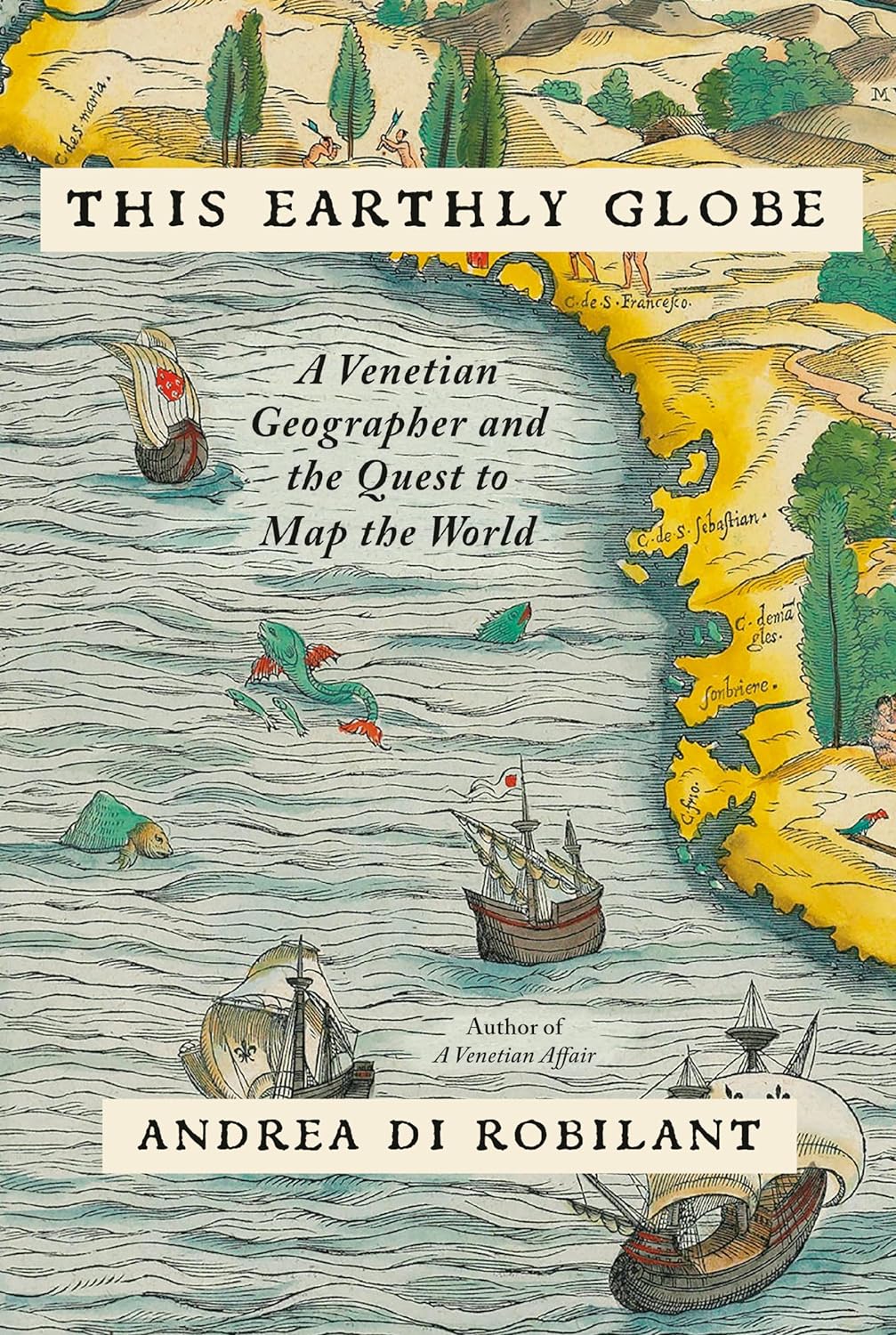
This Earthly Globe: A Venetian Geographer and the Quest to Map the World by Andrea di Robilant

This romp through history relates the lives and adventures of many travelers whose stories were compiled by a self-effacing Venetian civil servant in an extraordinary publishing feat.

With This Earthly Globe: A Venetian Geographer and the Quest to Map the World, Andrea di Robilant takes a convoluted but purposeful journey through history as well as geography to follow a remarkable achievement: the publication in the 1500s of an unprecedented three-volume collection. Navigationi et Viaggi, or Navigations and Journeys, was the life work of Giovambattista Ramusio, a career civil servant in Venice, but his name was not at first attached to “this remarkable collection of travel narratives, journals, private letters and classified government reports.” Humble and hardworking, Ramusio spent a lifetime compiling documents and notes from an impressive assortment of travelers. He found an early version of Marco Polo’s travel writings, corresponded with contemporary European explorers, and nurtured sources for long-secret documents; he was a dedicated editor, translator, and collector responsible for “one of the great publishing feats of the sixteenth century. It played a vital role in the final emancipation from a vision of the world still anchored to antiquity and became an indispensable source for the great cartographers of the second half of the sixteenth century.”

The world travelers whose notes, journals, drawings, and maps informed Ramusio’s work provide most of the color for di Robilant’s lively history. Ramusio’s own life is described, but it is Marco Polo, al-Hasan ibn Mohammad al-Wazzan, Antonio Pigafetta, Andrea Navagero, and many others whose adventures brighten these pages. Di Robilant (A Venetian Affair, Chasing the Rose, Face to Face) recounts their stories in vibrant detail. Marco Polo, in the region of present-day Afghanistan, saw “the landscape… stark against the deep blue sky: steep barren mountains, silvery green poplars along the banks of the river, the occasional mud village, and always a few flocks of sheep here and there nibbling at the rocky terrain.” Al-Wazzan, a “careful observer and diligent note taker… amassed a wealth of information on everything from the price of grains to particular weaving techniques to the quality of local wines in the places he visited.” He and Ramusio shared a “notion of what geography should be: not just maps and place-names but a more encompassing description of territory that might include observations on local crops, on manufacture, on trade patterns, on systems of transportation, irrigation and communication, on the social and political organizations of villages and towns, on religious practices.”

Di Robilant unfolds centuries of history, a dizzying array of characters, and a wide world of geography and culture in an easy storytelling style without falling into a dry recitation of facts and dates. This Earthly Globe offers a broad, accessible narrative about a publication that changed the world as it helped define it. Obviously for fans of history and geography, this sparkling story will also please general readers.


This review originally ran in the April 12, 2024 issue of Shelf Awareness for the Book Trade. To subscribe, click here.


Rating: 7 pomegranates.

Fatal Games by Mari Hannah

Book four in the DCI Kate Daniels series (following most recently Deadly Deceit) is Fatal Games, for me the most successful to date. I’ve enjoyed each of the previous three books, but always with some reservations, and wishing for a bit more of Daniels’ personal side, feeling she was a bit underdeveloped, perhaps. This time something finally really clicked for me. Don’t get me wrong: the fact that I’m still here for book four means something was working, but this one knocked it out of the park in a new way.

For one thing, I felt that we got into some personal life: not so much that of Kate herself, actually, but especially a few other characters. In fact, I’m beginning to buy that Kate is truly defined by an absence of personal life! (This is not a new message from the author, but maybe it took some convincing.) Secondary characters have more layers: I really like Daniels’ second in command, Hank, who is a real friend as well as professional Watson type. Her ex, Jo, also a professional colleague, is definitely more well rounded. And now we meet Emily, a friend to the rest, who appears mid-crisis: recently widowed, she has just returned to work as a prison psychologist, not the least stressful job to begin with, let alone grieving and struggling to parent a grieving twenty-year-old to boot. When further trauma presents itself – this being a murder-mystery series, friends – Emily does not cope well. Kate is perhaps not showing her best self when she says that her friend is “acting as mad as a box of frogs,” but she’s not exactly wrong, either. One character in particular gave me the creeps; I was not sure if he was going to turn out to be an actual bad guy (in the murder-mystery sense) or ‘just’ a really toxic dude, but ew. Throw in a manipulative psychotic sex offender and a few prison guards of questionable moral standing, and you’ve got a motley crew.

The mystery was properly complex, the cast of characters increasingly compelling, Kate herself showing the usual conflict between wanting to have a life outside work and being incapable of it. It started working for me in this book like it hasn’t before. I could feel her wanting, and trying, and then being consumed once again by the job – which, to be fair, is pretty soul-consuming, and it’s hard to be angry with someone for wanting to solve crimes and save lives… but if you’re her prospective partner, you do want some of her attention. Poor Jo.

The plot, which I’ve not even touched on yet, does involve murdered young girls. There are some truly heinous criminals. And even the law-abiding ones ostensibly on the ‘right’ side can offer some frustrations. It’s a hard-boiled mystery – note that blurb on the front cover that credits Hannah with ‘a dark heart.’ I’m on board like never before.


Rating: 8 gifts.

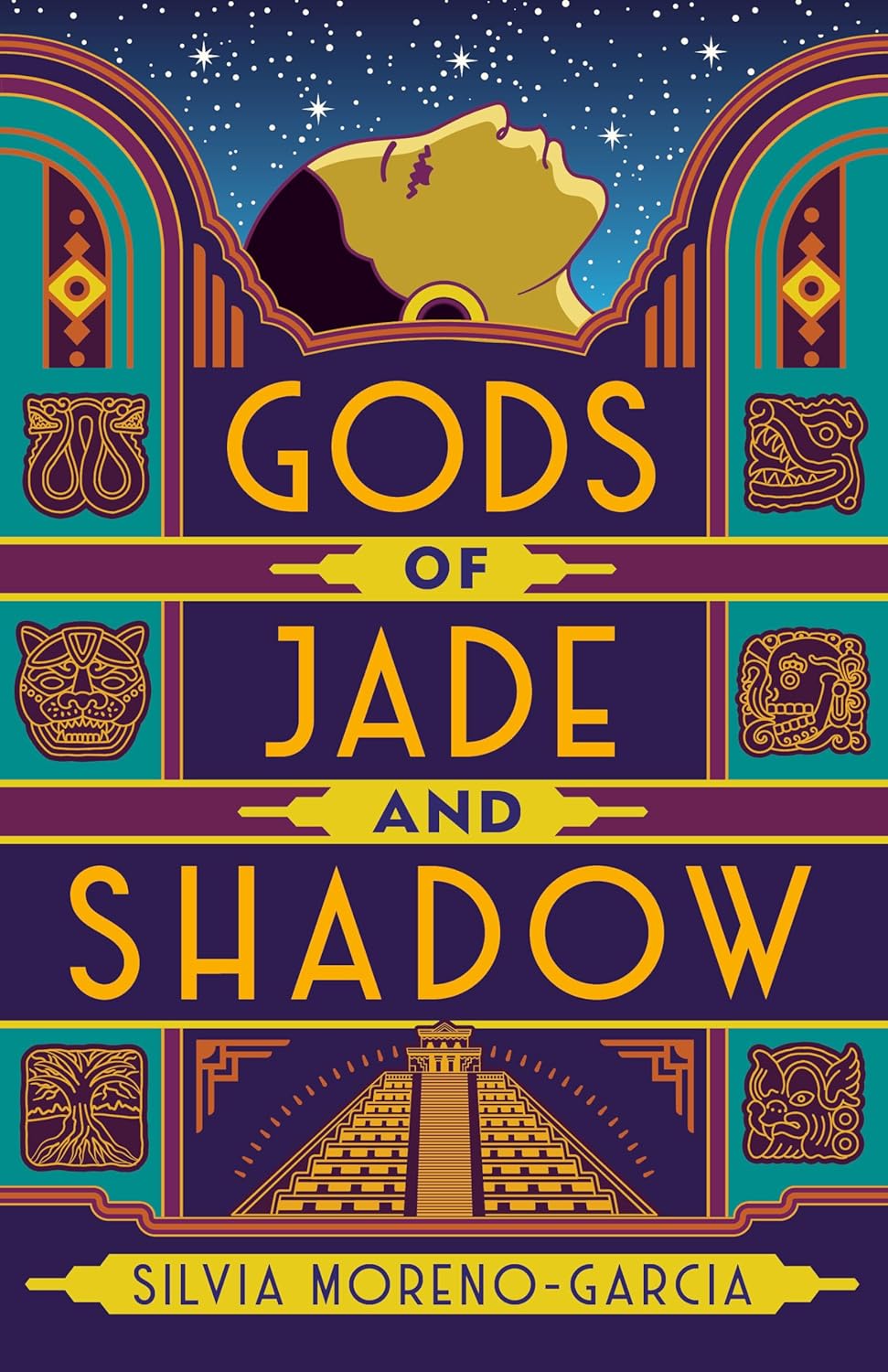
Gods of Jade and Shadow by Silvia Moreno-Garcia

A little bit of a fairy tale retold, relying more on Mayan mythology, recast in 1920s Mexico: culture, myth, and universal coming-of-age. I found it absorbing and will read more by this author (helped along by the teaser chapters at back of book from one of her other novels!).

We meet Casiopea when she is in her teens. She still thinks often of her father, a sensitive poet who taught her about the stars and named her for a constellation. Since his death, she and her mother have returned to her mother’s family home, where they are very much treated as poor relations, Casiopea doing a lot of scrubbing on her knees while harshly spoken to. Her grandfather is harsh, her aunts dismissive, but it is her cousin Martín who is cruelest. She is well aware of the Cinderella story and would prefer not to be framed this way–“she had decided it would be nonsense to configure herself into a tragic heroine”–but the reader sees it too. Instead, she resist self-pity, aims to never let her tormentors see her cry, and dreams secretly of escaping her small-minded small town and returning to her father’s city of Mérida.

She gets there by the most unexpected of paths: she accidentally releases a god of death, Hun-Kamé, who has been long imprisoned in a chest in her grandfather’s bedroom. With a fragment of his bone imbedded in her thumb, they are bound together. Hun-Kamé, dethroned and locked up by his twin brother, is missing a few key components–eye, ear, finger, and necklace–without which he cannot be. In his weakened state, Hun-Kamé needs the connection with Casiopea to move and live and make a bid for redemption, although this bond will make him increasingly mortal over time. And Casiopea will weaken and die if he does not remove the bone. But in the meantime, she gains a traveling companion, a meaningful quest, an adventure.

As a traveling companion, Hun-Kamé can be irksome; he has a tendency to boss her around, like everyone else in her world does, and servitude and submissiveness have never come easily to Casiopea. She is not afraid to work hard, but does not respond well to peremptory orders. She has to remind herself that this is a god–especially when traveling companion begins to feel like friend, something she’s really never had, and then even like something more. For his part, Hun-Kamé makes an effort to treat his traveling partner with respect. They have something, surprisingly, in common: both know the world mostly only at a remove, she from books, he from a distant deity’s omnipotence.

There is a lot to love about this story, several layers. Casiopea is a fun heroine: plucky, exasperated, curious about the world and yearning for fresh new experiences, yet concerned about breaking free of the rather conservative lessons she’s been taking in for a lifetime. The wider world is in flux: especially the cities she visits, like Mérida, Mexico City, and Tijuana, are full of music, fast dancing, and short-haired women in short dresses, all considered scandalous in the dusty village where Casiopea has spent her Cinderella years. In the company of a god who can pick up rocks off the ground and make them appear as coins, she suddenly has access to (for example) good things to eat, and I really enjoyed the repeated scenes where the mortal teenager is hungry and the god sort of sighs and patiently visits one café or restaurant after another even though food is not really his thing.

So we have a good-hearted, mature, responsible teenager–who is still a teenager–on a very important quest, the implications of which she and we learn only gradually, but also learning about the world, which is filled with cars, nice clothes, appealing snacks, flappers and ballrooms, and oh yes, a handsome god who is becoming part-mortal and therefore increasingly relatable. But also, because we’re drawing on Mayan myth, plenty of blood and monsters and decapitation and the highest of stakes. (Casiopea is as horrified as you are). Romance, mythology, violence, humor, dances and dresses, and family drama: in a fitting parallel, Hun-Kamé’s rival twin chooses as his own mortal champion the bumbling, cruel Martín, who is unlikeable but only human in his own struggles, to face off against Casiopea. It gets harder and harder to see how these characters will fight their way out of a pickle that involves fate and gods and a truly horrifying underworld, but read on til the end.

I love every bit of it, and got lost in this unique world. Can’t wait for more.


Rating: 7 waves.