Shut Your Eyes Tight by John Verdon

A breathtaking thriller in which retired NYPD Detective Dave Gurney can’t resist involving himself in the grisly case of a decapitated bride even as the case threatens his personal life.

Retired NYPD Detective Dave Gurney lives in the Catskills with his wife, Madeleine, trying to adjust to their new life and learn to appreciate nature. Madeleine is content, but Gurney can’t seem to halt his obsession with criminal investigations, so when a former colleague offers him the sensational case of a decapitated bride connected to a bevy of juvenile sex offenders and an international crime family, he can’t resist. The seemingly impossible and horrifying details fascinate him. Gurney ends up endangering himself and threatening his relationship with Madeleine, who resents the gruesome menace he brings home.

The case of the murdered bride expands and contorts to involve sexual psychology and sexual abuse, and is complicated by police forces so bent on thwarting one another that they seem willing to risk the case itself. The puzzle of the murder mystery, in which we participate alongside Gurney, is suspenseful and challenging, and as a psychological thriller keeps the reader breathlessly turning the pages.

Gurney is a likable character, tortured by his own past, and conflicted in his view of himself as a talented detective but an imperfect husband and father. He worries that he may be uncomfortably similar to the sociopaths he hunts: incapable of compassion and caring, more concerned with the chase than with his family. The reader sympathizes, however, as he grows into a fully developed man, battling an evil that increases as the story progresses, until the suspense and fear come together in a final heart-stopping crescendo.


This review originally ran in the July 22, 2011 issue of Shelf Awareness for Readers. To subscribe, click here, and you’ll receive two issues per week of book reviews and other bookish fun!

books that are on their way OFF my TBR shelves

Folks, I’ve said it before: there are too many good books in this world (this is not necessarily a bad thing) and not enough time. I have huge stacks, as do we all, of to-be-read books piled and shelved all around me. If they cave, Husband and two little dogs and I will be crushed. Please help. I’m getting ready to get rid of some of these TBR books that I’m not so sure I need to read, to make room for more. Below are the books that are on my shelves but I can’t remember why. This is your chance to make an argument for any I need to keep. In other words, please remind me why I have these books in the first place. Mom, especially you as I think you’re responsible for a number of them. Otherwise they’re off to better homes (like the library where I work). This is not a tragic fate; they’ll be read, never fear. Just not by me.

(Of course this list does not include all those I KNOW I need to read, sigh. That list is even longer.)

Thank you. GO.

The Elegance of the Hedgehog by Muriel Barbery

The Bookmaker’s Daughter by Shirley Abbott

Red House by Sarah Messer

Good Bones and Simple Murders by Margaret Atwood

(I have never not loved anything by Atwood but this has been sitting for like years. Why has it taken me this long? Should I give up?)

Ellen Foster by Kaye Gibbons

Nanga Parbat Pilgrimage by Hermann Buhl

The Club Dumas by Arturo Pérez-Reverte

The God of Small Things by Arundhati Roy

A Separate Peace by John Knowles

Sanctum by Denise Mina

Scoundrel Time by Lillian Hellman

If I can remember the original reason I wanted to read a book, it has stayed on the shelf. But these need a little push to stay. I await your comments.

the WSJ-YA uproar to which I am late

I had a patron approach me in the library to ask my feelings on this issue.

The background is… more than a month ago, the Wall Street journal published this article by Meghan Cox Gurdon, which immediately became a huge deal. I would encourage you to go read it, because that’s the best way to know what it says, but in a nutshell, this children’s-book-reviewer lady notes an increase in “darkness” in young adult (YA) literature, and comments that darkness is not good for our young adults. While she has some supporters, there was overwhelming indignation among bookish/literary/librarianlike internet dwellers. They have mostly said, in a dark world, kids can actually benefit from reading about situations that are like those they are facing. Also, you shouldn’t censor. The author of the original, offending article has since published, also in the WSJ, a rebuttal.

I resisted entering the fracas, mostly because I feel my opinion is unnecessary (because I’ve read some other excellent responses) and because I don’t feel terribly well-qualified to have an Important Opinion, not being a YA librarian or really much of a reader of YA. Even when I was a YA. But on the other hand, this blog rather exists for the publication of my Not Very Important Opinions, and so I’ll throw it out there.

So. I had a patron approach me here in my (definitively adult) library and ask for my thoughts. I tried to tell her why I’m not qualified to have one but she pushed. So, I told her I agree with those opinions that say, children in rough positions need to read about said rough positions. The cited instances of “darkness” include stories about rape, prostitution, violence in general, poverty, and cutting (self-mutilation). Young people living these situations are in a position to benefit from having them handled wisely in literature, and I appreciate that such things are available. My patron turned out to be (as I understood her position) arguing that children living in darkness need to read about light – happier, brighter situations – to which I say, sure! Great! Let them read that stuff, too! She proceeded to argue that there is too much dark and not enough light; the proportions are wrong; at which point I have to beg off, because my very limited knowledge of current YA doesn’t allow me to debate this point. I don’t know the proportions, quite frankly. I support the idea of diverse options, for sure – in all things, in fact. (For example, there should be more than two political parties in our electoral system.) Lots of options, please. But if you prefer for your YA to read only happier, lighter books, I don’t think that should necessarily limit others – who might be interested in those “darker” ones – in their access to those choices.

I have to take issue with one of Gurdon’s conceptions (from the original article).

In the book trade, [guiding what young people read] is known as “banning.” In the parenting trade, however, we call this “judgment” or “taste.”

I’m afraid she’s confused about “banning.” Or maybe she’s just being imprecise in the phrase, “guiding what young people read.” There are several ways in which parents, guardians, or whoever can guide what young people read. For example, they can pay attention to what their children read, and direct those choices. The Maryland mother whose personal experience begins Gurdon’s article was doing just this. She wasn’t banning anything; she was exhibiting judgment and taste, and guiding her daughter’s reading choices. This is the kind of guidance I recommend; I encourage parents who are concerned about what their children read to pay attention to what their children read, and limit it as they find appropriate. Banning, on the other hand, is what parents and various community members attempt when they submit complaints to public libraries (for example) requesting that certain books be pulled off the shelves. I am in favor of “judgment” and “taste” – I may not agree with yours, but that’s fine as long as your judgment applies only to your child. I am against “banning,” which involves limiting other people‘s access to books. See the difference? Banning is not synonymous with parenting.

I don’t think rape or cutting in books leads to rape or cutting in life. I think it has the potential to offer some relief or catharsis or therapy. Certainly some children don’t need therapy for these traumas; absolutely Gurdon is correct that not all teens are rape victims, thank goodness! But I’m not sure that reading about even those traumas that are outside their experience isn’t necessarily instructive and good, too. (I wasn’t involved in teen violence or gangs, but still found S.E. Hinton’s oft-cited The Outsiders amazing; it was one of my favorite books.) I won’t push these books on your child, certainly, but I fail to see how the availability of these options is a bad thing. Again, I’m all for more options. If I accept my patron’s thesis that there is too much dark and not enough light in YA today, then by all means, let there be more light, in the interest of a multiplicity of options.

But, the vampires I could take or leave, actually.

International Anita Brookner Day


The day is here! Today is International Anita Brookner Day as declared by Thomas over at My Porch. I am 100% behind this celebration, having read first Thomas’s initial argument in favor of Brookner, and then her novel Hotel du Lac which I found lovely (as you can read). So I present to you the

It’s full of book reviews and other reasons to get excited. Go check it out, and find yourself a Brookner book today!

did not finish: Split Second by Catherine Coulter

Caveat: I read (part of) an uncorrected advance proof.

I quit on page 59. Supposedly a suspenseful thriller, but I walked away quite contentedly, so you can judge the success of the suspense elements as you will. In only 59 pages, I saw formulaic elements. One example: woman reacts instantly with disdain for man with Bad Reputation, but is uncontrollably drawn to him, as she notes that actually he’s never been anything but sweet to her. Will they end up together? Come on. If I can guess at sub-plot endings before page 59, you’ve lost your audience.

The writing is terrible. “Lucy brewed herself some strong tea, swallowed two aspirin, a good way to prevent a hangover for her, and walked to the study…” The dialogue is slightly better than the third-person narration, but still feels stilted and forced; real people don’t talk like this. Events don’t flow together; the action is choppy. (Yes, uncorrected advance proof. But if a sparkling gem of a thriller comes out of this I’ll eat my pants. And then I’ll criticize the publisher for disservice to the author in releasing a rather awful ARC of a great book.)

Coulter has a huge fan base, and this book will sell, no doubt. I can’t speak to her earlier work – and really I can’t speak to this one as a finished and complete novel, but the first 59 pages of the ARC are uninspiring. Proceed at your own risk.

The Hard Way by Lee Child (audio)

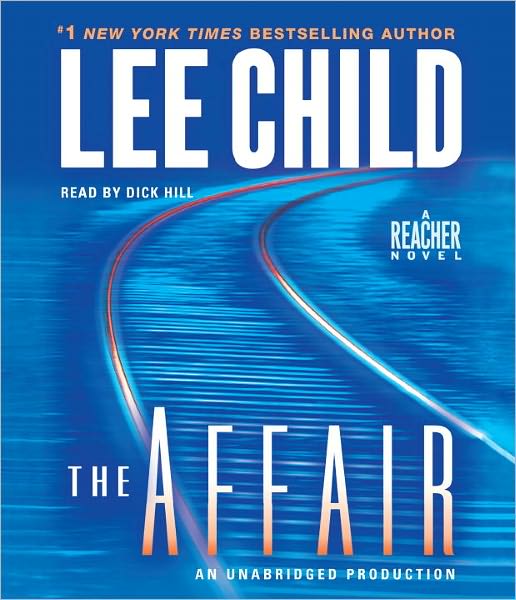
Okay, you all know I’m a big fan of the Jack Reacher series by Lee Child. I have read 9 of the 15 currently out (with The Affair to come in September, yay!). So please take me seriously when I say this is the best one I’ve read yet!

As has become my habit, I listened to this one as an audiobook in the car. I love the narrator, Dick Hill. I think he has just the right mix of slow, serious cadence (imbuing Reacher’s words with the gravity they deserve), and a lightheartedness in the right moments.

And like all the Reacher novels, this novel is fast-paced, suspenseful – I mean real edge-of-the-set, sitting-in-the-driveway-biting-my-nails-while-Husband-wonders-what-I’m-up-to suspense – and action-packed. Reacher is his usual superhero self. Mysterious characters approach him as he tries to mind his own business, and (with limited reluctance) he enters their world, to try and save a kidnapped woman and child. But wait! Are the bad guys really who we think they are? There is intrigue, including military and international intrigue. There are beautiful, sexy, strong, independent women; some of them are also traumatized. There are loyal sisters. Reacher is cool, funny, comforting, and simultaneously rock-hard strong and smart, and brutally violent. (Only when it’s appropriate, of course.)

In The Hard Way, Reacher is recruited by a team of mercenary ex-special forces soldiers to assist in solving the kidnapping of the boss’s wife & step-daughter. As things unfold, he discovers that he hasn’t been told everything – like the fate of the boss’s first wife, kidnapped five years prior, and the fate of two former employees. His loyalties shift; he’s not sure who he can trust. He meets a former FBI-agent, who was involved in the earlier kidnapping case, who may turn out to be a partner of sorts.

I think part of what made this one extra-special to me was the extremity of the danger and trauma at stake, and the happy ending that our sympathetic characters are teased with, the happiness they MIGHT achieve if Reacher is successful. There are some gruesome images offered up; this is not for the faint-at-heart. But if you love a lone ranger with iron-clad morals, a heart of gold, and a Rambo-style ability to inflict pain on those who deserve it, in a world of beautiful/handsome good guys and really bad bad guys, Reacher may be for you. In fact, it’s rather like the traditional Western novel in that lone-ranger sensibility. But these have an intelligence lacking in the traditional Western (not trying to call them stupid; bear with me). Reacher thinks things through in a split second, and we get to share his thoughts on bullet trajectories, angles, percentages, and the weighing of one possible outcome against another. It’s very cerebral at the same time that it’s very physical. I love it.

Before this novel, I didn’t think I’d have favorites within the series. They’re all pretty great. But I’d put this one up there, and if you’re curious, I’d also pick out Echo Burning as a favorite. It was my first Reacher novel, and I picked it up because of the setting: far West-Texas desert on the Mexican border, which is an area where I have spent some very good times. That got me in the door, and opened up the whole series for me, and I’m SO grateful. It had another extra-high-stakes plot (at least for me… I mean, they’re all high stakes, but these two got me somehow, I don’t know. maybe you’d be “got” by a different pair of them) and that setting that I appreciated so much. Also a real knock-down, drag-out OK Coral sort of final scene that really got me going.

Do you read Reacher? Which one is your favorite? And if you don’t – why not?!? No, I jest, sort of. We don’t all have the same tastes. But for suspense and action, I couldn’t recommend it more highly. If not this one, what’s your favorite series? And do you have a favorite within it?

The Eyes of the Panther by Ambrose Bierce

This week’s Story of the Week is The Eyes of the Panther by Ambrose Bierce. I read it in just a few minutes, and after adjusting to the somewhat clunky transition (is it just me? I had to go back and reread) on the second page, I really enjoyed it. It’s spooky; it reminded me of Poe, actually. I was not familiar with Bierce but did enjoy the introduction to him – particularly the mention of his relationship with Hearst, who figured in the book I just finished, Newspaper Titan. Small world. I love it when my reading overlaps itself like that.

At any rate – this is a short story about a woman’s explanation of her own insanity, and I don’t want to tell you more than that. It is quietly disturbing, in an enjoyably, cozily spooky way, and not in an unable-to-sleep-after-reading-it way (for me at least). Go check it out.

Immigrant Picnic by Gregory Djanikian

The 4th-of-July Story of the Week was not a story but a poem called Immigrant Picnic, by Gregory Djanikian. I enjoyed this Armenian-American poet’s celebration of a 4th-of-July picnic in all its multinational, English-as-a-second-language diversity. Please enjoy, below.

Immigrant Picnic

It’s the Fourth of July, the flags
are painting the town,
the plastic forks and knives
are laid out like a parade.

And I’m grilling, I’ve got my apron,
I’ve got potato salad, macaroni, relish,
I’ve got a hat shaped
like the state of Pennsylvania.

I ask my father what’s his pleasure
and he says, “Hot dog, medium rare,”
and then, “Hamburger, sure,
what’s the big difference,”
as if he’s really asking.

I put on hamburgers and hot dogs,
slice up the sour pickles and Bermudas,
uncap the condiments. The paper napkins
are fluttering away like lost messages.

“You’re running around,” my mother says,
“like a chicken with its head loose.”

“Ma,” I say, “you mean cut off,
loose and cut off being as far apart
as, say, son and daughter.”

She gives me a quizzical look as though
I’ve been caught in some impropriety.
“I love you and your sister just the same,” she says.
“Sure,” my grandmother pipes in,
“you’re both our children, so why worry?”

That’s not the point I begin telling them,
and I’m comparing words to fish now,
like the ones in the sea at Port Said,
or like birds among the date palms by the Nile,
unrepentantly elusive, wild.

“Sonia,” my father says to my mother,
“what the hell is he talking about?”
“He’s on a ball,” my mother says.

“That’s roll!” I say, throwing up my hands,
“as in hot dog, hamburger, dinner roll. . . .”

“And what about roll out the barrels?” my mother asks,
and my father claps his hands, “Why sure,” he says,
“let’s have some fun,” and launches

into a polka, twirling my mother
around and around like the happiest top,

and my uncle is shaking his head, saying
“You could grow nuts listening to us,”

and I’m thinking of pistachios in the Sinai
burgeoning without end,
pecans in the South, the jumbled
flavor of them suddenly in my mouth,
wordless, confusing,
crowding out everything else.

Is lovely, no?

Miss Peregrine’s Home for Peculiar Children by Ransom Riggs

What an odd, fun, creepy little romp this was! I had been fascinated by the idea of this book months before it came out. The story is this: our first-person narrator, Jacob, has always been close to his grandfather. Grandpa Portman has told him stories all his life of the peculiar, magical children he grew up with, in a home for orphaned refugees during World War II. He even has pictures: a levitating girl (on the cover); an invisible boy; a skinny boy lifting a giant boulder. As Jacob grows up a bit, he begins to understand that perhaps Grandpa’s stories were just that, stories; but when Grandpa dies in a mysteriously disturbing fashion, in Jacob’s arms, and with the strangest of last words, he begins to wonder again. Under the care of a psychiatrist, Jacob travels with his father back to the tiny Welsh island where Miss Peregrine’s Home for Peculiar Children was located. The story he begins to unravel… well. I don’t want to ruin anything for you.

This is really a YA (young adult) book, for two reasons: 1, the reading level, and 2, the young adult protagonist. Jacob is 16 or 17 years old. I found it very enjoyable, though, and I don’t read YA very regularly. It was a quick read, partly because of the rather basic reading level. But here’s the unique bit: there are quite a few pictures mixed in with the text. Grandpa Portman had a collection of pictures; Jacob has a few of his own; he discovers a cache of pictures in his explorations of Cairnholm Island. And every one of the pictures mentioned in the story is included, so we get to do our own examining of them alongside Jacob. This was very cool, because the oddness (or perhaps, the peculiarity) of these pictures is a large part of the point of this book. And here’s the kicker: while this is a work of fiction, and the impossibility of the photos is obvious, I found an interesting detail at the back of the book. The author writes, “All the pictures in this book are authentic, vintage found photographs, and with the exception of a few that have undergone minimal postprocessing, they are unaltered.” I don’t know what “minimal postprocessing” might entail, but it made me go back and reexamine the pictures all over again, knowing that they each have a real life mysterious story behind them. I love it: an additional facet to this curious tale.

This is a paranormal story, even one of time travel. I don’t necessarily spend a lot of time in these areas, but I found Jacob to be a likeable (if doofy – is this a regular facet of YA, too?) protagonist, and his Grandpa was a real hero. The peculiar children were extremely likeable and fascinating. I had a lot of fun with this diversion from my more normal reading.

Very Bad Men by Harry Dolan

A clever, complex thriller in which a killer hunts the perpetrators of a decades-old crime.

Anthony Lark has three names written down in his notebook, and he’s hunting them down one by one as part of his mission to avenge a 17-year-old crime. David Loogan (introduced in Bad Things Happen) is content with his life in Ann Arbor, with girlfriend Elizabeth Waishkey (who’s a police detective) and her daughter Sarah, and with his job as editor of a mystery magazine. Lucy Navarro is a tabloid reporter trying to dig up a story linking the old crime with a current political campaign. But David is drawn into the murky waters of Lark’s crusade, and Elizabeth is assigned to the investigation, so David feels compelled to help Lucy in her inquiries–especially after she disappears suddenly.

This fast-paced and intelligent thriller is told in David’s voice, but offers insight into Lark’s troubled psyche as well, as he battles the demons that make the words in his notebook breathe and tremble. Readers of the mystery genre will have a little extra fun with David’s work editing mystery stories; we even learn which authors Lark follows. Teenaged Sarah is a spunky addition to the diverse mix of characters trying to solve the crime: amateur David, tagging along with Elizabeth, the experienced professional; and indomitable Lucy, whose past holds a secret or two. Then there are the political players: an aging senator about to retire and his up-and-coming daughter-in-law, who may be tied to an old bank robbery. Complex and well-developed characters, a mind-bending plot and a wry tone make this novel impossible to put down.


This review originally ran in the July 8, 2011 issue of Shelf Awareness for Readers. To subscribe, click here, and you’ll receive two issues per week of book reviews and other bookish fun!