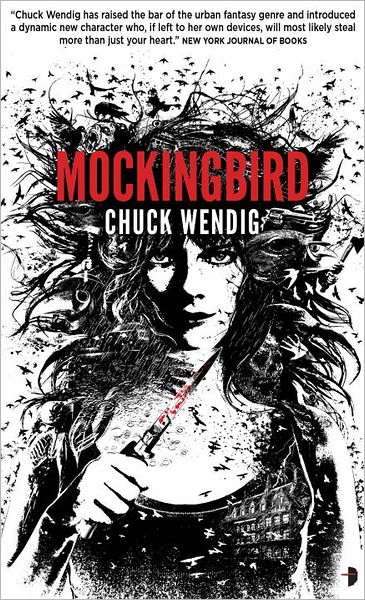
Blackbirds by Chuck Wendig

My paperback copy of Blackbirds instructs me (on the back cover, at the top, near the spine) to “file under Urban Fantasy.” I am a fan of these labels, not least as a librarian (!), especially with a book like this one that deviates from my usual genres a little bit. (My usual genres, if you’re a new reader, are mystery/thriller and various nonfiction, especially biography/memoir and nature writing.) So, this is fantasy. Urban. With paranormal aspects. And a very dark tone.

Miriam Black knows when and how people will die. All it takes is skin-on-skin contact. Shake her hand, bump her bare arm on the bus, and she sees your final minutes or moments in a flash. This is, not surprisingly, disturbing and traumatic for Miriam, but she’s learned how to make it work for her. She describes herself as a vulture, not a falcon: she doesn’t cause death (indeed, when she’s tried to stop it, she can’t, and often makes things worse), but she feeds off it. At the very least, she’ll rob the corpse.

This has gone on for a number of years at the opening scene of Blackbirds, and Miriam has developed a cynical, detached outlook that allows her to view death without so much internal damage. Of course, she’s experienced trauma in her life, not all of it linked to her unique gift. But then two forces impact the carefully orchestrated system she’s worked out. First, she meets a man – a nice man, in fact – and shakes his hand, and sees something she’s never seen before: a death scene in which she plays a role. Next, she meets another man who knows what she is and what she can do, and wraps her up in his own con.

The chronology of this story jumps around, which is a format not all readers appreciate, I know; but I think it works nicely here. We follow Miriam through “real time” in main chapters, and spliced in between are interludes, in which we hear her story as told to a young journalist, and the stories of other characters as told to Miriam. Chronology is further confused by the time-travel element in Miriam’s vision. Well, it’s not time travel, but it is a brief view of future events: she sees what happens and knows exactly when, without the benefit of knowing where or why. So we know what we’re rushing up to, but not how to get there.

This is a fast-paced, tremendously suspenseful read. I read it through in one sitting. [Warning: make time for this.] The sense of time passing, of momentum, is great. I couldn’t put this book down and halt the progression of Miriam’s fate; the stakes were too high! While there’s a feeling of inevitability, the ending applies a twist. I loved the dark atmosphere, too. Miriam is damaged, foul-mouthed, crude, but good-hearted and vulnerable, like so many great hero-villains. [While not entirely like any of them, Miriam evokes certain elements of Jack Reacher, Dave Robicheaux, Harry Bosch, Lizbeth Salander, and Mallory.*] In fact, my pleasant-surprise-observation is that this book is more similar to some of my murder mystery/thriller favorites than I expected. I think I feared a gothic blood-sucking-evil-death darkness and/or horror elements that would be too much for me, but instead I find this a great crossover read, and will be seeking more Wendig. Apparently there is a sequel coming soon! I am anxious!


*Fictional characters written by, respectively, Lee Child, James Lee Burke, Michael Connelly, Stieg Larsson, and Carol O’Connell.


Rating: 8 deadly daydreams.

Prehistory, Personality, and Place by Jefferson Reid and Stephanie Whittlesey

I picked this book up on a recent trip to the Gila National Forest in New Mexico. We stopped by the visitor’s center for the Gila Cliff Dwellings, and it just caught my eye; what can I say? I think it was the subtitle, Emil W. Haury and the Mogollon Controversy. I casually find archaeology as intriguing as the next person does, although it’s never been a serious interest; but the idea (as expressed on the back cover) of a controversy over whether a people deserve to be recognized as unto themselves, with their own accomplishments and culture, definitely appealed to me.

First of all, I appreciated the Preface, wherein the authors explain their personal connection to Haury (a teacher and mentor), their interest in the Mongollon question, and what they intend with this book. This is not to be a biography of Haury, but his story coincides heavily with the one they will be telling. I like to hear from authors (of nonfiction, anyway) what they’re up to like this.

Reid & Whittlesey do a fine job of completing their stated task. After reading this short (~150 pages) but dense book, I feel fairly well-versed (you know, for an amateur) in the Mogollon controversy and the players involved. In a nutshell, Emil Haury was a young and gifted archeologist who, in the 1930’s, discovered artifacts in the southwest United States (Arizona and New Mexico) that did not fit into the contemporary understanding of the two cultures then known to have inhabited those parts: Anasazi and Hohokam. He postulated that he had discovered evidence of a distinct culture which he named after the mountains where he was working: Mogollon. The archeological community was immediately up in arms over a few key issues, namely, whether the Mogollon were indeed a distinct and different group, and whether they were as ancient as Haury believed. There was also some question of their eventual fate: were they assimilated into the Anasazi culture, or did they continue to exist as a morphed but still individual culture, past 1000 AD?

Haury would spend the rest of his life and career working to validate the existence, antiquity, and distinctiveness of the Mogollon, while also investigating other cultures (there is tangential reference to the apparently significant-in-its-own-right Hohokam controversy), establishing field schools, and teaching. He seems to have been a remarkable man. By the mid-1960’s, the controversy was all but entirely resolved, more or less in favor of Haury’s initial theories. There were other important players as well, of course, and we meet many of them on both sides of the controversy; but Reid & Whittlesey make an excellent argument for the strength of Haury’s personality and his academic authority playing a key role in the decades-long discussion. Which brings me back to the title of the book. This book is about the Mogollon controversy, yes, but it is also about the relationship between personality, place, and the study of archeology (or prehistory, or anthropology, or – I venture to extend the concept – the study of most social disciplines). Reid & Whittlesey demonstrate how Haury’s personality was a key player, and also how the places that formed and influenced him – his birthplace in the wide-open Kansas plains to the striking vistas of the southwest – played their own roles in the drama.

I found their arguments about personality and place convincing and appealing. The archeology, and the questions (and relatively few answers) about prehistoric peoples, were mildly interesting to me; but I was definitely more engrossed by the drama of academic minds in debate. That was the more accessible human-interest story, if you follow. I continue to have questions about that debate, in particular its partisan nature. it seemed to me that there were really two “schools” of thought, and they follow the lines of literal schools of study so remarkably that I felt sure this was not a coincidence. In other words, it struck me not as a difference of intellectual interpretations of data, but of two groups of people pitted against each other. The archeologists who had helped establish our understanding of the Anasazi were invested in keeping that culture supreme in prehistory; they resisted the idea that there may have been other players in the same (or earlier) time, like they were rooting for their own dog in the fight. It’s a shame to think that these men (they were mostly men) were inserting personal feelings and alliances into the study of science. But that’s humanity for you, I suppose. For the record, this understanding, of the personal rather than scientific nature of the controversy, is mine, and not the authors’.

I thought this was a well-executed and informative book, and I recommend it, but be aware: it’s a little dense and academic for the general audience. I understand that it was intended for the general public, and I do think it works (I had no prior expertise, certainly) but it took a little extra effort, so bear that in mind.

I’m glad I picked up a total unknown, and I enjoyed it.


For another general-audience book on antiquity & archeology, you might be interested in my review of Tutankhamen: The Search for an Egyptian King by Joyce Tyldesley.


Rating: 5 academic papers.

Hayduke Lives! by Edward Abbey

Hayduke Lives! What fun! I have been looking forward to this one – with some trepidation, yes, since lovers of The Monkey Wrench Gang tend to be disappointed; but also with good cheer, because even if it’s not the bible of eco-warriors that the other is, I have faith in Abbey and his sense of humor. And my instincts were more or less correct.

We follow a few different plots in this installment. One: George Washington Hayduke is, yes, alive and well, and trying to reconnect with his fellow monkey-wrenchers Bonnie, Doc, and Seldom Seen. Bonnie and Doc have married and have a second child on the way, and Seldom Seen is trying to (ha) lay low and play family man to all three of his wives; none wants to be pulled back into criminal activity, but each is eventually sympathetic to the cause (naturally). Two: A new, younger generation of eco-activists, including the nascent Earth First!, is organizing (sort of) to stop the latest earth-terrorizing mega machine, in this case the Arizona GEM (Giant Earth Mover). [And this is getting kind of meta, since EF! in real life came about after publication of The Monkey Wrench Gang, inspired by it. Abbey never refers to the first book or his own role, in this second book.] Three: An unnamed government organization is working with local Utahn Mormon yahoo J. Oral Hatch and (from book 1) Bishop Love to try to infiltrate and undermine EF!. Hatch and Love are both total boobs, in their own ways, and provide much of the comic relief of this book.

As in TMWG, Abbey portrays a bumbling but good-hearted, solid, self-deprecating love of Mother Earth, some action, and some laughs. What doesn’t carry over is plot: I could sort of feel that Abbey was riding the popularity of TMWG, playing around with the well-loved characters and theme, without crafting the same total package. The first was not only a good story, with a little more plot to it, but also a remarkable magic chemical confluence of characters; I think part of what we fell in love with was the odd foursome that made up the Gang, and the way they all clicked. Where the first book was already a little silly, farcical, juvenile, and heavy on the penis jokes (and don’t get me wrong, I loved it), this book is practically only those things. Enjoyable? Yes, absolutely. As important as Monkey Wrench? Not by a long shot. But I have no regrets that I (appropriately) spent part of my camping-out-in-New-Mexico vacation time reading this silly romp; it was worth every minute.

And yes, I have already purchased my bumper sticker.


Rating: 6 raucous whoops.

Bossypants by Tina Fey (audio)

This book has been out for a little over a year. What took me so long? Thank you, fellow bloggers who raved about this book, for finally getting it into my ears. As others have said before, get the audiobook! It does make it slightly cumbersome to go find your pdf file to see the pictures she refers to; but it’s so worth it to hear her make her jokes herself.

Tina Fey is a funny lady. This I knew, and I looked forward to the laughs, which are there in abundance. But what I hadn’t entirely expected was the more serious handling of issues like a woman’s place in male-dominated industries – which was silly of me, because Tina Fey does address issues. She tells stories about her own upbringing, her youth, her discovery of acting and comedy, her time spent at SNL, the creation of 30 Rock, her honeymoon, motherhood, and more. She is always classy in her discussion of other celebrities or folks from the industry: any criticisms are well packaged in understanding and explanation, while she mostly praises her colleagues in glowing and meaningful terms. She doesn’t just call everyone talented and charming – she gives thought-out, complex, positive evaluations. And any time she has dirt on someone, she leaves that someone entirely cloaked in anonymity (“the letters from their names are sprinkled randomly through this chapter”). I never got the impression she was being less than honest, because she still made her criticisms, but she was always respectful of the people she has worked with, and that impressed me.

Tina analyzes the challenges that face a woman in a position like hers, breaking into a field that (in her early days especially) was thought to be men’s work, and she does so fairly. For example, she writes (narrates) a funny and wise anecdote about the moment that she realized that she was experiencing, not institutional sexism, but a sheer male ignorance of menstruation and “feminine hygiene.” And she gives good advice.

She is also hilarious, and wise, about women’s fashion and body image, and the culture of Hollywood, modeling, and television. In the chapter entitled “Amazing, Gorgeous, Not Like That,” she describes a “typical” magazine photo shoot in great detail. I found the scenes regarding hair and makeup especially exotic, weird and different. I’m pretty far from a fashion photo shoot, myself.

This book was great fun and very funny, as you might expect; but as you might not have guessed right off (I didn’t), it also makes some good, serious points. There’s some well-stated feminism to be found here amid the good times. Highly recommended, and as many others have said before me, do get the audio version.


Rating: 7 pairs of Tina Fey glasses.

guest review: Out Stealing Horses by Per Petterson, trans. by Anne Born – from Pops

Pops joins us again! You can see other contributions from my dad here. He says he wrote this one just to get me interested in reading it myself. 🙂 It’s on the stack, Pops. Thanks for the review!


This is one of the better books I have read in a very long time. I hesitate to use words like “spectacular!” because it’s not that kind of book. Rather, it is quite simply unique, heartwarming, insightful, and a joy to experience. I could also cite this book’s bestselling credentials (from 2005), and its broad acclaim in reviews – but let’s face it, that doesn’t always count for much.

I am also reluctant to describe what the “story” is, because in fact a summary may in itself sound spare and unremarkable – and spoil the real value here. What’s special is the way the story is told and how it is revealed, the author’s voice and the narrative structure he uses. This is a reading experience; I found myself rereading a paragraph to “taste” it anew each time: the content, the style, the implications. I liked the mood his tale creates – relaxed and thoughtful; the endearing characters, and the story’s sense of place.

Trond Sander is 67 years old as the 20th century is coming to a close and he has just moved into a small Norwegian cabin in the woods for his remaining life. In his first person narrative, we gain glimpses of his life from two perspectives: first, as he reflects while establishing a simple routine around the cabin, in the little village, on walks with his dog. His reflection also takes us back to a few formative years of his youth during & just after the German occupation of Norway, and key events that happened then.

His story unfolds in pieces between these times separated by 50 years. The narrative pace varies, sometimes relaxing and melancholy in short and simple sentences, then sometimes without warning winding up into a rush of action, revelation or redirection all in one long continuous sentence that had me holding my breath by the end. I quickly gave up any temptation to decipher “where is this story going?” – quickly I became deeply invested in the journey, it was so delicious; the destination mattered little.

And in fact, there is no conclusion, or closure, or any such catharsis. Against a simple but rich background, we learn a lot about the man, his life, his influences – and are left to contemplate the rest. Similarly, the narrative style leaves ample “work” for the reader to understand, appreciate, interpret. At the risk of confusing my point, in this way I was reminded of John le Carré – which in my sense is high praise; I love such work.

Finally, a word about the translation from Norwegian. I am always intrigued by wondering what a story was like in its original language. It seems the burden of good translation is great, and the results may be anywhere from great to disappointing; the translator essentially becomes a co-author. I don’t know Norwegian; I can only assume that such distinctive narrative style is from the author, and that its wonderful success in English reflects a skilled and faithful translation. Kudos to Anne Born for that. And, just so we get the author’s name right: Per is like “par” and Petter rhymes with “letter.”

Thanks for those final pronunciation tips. We don’t always know when we read, do we.

Well, I’m talked into it. Lovely review, Pops. Thanks for contributing!

The Price of Gold by Marty Nothstein and Ian Dille

A story of competition and commitment that will raise readers’ heart rates as it brings the antagonistic world of velodrome racing to life.

Marty Nothstein’s athletic accomplishments include dozens of national championships and several world championships. His event is the relatively obscure match sprint in track cycling, and he is the most accomplished American sprinter of the modern era. The Price of Gold details his journey from childhood to Olympic gold and silver, with serious injuries, deep disappointments and unimaginable intense training along the way.

The story begins with Nothstein’s silver medal at the 1996 Atlanta Olympics, then backtracks to a sleepy Pennsylvania town where a bored teenager seeks an outlet for his aggression. Nothstein’s natural talent, powerful physique and hostile, hyper-competitive spirit perfectly suit him for track sprinting. This sport combines cunning tactics with raw power, and Nothstein would become an exemplar of its reputation for ruthlessness. Relationships are built and sometimes broken, but the intense drama is blunted by a surprisingly sweet note, as Nothstein’s wife, Christi (herself an elite junior racer), provides constant and complete support.

Cycling fans familiar with Nothstein’s reputation for belligerence may be surprised at the thoughtful tale he has to tell here and will be tickled to recognize many cycling greats threading through his story. The Price of Gold focuses on hard work, competition and achievement, pulling no punches in conveying the rough edges, but also communicating great emotion.


This review originally ran in the June 12, 2012 issue of Shelf Awareness for Readers. To subscribe, click here, and you’ll receive two issues per week of book reviews and other bookish fun!


Rating: 7 laps.

Kristin Lavransdatter: The Wife by Sigrid Undset (trans. Tiina Nunnally)

Kristin Lavransdatter is a trilogy, comprised of The Wreath, The Wife, and The Cross. Here is book two; book one was reviewed here.


SPOILERS FOLLOW.

In The Wreath, we met Kristin as a child, watched her grow into a lovely young lady, and saw her lose her virtue out of wedlock to the dashing Erlend, break off an engagement with her father’s favored choice Simon, and finally, after much familial discord, succeed in marrying Erlend – while carrying his child, unknown to anyone. The Wife, naturally, follows her role as Erlend’s bride and mother to his children. All is not smooth sailing for the couple: first, in a literal sense, as Kristin is miserable on her first ocean voyage to her new home, pregnant and horribly seasick.

She has a very difficult delivery of her first son – who turns out to be the first of no less than seven sons. She and Erlend find themselves distancing almost immediately. When they were lovers, they shared a passion that was, if anything, increased by their shared sin. As I said in my review of The Wreath, Catholicism plays a weighty role. After her marriage, Kristin turns to God and religion all the more, seeking redemption for her betrayal of her father (in the sense that her father’s honor was compromised in her premarital affair). Erlend has a brother, Gunnulf, who is a holy man, and Kristin immediately becomes close to him.

Between the production of babies (the first five in under five years) and her ever-increasing piety (which involves fasting and self-deprivation), Kristin is unavailable to Erlend when he had hoped to have her as a companion nearly full-time; he has to travel on political & military business, and wants her at his side, but she is unwilling if not unable, fearing seasickness and not wishing to leave her babies. In addition, there is the added stress of Erlend’s two bastard children from an earlier liaison: the boy, Orm, warms to Kristin, but the elder Margret remains a source of conflict. Further tension is born of Erlend’s irresponsibility with his property. He is wasteful and profligate, politically less than astute – although his charm takes him further than he would otherwise have gone – and almost entirely faithful to Kristin (which, frankly, is better than I expected of him).

In the end, his risky politics get him into trouble with the young king, and he is imprisoned. Meanwhile, Kristin’s former betrothed, Simon, has married her younger sister Ramborg – more at Ramborg’s insistence than out of his own interest. Both Kristin’s parents have died. When Erlend is arrested, Simon is her closest male kinsman, and provides her with the support she needs; she does not realize he still loves her. Thanks to Simon’s interceding, Erlend’s life is spared, but his property is forfeited.

This was a fairly lengthy book at some 400 pages, but still felt easy to read. For all the friction in Erlend and Kristin’s marriage, they still love each other. When it comes down to it, they always turn back to one another, even after (for example) Erlend has an affair with another married woman purely to get back at Kristin when he feels slighted. I am a little surprised, and impressed at the strength of their relationship. I find it a little inexplicable, as I look back at this book, that I have found it as engrossing as I have. The somber, serious weight of Kristin’s piety is not something I especially identify with. But yes, I am heading into book three, The Cross, with enthusiasm. I wonder what good can come of Kristin’s family now that they’ve lost their tenuous grasp on Erlend’s shrinking estate. And I’m not sure that Simon will continue to be content with being Kristin’s brother-in-law. Stay tuned…


Rating: 5 pagesofjulia.

Loving Frank by Nancy Horan (audio)

I don’t know why I didn’t expect much of this book. Where did I get the idea that it was a fluffy love story? Not so. This is the fictional tale of Mamah Borthwick’s extramarital affair with architect Frank Lloyd Wright. Mamah really lived, and she really had an affair with FLW; but her story here is fictionalized. Another of those sticky questions of historical fiction: where is the boundary between fact and fict? Horan includes a nice author’s note at the end (probably my favorite way of handling this question) and gives some details about where she began using her imagination. History has not taken great note of Mamah Borthwick; most of the information available to her was about FLW.

This is a lovely story, well told. Several different threads are explored that I found interesting. Frank Lloyd Wright himself, and his art and architecture (subjects I had not explored previously) are outlined, along with his Oak Park celebrity and the birth of his “organic architecture.” Mamah is involved in the women’s movement, for suffrage and equal pay and general independence and equality. I especially loved the scenes where she picks up a book, and attends a lecture given, by the Swedish feminist author Ellen Key. Mamah is so moved, considers the topics so well – she is an intellectual and an artist herself, you see. She takes on a mid-life career translating Key’s work (again, this is true to history), and I found the depiction of translation, and Mamah’s own writing as well, to be a really rich part of her story. This is far from being a book about Frank Lloyd Wright. It is a book about love, and morals, and the dilemma of being married to one man and loving another. Mamah and Frank have nine children between them. Imagine that: nine children! There is also the issue of their reputations being irreparably damaged in the national media.

Frank and Mamah are fellow residents of Oak Park, Illinois (suburb of Chicago, and hometown of Ernest Hemingway, who was a small boy during the events of this book) when Mamah and her husband hire the local celebrity to build them a new home. There is chemistry immediately, although it takes a few years for the affair to begin. As their own marriages begin to fall apart, Mamah leaves Oak Park and takes her children with her to visit an old friend in Colorado, eventually leaving her children for her husband to collect, and meeting up with Frank for a tour in Europe. Their relationship blossoms and takes form as they travel, experiencing the world, getting to know one another more openly; it is here that Mamah meets Ellen Key, whose philosophies are hugely important in the couple’s worldview and feelings about their own actions. Frank has left a wife and six children; Mamah has left her children as well, and we can imagine how the world more than a century ago viewed a mother abandoning her children.

The two will eventually move to the Wisconsin valley that has been home to Frank’s family for generations, where he builds for Mamah the home called Taliesin. They are plagued by public disapproval, and the continuing unhappiness of various family members. But they also find the local community eventually supportive. And then there is the big event. Mamah’s story concludes with a shocking final episode that comes out of the history books, so let me say: if you don’t already know what happens, you might consider letting Horan surprise you. It is not a happy ending. But I feel that Horan handles it with great dignity.

I was reminded time and time again of another lovely work of historical fiction, Susan Vreeland’s Clara and Mr. Tiffany. These books are both about women who really lived but are marginalized in history, allowing two authors to write their stories, fictionalized, from research; both were involved (in different ways) with far more historically well-known men; both involve art and art appreciation; both are beautifully written, exploring emotions, and the issues of women’s role in art and in society at more or less the same time in history. I find myself noting these read-alike relationships, and sometimes worry that I may be seen as lowering one or the other of these books by comparing them to others, like I’m calling them less original. I am not. Both of these books are beautiful and original; just allow me to say that if you like one you may like the other.

I loved this book from start to finish. Horan, and narrator Joyce Bean, immersed me completely in the time and the many places of Mamah’s story. I cared very much about all the characters. The events of Frank and Mamah’s lives – bittersweet, shocking, loving, touching, tragic, hopeful, all of them – came fully to life. I really enjoyed getting to know these interesting people, even when they were not at their best. I am charmed, and impressed.


Rating: 8 translated lines.

Houston: It’s Worth It

I came across a book the other day that I found charming. The whole concept of “Houston: It’s Worth It” began as a discussion amongst friends and then become a website, here, that gained in popularity; then there was an exhibition of photography; and eventually, this book. It is mostly photographs, interspersed with brief quotations in extra-large text – perfect for coffee table browsing – communicating that tagline theme. Houston: it really is worth it.

The concept is to say that this city has a lot going for it despite what they call “the twenty afflictions” (they list, for example, the heat, the humidity, the hurricanes, the flying cockroaches, the mosquitos, the traffic, the construction, the sprawl…). You can get a pretty good idea of what they’re trying to do with the website, the book, the whole HIWI franchise, at their about page. As alluded to in my review of The Great Psychedelic Armadillo Picnic, I am rather a Houstonlover myself; and this is just my brand of cheerleading: a little self-deprecating (hey, it IS humid here), a little tongue-in-cheek, but at heart, appreciative of the awesome facets to my hometown.

The photographs are outstanding, and all citizen-contributed. They show nature, architecture, landmarks, food, drink, weather, and people. I think they show a great deal of diversity – of people (ethnic, religious, cultural) as well as lifestyle and cuisine – and diversity is always at the top of my list of what’s great about Houston.

In short, this is a great little coffee table book that shows why Houston is SO worth it in pictorial as well as text form; it’s attractive, well put together, and not too serious for its own good. I’m glad it happened across my desk.


Rating: 6 taco stands.

Dead Scared by S.J. Bolton

A disturbing high-speed thriller involving a rash of university student suicides and a mysterious someone with the power to give bad dreams.

Detective Constable Lacey Flint thinks she is going undercover as an attractive but neurotic student at Cambridge University in the hopes of exposing whoever might be driving students to commit suicide at an alarming rate and by violent means. The longer she spends living on campus and undergoing hazing and humiliation, however, and the more she learns about those earlier suicide cases, the less clear her role becomes. The university counselor who is her only contact is clearly living in fear, as are many of the women around her, and Lacey begins to undergo the same out-of-body experiences and gruesome nightmares described by the girls who’ve killed themselves. Is Lacey herself at risk?

The enigmatic DC Flint, introduced in 2011’s Now You See Me, has a storied past that Bolton leaves largely unrevealed–a trait shared by many other characters. Alternating with Lacey’s first-person perspective, the novel regularly checks back with her superior officer, Detective Inspector Mark Joesbury, who struggles with the truth of what he’s sent Lacey into. They share a shadowy past and some chemistry, but this is one of several aspects left shrouded in mystery, adding to the compelling, suspenseful mood established by thematic elements like evil clowns, sexual abuse, gory scenes of suicide and a panoply of psychiatric issues. Fast-paced, spooky and uncomfortable, Dead Scared keeps its reader on edge until the final paragraph.


This review originally ran in the June 8, 2012 issue of Shelf Awareness for Readers. To subscribe, click here, and you’ll receive two issues per week of book reviews and other bookish fun!


Rating: 6 whispers on the back of your neck.