rerun: The Solace of Leaving Early by Haven Kimmel

From early in my career with Havel Kimmel: please enjoy this review from April of 2013.

Langston Braverman has recently returned to her hometown of Haddington, Indiana. Very close to receiving her PhD she walked out of her oral exams. She is a strange, exceptionally erudite but socially fragile and problematic young woman. She has a dog named Germane: “named not after Germaine Greer, but as in: Germane to this conversation.” (I love that.)

Amos Townsend is Haddington’s pastor, of only a year or two now. He is tormented by the death of a local named Alice; he feels that he should have been able to stop her death, and he is struggling with his faith, which is actually nothing new.

Alice’s two children are left in limbo; their crazy aunt Gail has turned out to be unfit, and their grandmother Beulah is clearly too near death herself to wrangle with two traumatized little girls. Upon Alice’s death, they dispose of their original names, Madeline and Eloise, and state that they are now called Immaculata and Epiphany. They wear costumes from a Renaissance drama from school, that their mother made, all the time. Complete with hats: the tall cone-shaped kind with ribbons streaming off the tops.

Langston’s mother AnnaLee picks up some of the slack, and then insists that Langston step up: she is not in school, not working, and these children need her. Of course, Amos plays a role as well, so that this village will truly raise a child.

Langston and Amos are the stars of this story (along with the striking Immaculata and Epiphany, of course). When they meet, they repel one another like magnets. Despite sharing tastes and interests in reading, philosophy, theology, and (I can’t stress this enough) their particular brands of weird, they repel. And, as is clearly a theme in Kimmel’s work, the cerebral content, the philosophies and theologies that shape this part of the story are complex and thoroughly explored. I think I said this in my last Kimmel review, but: her many references partly pique me to go off and study, and partly exhaust me, making me so glad I don’t have to read Whitehead and Tillich and Frithjof Schuon. It makes me sit back and… wonder… that all these strange, complex, learned thoughts that Langston has are thoughts that Kimmel had to have first, had to conceive to put them in her heroine’s mouth; think of that.

Immaculata and Epiphany see Mary (the Mother of God) in the dogwood tree in their grandmother Beulah’s backyard. Naturally, because that is the kind of world this is. It is very strange and is a kind of beautiful, and again I observe that Kimmel’s gift is to create a midwestern small-town world that is both hopelessly humdrum and depressing and everyday, and also strange and exalted and worthy of examination.

What happens to our exquisitely odd cast of characters should definitely remain a surprise to you, reader. It’s pretty great, though.

I love this author SO MUCH that I am struggling to write reviews; but I will keep reading her. Next up is The Used World, and I am, of course, working to get my hands on her best-known bestselling memoir, A Girl Named Zippy.

I’ll close, as I tend to with Kimmel, with a few lines from the book that particularly caught my eye. Where these have, in the past, been lovely examples of her use of language, these are more concepts that I really liked. There is a book theme here. And the language is great – observe the curry comb, is that an image or what – but it’s the concepts that I like most here:

Amos knew as well as anyone what went into writing a book, having written a master’s thesis, and he considered the process to be akin to having one’s nerves stripped with a curry comb.

Maybe he knows what goes into writing a book as well as anyone… who hasn’t written a book?

The most intractable aspect of his bachelorhood was that Amos was uncomfortable eating without reading; he felt as if he were wasting both time and food.

Me too, Amos. I’m right there with you.

Amos tapped his fingers on his bony knees. “Why do you have a book and I don’t?”

“Because I’m a woman, Amos.”

“Yes, but why do you have a book and I never do in a situation like this?”

AnnaLee put the book down. “I carry a bag. I also have safety pins and emergency money, and a package of those little wet towelettes. We live in Indiana. I could get stopped by a train, I could get bored. I always carry a book.” She went back to reading.

How perfect is that. “We live in Indiana, Amos!” Perhaps it goes without saying that I, too, try to keep a book with me at all times? I fail on safety pins and wet towelettes, though.

I’m sure I’ve failed to do this book justice. But it’s divine.

Rating: 9 ribbons on a hat.
Lovely. I should reread her sometime.

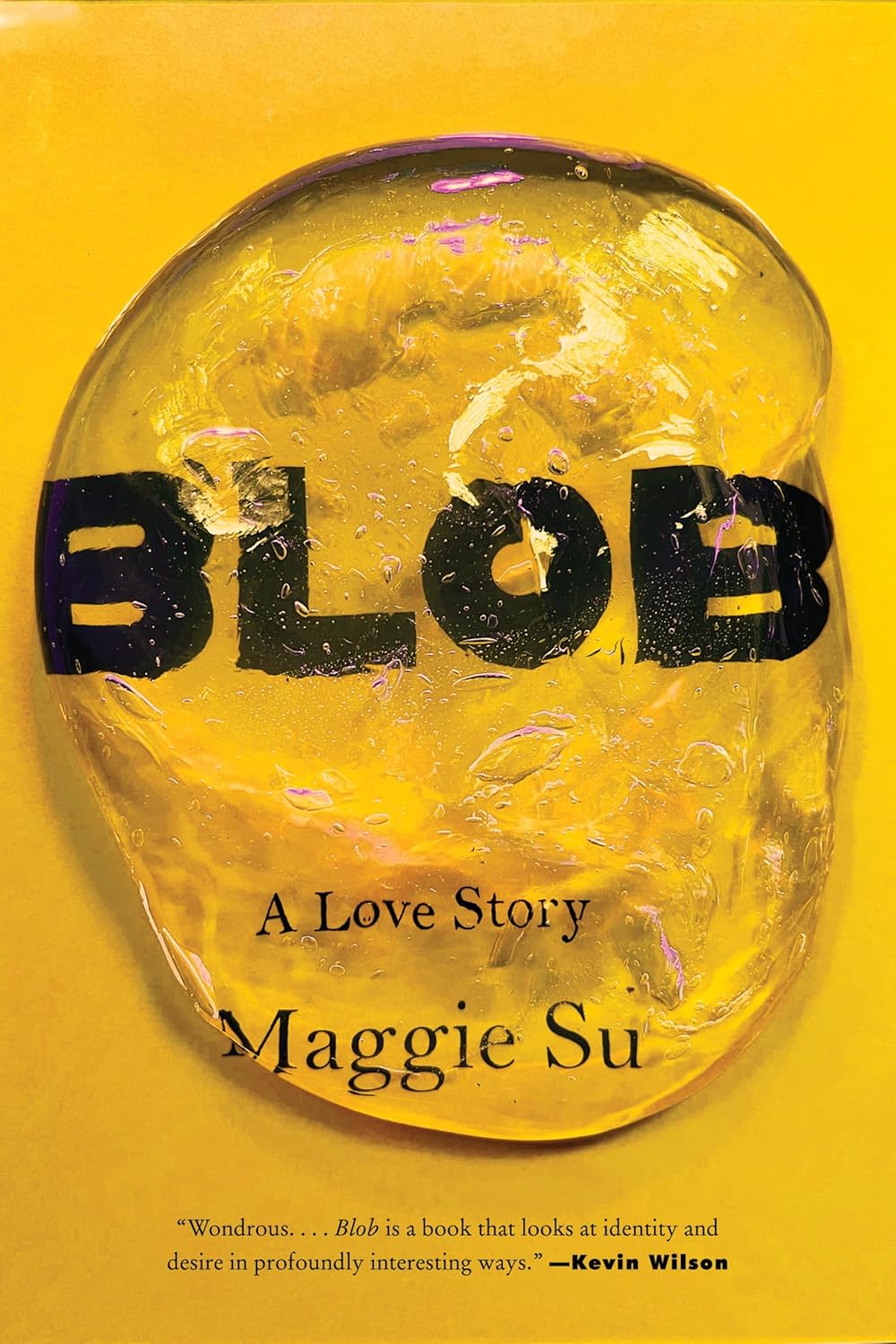
Blob: A Love Story by Maggie Su

This quirky, funny, pained novel considers the challenge, for any of us, of becoming fully human.

Maggie Su’s Blob: A Love Story is a funny and pathos-ridden tale of social awkwardness and self-realization; a modern, delayed coming-of-age. Su’s narrative voice is perfectly pitched for her inelegant but deeply sympathetic protagonist.

Vi is a 24-year-old townie and college dropout in a midwestern college town. She works a hotel chain’s front desk next to a too-perfect perky blonde named Rachel. Vi is still suffering from a breakup eight months ago, barely slogging through her days. Her Taiwanese father and white mother are well-meaning and supportive, but they have trouble connecting with Vi, who has always been a loner; her older brother can be a pain, but he cares, even when Vi struggles to. Then, on a night she ventures out for the rare social occasion, she stumbles upon something new in the alley behind a bar during a drag show: a shapeless blob with a mouth and two eyes. She carries it home and, under Vi’s yearning influence, it grows.

The evolving blob, which Vi will come to call Bob (it starts as a malapropism), is the only fantastical detail in a story otherwise rooted in a very familiar world, featuring the casual racism of Vi’s hometown and her awkwardness with social situations. Bob takes in lots of television (and Fruity Pebbles), and after examining the pictures Vi shows him of movie stars like young Hugh Grant and Ryan Gosling, fashions himself into a tall, stunningly handsome white man with a six-pack. Vi presents him as a hookup or boyfriend; the world has trouble assimilating their match. The pairing is, in fact, a strain. “For a while, he seemed happy enough to eat and breathe and exist–the perfect companion. I should’ve anticipated that molding him into a man would trigger something deeper, some sort of existential awakening. Now he’s just like everyone else. He has needs and desires beyond me…. He could leave without me ever knowing why.” The fear of being left, of course, is key to Vi’s difficulties in navigating the world.

What makes Blob special is its mix of heartrending conflict and silly, self-aware humor. Truly cringy scenes balance sweet ones. Rachel performs off and on as a friend–but Vi scarcely knows how to care for her own problems, let alone anyone else’s, and her past attempts at friendship have often ended in unintended cruelty. Su excels with characters who can be significantly flawed but stir the reader’s empathy. Even Bob, despite beginning his life as a blob, has a surprising amount of personality. In the end, discomfiting though it may be, Blob makes incisive observations about life for a 20-something trying to make it on her own. Blobs and humans alike may yet find home.


This review originally ran in the November 8, 2024 issue of Shelf Awareness for the Book Trade. To subscribe, click here.


Rating: 7 handfuls of cereal.

The Women Who Changed Photography: And How To Master Their Techniques by Gemma Padley

Gemma Padley’s The Women Who Changed Photography: And How to Master Their Techniques delivers brief, punchy profiles and incisive assessments of what is revolutionary about these underappreciated photographers. In short chapters, Padley presents 50 women–some well-known, some all but unknown–from all over the world, born from 1799 through 1992. Profiles and portraits are followed by photographs, with Padley’s instruction on how to mimic what is special about the work. This includes technical advice (how to combine and blend portraits; hand-tint a photo; play with angles, color, and flash) and the conceptual (how to use photo stories to raise awareness on an issue). Photographers include Anna Atkins, who “privately published the first book to be illustrated using photography,” and Anne Wardrope, the “first woman in America to photograph her own nude body.” They work in documentary, portraiture, art, photojournalism, and cover war, fashion, conservation, and more. Wide ranging and diverse, with fascinating storytelling, these contents are visually stunning and technically detailed, and will please readers with a variety of interests.


This review originally ran in the November 5, 2024 gift issue of Shelf Awareness for Readers. To subscribe, click here, and you’ll receive two issues per week of book reviews and other bookish fun.


Rating: 7 apertures.

rerun: Soundings: The Story of the Remarkable Woman Who Mapped the Ocean Floor by Hali Felt

Please enjoy this time capsule from August of 2012.

I’m so glad I picked this book up (and bought it for the library where I work). It sounded like just the sort of thing I appreciate: a biography of a little-known historical figure who made an important contribution to the world as we know it but was herself forgotten. In this case, the “remarkable woman” of the subtitle is Marie Tharp, whose meticulous study and cartography of the ocean floor established the concept of plate tectonics that science now recognizes as fact, but was at best a blasphemous and ridiculous notion before Tharp came along. Her achievements, however, were minimized by a scientific culture in which women did not belong. This biography is additionally appealing to me for its mood: author Hali Felt takes a whimsical, dreamy, almost fanciful tone at times. She describes her own attraction to Tharp’s story (born in part of Felt’s mother’s, and her own, fascination with maps) and the relationship she felt to her subject. She dreams of Tharp coming to her to explain the mysterious and unspoken parts of her life. This book is nonfiction, but it’s honest, personally related, and warm.

There is also an enigmatic love story of sorts hiding within Soundings: Tharp’s career and life were both tied to a man named Bruce Heezen. Heezen was her coworker, then her technical superior; but they shared a partnership in work, in science, in discovery, and apparently in all things. It is known that they were a couple, although they never married and the details of this side of their relationship are very few.

Felt follows Tharp from her childhood with a science-minded father she adored, through her education in English, music, geology, and mathematics, and to her first job in the oil & gas industry (oh, how familiar to this Texas girl). But she was held back: this was the 1940’s, and women in science were mostly expected to make copies, compute numbers, and brew coffee. Eventually Tharp found her way to New York, to Columbia University and the Lamont Geological Observatory. This is where she would meet and work with Heezen and quietly make history.

The science in this book is very friendly and accessible to a general reading public; the story that Felt set out to tell is more that of a woman’s life and accomplishments despite the limitations of her society, than that of tectonic plates per se. For that matter, Felt shows that it was Marie’s combined backgrounds in art as well as science that made her perfectly suited to play the role she did in history. Her meticulous re-checkings of data and attention to detail were indispensable – but so was her interest in visually representing the data available in a way that would show the general public (not just academics) what she’d discovered. So her achievement was artistic as well as scientific. Soundings does make the science side clear, but doesn’t dwell, and is never dry. Rather, Marie Tharp comes to life: she is a precocious child; an ambitious, able, frustrated student; a dedicated scientist; a life partner; an eccentric aging woman caught up in her own past, campaigning to honor and preserve the legacy of her other half.

Hali Felt was honest about the role she plays in the story she relates. She begins in her Introduction by briefly describing her own attraction to maps, and then follows a chronological format, beginning with Tharp’s childhood and following her life, and eventually her death. And then Felt returns to the story: her discovery of Marie Tharp’s existence, her interest, her decision to follow that interest, her research, her relationships with the living descendents of Tharp and Heezen’s world (the “Tharpophiles”), and in the Acknowledgements at the end, she even hints at the process by which she came to write and publish this book. I found all of these Felt-related details interesting too.

In a word, this is a lovely biography, and the style and tone of it may be my favorite part.


Rating: 9 double-checkings of data.

I remember it fondly.

Lines by Sung J. Woo

Disclosure: I was sent an advanced review copy of this book in exchange for my honest review.


This book came to me in an unusual way, and I just happened (entirely by accident, as far as I’m aware with my conscious brain!) to pick it up a few days before its publication date, and finished reading it on the very eve. So, happy birthday to this book just published on Tuesday (October 29, 2024). And a brilliant book it is: deeply beautiful, full of tragedy and pain but also awe and even bliss and the exaltation of quiet, daily acts of love and creation.

Lines contains two parallel stories. A prologue sets the hinging scene: early on a foggy Saturday morning in New York City, two locals walk in opposite directions near the entrance to Washington Square Park. Joshua Kozlov is forty years old, and not thrilled about his daily grind, nor his recent birthday. Abby Kim is twenty-nine, a working artist and a distance cyclist. They bump into each other, a full-on collision, ending in an unintended hug, laughter, coffee, and a lightning-quick rush to marry just two months later. Or, they walk past each other in the fog.

The rest of the novel follows both storylines, “Apart” and “Together,” in chapters that feature parallel events in the lives of two Abbys and two versions of the man called Josh or Joshua. Josh(ua) is an aspiring novelist in both lines, Abby always a painter with a passion for miniatures. They have the same friends and colleagues. They are recognizable but very different versions of themselves. In the first and greatest subversion of my expectations, the “Apart” narrative thread is not an absence of romance, a tragic missed-connection sort of story. Both Abby and Josh have found meaningful love, for one thing, with other partners. They have fulfilling lives in many ways. But they still find each other: searching for a birthday gift for his beloved wife, Josh is drawn to a hand-painted locket of Abby’s. He becomes a patron, and she becomes a muse, as he writes a series of flash fiction pieces based on miniature paintings of scenes from one of Abby’s solo European cycle-tours. They share a deep connection.

The title of Lines, I think, has several meanings. You could think of the two parallel stories as threads, or lines. Josh(ua) writes in lines, of course, and Abby draws with them. The concept implies connection, ties. Like much about the novel, its title is subtle, a whisper.

This book is definitely about possibilities, and multiplicities. What if there were another version of my life, my choices, my loves? It’s about art, inspiration, the balance between creative work for pay and for pure creative joy. It’s about the different kinds of love and commitment that exist in the world, about births and deaths. Neither version of this story is without pain, but there is wonder and sweetness even in the tragic moments. I’m not sure there is a final “right” place for either Abby or Josh(ua) to be, and that’s an artistic choice on Woo’s part that I respect deeply. Simple, clean-cut, black-and-white solutions are easier to write but feel less true.

My copy of Lines (an ARC, of course), came with a glossy, full-color insert featuring the 16 miniature paintings that star in the story – they are Abby’s, in the fictional version, and in real life are credited to Dina Brodsky. Josh tells Abby in the book (in their “Apart” line) that he’s working on a novel about their story, but will swap their ethnicities: he’ll make the female character Belarusian and the man, Korean. Sung J. Woo is Korean-American. Brodsky is a cyclist as well as a painter. This reader, at least, cannot help but be curious about the lines drawn between life and art! Brodsky’s paintings are indeed hypnotic, and I feel happily lost in the layers of ekphrasis: a novel about writing about painting… the images themselves, the writing by Josh, within the writing by Woo. I’m writing this review within minutes of finishing the book, and I’m sure I’m missing so much. But I also know I’ll be thinking about it for a long time.

I feel so lucky to have this book come across my desk, and to have opened it almost eight months later, to finish it (quite by accident) on the eve of its publication – what are the chances? It’s nearly as magical as what’s inside.

Check it out. And thank you so much for reaching out, Sung.


Rating: 9 flights.

Mask of the Deer Woman by Laurie L. Dove

A disgraced police detective takes a job as tribal marshal to pursue the mystery of a series of missing women, but has trouble seeing beyond her own lost daughter.

Laurie L. Dove’s atmospheric, frequently grim, and emotionally charged debut, Mask of the Deer Woman, features a former police detective trying to outrun her old life by taking a job as tribal marshal on an Oklahoma reservation. Carrie Starr is half Indigenous, but out of touch with that part of her personal history. Tasked with solving the cold cases of a growing number of missing Indigenous women and girls, she is inclined to focus instead on her own lost daughter.

Marshal Starr is the novel’s protagonist, but Mask of the Deer Woman‘s chapters shift among various characters, beginning with Chenoa Cloud, a college student from the rez who is determined to prove the presence of an endangered beetle on her tribal grounds. Documenting an endangered species promises to earn her funding and a job–a way off the rez for good, and not like the others “who left and never came back, or who couldn’t come back.” Chenoa’s disappearance into the Saliquaw Nation’s backcountry sets the stage for Starr’s arrival. The Bureau of Indian Affairs job is a last resort for Starr, and not one she relishes, but her daughter’s murder and the man she subsequently gunned down ended her career as detective. Trading on her late father’s Saliquaw identity earns her a poorly appointed cinder-block office, a BIA-issued, broken-down Ford Bronco, and the locals’ distrust. She carries a bottle of Jameson in her backpack and under the Bronco’s front seat, and a joint in her shirt pocket. Each missing young woman blurs into her daughter, and she flinches away from “the terrain she’d have to cover in the process. The dark space of whatever was out there. Caves. Old mines. Her own mind.”

Beyond the intoxicants she takes to escape her pain, Starr is knocked off-balance by tales of the Deer Woman. Part monster, part avenging angel, part capricious force of nature, this legend seems to follow the disoriented marshal, although the boundaries between magic, hallucination, and self-medicated grief are unclear. To boot, the rez is at odds with the nearest town, and the tribal council must field a controversial proposal to frack for oil, with associated infrastructure. Political and commercial machinations accompany the missing women and the struggling tribal marshal in a novel of grief, violence, community, empowerment, and pain.

This dark mystery will thrill readers and immerse them in a powerfully portrayed world of great losses and high stakes.


This review originally ran in the October 25, 2024 issue of Shelf Awareness for the Book Trade. To subscribe, click here.


Rating: 6 blue jay feathers.

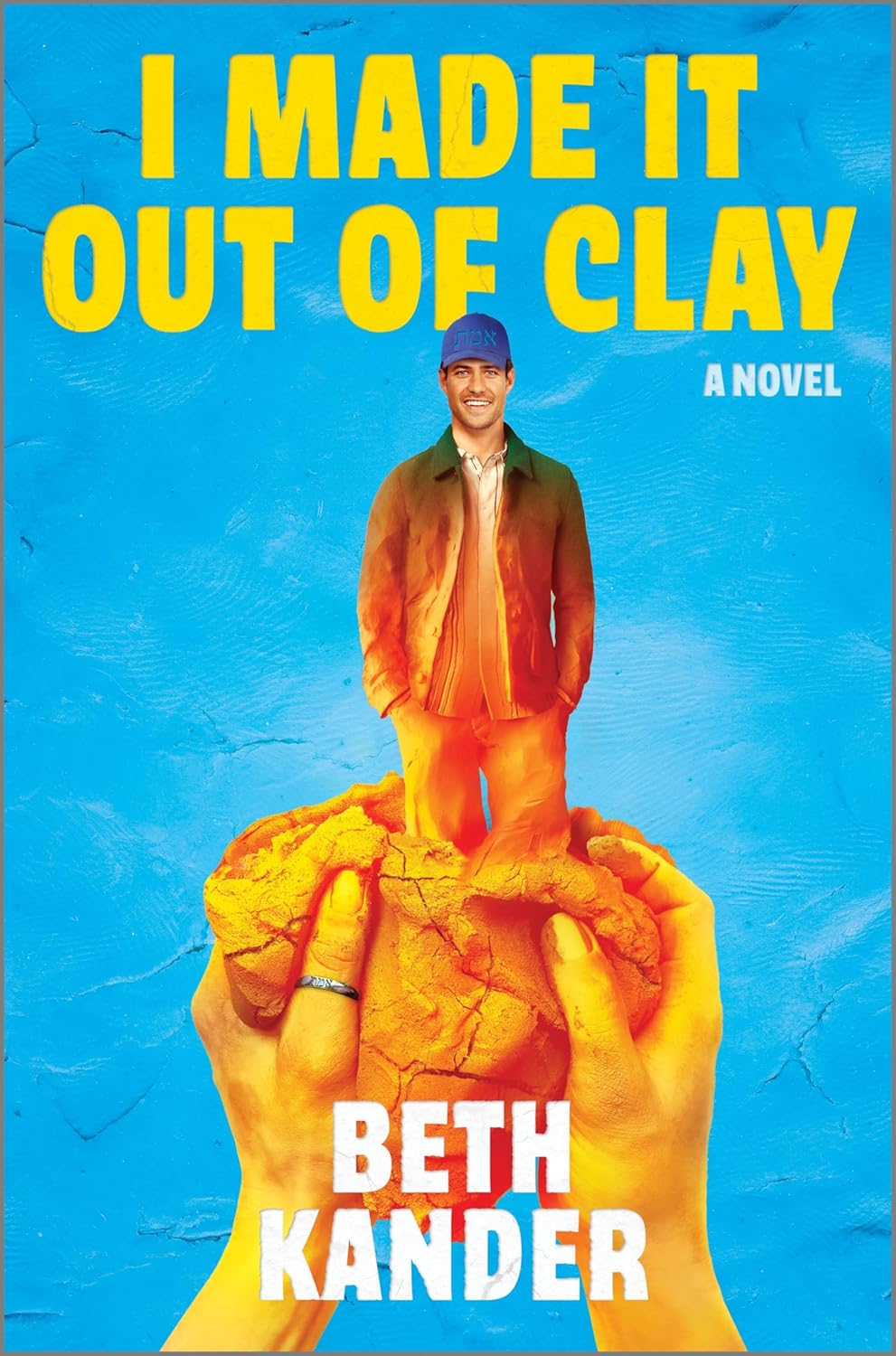
I Made It Out of Clay by Beth Kander

As Eve’s life devolves into crisis, she creates a golem to solve it all, in this lovely, absorbing novel of grief, dark humor, and love and friendship, with a dash of magic.

Beth Kander’s I Made It Out of Clay is a lovely, absorbing novel of grief, dark humor, and love and friendship, with a dash of magic.

In contemporary urban Chicago, as the holiday season approaches, Eve is struggling: she’s about to turn 40 years old, and she’s nowhere near done grieving her beloved father, who died just over a year ago. Eve and her father always loved Christmas–a guilty pleasure in their Jewish family not shared by the surviving members. Layoffs are threatened at work, her best friend has been distant, she’s had some disturbing encounters on the train recently, and she’s begun hallucinating her dearly departed grandmother, a Holocaust survivor who seems to be trying to warn Eve of something. Eve is not close to her mother (overbearing) or her younger sister Rosie (overly perfect), who’s scheduled her wedding for Eve’s 40th birthday weekend. Eve has (foolishly) promised to bring a plus one to Rosie’s wedding, but she’s so far failed to find a date. Unfortunately, her neighbor crush doesn’t seem to get her jokes or her cringeworthy attempts at flirtation.

In desperation, late at night and rather drunk, Eve recalls a story told by her grandmother, ventures into the dank corners of her apartment’s basement, and builds herself a golem out of foundation clay. A golem serves as protector and companion in Jewish tradition, and she feels in dire need of both. The next morning, a hungover Eve wakes up to find a handsome (and very naked) man in her apartment. She is horrified, in disbelief, attracted to him, and a little disgusted with herself. Is Eve’s golem a figment of her imagination? A monstrosity? Or the answer to her fondest wishes? Heading into Rosie’s wedding, all of Eve’s crises–work, friendships, the absence of romance, family strife, civil unrest in the wider world–crash and crescendo together. A golem is either the best or worst idea she’s ever had.

I Made It Out of Clay is a charming rework of a traditional tale. Frequently grim, it explores some of the darker elements of modern life: depression, loneliness, grief, bigotry. But it’s also sweet and very funny, especially in the moments when Eve lets her friends and, eventually, family into her life, and finds that they may have some of their own struggles. Kander gifts her readers with a novel that is often serious and sad, but ultimately uplifting, as Eve learns, “This isn’t the end of anything. It’s just one more beginning, like every damn day can be if we just let it.”


This review originally ran in the October 4, 2024 issue of Shelf Awareness for the Book Trade. To subscribe, click here.


Rating: 7 bagels.

The Greatest Lie of All by Jillian Cantor

A young actress takes on the role of a glamorous romance author and gets more mystery–and romance–than she’d reckoned for.


The Greatest Lie of All by Jillian Cantor (Half Life; The Hours Count; Margot; The Lost Letter) is a propulsively paced story of intrigue, romance, and suspense starring two women a generation apart navigating family, love, secrets, and art. In one of their several parallels, each uses a professional pseudonym, so that four names delineate these two character arcs.

Readers meet the young, up-and-coming actress Amelia Grant just after the death of her beloved mother, and in the moment when she discovers her actor boyfriend in bed with his costar. At this low, Amelia is primed to accept her biggest role yet: to play the fabulously successful romance author Gloria Diamond in a biopic. Gloria had been Amelia’s mother’s favorite; it feels like a sign and a way to be close to the mother she’s lost, the only person who had called her by her birth name, Annie.

Heartbroken but determined, Amelia travels from Los Angeles to Gloria’s remote Seattle-area home to get to know her subject before filming begins. But “the Gloria Diamond” is distinctly unfriendly, cold, and dismissive. Even as Amelia finds a tentative friendship with Gloria’s son, Will (“cute, in an academic kind of way”), she despairs at ever understanding what makes the older woman tick. Gloria’s career was built on her famous, brief romance with her late husband, Will’s father. But the more Amelia learns, the less convincing that story is. She embarks on an informal investigation fueled by shadowy motives: her desire to play a “true” Gloria Diamond; her curiosity about the nature of love, especially as her mother so appreciated it in Diamond’s fiction; and Will’s reluctant desire to understand his mother. As she pursues the history of the author once known as Mary Forrester–Mare to her friends–Amelia begins to wonder about her own role in the drama unfolding before her.

In chapters that shift between Amelia’s perspective and that of the young Mare, The Greatest Lie of All shines in its plot twists and surprises, and, most of all, its pacing, which accelerates from a slow burn to a heart-thumping momentum. The tension increases, stakes rising as Gloria/Mare and Amelia/Annie must reckon with their pasts to chart their shared present. Danger accompanies every possibility of romance, and family history matters more than it originally appears. Cantor’s experienced hand shows in this classically crafted thriller, which will keep its readers tautly engaged to the final scene.


This review originally ran in the September 24, 2024 issue of Shelf Awareness for the Book Trade. To subscribe, click here.


Rating: 6 glasses of wine.

Frighten the Horses by Oliver Radclyffe

Oliver Radclyffe’s memoir, Frighten the Horses, is an arrestingly forthright and open account of self-realization, a portrait of a transgender experience that is beautiful, honest, and raw.

After an absorbing, funny opening scene, Radclyffe rewinds to a less happy time. Readers accompany him on a difficult path as he spent the first four decades of his life trying to live up to expectations. His British upper-class childhood was privileged but disjointed. On brief occasions in boarding school, art school, and while riding motorcycles, he felt like one of the boys, but never felt he truly fit in. He became a housewife of status, then immigrated to the Connecticut suburbs and soon found himself raising four children and a golden retriever puppy. But something had always been off, and the memoir moves back and forth in time to portray Radclyffe’s anxiety and soul-searching. He eventually comes out as lesbian, divorces, and comes out as a transgender man.

These events and discoveries are presented in scenes with color, detail, and dialogue, and Radclyffe’s writing style is smooth, relatable, and effortless to read. With humor and compassion for himself and others, Radclyffe describes his own resistance to and acceptance of his gender and sexuality as he wrestles with the complexities of gender identity, sexual orientation, feminism, class, and family dynamics. This disarming, gorgeously written, and generously vulnerable memoir uses imagery to great effect. In sharing this individual narrative, Radclyffe expands and advances the way trans experiences are represented in literature. Smart and incisive, Frighten the Horses is unforgettable.


This review originally ran in the September 20, 2024 issue of Shelf Awareness for Readers. To subscribe, click here, and you’ll receive two issues per week of book reviews and other bookish news.


Rating: 9 steps.

Come back Friday for my interview with Oliver Radclyffe! I’m really excited about this one.

A Declaration of the Rights of Magicans by H. G. Parry

A sprawling epic by one of my new favorites, A Declaration of the Rights of Magicians combines history–the 1770s-1790s Age of Enlightenment in England, France and Saint-Domingue–with fantasy. In this alternate history, magical powers are relatively common, but only permitted in Aristocrats. Commoners with a magical Inheritance must be registered and wear a bracelet that will burn them painfully if they use their forbidden powers. The idea of a more equitable world, “one whose Commoners could use their magic freely, not to steal to feed their children but for their own education and enlightenment,” fires the imagination of several reformers the novel will follow in both England and France; chief among these are real historical figures like William Wilberforce, William Pitt the Younger, and Maximilien Robespierre. The abolition of slavery (the recognizable, historical practice of stealing and trading in African people) is a parallel issue for many of the same men. Meanwhile, in modern-day Haiti, an enslaved woman named Fina learns that she holds extraordinary powers of her own, which she will use to advance the cause that is most important to her and her friends: their freedom to move and speak and act, let alone to use magic. In this world, slaves are spellbound by their so-called owners: fed a certain elixir, they are unable to disobey orders, unable even to move or speak of their own volition.

It is an important facet of this story that characters with great and noble values and aims must confront questions about what means are justified by what ends. There is an introduction of dark magic of a kind that has been outlawed – and supposedly eradicated – for generations. There are questions of sticking to one’s principles in the face of certain defeat, versus compromising in profound ways to achieve interim goals. This intersection, again, of fantasy with real history (and very real human struggles) is exceptionally well done.

In over 500 pages, the reader gets to know Pitt and Wilberforce and their friends in London; Robespierre and his in Paris; and Fina and her fellows, before and after Saint-Domingue’s famous slave rebellion. Parry’s setting and characters may be based on history, but she’s absolutely doing in-depth worldbuilding all the same; she has laid out not only the ‘rules’ of this world in terms of its realities (how magic works, who has it) but the laws to be obeyed or broken (who is permitted magic, how the bracelets work, how the court systems function). The relationships – in particular the friendship between Pitt and Wilberforce, which I found the most compelling of the book – are involved and engrossing. The personalities – especially poor, despicable, manipulated Robespierre – are complex. I found Fina to be the least developed of the lead characters, which is an absolute shame; to be clear, she gets the least screen time (cause or effect, chicken or egg?), but still concerning. (I have a vague impression this is somewhat corrected in book two of the duology.) The historical content feels right, and a few quick googles reinforce that impression, but by no means am I sufficiently up on my Enlightenment history to judge. The fantasy is intricate and satisfying. Parry’s greatest strength is in her characters. It only hit me after I finished reading that there is a shortage of women in this story; I am a bit sad about that, too.

I don’t often get excited about an expansive, wide-ranging saga, but if anyone can keep me page-turning for 500 pages, it’s this author. I’ll be reading book two. I’d be even more stoked for more of Uriah Heep or the Daughter, though.


Rating: 7 birds.