Live Fast by Brigitte Giraud, trans. by Cory Stockwell

Brigitte Giraud’s Prix Goncourt-winning Live Fast is a powerful and concise study of love, loss, and the small decisions and turning points that shape life and death.

Brigitte Giraud, the author of more than a dozen novels, won the 2022 Prix Goncourt for Vivre vite. Published in the U.S. under the title Live Fast, this is Giraud’s first book to be translated from French to English. The highly autobiographical novel examines the 1999 death of the narrator’s 41-year-old husband, Claude, in a motorcycle accident. She writes: “There was only one thing I was truly obsessed with, and I’d kept it secret so as not to frighten those around me… because after two or three years, it would have seemed suspicious if I’d persisted in trying to understand how the accident happened…. My brain had never stopped running wild.”

Brief, taut, and tortured, Live Fast begins as the narrator, Brigitte, sells the house she and Claude had been moving into at the time of his death 20 years earlier. Letting the house go is significant, but she has never let go of her confusion and despair over her loss. “The house is at the heart of what caused the accident,” she insists, then embarks on a list of hypotheticals, such as “If only I hadn’t wanted to sell the apartment,” “if only my mother hadn’t called my brother to tell him we had a garage,” “if only it had rained,” and on and on. These wishes form the novel’s chapter titles, and Brigitte compulsively dissects each point on a diagram about cause and effect that she’s been plotting for years.

In this way, as though she’s conducting an incisive postmortem accounting, Giraud analyzes the events that led up to Claude’s inexplicable death. Their family–Brigitte, Claude, and their eight-year-old son–were moving house. They got the keys early; they had access to a garage; Brigitte’s brother needed to store a motorcycle. Readers are treated to detailed descriptions of the Honda CBR900 Fireblade and Honda’s famed engineer Tadio Baba, as well as what song Claude may have chosen to end his final workday with. Giraud even postulates that had Stephen King died–rather than being seriously injured–when he was struck by a minivan in Maine three days before Claude’s accident, Claude might have been spared.

This is a novel about obsessive, repetitive investigation: “You rewind and then you rewind again. You become a specialist in causal relationships. You hunt down clues…. You want to know all there is to know about human nature, about the individual and collective springs from which events gush forth. You can’t tell if you’re a sociologist, a cop, or a writer. You go mad.” In examining these large and small, exceptional and mundane events, Giraud maps grief and yearning as much as the tragic death of a beloved husband and father. Cory Stockwell’s stark translation blends emotion and analysis in the voice of a woman as bereft as ever. Live Fast is a pained but lucid look at loss in its long term.


This review originally ran in the December 10, 2024 issue of Shelf Awareness for the Book Trade. To subscribe, click here.


Rating: 7 columns.

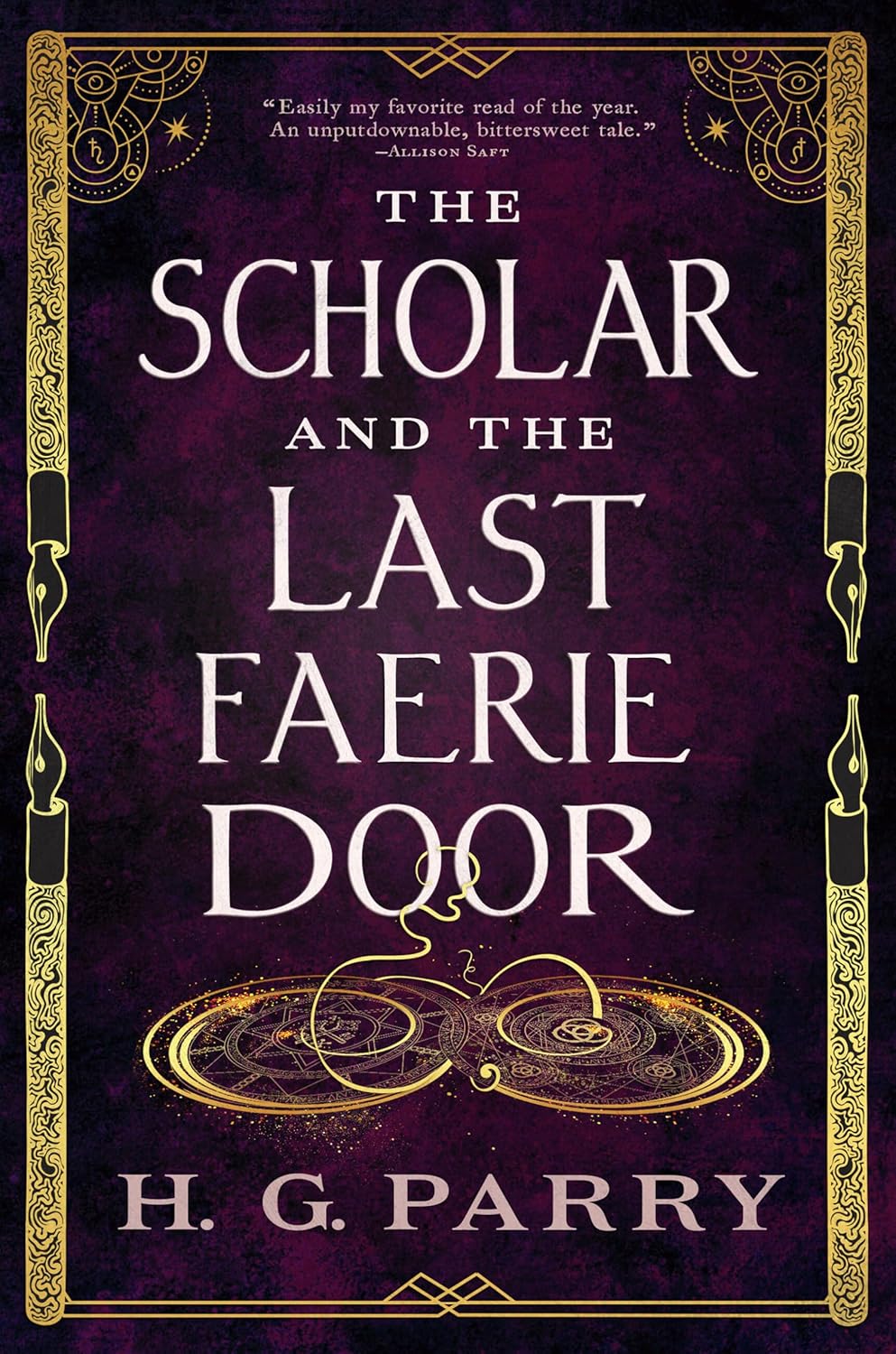
The Scholar and the Last Faerie Door by H. G. Parry

H. G. Parry continues to impress me deeply (see previous reviews here). I think this might be my favorite of her books, although The Magician’s Daughter was a feat. (This is not the first year I’ve given two books from the same author a perfect 10 rating: Alix Harrow, Stephen King, and Norman Maclean have each held this spot. Still.)

The book opens with a fateful meeting of the narrator, Clover Hill, with a person who will become one of the most important figures of her life. Chapter 2 rewinds to how she got there. “If it hadn’t been for the Great War, I would never have gone to Camford University of Magical Scholarship. I would never have known it existed.” Clover comes from a farm near a tiny village in Lancashire, a humble family background. She was very close to her older brother Matthew, despite five years of age difference, and it was Clover who helped convince their mother to let Matthew go to war, with some misgivings on Clover’s part. And so she carries the predictable guilt when he returns to them after four long years, alive, but scarcely recognizable. His homecoming is preceded by a visit from a fellow soldier who tells the family a wild and unbelievable story: Matthew’s is no ordinary war wound. He has been the victim of a faerie curse.

Families like Clover’s aren’t normally made aware of this fact, but magic is alive and well in the world she inhabits. Its study and practice, however, are reserved for select few magical Families (always capitalized), who possess great wealth and privilege as well as inherited, secret powers. Matthew suffers terribly. His life is in danger. And young Clover, already an ambitious girl who’d hoped to escape the family farm by way of teachers’ college, decides that she will pursue magic instead. A very, very tiny number of students are accepted to England’s university of magical scholarship, if their entrance exam scores are exemplary. Perhaps a tinier number of students even from the great Families are women. Clover will need to be very good indeed. But with the hopes of recovering Matthew’s health – even saving his life – to motivate her, Clover can do great things.

Camford University is located (as you might guess) in a mysterious space accessed by two enchanted doors in Cambridge and Oxford Universities, respectively. It’s a charmed and charming place, and upon first sight, Clover wants only to be a part of the place. Her desperation to save her beloved brother is quickly paralleled by her passion for magical scholarship (at which she excels, despite the oft-repeated claim that only members of Families should be so talented) and her desire to belong to Camford. Her heart leaps further when she clicks into place as part of a foursome of close friends: Hero Hartley, a lovely, glamorous girl, socially gifted and a serious scholar in her own right. Eddie Gaskell, awkward, shy, deeply devoted to plants and the natural world. And Alden Lennox-Fontaine, the golden boy of their year at Camford and beyond. He is physically stunning, impossibly wealthy, clever, graceful – “he was like a burning sun.” In Alden in particular, Clover finds a partner in the study of faerie spells and magic, which has been outlawed since the sensational wartime accident that changed Matthew’s life. The foursome make a project of studying what has been forbidden. Clover wants to save her brother. Hero wants to achieve the kind of academic success that will justify her career as a scholar so that she doesn’t have to marry a rich bore like her father intends for her. Eddie wants to please his friends. It’s not clear what drives Alden to study the fae.

The novel is historical fiction, in that it takes place just before, during and after World War I, reestablishing those events in a world with secret magic held by a chosen few. It’s about academia, the ivory tower that elevates and excludes, while offering a thrilling search for truth and self-betterment. It’s very much about friendship: the less-literal ‘magic’ of finding one’s people after a young life spent feeling alone – the magic of friendship, belonging, fellowship – is atmospheric and thick and real, evoked here in a way that it took me a while to realize reminded me of Tana French’s work in The Likeness or The Witch Elm or maybe The Secret Place. (There are also obvious parallels to the Scholomance series by Naomi Novik.)

As is often true in Parry’s work, there is metaphor available, if one considers that Clover is an outsider by gender, by class, and by not coming from a magical Family – England having a nuance of caring not just about class but about family and ‘breeding.’ We can think of the inherited ability to do magic as another manifestation of class or caste. And it is revealed late in the book (spoiler appears here in white text; highlight to read) that it is not Family at all that confers ease of magical learning, but the inhalation of magical pollen at the various universities of magic around the world. The Families know this, and purposefully keep that pollen to themselves, feeding it (as it were) to only their own, to keep alive an appearance of difference and superiority where there is none. It’s like giving multivitamins to your kids and then pretending they’re inherently better than those lousy malnourished kids down the street. That’s a whole ‘nother level of ugliness.

These issues of caste and injustice, and the idea of who is worthy and who is harmed by being kept out, are revealed and considered in layers as the story progresses. After a youth of yearning to be let in, to belong to Camford, Clover achieves what she seeks, more or less: in later, fast-forwarded sections of the novel, she is a PhD candidate and professor at her alma mater. But continuing injustices will eventually force her to realize that nothing has been resolved by her own promotion except her own personal success (which is tenuous). “The only difference was that the door had let me in, and so I hadn’t questioned who else it was keeping out and why.”

As you might be gathering, Clover and her friends and their secret work on faerie magic wind up involved in larger issues than they originally expect: not only Matthew’s fate but the very world around them are at stake. They must navigate split loyalties, major sacrifices, and big questions of right and wrong. Secrets also exist in layers: the magical world mostly a secret from the larger mundane one that Clover is native to; her studies with her friends on faeries, necessarily a secret from Camford and the magical world; and each of the friends, perhaps, keeping secrets from each other. There is heartbreak in the development and breaking of the friendship bond. More so in the possible breaking up of the world.

I think this is the most brilliant of H. G. Parry’s work yet.


Rating: 10 roses.

Fairy Tales of Appalachia ed. by Stacy Sivinski, photographs by Jamie Sivinski

I really loved The Crescent Moon Tearoom earlier this year, so imagine my delight to find that its author had also compiled and edited this collection of fairy tales from my adopted home region. The two books are of course very different. But I can hear the echo that the same author/editor was involved with each.

Sivinski opens with twenty-plus pages of introduction in which she details how this book came to be, and this was my favorite part of the book. She begins with her childhood, which was rich with oral storytelling, via her family and community and a unique elementary school that emphasized oral history. An early interest in oral history, and the experience of folktales as living, breathing, changing, current beings, took her through college and graduate school. It was as a graduate student that she found a shortage of “books that portrayed Appalachian folklore as a living genre.” Those she did find felt dated, in their illustrations and in their text, and often felt patronizing or stereotyped, as in their use of ‘eye dialect.’ A new term for me, this is the “transcription process that deliberately misspells words to make them seem more ‘authentic.'” In her graduate research, Sivinski was delighted by the recordings she found of Appalachians telling stories that often featured strong women and girls as central characters, and that played in curious ways on the familiar fairy tales and folktales of Scotch-Irish and German (Grimm) traditions. She quickly began thinking about how to offer those stories in a more modern and ‘living’ book than the ones she found available. And, wouldn’t you know, her sister Jamie Sivinski was already working as a photographer “who specializes in fairy-tale shoots.” So here is this book, a family affair.

There is more to the introduction, about fairy tale traditions, about research and transcription processes and Sivinski’s decision making there, about storytellers and collectors who’ve come before, and about the definitions of fairy tales, folktakes, and wonder tales. I found all of it fascinating, but I liked Sivinski’s personal history and story of this book’s birth the best.

Fairy Tales of Appalachia focuses intentionally (although not exclusively) on stories that center girls and women, with a bit of a corrective aim in response to a story-collecting tradition that has tended to center men. Stories are short – eight or ten pages or just two or three. Each is preceded by Sivinski’s brief notes placing the story in a larger context, for example, of fairy tale traditions: some play on Cinderella or Beauty and the Beast, some combine known elements, and some subvert them. Each contains a reference to the recording (or, in a few cases, transcription) where Sivinski found it. “The Hare Bride” comes from a transcription, with two credited storytellers – Sivinski interprets that one was the teller and the other the transcriber – and one of them hailed from Upshur County, West Virginia, where I live now.

The stories themselves are short, simple, often formulaic, and were not the part of the book that interested me most. (I found the same thing with the Foxfire book, Oral Tradition in Southern Appalachia.) To be fair, Sivinski points out that these stories are best read aloud and shared that way. I did read one aloud and agree that it improves the experience; haven’t tried it with friends yet. I liked the academic work and personal background at least as much as the stories themselves. I’m so grateful they’re collected here.

Jamie Sivinski’s accompanying photographs are certainly beautiful. Some are in black and white and some in color, all matte rather than glossy. I didn’t find that they especially correspond with or illustrate any stories in particular, but rather felt that they just set the tone. While I appreciate the effort, I actually found their inclusion a little distracting, in part because I was looking for connections I didn’t find. I worry that the effort to update the dated illustrations of past collections will only be dated in turn. And… there wasn’t a ton of diversity in the characters / models depicted. I know we think of Appalachia as overwhelmingly white (and my little town here certainly is), but that’s less true throughout than the reputation asserts. The characters in these pictures are almost all girls and women, almost all white, and all stunningly beautiful – rather than looking like ‘real’ people. Maybe that’s the fairy-tale aspect of it. It didn’t work all that well for this reader, although the photos are undeniably lovely in themselves.

I’m glad this scholarship exists and glad the stories are collected in this way, and I’m just trying to figure out which of several friends I’ll pass this one on to.


Rating: 7 apples.

The Shadows Rule All by Abigail Owen

The Shadows Rule All is the final installment in the Dominions trilogy, following The Liar’s Crown and The Stolen Throne. It continues the work of the previous two in an anticipated fashion, which is not a criticism. I was just talking with a friend about the expectations set up by a series, and what it means to meet or thwart them, and how much of the latter might be tolerated by a fan base. When I say Owen has met expectations with this one, I mean that in a good way. In the previous two books, she taught me to look for action; intrigue; humor; teenaged awkwardness; the challenges of split loyalties (both for teens and for monarchs, worse for teenaged monarchs); youthful navigations of romance and sex; familial love; loss and grief and magic and more. All of those elements were present, while leaving room for surprises in terms of plot. For the most part, I feel this upholds the contract set up by the first two books in a trilogy. It will be a rare series (let alone trilogy – perhaps a more tightly bound subset of series) that subverts reader expectations without pissing them off. And there was still plenty to keep me engaged and guessing.


Beginning here, a reminder: as I’ve done before with series reviews, this review will contain spoilers for the previous two books. Just one nice, vague one for this title.


As is probably appropriate for the finale in a trilogy, Owen goes big. The stakes are higher than ever. Some very big issues in Meren’s world must be resolved: various forces are working to release the goddesses who’ve been locked in the amulets for many generations; the Shadows that haunted Reven and now haunt Meren must find their final destinations; the dominion of Aryd which is Tabra’s (and/or Meren’s?) to rule must find its ruler and its peace. Eidolon will, hopefully, be dispatched. There will be a huge, pitched battle, with all the consequences, action sequences (including magic), and some serious losses. As much as it hurt to read, I applaud Owen for being brave enough to kill off a few characters who have been central and loved. That’s what a book like this calls for.

A love story has been brewing in previous books, between Meren and Reven, originally her kidnapper (who assumed she was her twin, Tabra), although he had his reasons. In the previous book they were “bound,” in a magical ritual that means they will always find each other even in later lives, and that they can communicate nonverbally and feel one another’s feelings, among other things. In this book, Reven returns from a terrible trauma without any memory of Meren. Most inhabitants of their world find this unprecedented for a bound couple, but assume as he recovers his memories they will come back together. Worse and stranger, the physical manifestations of their bond – lines that light up under the skin – are absent. Worst of all, Meren can still feel the bond, although she cannot access his mind and feelings. These are often the most powerful elements of fantasy or absurdist stories: literalizations of concepts we already know in our ‘real’ world. So: Meren feels the loss of her traumatized, amnesiac lover physically, as literal pain, while he is oblivious, or confused by an explicable magnetism. The Meren-and-Reven push-pull feels to me like the most important thread in the story, although there are many that matter, not least the rule of Aryd, the sisterly bond between Meren and her twin Tabra, the righting of the entire world via goddesses and climate, and various other love stories. Tabra has a sweet one of her own, and by the way, my previous concern that she was too sweet has been entirely corrected here: a dear friend to those she loves, yes, and good-hearted, but with her own priorities and stubborn points and a backbone of steel.

This novel and this series contains action, gore, and loss, hard decisions and monsters and deaths. For all that, it is still an upper YA or “new adult” book with coming-of-age themes: relationships, responsibilities, finding oneself. And it is a comfort read (for those of us who take some blood with our romance). I was surprised at what a fairy-tale, happily-ever-after ending Owen granted us in the end, not that she didn’t put us through some pain on the way there. I enjoyed every minute of it.


Rating: 7 petals.

Somewhere Beyond the Sea by TJ Klune

Here it is: the long-awaited sequel to The House in the Cerulean Sea, which I found lovely and transcendent. Somewhere Beyond the Sea continues in that vein in fine form. We pick up Arthur, Linus, and their endearingly and massively weird household with six magical children – originally an orphanage, but now building into a family and a home – more or less where we left them. Linus has left his employment with the Department in Charge of Magical Youth to be with Arthur, and the two men are working on adopting their six charges. Theodore, a wyvern with an obsession with buttons. Talia, a garden gnome, a lovely girl with a lovely beard and a way with plants. Phee, a forest sprite. Sal, the eldest, a shifter who spends some of his time as a Pomeranian and is developing strong leadership skills. Chauncey, a “biologically unique” green blob and bellhop. And Lucy, short for Lucifer, the seven-year-old son of devil, who has his murderous tendencies but also a pretty standard seven-year-old sense of mischief, and a good heart. These pages will add to the mix David, a teenaged yeti, who is slow to trust his new household but also inclined to fit right in. He’d like to submit that fear is not always a bad thing: humans watch scary movies for fun, right? What’s the harm in a little good-natured roar now and then?

Pitted against this evolving family, of course, is the government, in the form of the Departments in Charge of Magical Youth and Adults, who would like to see everyone involved put in their place, under lock and key and with what some less enlightened folks still feel is an appropriate amount of shame. Arthur, himself a former magical youth – he is a phoenix, possibly the last living one of his kind – has come a long way from his trauma at the hands of DICOMY and his defensive isolation with his six orphaned charges. With the love and support of Linus, their dear friend (and island sprite) Zoe, and Zoe’s girlfriend Helen, mayor of the nearby village, Arthur and the children now regularly venture into town and mingle with humans and magical folks there. And when the book opens, Arthur is set to testify before the government about the abuse he suffered as a child and his work with his own children; he is hoping to help build a better world, and through adoption, formalize his family. But the close-knit family is up against some truly formidable villains with all the power in the world.

Like Cerulean, this sequel plays in several registers. The antics of the kids are sweet, silly, hilarious; there is lots of good fun and humor and also wholesome good lessons about mutual love and support. The continuing romance between Arthur and Linus is equally wholesome and feel-good. In inviting David in to their family, the household faces some new challenges in how to build trust and honor the newcomer’s need for distance.

Trust, Arthur knew, was a treasure effortlessly stolen, often without rhyme or reason. And this particular treasure was a fragile thing, a piece of thin glass easily broken. But here was David, surrounded by strangers in an unfamiliar place, attempting to pick up his pieces and put them back into a recognizable shape. Whatever else he was, David’s bravery in the face of seemingly insurmountable odds proved yet again what Arthur had always believed: magic existed in many forms, some extraordinary, some simple acts of goodwill and trust, small though they might be.

I think this illustrates some of the book’s larger themes: trust, fragility, vulnerability, bravery, and how these elements can help form family and community. The concept that even those in power – in government or in families – need to have the ability to acknowledge when they have been or done wrong. Arthur must navigate a misstep when he encourages David to be whatever he wants to be, including a “monster”, while having told Lucy that he should be less monstrous. (David’s monstrosity is less threatening. But should Lucy’s right to self-realization be any less?) This is still and again about trust: how Lucy can trust a father whose rules change; how a father or fathers should trust their child’s judgment as they grow and mature. Change requires flexibility; growth can be painful. But this loving family is very strong, perhaps because they challenge each other. And the letting-in of the village has been a good move: under the influence of Arthur and Linus’s household, the human inhabitants have learned greater tolerance, and magical visitors (and their tourist dollars) have begun to transform what was a typically mistrustful community into a more welcoming one. It will take a whole village in the end to defend what’s right.

A beautiful novel about family, trust, community, recovery from abuse and trauma, and systemic ills, all leavened by mischievous humor and filial and romantic love. Same-sex couples abound in the book, and Klune’s Acknowledgements prioritize defending trans people’s rights, but I’d say the metaphor at work in this world – where magical people are hidden away, poorly understood, and discriminated against by a larger population which will benefit from their inclusion – works for any disadvantaged minority. It’s great reading, sweet and funny, with great messaging. I can’t wait for more like it from this fine author.


Rating: 9 fish named Frank.

rerun: Dirt Work: An Education in the Woods by Christine Byl

Because I still talk about and think about Dirt Work, and because (I still can’t believe my good fortune) I now get to build trails for a living, it feels right to talk again about this transcendent book. I hope I get time to reread it someday. Original publication and review from 2013. For more, check out Lookout, which also got a 10 (and those are rare).

Christine Byl opens her memoir with the pleasant scene of herself and three fellow crew members, crusty and dirty, having a post-hitch beer at a small-town Montana bar. A young woman approaches and asks how she keeps up with the boys, one of whom volunteers that it’s all they can do to keep up with her.

She then backs up and tells the story of how she got there. Like many young women in our culture, Christine was expected and expecting to go to college, to do cerebral work and keep her hands (literally) clean; but a summer gig held her, and she reveled in physical challenges, in learning new things, in the mechanical world. Eventually she reveled in her hardening muscles and her expertise, in surprising men with her ax-work and in mentoring other young women coming up in the “matriarchy” of trail work (still predominately male) within Glacier National Park.

After six seasons in Glacier, alongside boyfriend and eventual husband Gabe (a delightful character: mostly off screen, but clearly a capable young man in his own right, and clearly happy to stay lovingly out of Christine’s way), she does return to graduate school, in Alaska. But during the summers she still works on building and maintaining trails, this time in Denali. Christine and Gabe come to love Alaska – yes, even the winters: there is a delightful passage arguing that the light summers are in some ways harder than the dark winters, and I made both my parents (recently moved from the Mexican to the Canadian border) read it. They settle a few miles outside the borders of Denali National Park, and Christine finds a balance between the cerebral – she gets an MFA in fiction, and writes this beautiful book; and the physical – she and Gabe now run their own independent trail-building company.

So many things to love in this book; where to begin? As a sometimes volunteer trailworker myself, I don’t pretend to know 2% of what Christine does; but I might know just enough to appreciate what she loves about it, and what a challenge it can be. I still haven’t mastered the efficient, all-day ax swing myself, but I’d like to. Also, I have a friend named Susan who I’ve written about before, who has a great deal in common with this author. (I briefly wondered if “Christine Byl” was a pseudonym.) Susan, like Christine and apparently like many trail workers, has an advanced degree but chooses to labor for a living; she’s a woman in what is clearly a man’s world, and is half of an independent trailbuilding company. I get the impression that while it’s hard work, Susan and her husband Ryan wouldn’t do anything different.

Christine writes beautifully about the phenomenon of choosing to do physical work when she could be keeping her hands soft. She writes about the well-intentioned questions her family asked, about when she was going to get a “real job”: she says that they have confused happiness with orthodoxy. (I can only imagine how many of us can sympathize with that concept!) She writes about the “sorority” of men in trailwork, and the way that pulls women together; she writes about the pride she feels when upending male expectations of her blonde head and small frame. As a writer, and clearly a gifted one, she structures this book as solidly as she would a bridge or retaining wall. Each of 6 chapters is represented by a tool (axe, rock bar, chainsaw, boat, skid steer, shovel), a location (North Fork, Sperry, Middle Fork, Cordova, Denali twice) and a locale (river, alpine, forest, coast, park, home). Within those chapters she roves and rambles, musing on natural phenomena, social relations, her own body and personality, strengths and shortcomings, and then returns to tool and place to ground herself. The structure of this book, then, is both well-anchored and floating, and I found that it worked very well.

I was charmed by Christine Byl’s honesty; her love of place; her range of experiences and understanding of two worlds, that of universities and that of woods; and of course her lovely writing. She’s hard as nails, with two hernia surgeries and a preference for outhouse over indoor plumbing. She’s brash and can tend towards a loud and dirty mouth (that makes two of us), but she’s got a soft core. I like her; I’d like to be her friend, and of course I’d really love to learn from her.


Rating: 10 pulaskis (my personal favorite trailwork tool).

So good.

Maximum Shelf: Old School Indian by Aaron John Curtis

Maximum Shelf is the weekly Shelf Awareness feature focusing on an upcoming title we love and believe will be a great handselling opportunity for booksellers everywhere. The features are written by our editors and reviewers and the publisher has helped support the issue.

This review was published by Shelf Awareness on November 18, 2024.


Old School Indian by Aaron John Curtis is an engrossing trip cross-country and through time with an unusual protagonist-and-narrator duo, who together explore family, culture, history, identity, health and healing, community and connection. With serious situations and heartbreaking turns, this debut novel is both thought-provoking and hilarious.

When readers meet Abraham John Jacobs (Abe), he stands half dressed in his great-uncle’s trailer on the reservation where he was born and raised. He’s 43 years old, ill with a yet-undiagnosed malady, and he’s reluctantly agreed to let Uncle Budge try a healing. “If Rheumatologist Weisberg hadn’t canceled his appointment the day before he was supposed to finally get a diagnosis, Abe would probably still be in Miami, trying to decide which Halloween parties to attend.” Budge is an aging former alcoholic with a Butthole Surfers t-shirt stretched across a big belly; his spiritualist mystique fits in between more pedestrian concerns. “Not everythin’ we’re put here to do feels great,” he points out.

Abe has flown in for this visit, or recuperation, minus his wife, Alex, with whom relations aren’t so strong at the moment. The narrator, Dominick Deer Woods (whose identity won’t be clear for some time, and who is given to direct addresses to the reader), acknowledges that “Abraham Jacobs might not sound like an ‘Indian’ name, but you’ve got the hardcore Catholic first name and the surname of what used to be the biggest landowners on Ahkwesáhsne. So if you’re in the know, then you know the name Abraham Jacobs is rez as hell, cuz.” Feisty, bold, and brimming with voice, Dominick enriches this account at every turn.

This latter-day Abe, in Ahkwesáhsne in 2016 with the yet-to-be-diagnosed autoimmune disorder, anchors the novel’s present timeline, which is interspersed with flashbacks to the story of Abe’s life up to this point. Dominick relates Abe’s childhood and teenaged years in less detail, but focuses in earnest when he leaves the rez to attend Syracuse University, where he immediately meets Alex, a larger-than-life, sparkling, Miami-born, blonde musical theater major with whom he will be permanently infatuated. With Alex, Abe moves from Syracuse to Virginia to Miami, enjoys an expansive and mostly fulfilling sex life with a multiplicity of partners of all genders, performs at open mic nights as a budding poet, and eventually marries. Alex has been a regular on the rez for Thanksgiving holidays (a high point for the Ahkwesáhsne Kanien’kehá:ka, who white folks know as Mohawk Indians, and, yes, Dominick gets the irony) for decades. But he will take his time revealing why she’s not here.

At the rez, Abe gets sicker. The lesions on his lower legs look terrible but feel okay; his joints look fine but cause him excruciating pain. His medical team back in Miami is slow with a diagnosis, but when it comes, it’s grim. His faith in Uncle Budge’s healing increases with his pain, desperation, and reluctant observation of the older man’s wisdom. Lying on the carpet to be massaged is one thing; a much harder part of the process involves Abe examining his relationship with his family and the reservation community. The situation with Alex–still at home in Miami while Abe deteriorates up north–continues to decline. Unexpected help may yet be on the way.

Dominick Deer Woods brings intriguing dimensions to this novel. He is “your proud narrator,” while Abe is “our humble protagonist.” He reviews that Abraham Jacobs is “a Native name but that doesn’t make it an Indian name. Dominick Deer Woods, though? You could light a peace pipe with it.” Dominick in these and other respects exists in contrast to Abe. Where Abe is serious, hesitant, and out of touch with Ahkwesáhsne, Dominick is hard-hitting, informed, playful, angry, and very funny. He offers an interplay, a not-quite-literal dialogue, throwing Abe into relief, helping to illustrate and define him. He also offers poetry, and one of the most electrifying descriptions of writing poetry that readers are likely ever to come across.

Abe’s life and Dominick’s smart observations of it present a nuanced investigation of family (by both blood and marriage) and several layers of identity: what it means to be Ahkwesáhsne Kanien’kehá:ka (or, if you must, Mohawk); to be from the rez, on the rez, off the rez; and to navigate American history and modern cultural tropes. Old School Indian is concerned with gaps and distances: between the reservation and Syracuse, between Syracuse and Miami, between Abe and Alex, between Abe and his family back on the rez, between Abe and Dominick. As middle-aged Abe confronts difficult truths about himself, his body, and his relationships, he will consider how he wants to move through the world in large and small ways: in poetry, in love, in health. Dominick observes about a teenaged band that plays on the reservation, “No gig… will be as well-received as this one, since the reality of them will always be chasing listeners’ memories. But they have tonight, and they play and sing like the world is ending tomorrow.” Abe may yet do the same, and he and readers will be better for it.


Rating: 8 gingham sheets.

Come back Monday for my interview with Curtis.

rerun: The Warmth of Other Suns: The Epic Story of America’s Great Migration by Isabel Wilkerson (audio)

Now seems like a fine time to revisit Isabel Wilkerson’s excellent 2010 work, in my 2012 review here. (For later reads, also check out Caste and a corresponding interview I was lucky to get.)

I didn’t really know what this book was about when I picked it up – only that it was well-regarded. I’m so glad it found its way into my hands. Isabel Wilkerson has taken on a large-scale, ambitious subject here, and rendered it beautifully. And the audio reading by Robin Miles is lovely to boot.

The “great migration” in the subtitle refers to the movement of black Americans out of the South and into the northern and western United States in 1915-1975. Wilkerson starts from the very beginning, looking at the experiences of former slaves just after Emancipation in an impoverished region struggling to rebuild with a new order of things. The creation and expansion of Jim Crow laws designed to hold blacks down took time after the end of the Civil War to take effect. In the new caste system, former slaves and their descendants were unable to move up in the world and were in constant fear for their lives if they were to misstep around Southern whites. By 1915, they had begun to move out of the South, in what became a mass migration along lines so distinct that enclaves of blacks from specific towns and states were recreated in new locations.

Wilkerson shifts between two ways of studying the Great Migration. Sometimes she takes a broad view of history, in which she cites her own interviews (she states that she did over 1,200) with migrants and their descendants as well as a number of historical sources, to render the story of the Migration generally. And sometimes she follows the specific personal stories of three individuals who she interviewed at great length over a long period of time, traveling the country with them and becoming part of their lives. (In this respect, the journalist/author becoming part of the family of her subject, I was reminded of Rebecca Skloot’s amazing The Immortal Life of Henrietta Lacks.) George Swanson Starling moved from Eustis, Florida to New York City, later sending for his wife Inez to join him there. He had to leave Florida suddenly because a friend tipped him off that a lynch mob was coming for him; he had been involved in organizing his fellow citrus pickers to demand higher wages. Ida Mae Brandon Gladney moved with her husband George and their two children, with a third on the way, from Mississippi where they had been sharecroppers. They would eventually end up in Chicago, by way of Milwaukee. And Robert Joseph Pershing Foster was an ambitious surgeon and veteran from Monroe, Louisiana, with his heart set on Los Angeles. Known as Pershing in Monroe, he would resettle as Robert (or Bob, or Doc) in LA and send for his wife and daughters to join him there, where he built a new life in high society with the big house and booming practice he’d always wanted.

I found this shifting back and forth between the broad view and three personal histories extremely effective. Anecdotes from the lives of Southern blacks drove well home the misery of their bottom-rung status there; some of these stories are horrific, but important to show the desperation some migrants felt when they left their homes in the South. National trends played a role – for example, during WWII demand for Florida’s citrus was high while the supply of labor to pick the fruit was low, with everyone off at war, and this imbalance led to George Starling’s ability to demand higher wages. And the history of Chicago’s race relations and residential segregation puts Ida Mae Gladney’s home ownership into the proper perspective. You get the point. The history is well-documented and, I’m convinced, well-researched; and the personal stories make it all, well, personal. I was deeply involved with our three representative individuals by the end of the book and, yes, I cried.

I love that Wilkerson brought such a large-scale, important trend, that has had such huge effects on American history, to life the way she did. I also like that she examined the broad effects of the Great Migration, in terms of the cultures of both white and black residents of the North and the South, and took the time to show that black migrants were really far more like immigrant groups in history than like migrants within their own country. I recommend this book as part of a study of American history – but one need not be an academic to appreciate it. The story of the Great Migration is made accessible here, and I’m glad I know more about it now. This 19-disc audiobook (over 600 pages in print) went by easily. This is how I like to take my history lessons. Check it out.


Rating: 8 train rides north.

rerun: The Solace of Leaving Early by Haven Kimmel

From early in my career with Havel Kimmel: please enjoy this review from April of 2013.

Langston Braverman has recently returned to her hometown of Haddington, Indiana. Very close to receiving her PhD she walked out of her oral exams. She is a strange, exceptionally erudite but socially fragile and problematic young woman. She has a dog named Germane: “named not after Germaine Greer, but as in: Germane to this conversation.” (I love that.)

Amos Townsend is Haddington’s pastor, of only a year or two now. He is tormented by the death of a local named Alice; he feels that he should have been able to stop her death, and he is struggling with his faith, which is actually nothing new.

Alice’s two children are left in limbo; their crazy aunt Gail has turned out to be unfit, and their grandmother Beulah is clearly too near death herself to wrangle with two traumatized little girls. Upon Alice’s death, they dispose of their original names, Madeline and Eloise, and state that they are now called Immaculata and Epiphany. They wear costumes from a Renaissance drama from school, that their mother made, all the time. Complete with hats: the tall cone-shaped kind with ribbons streaming off the tops.

Langston’s mother AnnaLee picks up some of the slack, and then insists that Langston step up: she is not in school, not working, and these children need her. Of course, Amos plays a role as well, so that this village will truly raise a child.

Langston and Amos are the stars of this story (along with the striking Immaculata and Epiphany, of course). When they meet, they repel one another like magnets. Despite sharing tastes and interests in reading, philosophy, theology, and (I can’t stress this enough) their particular brands of weird, they repel. And, as is clearly a theme in Kimmel’s work, the cerebral content, the philosophies and theologies that shape this part of the story are complex and thoroughly explored. I think I said this in my last Kimmel review, but: her many references partly pique me to go off and study, and partly exhaust me, making me so glad I don’t have to read Whitehead and Tillich and Frithjof Schuon. It makes me sit back and… wonder… that all these strange, complex, learned thoughts that Langston has are thoughts that Kimmel had to have first, had to conceive to put them in her heroine’s mouth; think of that.

Immaculata and Epiphany see Mary (the Mother of God) in the dogwood tree in their grandmother Beulah’s backyard. Naturally, because that is the kind of world this is. It is very strange and is a kind of beautiful, and again I observe that Kimmel’s gift is to create a midwestern small-town world that is both hopelessly humdrum and depressing and everyday, and also strange and exalted and worthy of examination.

What happens to our exquisitely odd cast of characters should definitely remain a surprise to you, reader. It’s pretty great, though.

I love this author SO MUCH that I am struggling to write reviews; but I will keep reading her. Next up is The Used World, and I am, of course, working to get my hands on her best-known bestselling memoir, A Girl Named Zippy.

I’ll close, as I tend to with Kimmel, with a few lines from the book that particularly caught my eye. Where these have, in the past, been lovely examples of her use of language, these are more concepts that I really liked. There is a book theme here. And the language is great – observe the curry comb, is that an image or what – but it’s the concepts that I like most here:

Amos knew as well as anyone what went into writing a book, having written a master’s thesis, and he considered the process to be akin to having one’s nerves stripped with a curry comb.

Maybe he knows what goes into writing a book as well as anyone… who hasn’t written a book?

The most intractable aspect of his bachelorhood was that Amos was uncomfortable eating without reading; he felt as if he were wasting both time and food.

Me too, Amos. I’m right there with you.

Amos tapped his fingers on his bony knees. “Why do you have a book and I don’t?”

“Because I’m a woman, Amos.”

“Yes, but why do you have a book and I never do in a situation like this?”

AnnaLee put the book down. “I carry a bag. I also have safety pins and emergency money, and a package of those little wet towelettes. We live in Indiana. I could get stopped by a train, I could get bored. I always carry a book.” She went back to reading.

How perfect is that. “We live in Indiana, Amos!” Perhaps it goes without saying that I, too, try to keep a book with me at all times? I fail on safety pins and wet towelettes, though.

I’m sure I’ve failed to do this book justice. But it’s divine.

Rating: 9 ribbons on a hat.

Lovely. I should reread her sometime.

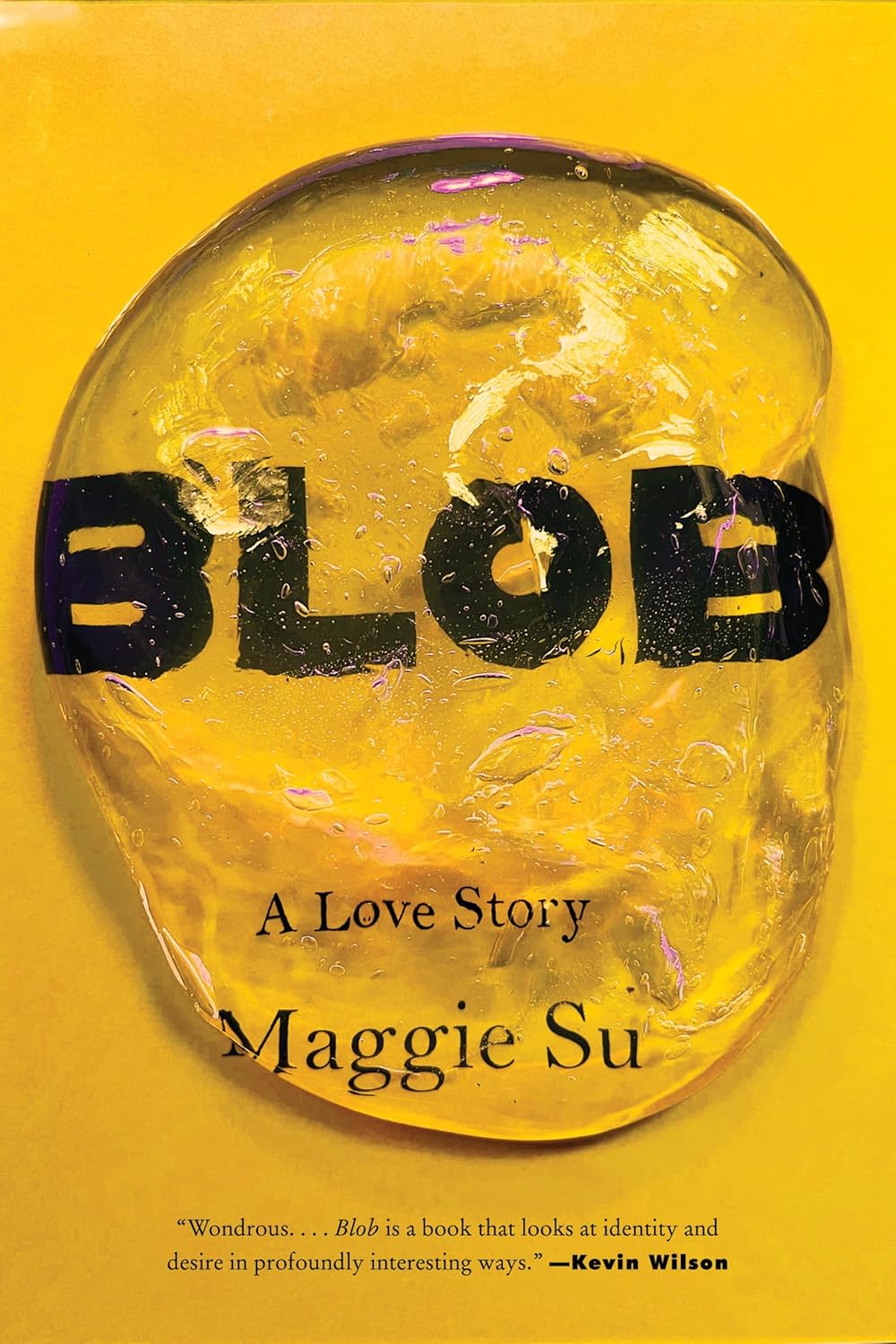
Blob: A Love Story by Maggie Su

This quirky, funny, pained novel considers the challenge, for any of us, of becoming fully human.

Maggie Su’s Blob: A Love Story is a funny and pathos-ridden tale of social awkwardness and self-realization; a modern, delayed coming-of-age. Su’s narrative voice is perfectly pitched for her inelegant but deeply sympathetic protagonist.

Vi is a 24-year-old townie and college dropout in a midwestern college town. She works a hotel chain’s front desk next to a too-perfect perky blonde named Rachel. Vi is still suffering from a breakup eight months ago, barely slogging through her days. Her Taiwanese father and white mother are well-meaning and supportive, but they have trouble connecting with Vi, who has always been a loner; her older brother can be a pain, but he cares, even when Vi struggles to. Then, on a night she ventures out for the rare social occasion, she stumbles upon something new in the alley behind a bar during a drag show: a shapeless blob with a mouth and two eyes. She carries it home and, under Vi’s yearning influence, it grows.

The evolving blob, which Vi will come to call Bob (it starts as a malapropism), is the only fantastical detail in a story otherwise rooted in a very familiar world, featuring the casual racism of Vi’s hometown and her awkwardness with social situations. Bob takes in lots of television (and Fruity Pebbles), and after examining the pictures Vi shows him of movie stars like young Hugh Grant and Ryan Gosling, fashions himself into a tall, stunningly handsome white man with a six-pack. Vi presents him as a hookup or boyfriend; the world has trouble assimilating their match. The pairing is, in fact, a strain. “For a while, he seemed happy enough to eat and breathe and exist–the perfect companion. I should’ve anticipated that molding him into a man would trigger something deeper, some sort of existential awakening. Now he’s just like everyone else. He has needs and desires beyond me…. He could leave without me ever knowing why.” The fear of being left, of course, is key to Vi’s difficulties in navigating the world.

What makes Blob special is its mix of heartrending conflict and silly, self-aware humor. Truly cringy scenes balance sweet ones. Rachel performs off and on as a friend–but Vi scarcely knows how to care for her own problems, let alone anyone else’s, and her past attempts at friendship have often ended in unintended cruelty. Su excels with characters who can be significantly flawed but stir the reader’s empathy. Even Bob, despite beginning his life as a blob, has a surprising amount of personality. In the end, discomfiting though it may be, Blob makes incisive observations about life for a 20-something trying to make it on her own. Blobs and humans alike may yet find home.


This review originally ran in the November 8, 2024 issue of Shelf Awareness for the Book Trade. To subscribe, click here.


Rating: 7 handfuls of cereal.