






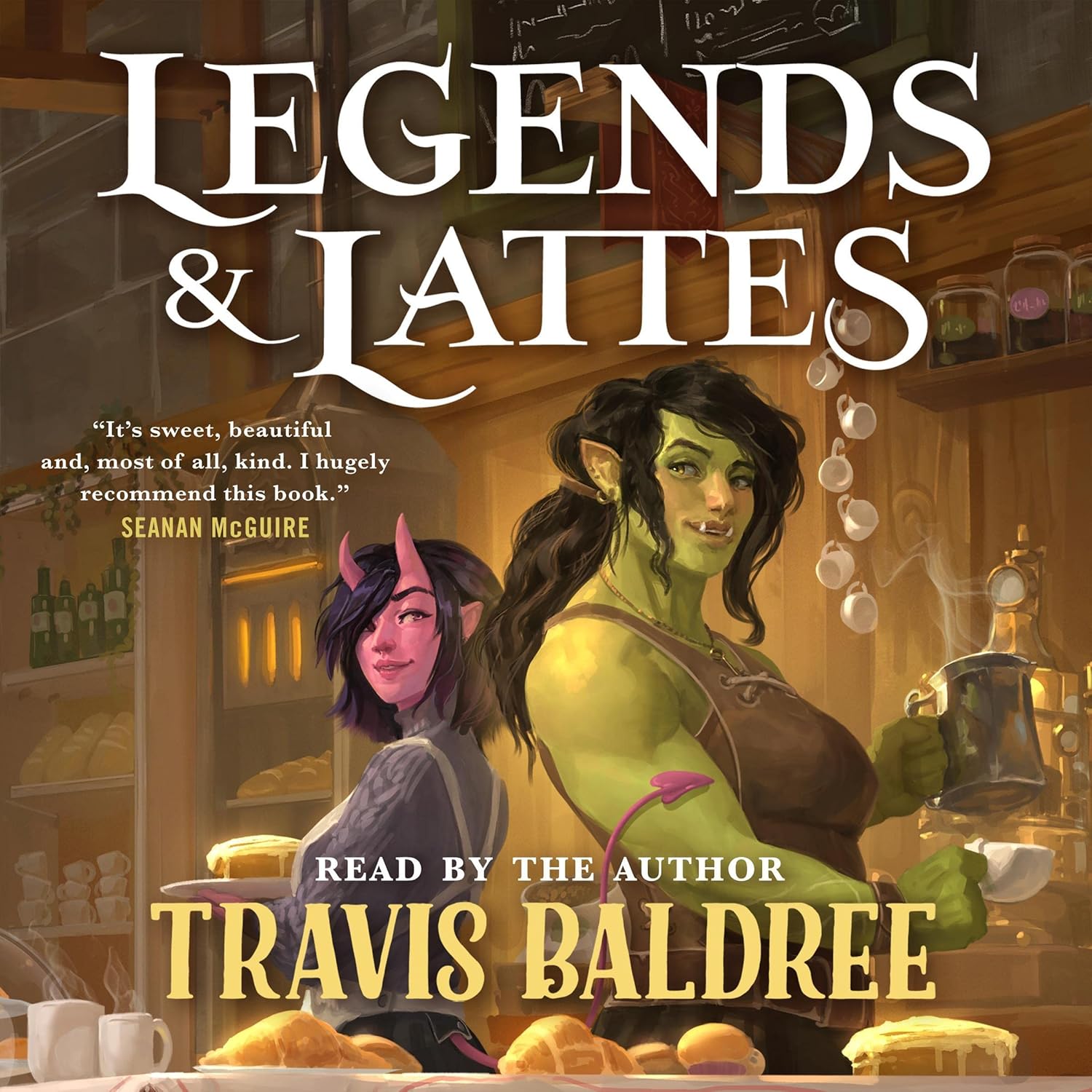
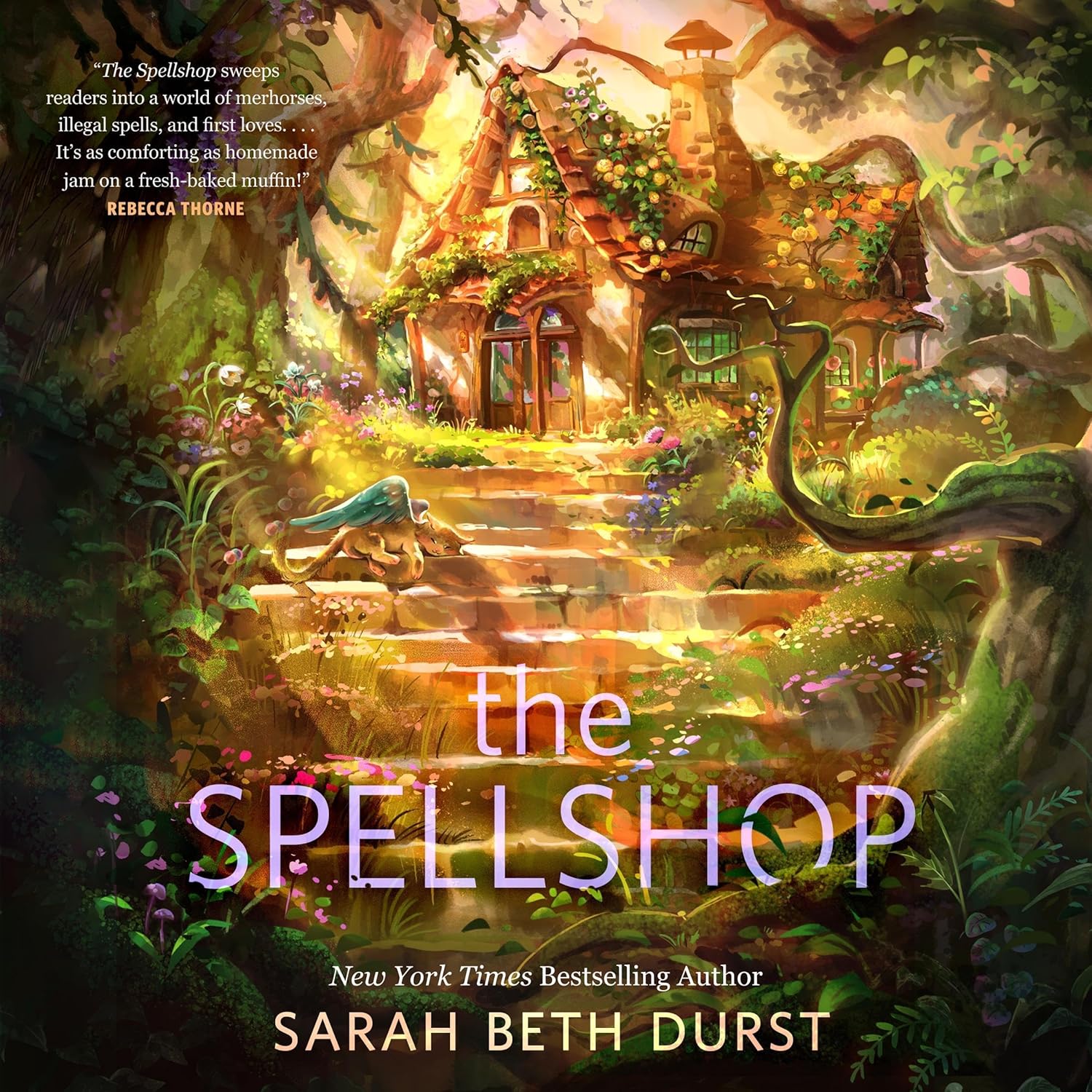
 I somehow got this book recommended, I think as a comp for The Spellshop which I loved. It was a good rec! Legends and Lattes is likewise cozy, although not without threat and even violence; offers subtle romance; and incorporates fantasy and worldbuilding elements. It was on the short side, and I got so engrossed I finished it in just two days! (I’m currently engaged in the included short story, a prequel, and will write that one up for you soon.)
This novel features Viv, an orc who has worked as a mercenary – hunting bounties, killing bad guys and monsters – with a small group of associates (who are mostly also friends). She’s been dreaming of getting out of the game, though. Her back hurts. As the story opens, we see her grasp a mysterious item, a bit of a good luck charm. She journeys along ley lines to the town she’s chosen for its advantageous position. Between her luck object, the ley lines, a witching rod, and a nest egg she’s saved up, she methodically sets about establishing the first coffee shop in the town of Thune. In an interesting retail challenge, no one in Thune has ever heard of coffee; Viv herself had only encountered it in a distant gnomic city. Not only is she embarking on her first retail venture, she’s introducing an unheard-of product. Bean water?, her first few acquaintances ask her, clearly doubtful. But she has her good luck charm.
The truly cozy aspect of this story lies in Viv’s earnest desire to leave behind a life by-the-sword in favor of a more wholesome one – ‘cozy’ is in fact the word. The gnomic coffee shop she’d fallen in love with was warm, bustling, with a sense of community, as well as delicious drinks. In Thune, she slowly builds her own version of this, making friends (almost by accident and almost without noticing it) along the way. First she hires a builder, an expert craftsman but one disregarded by his local society, making him ready to appreciate Viv’s valuing his services. Next she hires an assistant, also a bit of a social outcast, but who turns out to be PR/marketing whiz (and an artist, who enlivens the chalkboard menu and signboards). Then she stumbles almost by accident on a baker, a tiny ‘ratkin’ of few words but a genius with dough and flavor. A painfully shy giant comes in to play the lute. An awkward scholar comes to study and eventually share his skills. Viv wanted a new life and livelihood; she winds up establishing a community, even a built family. And good thing, because the troubles of her old life are just around the corner.
Sweet, entertaining, page-turning. Can’t wait for more.
Filed under: book reviews | Tagged: audio, cozy, fantasy | Leave a comment »




 pagesofjulia