book beginnings on Friday: The Forest Lover by Susan Vreeland

Thanks to Rose City Reader for hosting this meme. To participate, share the first line or two of the book you are currently reading and, if you feel so moved, let us know what your first impressions were based on that first line.
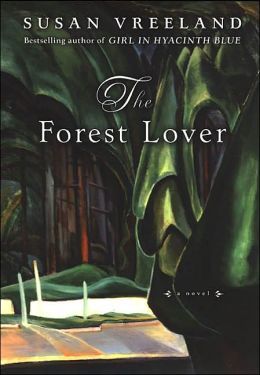
forestlover

I was inspired to pick up The Forest Lover by a mention in the acknowledgements of Scott Elliot’s Temple Grove (review to come!), helped along by my admiration for Vreeland’s Girl in Hyacinth Blue and especially her Clara and Mr. Tiffany. In other words, I have high expectations; and the opening lines reinforce them.

Letting her cape snap in the wind, Emily gripped her carpetbag and wicker food hamper, and hiked up the beach, feasting her eyes on Hitats’uu spread wide beneath fine-spun vapor. Cedars elbowing firs and swinging their branches pushed against the village from behind.

In those sentences alone, I see several things. This is a book about a woman of another time; she “feasts her eyes” upon a natural setting; and there is a native, non-English presence. I think it will be lovely.

I can’t share the whole first page, because that’s not in the spirit of this meme and gets a little more tenuous regarding copyright; but Pops, if you read the first page of this book I suspect you might be convinced that it should go on your list. I’ll keep you up to date as I read on. (And for those interested in that whole first page – it’s freely available on Amazon and Barnes and Noble where you can “look inside” or “read instantly.”)

Looking good!

book beginnings on Friday: The Norman Maclean Reader

Thanks to Rose City Reader for hosting this meme. To participate, share the first line or two of the book you are currently reading and, if you feel so moved, let us know what your first impressions were based on that first line.

maclean

For this book beginning, we are treated to a previously unpublished chapter from Maclean’s abandoned book about George Armstrong Custer and the Battle of Little Bighorn.

It was in the year – even in the season of year – marking the 80th anniversary of the Battle of the Little Big Horn that Major Edward S. Luce retired as Superintendent of the Custer Battlefield National Monument. He and the Hill have long been closely connected.

Even in those few words, I recognize Maclean and his attention to detail and his interest. As I’ve just read in the introduction, Maclean’s obsession with the Mann Gulch Fire (see Young Men and Fire) is at least matched by his obsession with Custer; but his high standards and (argues the editor who wrote the introduction) his proximity to the subject caused him to leave this book behind.

I am super-extra-excited to have more Maclean to dig into. Let’s have it.

book beginnings on Friday: The Boy Who Could See Demons by Carolyn Jess-Cooke

Thanks to Rose City Reader for hosting this meme. To participate, share the first line or two of the book you are currently reading and, if you feel so moved, let us know what your first impressions were based on that first line.

demons

Despite a passing resemblance to The Sixth Sense, based only upon the blurb I saw somewhere, I am interested in getting into this Boy. It begins:

People look at me funny when I tell them I have a demon.

“Don’t you mean, you have demons?” they ask. “Like a drug problem or an urge to stab your dad?” I tell them no.

We shall see.

What does your weekend hold?

This quotation comes from an uncorrected advance proof and is subject to change.

book beginnings on Friday: The Happy Atheist by PZ Myers

Thanks to Rose City Reader for hosting this meme. To participate, share the first line or two of the book you are currently reading and, if you feel so moved, let us know what your first impressions were based on that first line.

happyatheist

I am pleased to be reading blogger PZ Myers’s new book, The Happy Atheist. It begins:

On any fine morning in rural Minnesota, I can step outside the door of my home and look a few blocks to the southwest and see the Church of the Assumption of the Blessed Virgin Mary. A few blocks to the west, just out of sight behind nearby houses, lies the First Lutheran Church.

He goes on for several paragraphs naming churches, to the conclusion that in his town of 5,000 people, he has 15 churches to choose among (or not). Which immediately reminded me of an oft-cited Edward Abbey quotation, natually:

Page, Arizona, Shithead Capital of Coconino County: any town with thirteen churches and only four bars has got an incipient social problem. That town is looking for trouble.

(from A Voice Crying in the Wilderness.)

Myers doesn’t go that far – at least not in the opening paragraphs…

This quotation comes from an uncorrected advance proof and is subject to change.

book beginnings on Friday: Young Men and Fire by Norman Maclean

Thanks to Rose City Reader for hosting this meme. To participate, share the first line or two of the book you are currently reading and, if you feel so moved, let us know what your first impressions were based on that first line.

young men and fire

Following an informative and lovely Publisher’s Note, which tells us that this is a posthumous publication of an unfinished (but largely formed) work, Norman Maclean begins his book Young Men and Fire with a story about the beginning of his involvement with the Mann Gulch Fire.

It was a few days after the tenth of August, 1949, when I first saw the Mann Gulch fire and started to become, even then in part consciously, a small part of its story.

To think that while the fire was still burning, in 1949, Maclean knew he’d be tied to it forever – though he didn’t begin this book til 1976, and it was unfinished at his death in 1990 – is profound in itself.

I think I am a serious Maclean fan. Stay tuned.

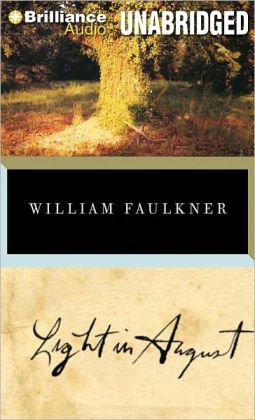
book beginnings on Friday: Light in August by William Faulkner

Thanks to Rose City Reader for hosting this meme. To participate, share the first line or two of the book you are currently reading and, if you feel so moved, let us know what your first impressions were based on that first line.

august

Friends, I have a confession: I fear Faulkner. I tried to read The Sound and the Fury once, and I was left feeling certain that either I’m an imbecile, or he is. The jury is still out. But I found this collection of audio lectures on iTunes University, from Yale, on Hemingway, Fitzgerald and Faulkner; and I already love two of those authors, and the three are often considered together; and I want to listen to these lectures and be able to follow along; so here I am again, attempting Faulkner. I’m told Light in August is a little easier than The Sound and the Fury. Wish me luck. It begins lucidly enough:

Sitting beside the road, watching the wagon mount the hill toward her, Lena thinks, ‘I have come from Alabama: a fur piece. All the way from Alabama a-walking. A fur piece.’ Thinking although I have not been quite a month on the road I am already in Mississippi, further from home than I have ever been before. I am now further from Doane’s Mill than I have been since I was twelve years old

[Regarding punctuation: I checked two print editions and both left off that final period, so I guess that was Faulkner’s work. I actually value punctuation, myself; trying not to let this make me nervous.]

Any Faulkner fans out there who can reassure me? I want to like this book!

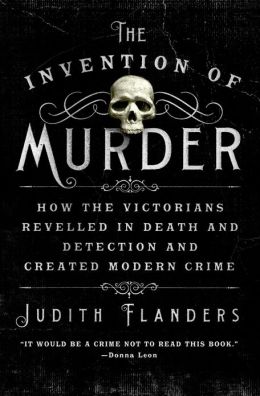
book beginnings on Friday: The Invention of Murder by Judith Flanders

Thanks to Rose City Reader for hosting this meme. To participate, share the first line or two of the book you are currently reading and, if you feel so moved, let us know what your first impressions were based on that first line.

murder

I am pleased to be reading this hefty work of history regarding the Victorians’ fascination with murder – a relative rarity in that era – and the birth of the murder mystery genre in literature (as you know, that’s my favorite genre in fiction). And I’m pleased to share with you a great, and representative, book beginning:

“Pleasant it is, no doubt, to drink tea with your sweetheart, but most disagreeable to find her bubbling in the tea-urn.” So wrote Thomas de Quincey in 1826, and indeed, it is hard to argue with him. But even more pleasant, he thought, was to read about someone else’s sweetheart bubbling in the tea urn, and that, too, is hard to argue with, for crime, especially murder, is very pleasant to think about in the abstract: it is like hearing blustery rain on the windowpane when sitting indoors.

This statement is a little disturbing, but I think inarguable, and maps out where the book is heading.

This quotation comes from an uncorrected advance proof and is subject to change.

book beginnings on Friday: The Solace of Open Spaces by Gretel Ehrlich

Thanks to Rose City Reader for hosting this meme. To participate, share the first line or two of the book you are currently reading and, if you feel so moved, let us know what your first impressions were based on that first line.

solace

Fil wins again with this outstanding and unknown (to me, and I’m pretty sure he said to him as well) little book. Gretel Ehrlich writes beautifully and I love it. She begins:

It’s May and I’ve just awakened from a nap, curled against sagebrush the way my dog taught me to sleep – sheltered from wind. A front is pulling the huge sky over me, and from the dark a hailstone has hit me on the head.

She’s writing about living in Wyoming, nearer nature than most of us do, working as a sheepherder and a ranch hand and escaping her life in New York City and a recent personal tragedy. It’s lovely. I marvel at how I can’t get enough of lyrical nature writing; and this is a woman’s story of dealing with life, to boot. I recommend it. Review to come.

As usual, thank you, Fil.

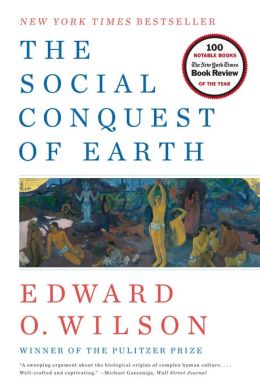
book beginnings on Friday: The Social Conquest of Earth by Edward O. Wilson, from Pops

Thanks to Rose City Reader for hosting this meme. To participate, share the first line or two of the book you are currently reading and, if you feel so moved, let us know what your first impressions were based on that first line.

wilson

Today’s book beginning comes to us courtesy of my father, who in the spirit of Derrick Jensen’s Endgame and Daniel Quinn’s Ishmael is reading The Social Conquest of Earth, by Edward O. Wilson, with whom Pops is impressed. He writes to me:

This is Harvard biologist Edward O. Wilson explaining the human condition and our impact on the world, using his background in biology (esp. evolution) as well as philosophy, psychology, neuroscience, creative arts, religion, etc. After a unique and compelling preface evoking Gauguin’s “finest work,” this is just the 2nd paragraph of the book.

Writes Wilson:

Humanity today is like a waking dreamer, caught between the fantasies of sleep and the chaos of the real world. The mind seeks but cannot find the precise place and hour. We have created a Star Wars civilization, with Stone Age emotions, medieval institutions, and god-like technology. We thrash about. We are terribly confused by the mere fact of our existence, and a danger to ourselves and the rest of life.

Like Jensen’s writing, this both rings true and terrifies at the same time. At least that’s my reaction. What’s yours?

book beginnings on Friday: Ishmael by Daniel Quinn

Thanks to Rose City Reader for hosting this meme. To participate, share the first line or two of the book you are currently reading and, if you feel so moved, let us know what your first impressions were based on that first line.

ishmael

This novel looks to be one of those lesser-known classics, with sort of a cult following but not generally known to the public consciousness. (My local public library does have it shelved under Classics.) Have you heard of it? I only recently did, but it comes recommended from my Pops, so here we are. It begins:

The first time I read the ad, I choked and cursed and spat and threw the paper to the floor. Since even this didn’t seem to be quite enough, I snatched it up, marched into the kitchen, and shoved it into the trash.

Strong feelings, no? I like that our attention is grabbed right at the start!

Happy Friday and happy reading, kids!