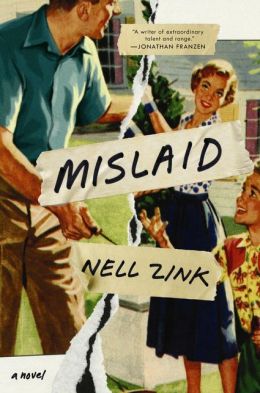
Mislaid by Nell Zink

A Southern comedy of errors starring a broken family stretched across social classes.
mislaid

At the start of Nell Zink’s delightfully odd first novel, Mislaid, Peggy is a lesbian teenager in 1960s Virginia heading off to Stillwater College, a remote women’s school, where she plans to sow her oats with all those other young ladies and become a famous playwright. Instead, she begins a strangely lusty affair with one of the few male faculty members, Lee Fleming, a famous poet hidden away at Stillwater by his wealthy and proper Virginia family because he is gay. Their misguided, mismatched affair quickly results in a pregnancy and marriage. After 10 years, Peggy finds herself miserable, acting as servant to Lee’s obnoxiously pretentious literary house guests while he engages in infidelities and general disrespect. She runs away, taking their three-year-old daughter and leaving their nine-year-old son, Byrdie.

Because Lee has also threatened to have her committed, Peggy goes into hiding. She conveniently acquires a birth certificate from a recently deceased African American child to rechristen her white-blonde daughter as Karen Brown, herself as Meg. They squat in a condemned house in abject poverty, making a new life, but the oddest part is that “Karen and Meg Brown” on their paperwork are black. “Maybe you have to be from the South to get your head around blond black people,” writes Zink, but Meg and Karen, white as they are, do pass.

A decade later, when Karen enters the University of Virginia on a minority scholarship as a freshman, Byrdie is a senior there and the two finally meet. The ensuing drama of confused identities drips of both tragedy and hilarity, as family dynamics and literary ambitions propel a broad cast of quirky, complex, lovable characters into odd scenarios. Meg has mixed herself up in some illegal dealings in her years as a single mom and met some interesting folks. Karen’s boyfriend and his family are equally zany and winning. Zink pulls no punches in portraying Virginia’s mores and peculiarities. Mislaid‘s pathos is charmingly funny, and a sentimental streak softens the sarcasm.

With its distinctively Southern setting and bizarre range of sincere men and women making their way in a weird world, Zink’s novel captivates from the very first page. Readers may be tempted to blaze through this slim book in a single sitting. Comic, sympathetic, heartbreaking and outrageous, Mislaid is a wonderful, raucous book with everything of life in it.


This review originally ran in the May 12, 2015 issue of Shelf Awareness for the Book Trade. To subscribe, click here.


Rating: 9 BLT’s.

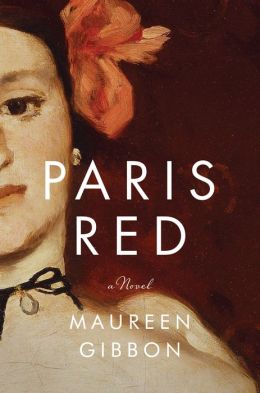
Paris Red by Maureen Gibbon

The model for a famous Manet nude is exquisitely fictionalized as a young woman voracious for experience.

paris red

“That day I am seventeen and I am wearing the boots of a whore.” So begins Maureen Gibbon’s Paris Red, a novel of art, love, sex and survival in 1860s Paris. Victorine, the red-haired narrator, is not a whore herself; the boots were a gift. She works instead as a brunisseuse–silver burnisher–along with her best friend and roommate, Nise. The two sometimes pick up men, though, and this new one, Eugène, is different from the others: he wants them both. Unlike Nise, Victorine pursues experience headlong, wanting to feel it all, and it is she who wins Eugène’s devotion. In the process she puts ambition above friendship, losing Nise, choosing instead a position as Eugène’s model and muse. She purchases oils and pastels for him, poses for sketches and paintings, and luxuriates in the role of his lover.

Paris Red is a sensual, luscious novel, filled with tastes, smells and sounds, as well as colors. Eugène is actually Édouard Manet, strolling the streets under a false name, but Gibbon’s focus here is Victorine, the real historical model for Manet’s Olympia. She finds a home for her passion for color in his studio, and plays model-actor in Eugène’s world, while also learning about–and never losing–herself.

In powerful, vivid prose, Gibbon (Thief) pulls her reader into a sensory Paris that cuts across class lines, painting a strikingly intense and intelligent young woman in Victorine. The overall effect is erotic, but also clever and perceptive, a remarkable glimpse into a moment of art and time. Readers will never view Olympia the same way again.


This review originally ran in the May 8, 2015 issue of Shelf Awareness for Readers. To subscribe, click here, and you’ll receive two issues per week of book reviews and other bookish fun!


Rating: 8 apple fritters.

The Secret Place by Tana French (audio)

secretI think I will call it a great credit to Tana French that even though this novel took me months to finish, due to my much-reduced audio-listening time, I never lost the thread or lost interest. It can be hard to read a book that slowly, over that much time. But The Secret Place is gripping, compelling, peopled by fine, interesting, and distinctive characters; it lent itself pretty well to this less-than-ideal reading (listening) schedule.

French’s dedicated readers will recognize several characters from earlier novels, although these books do not exactly form a series. The central detective in The Secret Place is Stephen Moran, who has been relegated to the depths of the Cold Cases unit, where he is not particularly happy. Then a gift is dropped in his lap: Holly Mackey, who was but a little girl in Faithful Place, is now 16 years old and boarding at a chi-chi girls’ school called St. Kilda’s. She brings Moran a card stating that the writer knows who killed Chris Harper, found murdered last year on St. Kilda’s grounds.

Moran takes this card to the Murder squad, where he has ambitions, and begins working with Detective Antoinette Conway, a prickly, defensive sort. The two form an unlikely, tentative team, and the rest of the novel covers a single, very long day they spend on campus at St. Kilda’s, solving the case.

Or at least part of it does. The Secret Place is split into two narratives, which alternate chapters: the story of Moran & Conway’s single long day, and the last 18 months or so in the lives of Holly Mackey and her three girlfriends. Holly, Selena, Julia and Becca are very, very close. They all knew Chris Harper, some more closely than they’ve let on to the police; their friendship and their lives are caught up in the case, and Moran knows it. As Moran & Conway work the case, the second narrative brings readers up to date in the girls’ lives.

As an audio production, this is effectively played by two readers, a male reader for Stephen Moran’s story and a female third-person narrator of Holly and her friends’ lives. The latter narrative is ghostly, compelling, and mystical; there are magical elements, although of course this is a realistic story; the magic is simply that of youth.

Moran is a sympathetic character who wants badly to “make it,” to fit in in Murder, to have a partner, to have a friend. He is sensitive and self-conscious, yearning. The girls wield their own self-referential magnetic power, very much evocative of the strange world of teenagerhood. Friendship, its meaning and its powers, are very much the central themes of this story.

In short, Tana French has done it again. Her characters are mesmerizing, both realistic and spell-binding. The plot is twisty: beware thinking you know where she’s headed! I love this stuff. Keep it coming.


Rating: 7 earbuds.

In the Spider’s Web by Jerome Gold

Striking, deeply honest, and sensitively told, this novel based in real life considers juvenile prisons and all its dramas.

spider

Jerome Gold calls In the Spider’s Web a “nonfiction novel.” In it, he depicts the routines and characters of a prison for juveniles, centering on one young woman in particular. All the events really happened and are drawn from his years working as a rehabilitation counselor at the institution he calls Ash Meadow–some supporting characters are composites, but all the major players are real people; names except his own, places, and some other details are changed to shield identities. As might be expected, the stories Gold relates are often disturbing, but they are beautifully told from a sober and compassionate perspective.

…Click here to read the full review.


This review was published on April 28, 2015 by ForeWord Reviews.

IMG_4538


My rating: 8 points.

A Buzz in the Meadow: The Natural History of a French Farm by Dave Goulson

A celebration of biology and the joy of discovery–and a reminder to tread lightly.

buzz
Dave Goulson follows A Sting in the Tale, about his years studying bumblebees, with A Buzz in the Meadow: The Natural History of a French Farm. In 2003, Goulson purchased a 33-acre property with a decaying farmhouse and barn, and turned it into a private nature reserve; here he describes the multitude of wildlife he shares those acres with. His goal is to celebrate the wonder of the natural world–especially insects, which make up roughly two-thirds of known life on Earth.

Goulson charmingly depicts the mating practices of dance flies and the many butterfly species he sees on his daily run, and elucidates the habits of the famously cannibalistic female mantis with added knowledge gained through his own studies. A Buzz in the Meadow is both a descriptive work and a call to arms, a reminder that all species are precious and necessary, even the tiny ones. Goulson repeatedly states that conservationists should look beyond large and charismatic creatures like whales and tigers; he perhaps overstates that “the extinction of the giant panda… would not have any knock-on consequences. There would perhaps be a tiny bit more bamboo in a forest in China,” but his point is well taken–that insects make up the majority of life and play an outsized role in the interconnectivity of biological systems worldwide. Goulson’s tone is personal, even humorously self-effacing, but clearly expert. A Buzz in the Meadow accessibly presents natural science and gracefully offers an earnest wake-up call to conservation.


This review originally ran in the April 28, 2015 issue of Shelf Awareness for Readers. To subscribe, click here, and you’ll receive two issues per week of book reviews and other bookish fun!


Rating: 6 dormice.

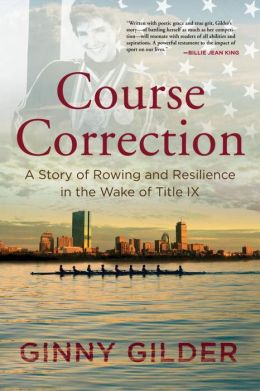
Course Correction: A Story of Rowing and Resilience in the Wake of Title IX by Ginny Gilder

The exertions of rowing crew under Title IX, as a means to overcoming one woman’s demons.

course

Ginny Gilder made her way from a privileged Upper East Side life in New York City to Yale University in 1975, in the early years of Title IX, which legislated equal educational opportunities for both men and women in all areas, including athletics. Ginny had never been an athlete; her family instead emphasized business success and keeping up appearances. But she was drawn to the grace, beauty and seeming effortlessness of rowing, and against the coach’s instincts, joined the Yale crew. The story she tells in Course Correction of collegiate competition, gender discrimination, the long road to the Olympics and personal growth, also yields Ginny’s eventual healing from the emotional traumas of a well-concealed family history.

In four sections titled Catch, Drive, Release and Recovery–the four parts of a well-executed rowing stroke–Gilder details the corresponding segments of her life. Rowing captures her passion; she drives herself through injuries and health problems to an eventual Olympic medal; she learns to let go; she forms a successful family of her own, despite a damaged past.

Gilder’s prose is earnest, heartfelt, expressive and clearly strongly felt. Her narrative will appeal to sports fans and readers dedicated to memoirs of pain and redemption. Course Correction touches on the injustices that Title IX was designed to correct (including a memorable scene involving a nude protest), and portrays a painful, affecting and impressive athletic career. But it is centrally a story of one woman’s lengthy and hard-won coming-of-age and coming home.


This review originally ran in the April 24, 2015 issue of Shelf Awareness for Readers. To subscribe, click here, and you’ll receive two issues per week of book reviews and other bookish fun!


Rating: 7 ankle bracelets.

The Light of the World by Elizabeth Alexander

Moving, charming, delicately lovely, this memoir of a husband’s death offers solace and even joy.

light world

Poet Elizabeth Alexander (Crave Radiance; the 2009 Inaugural Poem) was enjoying a loving, creative, exultant and full life with her husband, Ficre Ghebreyesus, and their two sons, when Ficre died suddenly. The Light of the World is her record of that man–a husband and father, an artist, activist and chef–and of Alexander’s grief and gratitude for the years she shared with him and the love and family they made.

This astonishing and naturally poetic memoir of love and loss is vivid and abundant with sensory detail and bright color. Alexander includes recipes–Ficre’s, and those that comforted her after his death; gives evocative descriptions of his paintings and the food and music they both loved; counts his scars; and recounts her dreams of him. But The Light of the World is not a dream itself: Alexander is lucid and absolutely present. Perhaps to ward off the end it threatens, the story she sets out to tell starts, and starts again, and starts again: at their respective mothers’ pregnancies; at Ficre’s 50th birthday, the week of his death; when they met at a coffee shop in 1996. Alexander then resolutely travels through the tragic center of her story and into the life that follows, when her family of four becomes “a three-legged table,” as she phrased it in her first poem afterwards. In this tender, perceptive portrayal, Ficre comes alive again: an Eritrean native, a peace-lover born into war, a painter also accomplished in photography, collage and sculpture, an eager reader fluent in seven languages and who “could say hello and thank you in literally dozens of other[s],” an activist and member of African, African-American and global communities. “Your life is just like a foreign film!” a friend rightly exclaims, and Alexander’s is just the voice to portray his broadly informed, musical, painterly existence.

Short chapters and language of unrivalled beauty ease a sad story, and Alexander and her sons do make a joyful noise in the end. She feels that she carries “a Santa’s sack of gifts” of Ficre’s thoughts and impressions that belong to her alone; she celebrates the time they had. Their shared dreams, scars, meals, songs, dances, history and family are fittingly and exquisitely honored here.


This review originally ran as a *starred review* in the April 23, 2015 issue of Shelf Awareness for the Book Trade. To subscribe, click here.


Rating: 9 red lentils.

Brian Doyle at Chuckanut Radio Hour

You will of course remember my glowing review of Brian Doyle’s most recent novel, Martin Marten, which remains the best book of 2015 to date (and may well make it through: I rarely award more than one *10* in a year). The same week that that review published over at Shelf Awareness (and my teaser posted here), he came to my little city to speak at a local event, the Chuckanut Radio Hour.

The Chuckanut Radio Hour is edited and aired on local radio a few times afters its live production, and it costs $5 per person (plus fees, naturally) to be part of that live audience. My parents and I went to see this edition, because Brian Doyle! I hadn’t been before (my parents had). The show describes itself as

…a radio variety show that began in January 2007. Each Chuckanut Radio Hour features a guest author and includes guest musicians, performance poet Kevin Murphy, Cascadia Weekly columnist Alan Rhodes, an episode of “The Bellingham Bean” serial radio comedy, and some groaner jokes by hosts Chuck & Dee Robinson and announcer Rich Donnelly.

(Chuck and Dee are the owners of Village Books, our local top-shelf independent bookstore.) I have wholesale stolen that quotation because it’s quite accurate, although in this edition we missed Alan Rhodes and instead took an extra musical number by guest artists 3-Oh. The band was good, and funny, with covers and originals; the spoken-word/poetry was good; “The Bellingham Bean” was quite funny (and guest-starred the versatile Brian Doyle to boot). The hosts’ jokes were, yes, groaners. But of course we were there for the author. Brian Doyle turns out to be a falling-down fine comedian in his own right, who knew? Also a very good storyteller, although that is less surprising. He didn’t really need an interviewer – just a microphone and a stage, and free rein. He monologues quite cheerfully, energetically, happily, and oh so funnily. He then continued this performance after the show was wrapped up, as we lined up to get our books signed (did I cheat by having him sign my galley?) and talk with him: the line was long because Doyle was so generous with his time and attentions, and I am grateful.

That’s two very good author-talk experiences in a row. If you get a chance to see Brian Doyle live, do! And for now, go get yourself a copy of the new Martin Marten: it’s outstanding and unique. And join me in investigating his earlier work, too, which includes two novels (The Plover and Mink River) as well as a bunch of essays. Here’s to local theatre etc.!

Teaser Tuesdays: The Secret Place by Tana French

Teaser Tuesdays is a weekly bookish meme, hosted by MizB of Should Be Reading.

It’s astonishing how long it’s taking me to listen to this book, isn’t it?* It’s certainly astonishing to me; and let me say that it’s no fault of The Secret Place itself, which is as wonderful as any of Tana French’s novels. (I’ll wait to rank it til I’ve finished, of course.) I’ve already teased you with it once, but here we are again.

secret

Today I’ll share with you a few lines spoken from Frank Mackey (who we remember from The Likeness and Faithful Place) to Detective Stephen Moran.

“Always fuck with people’s expectations, Sunshine. It’s good for their circulation.”

Good advice from Mackey, I’m sure. Keep that in mind, kids. And stick around: one day I will finish this book and review it for you.


*If you’re curious, my lifestyle is much changed these days, now that I don’t have a day job. I no longer have a lengthy commute during which to listen to audiobooks. I am clearly not spending nearly enough time in the gym or doing housework, either. I’m loving the new life; but it’s skewing me much more towards print and away from the audio. Bear with me.

coffee helps me read and write

Realizing the obvious: as a creative person, I have good days and bad ones. When I get discouraged, I get very discouraged, and feel unable to do the writing & editing I know I need to do; I want to give it all up. As my friend Liz says, though, some days we just need to lie fallow (and give ourselves permission to do so).

I don’t want to dwell on that negative side today, though: I want to talk about the other days, the hyperproductive ones, when I can write 3 book reviews, do an author interview, schedule 4 blog posts and finish an essay I’d been working on. That happens sometimes, too! And you know what those productive days have in common? Coffee.

Shelf Awareness shared with me the other day an article called 12 Literary Coffee Mugs All Book Nerds Need in Their Lives. I am tickled by the concept, naturally. Go ahead, click the link, and see the bookish, readerly coffee mugs on offer there. I have made my own collection, though, and naturally think mine are a better set of choices: readerly and writerly as well.

a nod to the librarian stereotype

a nod to the librarian stereotype

a little humor - and truth

a little humor – and truth

a Sugar reference

a Sugar reference

often, but falsely, attributed to Hemingway: never mind, it sounds like him

a gift from my parents, from the Library of Congress

a gift from my parents, from the Library of Congress

What about you, dear readers? Coffee or tea? In what mug? Does it matter?