guest review: The Warmth of Other Suns by Isabel Wilkerson, from Pops

More than three years ago, I listened to the audio version of this book, and reviewed it here. At that time, Pops commented:

You make a most important point – that this is essential American history, of which most white Americans are sadly unaware. Jim Crow discouraged personal initiative and disrupted families & communities – a loss for the South. The challenge for black Americans to recreate their lives in “foreign” parts of the country, and the consequences for those regions, is an important part of our collective & continuing history.

He has now gotten around to reading The Warmth of Other Suns himself, and posted a longer comment to that original review. I thought it deserved its own post here so that more readers would have a chance at his thoughts.

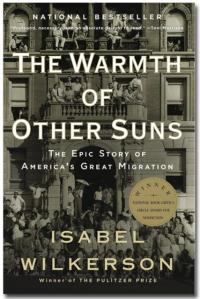
warmth

I finally picked this one up, overcame the weighty intimidation of 600 pages and fully appreciated what Wilkerson created. I will simply add to your good observations.

Like you, I enjoyed her written voice and how she allows herself to be part of the story. Her own family story, and its part in her motivation for writing, is important and contributes to the warmth of her people stories. She writes with open sympathy, if not empathy, for the migrants, and full appreciation for the courage & fortitude revealed in their experiences; and I found that appropriate. Just one example, from her earliest pages describing the magnitude of the migrants’ decisions: “it was the first big step the nation’s servant class ever took without asking.”

I am struck by the breadth of her story, much attributable to how she weaves in anecdote & nuance in the course of her narrative. Whole books can be written of the wide ranging cultural contributions in literature, music, sports (maybe even “root doctors” in medicine?) – from the early stages of slavery forward, but released in a torrent once the migration began escaping Jim Crow. She mentions this in passing, but we learn more as she accumulates anecdotes & chapter heading quotes.

The racism implicit in mainstream history & sociology accounts is due full treatment elsewhere, but she obliquely makes the point well with examples of contemporary “professional” accounts, including some that are uncomfortably recent.

And I’m glad she also observes the way the migrants changed the cities, not just the reverse; this is not a Black History Month episode – it’s an essential part of American history that has been ignored and misunderstood at our loss. Her treatment of the Jim Crow regime is a good example, as she describes the deliberate way it was constructed, one little ordinance or ambiguous social convention at a time, enforced by law but often also arbitrarily, in the shadows, hidden under literal cloaks as well as cloaks of darkness. The not-knowing was part of the terror; her analogy to the spread of Nazism is worthy. She describes the terrible impact on individuals, both physical & mental; but also the deep & insidious cultural impacts, including the scars on a white culture so pitifully dependent on the master/slave mentality.

Hers is a wonderful contribution to our history, and will no doubt guide my further reading as it has yours.

Thoughtful as ever. Thanks, Pops. For those that missed it, this is an exhortation to go get Wilkerson’s excellent book today! (My final editorial addition: I really do recommend the audio version.)

Merry Christmas, y’all.

The Merman by Carl-Johan Vallgren, trans. by Ellen Flynn

In this grown-up fairy tale, a young women’s battles with poverty, violence and neglect are further complicated when a mystical creature enters her life.

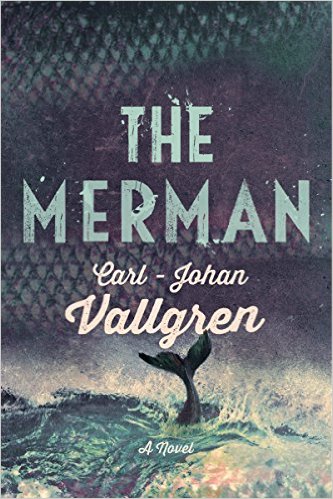
merman

Carl-Johan Vallgren’s The Merman, translated from the Swedish by Ellen Flynn, concerns the realistic and heartbreaking circumstances of teenaged Nella and her little brother, Robert; at the same time, it is a dark fairy tale about a mythical creature from the deep and the possibility of resisting evil.

Nella and Robert’s parents are terribly incompetent, uncaring people, more focused on drinking and crime than their children’s welfare. Robert struggles with learning disabilities and is bullied at school; protecting him, getting him the glasses he needs, and his general well-being falls to his sister. Nella is hard-pressed to handle the responsibilities of the household, including cleaning up after her alcoholic mother, about whom she muses, “it was about as hard to judge her as it was to understand her.” This mature and nuanced observation is typical of a girl who, despite her own troubles, seems drawn to others who need her help, such as a disabled man who is one of her few friends.

When the neighborhood bullies begin to threaten Robert with violence, Nella turns to her only ally at school, a boy named Tommy. But contact with Tommy’s brothers presents a new difficulty. They have pulled a mystical being from the ocean, whose otherworldly nature and wordless communication will change everything Nella understands about her life. All at once, Nella struggles with the bullies’ extortion and Robert’s fear; their father is released from prison and brings criminals home with him to disrupt their fragile household; their mother threatens to leave; and the sea creature looks to Nella for help. A burdened but strong and compassionate young woman, she will learn and grow through these tests, and wins the reader’s heart by the time her story reaches the final, hard decisions.

Nella is a compelling protagonist, reminiscent of Roald Dahl’s Matilda in her miserable circumstances, but with a harder, more adult edge. Robert’s suffering is almost unbearable, but sadly realistic. In Ellen Flynn’s translation of Vallgren’s tale, dialogue can be a bit stiff and formal, especially in the children’s cases, but overall she establishes a tone appropriate to the balance of reality and mysticism in Nella’s story, and the stark ugliness of her life. Vallgren evokes his fantasy element with wonder and detail; The Merman is a singular story. Fans of adult fairy tales and bleak realism will be haunted and enthralled by this novel of human tragedies, and the mystery of what lies beyond.


This review originally ran in the November 5, 2015 issue of Shelf Awareness for the Book Trade. To subscribe, click here.


Rating: 7 cartons of cigarettes.

still grasping for a definition of “classics”: a list

I get an excellent email, five days per week, from A.Word.A.Day. Occasionally there is an ad, and I think I’ve seen this one before, but was just recently interested enough to click through. “Listen to the 100 Greatest Books of All Time,” it cries! Well, you know my question: what on earth are the 100 greatest books of all time?? (I’ve wondered before.) I always have to refer back to that BBC list. I think it’s fun to look at what rates, and how it changes. Of course we shall never all agree. But listing books we love is an inherent pleasure, I think. As I’ve done before, I’ve marked up this list:

Bold = I’ve read it
Underlined = I’ve started the book, but never finished
neither = I haven’t picked it up.

The Adventures of Tom Sawyer, Mark Twain
Romeo and Juliet, William Shakespeare
The Wonderful Wizard of Oz, Frank Baum
Alice’s Adventures in Wonderland, Lewis Carroll
The Adventures of Sherlock Holmes, Arthur Conan Doyle
The Legend of Sleepy Hollow, Washington Irving
Walden, Henry David Thoreau
The War of the Worlds, H.G. Wells
The Phantom of the Opera, Gaston Leroux
The Raven, Edgar Allan Poe
A Christmas Carol, Charles Dickens
The Red Badge of Courage, Stephen Crane
Macbeth, William Shakespeare
The Odyssey, Homer
The Call of the Wild, Jack London
The Tale of Peter Rabbit, Beatrix Potter
The Tell-Tale Heart, Edgar Allan Poe
The Princess and the Pea, Hans Christian Andersen
White Fang, Jack London
The Scarlet Letter, Nathaniel Hawthorne
Oedipus Rex, Sophocles
Frankenstein, Mary Shelley
Paradise Lost, John Milton
The Time Machine, H.G. Wells
Tarzan of the Apes, Edgar Rice Burroughs
Through the Looking Glass, Lewis Carroll
Daisy Miller, Henry James
The Gift of the Magi, O. Henry
Young Goodman Brown, Nathaniel Hawthorne
Beowulf, unknown
The Tale of Benjamin Bunny, Beatrix Potter
A Portrait of the Artist as a Young Man, James Joyce
The Return of the Native, Thomas Hardy
Babbitt, Sinclair Lewis
The Prince, Niccolò Machiavelli
The Turn of the Screw, Henry James
The Art of War, Sun Tzu
The Masque of Red Death, Edgar Allan Poe
The Indiscreet Letter, Eleanor Hallowell Abbott
Adrift in New York, Horatio Alger, Jr.
Anne of Green Gables, Lucy Maud Montgomery
King Lear, William Shakespeare
The Ransom of Red Chief, O. Henry
The Inferno, Dante Alighieri
Just So Stories, Rudyard Kipling
The Pit and the Pendulum, Edgar Allan Poe
The Thirty-Nine Steps, John Buchan
The Importance of Being Earnest, Oscar Wilde
A Prisoner of Morro, Upton Sinclair
Euthyphro, Plato
Moby Dick, Herman Melville
A Tale of Two Cities, Charles Dickens
Pride and Prejudice, Jane Austen
Little Women, Louisa May Alcott
Gulliver’s Travels, Jonathan Swift
Treasure Island, Robert Louis Stevenson
Julius Caesar, William Shakespeare
Wuthering Heights, Emily Bronte
The Curious Case of Benjamin Button, F. Scott Fitzgerald
Robinson Crusoe, Daniel Defoe
A Room with a View, E.M. Forster
Rip Van Winkle, Washington Irving
Black Beauty, Anna Sewell
Peter Pan, J.M. Barrie
Around the World in 80 Days, Jules Verne
Hamlet, William Shakespeare
The Metamorphosis, Franz Kafka
The Voyages of Doctor Dolittle, Hugh Lofting
The Prince and the Pauper, Mark Twain
The Jungle Book, Rudyard Kipling
A Haunted House, Virginia Woolf
A Midsummer Night’s Dream, William Shakespeare
The Last of the Mohicans, James Fenimore Cooper
The Emperor’s New Clothes, Hans Christian Andersen
Heart of Darkness, Joseph Conrad
Beyond Good and Evil, Friedrich Nietzsche
A Modest Proposal, Jonathan Swift
The Fall of the House of Usher, Edgar Allan Poe
The Strange Case of Dr. Jekyll & Mr. Hyde, Robert Louis Stevenson
Othello, William Shakespeare
The Song of Hiawatha, Henry Wadsworth Longfellow
Common Sense, Thomas Paine
Much Ado About Nothing, William Shakespeare
The Man Who Would be King, Rudyard Kipling
The Purloined Letter, Edgar Allan Poe
Candide, Voltaire
Politics, Aristotle
In Defense of Women, H.L. Mencken
McTeague, Frank Norris
Ben-Hur: A Tale of the Christ, Lew Wallace
The Apology of Socrates, Plato
A Letter Concerning Toleration, John Locke
A Doll’s House, Henrik Ibsen
The Five White Mice, Stephen Crane
An Occurrence at Owl Creek Bridge, Ambrose Bierce
Siddhartha, Hermann Hesse
O Pioneers!, Willa Cather
The Idyl of Red Gulch, Bret Harte
Ethan Frome, Edith Wharton
Maggie: A Girl of the Streets, Stephen Crane

I’m surprised to see the blocks of books I have or haven’t read showing up together, rather than sort of equally dispersed down the list. I wonder what ordered these selections and what that means.

It quickly becomes clear that this list employs a heavy cultural bias toward the usual Dead White Guys (hat tip to an excellent blog by that name). Of 100 books, only 12 are by women (11 different women, with Beatrix Potter’s delightful anthropomorphizing children’s books represented twice). At a glance, I’m pretty sure that none of these authors are living. And overwhelmingly Western: Twain, Dickens, Shakespeare, Poe, Crane, Kipling and Stevenson all recur; Sun Tzu is the only non-Western name of the bunch. Plenty of Greeks, no Romans. Only one Fitzgerald (but no Gatsby!), and no Hemingway: and yes, you know I’m biased, but really I think few of the anointed minds who rate “great literature” – academics, professors, professional writers and reviewers – would leave Hemingway off a list of Greats. He’s not for everyone, but I think his talent and achievements are relatively inarguable. He won both a Pulitzer and a Nobel. Actually, that would be another interesting way to look at this list: to cross-check it with prizewinners. Hm.

I’m not overwhelmed by the originality or diversity of this list.

You’ll notice I took the liberty of linking to my reviews, where I’ve written them. These are relatively few, I think because I read many “classics” in school, which is to say pre-blog. There is also a large overlap between this list and the Great Illustrated Classics I remember as a kid (and yes, I gave myself credit for a few I know only from that format [very few], just as an indication of my familiarity with the story). They were my introduction to many classics: Huck Finn, Tom Sawyer, A Journey to the Center of the Earth, 1,000 Leagues Under the Sea, Around the World in 80 Days, Oliver Twist, Treasure Island, Frankenstein, The Call of the Wild, White Fang, Gulliver’s Travels, The Invisible Man (Wells, not Ellison), The Swiss Family Robinson. Some of these I would later read in their unabridged versions, but some, not. I treasured those books. I don’t know what happened to them.

I researched this series later, as a professional librarian, and was dismayed at their reputation. It left me wondering what misconceptions I have, what I missed. Of course the very definition of abridgment is missing things, but these are said to be especially extreme. Here I am with my whole experience of Oliver Twist defined by those illustrations I can still see clearly in my mind: the orphan as interpreted by Great Illustrated Classics had lovely, long eyelashes. On the other hand, I happily read many of the same stories in their full and unabridged versions later on. And I recommend doing so.

The “100 best books of all time” list appears to have been compiled with Dead White Guys in mind, and by more or less the same folks who chose the Great Illustrated Classics. These, at least, are unabridged. And, hey, they’ve got a point: at $99, this is indeed a hell of a deal for all these books pre-loaded onto a player for you. But just don’t forget to survey some women and writers of color and those born in the last 100 years or so, too. There is always my list in progress if you need some tips.

Worlds Between by Carl Nordgren

An engaging and sympathetic tale of families and cultures, and the choices that shape them.

worlds between

Carl Nordgren’s Worlds Between is the second in the River of Lakes series, which began with The 53rd Parallel. With dual settings in Ontario and Ireland and a diverse cast of characters, this moving story charts divided loyalties and dangers from all directions.

…Click here to read the full review.


This review was published on November 27, 2015 by ForeWord Reviews.

IMG_4538


My rating: 7 colors in refracted light.

The Darling by Lorraine M. López

A complex and disarming young woman follows her heart, lust, and taste for adventure in an unusual route to maturity and self-actualization.

darling

Lorraine M. López’s The Darling is a coming-of-age story in the time-honored tradition, a tribute to literary giants, and a fresh perspective on life and love. Its heroine challenges assumptions, and after a winding and bumpy journey, evokes a spirit of celebration.

…Click here to read the full review.


This review was published on November 27, 2015 by ForeWord Reviews.

IMG_4538


My rating: 7 items of marginalia.

Memento Mori: The Dead Among Us by Paul Koudounaris

Photographs of memento mori from around the world illustrate rich relationships with death.

memento mori

Paul Koudounaris (The Empire of Death) presents phenomenal photographs and a fascinating survey of death across cultures and history with Memento Mori: The Dead Among Us. His text is concise but effective, allowing his photography to take the lead. Images are gorgeously rendered in large format and across full spreads. They feature ossuaries, charnel houses and intricate, artistic arrangements of bones, mummies and decorated skeletons from various cultures.

Koudounaris portrays the Torajans of Indonesia, who place their dead in caves, and after the coffins disintegrate, arrange the bones decoratively; the Aymara Indians of Bolivia, who keep treasured skulls in their homes and ask them for advice; and the elaborate, even decadent, Catholic ossuaries created in response to Protestant reforms. Buddhists gilded certain mummies; Rwandans set up memorial vaults. Wrapped in a blue satin cover, with more than 500 illustrations, Memento Mori offers a striking tribute to many ways of remembering and honoring death and the dead.


This review originally ran in the November 27, 2015 issue of Shelf Awareness for Readers. To subscribe, click here, and you’ll receive two issues per week of book reviews and other bookish fun!


Rating: 7 perspectives.

Because She Never Asked by Enrique Vila-Matas, trans. by Valerie Miles

This enigmatic novella in translation asks if life imitates art or vice versa.

because she never asked

Enrique Vila-Matas (Illogic of Kassel; Dublinesque) experiments with form and his reader’s trust in Because She Never Asked, a novella about the circularity of art and life.

This twisting story is told in three parts. In the first, a young artist, Rita Malú, lives in Paris and obsesses over another artist, Sophie Calle. Rita “carrie[s] out a series of experiments with truth”; in one of these, she embarks on a journey to Portugal to search for an author she does not really want to find. In the second part, a narrator reveals that he has written Part 1 at Sophie’s request, as a work of art that she will then live out as written. Part 3 questions again what has come before it. This convoluted structure, almost a story told in reverse, discloses details and layers of artifice as the reader proceeds. At least two subtly distinct voices demand attention and credibility.

Valerie Miles’s translation from the Spanish preserves a roguish tone that feels apt in this playful and puzzling novel, whose brevity–under 100 pages–belies its complexity. The narrator labors with questions about the reality of life, its relationship to art and their relative worth. He invokes the dreaminess of Don Quixote and the inscrutability of Marcel Duchamp, and when he becomes frustrated in explaining the jealousy of lovers, commands his reader to “read Proust to understand it better.” Vila-Matas’s novella is about something different by its end than at its beginning: a carefully packaged riddle, intriguing and stylish.


This review originally ran in the November 24, 2015 issue of Shelf Awareness for Readers. To subscribe, click here, and you’ll receive two issues per week of book reviews and other bookish fun!


Rating: 6 moments of circular imagination.

Writers by Barry Gifford

Barry Gifford’s brief fictional scenes of celebrated authors are funny, tragic and insightful.

writers

The prolific and versatile Barry Gifford (Wild at Heart; The Lost Highway) has a little fun with a range of literary figures in Writers, a collection of dramatic scenes “intended to be read as stories as well as performed as plays.” Gifford begins with “Spring Training at the Finca Vigía,” in which Hemingway showcases his famous bluster and paranoia while hosting two Brooklyn Dodgers at his Cuban home; Martha Gellhorn also makes an appearance in this longest of Gifford’s imaginings. Most run around 10 pages in length, and are short and pithy.

The settings range from “relatively realistic” to “wholly imaginary,” Gifford warns, and include a conversation between the living Roberto Bolaño and the ghost of Jorge Luis Borges. Arthur Rimbaud tells his sister on his deathbed, “I have been bitten by life before and survived.” Marcel Proust’s final words are likewise recorded. Herman Melville laments the public’s reaction to Moby-Dick to a passing policeman, who worries that he is suicidal. Emily Dickinson questions her sister: “Why? I’m nobody. Who are you? Aren’t you nobody, too?”; James Joyce and Samuel Beckett exchange silences. Joining these cameos are Kerouac (with characteristic openness and affinity for drink), Albert Camus, Nelson Algren, Jane Bowles, Baudelaire and others.

Gifford’s imagined anecdotes occasionally reference the absurd, but overall tend to confirm readers’ impressions of large and troubled personalities. These famous artists appear surreal and often ugly, but by caricaturing them he also reasserts their humanity. The result is both entertaining and thought provoking.


This review originally ran in the November 24, 2015 issue of Shelf Awareness for Readers. To subscribe, click here, and you’ll receive two issues per week of book reviews and other bookish fun!


Rating: 6 sets based on my personal affinity.

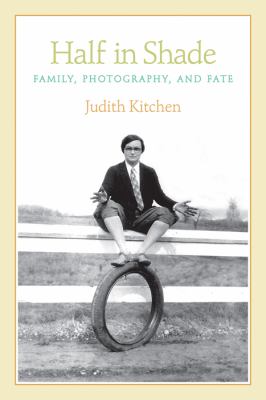
Half in Shade: Family, Photography and Fate by Judith Kitchen

This is a complex one. Judith Kitchen has inherited dusty boxes of old photographs, belonging to her family and stretching back over generations. Some of the black-and-white figures she finds there are labeled, or recognizable to her; but many are strangers. In a series of short pieces – meditations, essays, ramblings, experimental forms – she wonders over these photographs. Sometimes she uses her imagination to tell their stories; sometimes she uses research.

She is also being treated for cancer, and the narrative of surgery, chemotherapy, and radiation responds to the history she researches and creates. She plays with concepts. Every photograph has an unseen character, the one behind the camera; who was he or she, what did he or she see? In looking back into time, she can see both more and less than the characters in these pictures. They know one another, they know where they are, and oftentimes Kitchen does not. But she knows what Paris in 1939 has looming over it. She knows what will come.

My reactions to these pieces varied. Kitchen is a poet, and she wanders into a sort of free-form poetry that reminds me of abstract art: I understand that the people around me see and interpret a great deal that is hidden from me. I wonder if I’m not smart enough for the appreciation of this art. I like Kitchen best when she says what she means, playing with language a little along the way. The more abstract she gets, the less I comprehend. I don’t think my mind works the same way hers does.

But I like what she did with the idea of photography, the examination of light and exposure, the questions about how certain confounding photos (like the young woman surrounded by handled objects before a snowy lake) were posed, arranged, intended, carried out. I like what she did with history, and family history, and the uncertainties we have to accept. I love the artistry of this sentence:

The clapboard’s horizontal plane cuts through the outlines of their lives as they stand facing us across the intervening years, chance encounter that will fuse her rough pinked hem, his knot at ease, our own unbridled mysteries.

The homonym of knot, the rhyme of ease and mysteries.

Half in Shade is a complicated thing and contains many different opportunities to delve in. I’m not sure I’m up to it, at least not on my own. I think this is a class someone could teach for a whole semester. Recommended for people who understand and like Faulkner.


Rating: 7 second looks.

Maximum Shelf author interview: Ruth Wariner

Following Friday’s review of The Sound of Gravel, here’s Ruth Wariner: Finding a Voice.


Ruth Wariner was 15 years old when she left the polygamist Mormon colony where she grew up in Chihuahua, Mexico, and took her siblings with her to California. She raised her three youngest sisters while earning her GED and putting herself through college and then graduate school, eventually becoming a high school Spanish teacher. She now lives in Portland, Ore., where she remains close to her siblings and is happily married. The Sound of Gravel is her first book.

wariner
When did you know you wanted to write this story? How long did it take?

There was one specific moment when I realized I needed to write my story. It was late May in 1995, and I was 23 years old. My three youngest sisters, Elena, Leah and Holly, who were 12, 10 and eight at the time, and I were living in Grants Pass, Oregon, and eating a lunch that we’d ordered from the dollar menu at Burger King. We were sitting there when out of the blue, Leah asked, “So what happened to our mom anyway?” I was stunned by the question and suddenly realized that I had never told my sisters the story of where we came from.

That was when I began thinking about writing my memoir. But I was in college, and had full responsibility of my sisters. I was working a part-time job with barely enough time to do my homework. After I finished graduate school a few years later and started teaching, I began taking memoir and creative nonfiction writing classes after work. By then my sisters had grown and moved out of my apartment, but still, I wanted them to know who our mother was–or at least to know her as I had known her. I wanted them to know where we had come from and why we had to run away and grow up without parents.

Once I was ready to sit down and actually start writing The Sound of Gravel, it took me almost five years to finish. I couldn’t spend more than a few hours a day writing and often had to step away for a break, especially when I wrote about my most painful memories. There were times when it took me a few days to get back to finishing a disturbing scene.

Why did your story need telling, other than for your sisters?

My reasons for writing have always been very personal: I wanted to share my memories with my siblings–for their own healing and to help them understand the life we left behind. The more I wrote, the more I recognized my own need to process those most heartbreaking parts of my life and to express how I felt about those moments. It’s never been my intention to promote a particular cause or belief system, nor is it my intention to disparage any readers’ own beliefs or religion.

This retelling was painful. What made that process worthwhile?

The story was definitely a hard one to tell, but it has been an incredibly healing journey. Some of my memories bothered me more than I had expected them to. I hadn’t thought about my younger sister Meri in years, but when I wrote the scenes with her in them, I did so through tears.

Revisiting my mother’s life and writing about her in detail was also amazingly cathartic. Looking at photographs of her and remembering the way she smelled, the sound of her voice, the way she combed her hair, the way she smiled and the light freckles on her skin brought her back to me in a very raw and real way. Being able to think about her choices from a more adult perspective also helped. As I’ve grown and reflected on my own life and my relationship to the world, I realize my mom didn’t have a lot of self-love and self-acceptance. She chose a life and a belief system that reflected how she felt about herself.

Even though I know I’ll have to talk about my childhood in the coming months, I feel like I left so much of my past on those pages, which has made it easier for me to talk about. I’m grateful for the opportunity to share my experience. Writing this book also ended up being a process of self-discovery and personal healing. I feel like I found a voice I honestly didn’t know I had. I needed to recognize for myself that my life, my experience and what I had to say about it matters. This was especially important for me after growing up in a large, chaotic household where I really wasn’t heard.

You’re narrating the audiobook yourself. How has that project played out?

I actually just finished recording the audio book yesterday. I hadn’t considered reading myself but the Macmillan team felt that because the memoir is written in such a personal way, it needed to be read and recorded in my voice. The idea of reading it aloud to people really frightened and intimidated me, and I was so nervous that I broke out into hives the day before I started recording! When I finally sat down in the tall chair in front of the microphone with a digital version of my book in front of me, my throat became dry and tight, and my voice trembled. But after reading a few paragraphs and taking a few deep breaths, I felt more relaxed and was able to get into the flow of a natural reading pace. I ended up spending three full days in the studio with a fantastic recording team, and even though it was really hard, emotional work, and even though I felt completely out of my comfort zone, I’m so grateful to have had the opportunity to record my book and feel that it will be more powerful for listeners.

You’ve shared many personal details. Did you choose to withhold any?

I chose to leave out some details of my siblings’ experience in the Colony because their stories really aren’t mine to tell. I only wanted to share the details of their lives in relation to how they intertwined with my own. But when it came to my story, I honestly didn’t hold anything back. I have nothing to hide.

What do you want people to know about you that’s not in your book?

I’m still really close to my siblings on my mother’s side. All of us except for Matt, who is still a committed member of my dad’s church, live in the Pacific Northwest. We spend every holiday together and are a strong support system for each other. Growing up in the kind of poverty we did made our bond with each other stronger; we just didn’t have enough stuff (electronics, cable TV, computers, etc.) to distract us from each other. Growing up without parents also secured and strengthened our bond, and I am incredibly grateful that we were able to stay together through very challenging situations. For me, it’s important that my readers know this because in spite of our troubled childhood, there has been so much goodness and joy that has grown and blossomed. We grew stronger than our circumstances.


This interview originally ran on November 19, 2015 as a Shelf Awareness special issue. To subscribe, click here, and you’ll receive two issues per week of book reviews and other bookish fun!