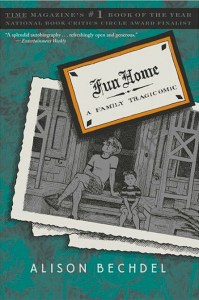
book beginnings on Friday: Fun Home by Alison Bechdel

fun home

Thanks to Rose City Reader for hosting this meme. To participate, share the first line or two of the book you are currently reading and, if you feel so moved, let us know what your first impressions were based on that first line.

I loved Are You My Mother?, and don’t know why it took me so long to pick up Fun Home, her earlier work and sort of a partner to Mother. She is still hilarious, insightful, and smart.

Because this is a graphic memoir, I’ll have to do this beginning a little differently. Here is an image of the whole first page.

fun home start

That reference to Icarus was when I knew (not that I doubted) that we were going in a good direction. I can’t wait to spend some more time with Bechdel and her wacky family and amazing mind.

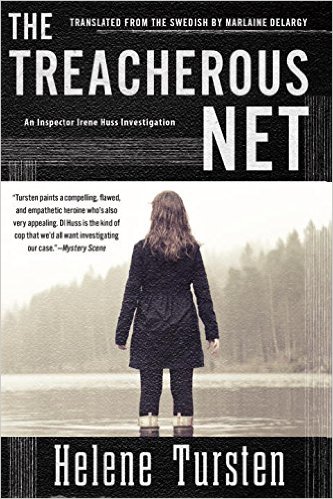
The Treacherous Net by Helene Tursten

Detective Inspector Huss works to protect a Swedish city beset by multiple violent crimes.

treacherous net

The Treacherous Net is the eighth book in Helene Tursten’s series starring Detective Inspector Irene Huss, who continues to be challenged by upheaval in her workplace and her personal life.

In the city of Göteborg, Sweden, Huss is frustrated with the new female boss of her Violent Crimes Unit, who uses her sex appeal to manage the men in her department; she has no use for Huss, the only other woman. Huss has lost her longtime partner, now the boss’s deputy, and the unit is short-staffed and overextended by an unusually high crime rate. Gang-related murders are up, a mummified corpse has been found bricked into a chimney during demolition of a burned-out building, and two teenaged girls have been raped and murdered. One was from an affluent family who promptly reported her missing; the other had scarcely been missed. Meanwhile, Huss worries over her supportive but stressed and overworked husband, her aging mother and her young adult daughters, now out on their own. A new addition to her work team will ease some of the load–and present new challenges.

Huss is a tough, committed investigator and a loving family woman, and her shifting alliances present a twist on the standard police drama. Several of the actors involved with the crimes in question are well-developed characters as well. But The Treacherous Net is most accomplished in its plot, with several threads exploring history, long-standing social stigmas and the power of the Internet. This fast-paced, gritty thriller offers both a dark story and a striking hero.


This review originally ran in the January 5, 2016 issue of Shelf Awareness for Readers. To subscribe, click here, and you’ll receive two issues per week of book reviews and other bookish fun!


Rating: 6 cups of coffee.

how long the lines would be

I’ve said it before. I think I started saying it when I worked as a librarian in the leisure-reading library of a hospital, and people would ask me for reading recommendations: when they insisted on hearing what I would read, I would carefully point out that that’s not necessarily relevant to their needs. We can’t all like the same things in life, and it’s a good thing: imagine how long the lines would be.

I think it’s okay, and even beautiful, that we don’t all like the same things or have the same strengths & weaknesses. As my marriage of almost 8 years now continues to grow and flow, I learn more and more how different Husband and I are, in how our minds work, although we share many tastes & values. It makes us a stronger team, which is something I didn’t consciously recognize when we married. That’s a digression, though. I’m talking about what we all enjoy in life. We like different music, different food, different hobbies and different people – and again, good thing, because it wouldn’t work out well if we all wanted to marry the same person or thought Johnny Cash was the *only* artist worth listening to: how boring.

In books, though, there seems to always be a pressure to recognize one novel by a certain author as her classic work, or to agree that Faulkner is high art and Stephen King is pulp. I confess that some part of me still feels this pressure from time to time (although I think I’ve given up on Faulkner). But I’ve been trying for years to learn for myself, and to assert to any audience I may have, that it’s okay that we have different tastes. It really is.

The other day, I reviewed The Tender Bar, a book I loved. Not everyone will love it, though. For one thing, the author is extremely nostalgic and loving of one bar. This should go without saying, but if you are impatient with nostalgia in general, or opposed to bars in particular, this book will not work for you. I read a review online by a reader who doesn’t drink and doesn’t “get” the love of an individual bar: he didn’t like this book. Surprise, surprise. It’s okay! This just wasn’t a good match.

Further, Moehringer indulges in sentiment. If this is a major turn-off for you, no problem; but you should read elsewhere. We don’t all like that tone. And probably many of us like that tone only when it’s a nostalgia we can share – like, if you’ve loved a bar the way Moehringer loves the Publican, you’ll be better able to tolerate and appreciate his sentimental remembrances than if you have not. This doesn’t mean that I’m wrong, or that that other reader is. There’s room for both of us.

A writer I greatly respect recently expressed surprise that I love Rick Bragg as much as I do. He wrote to me:

I’ve always thought Rick Bragg was a bit of a blowhard. Maybe I’m too northern, or too judgmental when it comes to style. Maybe I just like a cleaner line.

When I read those lines, I immediately felt that I knew exactly what he meant; and I understand his criticisms. I think we are observing more or less the same things, although of course I didn’t describe my observations the way my friend did: I had a different personal reaction to the same writer. Because my friend and I are two different people. And isn’t that as it should be?

When I write book reviews solely for this blog, I am speaking with my personal voice, as Julia, about my personal reactions. When I write for ForeWord, or Shelf Awareness, or other employers, I am supposed to remove the personal: I’m supposed to behave like I did when I was a librarian performing readers’ advisory services. I try to show what the book is about and what strengths it has to offer and, in other words (sometimes explicitly, sometimes not), what kind of reader might enjoy it or be turned off. This is why I (rarely) add an addendum to the published review when I repost it here on my blog. This is also why you might see me rate a book lower than the review seemed to imply. That is to say, this is a good book – for a different reader than I.

As the number of books I read and review continues to grow, I continue to feel lucky to get to do this work. I love learning, I love meeting new people and concepts between the pages, and I love the intellectual as well as the emotional play between the book and myself. And I guess I just wanted at this point to stop and say: we won’t all love the same things, and that’s a beautiful fact. Take my ratings with a grain of salt. Ideally even, learn my tastes so you can recognize where we will and won’t agree. Don’t be afraid to like different things than the next person. I know a lot of people can’t stomach Hemingway, and that doesn’t mean we can’t be friends! Anyway, the lines are shorter this way.

poetry: Dickinson, Frost, Coleridge and more

The papers have been piling up on my desk. Once upon a time, while working as a librarian, I had a volunteer who helped me out one full day per week, who was herself a retired librarian. I was at the start of my career. She said once that you can always tell a busy and productive librarian by all the piles on her desk. (My mother points out that this is not necessarily a sign of productivity, but I like Anne’s thought better.) Well, I have piles. Hopefully this wisdom applies to writers, too.

I often pick up tips or follow links to short pieces of writing. For whatever reason, I am much more eager to pick up a whole book than I am to read an essay or short article; must be a mental block. When I come across short things that need reading, I often print them out and stack them up. After carrying this stack of papers cross-country on at least two trips now, I have finally gotten around to some reading. Today’s theme is poetry. And you may know that I am a perfect amateur when it comes to reading poetry, so these are the layperson’s interpretations.

The Rime of the Ancient Mariner” (text of 1834), by Samuel Taylor Coleridge: this was by far the longest poem of the stack, but it was a pure pleasure. I can remember my mother reciting the lines, “water water everywhere, and all the boards did shrink… nor any drop to drink” from way back, but I’d never read the whole thing. I love the rhythm, the rhyme, and the sound: I found myself mouthing the words, repeating lines and stanzas, tapping out the beat; the pure language and music of it is astounding art. I enjoyed some of the usages that are no longer modern, and have some questions for Mom (who is, among other things, a linguist) about historic pronunciation. Beyond all of these features, there is a story, that I found charming as well – particularly the concept, that this man must tell his story, that it is something like a bodily need. Naturally, for those of us that love stories, that is appealing. As I often feel when I encounter poetry, I wish I had an expert to help me delve into its depths; but I found The Rime of the Ancient Mariner to be more accessible than most. It has musicality and storytelling, and was easy to follow. Clear win all around. I can’t wait to read it aloud. Will Husband tolerate it?

Next, two Robert Frost poems: “The Oven Bird” and “Mending Wall.” I am sure I pulled these two titles from something I read recently, but I didn’t make note of the reference; why?? I’m afraid Frost lost me. For one thing, I kept looking for rhythm and rhyme, which Coleridge did so beautifully, and what I found here was no rhyme, and any rhythm was scarcely or not at all discernable to my untrained mind. The subjects were a little obscure to me as well. Ah me. I need the seminar course.

And then a batch of poems I pulled from someplace, some months ago, with the bizarre idea that I wanted to try memorizing poetry. (This may go nowhere.) They are therefore, mostly, short. I’m afraid I have lost my original source for the list. Nevertheless, here they are.

Risk,” by Anaïs Nin: eight lines, clever, thoughtful and wise, unrhyming but perfectly clear to me: lovely.

Nothing Gold Can Stay,” by Robert Frost: nice, short, clear Frost for a change. Like many in my generation, perhaps, I first met this poem in S.E. Hinton’s The Outsiders. (I haven’t seen the movie; does Ponyboy recite the poem like in the book?) I seem to still have it memorized from that childhood reading. It made an impression; and it rhymes. Maybe I’m simpleminded, but it’s easier when it rhymes. I like that it involves nature as well as a plainly stated concept about Life.

The Fish,” by Elizabeth Bishop: I read this aloud to Husband and he nitpicked the details of the story, because he is a fisherman and perfectly literal-minded. I find it a lovely piece of description and imagery, but I share his concern that she let the fish go without removing those other nasty hooks. No rhyme, but I found it a perfectly readable, comprehensible piece of carefully composed writing.

Kubla Khan,” by Samuel Taylor Coleridge: I recognized the language, the lilt and sound immediately, and felt glad. The story here is less clear to me, but I like the sounds. This is where I definitely need an expert to walk me through.

Do Not Go Gentle Into That Good Night,” by Dylan Thomas: unlike Coleridge, whose beat varies throughout, this one has a single, strident, regular rhythm. It is a strong poem, and with strong subject matter. I again wanted illumination of the finer points, but have no trouble understanding on some level what he is getting at, and the tone and pace of it is powerfully captivating. I would certainly be glad to have this one handy in my head to recite at will.

Hope,” by Emily Dickinson: it’s been a long time since I’ve read Dickinson (high school English with Mrs. Smith; I still own a big fat volume of it), but I suspect not all of her words are so clear as these, and I feel sure not all are this hopeful. I love love love the image, and every line of this short, charming poem is as good as every other.

Richard Cory,” by Edward Arlington Robinson: am I the only one who thought of the Beatles’ Eleanor Rigby? Sort of as a counterpoint. Powerful images, a strong and regular beat (although not so drumlike and insistent as Thomas), and a clear and striking finish. Not my favorite here – perhaps because its ending is so disturbing, as it is meant to be – but very good.

No Man is an Island,” by John Donne: I have always been captivated by this poem, because its concept is so big and calls for contemplation. There is the added attraction of its famous penultimate line, which as we know as been recycled as the title of one of the finest novels I know. Free verse again, but somehow still with a rhythm, a compelling set of sounds that propel it to its finish.

The Road Not Taken,” by Robert Frost: I am aware of some question as to Frost’s point in this one, and again wish I had a friend to discuss. Pleasant images, certainly, that I would sit comfortably with for an afternoon. Clearer than those Frosts, above. But somehow not my favorite.

This has been an enjoyable and thought-provoking exercise; I should do it more often. As to memorization, my busy schedule says HA!, but I would love to learn a few of these by heart: “No Man Is an Island”; “Hope”; “Do Not Go Gentle”; “Risk.” And for that matter, I would love to be able to recite “The Rime of the Ancient Mariner” by heart – but it is fifteen and a half pages long; I may as well aspire to learn the Odyssey (which would be great). I would happily settle for paraphrasing, and a few individual lines here and there. My brain is filling: for years and years I knew the title, author and synopsis of every book I’d ever heard. And then in the last two years or so, I stopped being able to add new ones, except for the very most outstanding of the books I continued to discover; and the less impressive of those from years back began to fade away. Ah, me. Rage, rage against the dying of the light…

The Tender Bar by J.R. Moehringer

tender barI loved this one.

The Tender Bar is a memoir of one man’s life in a bar. JR was a little boy surrounded by women and girls: he lived with his mother, grandmother, aunt and four girl cousins (and a grandfather, uncle and a boy cousin, but still). He felt drawn to men: in his hindsight telling, he felt the lack of a father, and sought male attentions and teachings, and a model for becoming a man. He found this in his uncle, but even more so, in the hallowed space just 142 steps away, where his uncle tended bar.

This is both a bildungsroman and the story of a bar. By some extension, it is thirdly the story of a place: Manhasset, Long Island, a town historically fixated on drinking and comfortable, sociable places to do it in. We see JR’s childhood – deeply chaotic and troubled in his home life, but bolstered by a beloved and mostly stable (if chaotic in their own way) group of men from the bar. We see him grow up, learn about himself and the world, and experiment with concepts of what he owes to his world and what he’ll do with himself. There is always the bar, at the center of these concepts. Eventually, JR becomes an adult, and the bar ages alongside him. Losses come with age, culminating in the losses of September 11, 2001, which were widespread for a town that commuted into the City and into the World Trade Centers.

I loved many things about this book. I loved the format, which begins with some (presumably research-based) backstory about Manhasset, and with some musings on bars and life. (See my book beginning.) I loved Moehringer’s tone: of immense and frequent humor, often self-deprecating, but also of sober reckoning. He made me laugh out loud until I had to put the book down and hold my belly. I liked the perspective he took, the places where his adult’s wisdom did and did not inform his telling of the child’s experience. I felt drawn to the family, the bar community, and JR’s difficulties with differences in class (when he goes off, of all places, to Yale) and geography (moving at one point to Arizona, where his accent stands out). Despite being totally foreign to me, the Manhasset setting made sense, came alive in this telling. (And not for the first time: Manhasset is the model for the setting of The Great Gatsby.) And of course as much as anything I loved this bar: I loved his love for the bar, and sympathized with it, and I loved the place itself. I recognize and feel affection for a place with playfully rude, unhurried service, a divey atmosphere but with professional cocktail construction. It is a literary place, named Dickens in Moehring’s youth and later changed to Publicans but keeping its nod to culture, song and theatre, and especially words. JR tried for years to write about the place while in the place – the concept that the reader knows would eventually become The Tender Bar.

In this place he meets men (and some women) from all walks of life, professors and police officers and bookies and poets and more. He compares the bar to the Iliad (sure to either win my heart or offend me; here, the former):

In fact the bar and the poem complemented each other, like companion pieces. Each smacked of ageless verities about men.

And he goes on to identify the Ajax, the Hector, the Achilles he finds in Publicans.

I’m sure I give the impression that this is a book seeped in testosterone, and that’s not untrue, but it’s more nuanced than that. For years, JR looked for men to teach him what it meant to be a man. It was something of an obsession for this mostly-fatherless boy (although one wonders how much of that is inserted in hindsight). There are women in the story, too, of course: a girl cousin, a girlfriend, female friends, but centrally his mother, from whom he learns a lot. In the end, he acknowledges that she did a better job of many of the virtues he looked to men for, than did the men he found.

He offers nuggets about writing. As attributed to a priest he meets in the bar car of the train from the City back to Manhasset:

Do you know why God invented writers? Because He loves a good story. And He doesn’t give a damn about words. Words are the curtain we’ve hung between Him and our true selves. Try not to think about the words. Don’t strain for the perfect sentence. There’s no such thing. Writing is guesswork. Every sentence is an educated guess, the reader’s as much as yours. Think about that the next time you curl a piece of paper into your typewriter.

I could spend all day on this quotation alone, some of which I’d take issue with – I think words are very important, and I think the perfect sentence is to be sought – but there’s a lot to ponder and a lot of wisdom there.

I feel like I’ve gotten to know JR Moehringer by reading his story, and I like him. I acknowledge his flaws but would be his friend. That’s a fine outcome for a memoir, I think. This was an excellent book, in its stories, its characters, its format, the details of its writing, and its emotional tone. It’s a little like The Liars’ Club in its best parts: funny, self-deprecating, sad, beautiful, brave, honorable, ironic. I raise my glass.


Rating: 9 pet mice.

book beginnings on Friday: The Tender Bar by J.R. Moehringer

Thanks to Rose City Reader for hosting this meme. To participate, share the first line or two of the book you are currently reading and, if you feel so moved, let us know what your first impressions were based on that first line.

It felt like a great and happy luxury to take time out of my professional reading to read this book just for me. (Actually it is referenced as a standard by a book I was hired to read, and you will see that one come up later. But I already had this one on my desk. So it counts.) I was struck immediately by the opening lines: how perfect.

tender bar

We went there for everything we needed. We went there when we were thirsty, of course, and when hungry, and when dead tired. We went there when happy, to celebrate, and when sad, to sulk. We went there after weddings and funerals, for something to settle our nerves, and always for a shot of courage just before. We went there when we didn’t know what we needed, hoping someone might tell us. We went there when looking for love, or sex, or trouble, or for someone who had gone missing, because sooner or later everyone turned up there. Most of all we went there when we needed to be found.

There is, of course, a certain special bar that I think of, where I have gone when happy and when sad. Miss y’all.

Just a few paragraphs later, another piece of profundity:

While I fear that we’re drawn to what abandons us, and to what seems most likely to abandon us, in the end I believe we’re defined by what embraces us.

I think this will be a good one, friends.

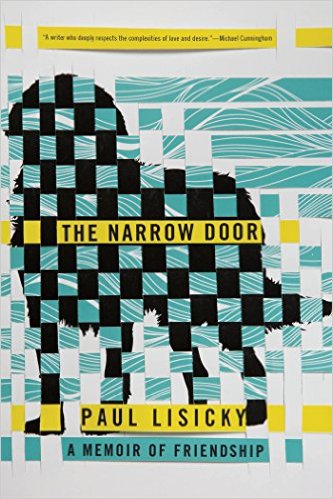
The Narrow Door by Paul Lisicky

The Narrow Door is literary, smart and poignant, an extended eulogy for a friend and a meditation on friendship.

narrow door

The Narrow Door is a striking memoir of love and loss by Paul Lisicky (Lawnboy; The Burning House). At its center are the life and death of Denise, Paul’s longtime best friend; in parallel, Paul and his husband slowly pull apart and finally break up. The ups and downs of these two relationships define the story Lisicky tells, but they also give him space to muse on larger questions: the craft of writing, competition among writers, the meaning of love and events in the larger world.

Paul met Denise in the early 1980s, when they were both teaching assistants at Rutgers. They became fast friends, talking on the phone for hours, sharing the pain and joy of writing. Denise becomes a published novelist first, but Paul’s later success threatens her. A tender passage about “Vincent” and Gauguin, about the painters’ competitive feelings and their wrecked friendship, helps Paul deal with his struggle with instincts leaning both toward and away from competition with Denise. This is only one example of the wide range of Lisicky’s subject: the Deepwater oil spill and the Haitian earthquake likewise influence his reactions to Denise’s cancer diagnosis and other immediate concerns. Paul and Denise are Joni Mitchell fans, and their story is guided by her music. When a hotel in Atlantic City is demolished, Lisicky writes, “It comes down as a person would…. I take it personally.” These disparate threads are tied together expertly, with tenderness, in careful prose.

Paul’s husband, identified simply as M, is a successful poet and has his own, weaker friendship with Denise. He supports Paul when she dies, but soon after, the couple begin their drift apart. The Narrow Door employs a disordered chronology, in sections headed by year: 1983, when Denise and Paul’s friendship is budding; 2008, when she dies; 2010, when Paul and M are at their rockiest; and times in between, as these relationships grow, change, climb and descend. When he fights with Denise, Lisicky considers losing a friend, as opposed to breaking up with a lover: “Sure, it might feel like rage, but aren’t rage and love part of the same water?”

This is an artistic work, poetic and layered and carefully structured. The tangled sequence of events emphasizes the ever-changing nature of relationships and emotional reactions. Lisicky’s tone is sometimes elegiac, sometimes gently humorous, and consistently introspective, questioning. The Narrow Door is not a long book; nonetheless, it requests the reader’s measured consideration of language, pitch, philosophy and emotion. This portrait of a friend in all her complexities is lyrical, intellectual and occasionally challenging. In an austere mood, Lisicky avoids the idea of comfort for its own sake but asks, “Couldn’t there be some rigor to comfort?” The Narrow Door answers with both, in a compelling package.


This review originally ran in the January 4, 2016 issue of Shelf Awareness for the Book Trade. To subscribe, click here.


Rating: 8 cups of coffee.

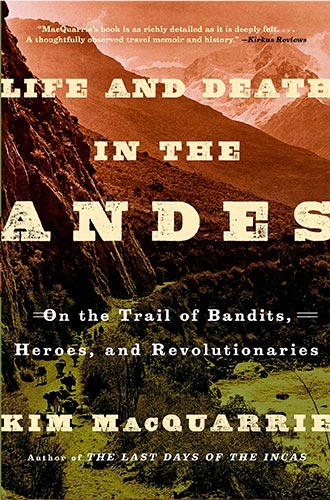
Life and Death in the Andes: On the Trail of Bandits, Heroes, and Revolutionaries by Kim MacQuarrie

This mesmerizing history of the Andes Mountains smoothly brings colorful characters and outrageous stories to general readers.

andes

Kim MacQuarrie (Last Days of the Incas) has long been fascinated by the vast region defined by the Andes Mountains. Having traveled and studied the length of these mountains, 4,500 miles of South America, he shares their stories in Life and Death in the Andes: On the Trail of Bandits, Heroes, and Revolutionaries.

Protagonists range over centuries and national borders, and include Pablo Escobar, the modern Colombian drug lord; Charles Darwin as an amateur naturalist in Ecuador’s Galápagos Islands; the 1980s Shining Path guerrilla movement in Peru; a teenaged girl sacrificed by the Incas in the 1400s; Che Guevara, making his final stand in Bolivia; and Butch Cassidy and the Sundance Kid, whose lives likewise end in Bolivia. MacQuarrie explores cultural conflicts with sensitivity, as in examining Hiram Bingham, the “discoverer” of the Machu Picchu ruins in Peru, who conveniently ignored earlier local knowledge of the site. Finally, MacQuarrie introduces the Yámana people of the southernmost points of Chile and Argentina, and meets with the last speaker of the Yámana language.

Life and Death in the Andes is captivating, its fascinating tales told with enthusiasm as well as careful research when dealing with relatively straightforward facts or with the story of “Juanita”–a young woman who lived in the 15th century–told as “an imaginative reconstruction based upon historical, ethnographic, forensic, and archaeological evidence.” This engaging history of dramatic stories and arresting characters is entertaining as well as informative, and its readability serves to recommend it widely.


This review originally ran in the December 22, 2015 issue of Shelf Awareness for Readers. To subscribe, click here, and you’ll receive two issues per week of book reviews and other bookish fun!


Rating: 8 coca leaves.

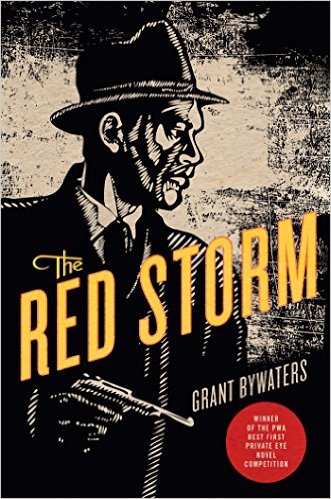
The Red Storm by Grant Bywaters

The case of a disgruntled P.I. with mysterious enemies is set in atmospheric 1930s New Orleans.

red storm

Grant Bywaters employs his expertise as a licensed private investigator in his first novel, The Red Storm. William Fletcher was a 1920s black prizefighter whose ambitions for the heavyweight title were frustrated by the prejudices of his day. After the end of his boxing career, he becomes a P.I. in New Orleans, a city Fletcher credits with a “more lax view on segregation.” He struggles to make a living, though, so when a contact from his old life shows up more than 15 years later requesting help, Fletcher reluctantly agrees to investigate, even though Bill Storm is a wanted murderer. Storm wants to find his estranged daughter. But as soon as Fletcher contacts her, violence breaks out around both Fletcher and Zella Storm. What, exactly, has Storm gotten him into?

Fletcher is a loner, with racial tensions adding to the distinctive anti-authority stance his profession tends to take. Zella is a peppery character, with an ambitious career singing in French Quarter establishments that would rather she just take her clothes off. Bywaters evokes a recognizable New Orleans and surrounding swamps, and the police are hard beset by organized crime, both local and inbound from New York City. Fletcher may be just the man to help out, if he can keep himself and Zella alive. The Red Storm‘s plot is solid, but it is the setting in both time and place that distinguish this classically styled noir P.I. story, which Bywaters flavors with period slang as liberally as a Creole cook spices food.


This review originally ran in the December 22, 2015 issue of Shelf Awareness for Readers. To subscribe, click here, and you’ll receive two issues per week of book reviews and other bookish fun!


Rating: 6 songs.

The Winter Girl by Matt Marinovich

At a borrowed home in the Hamptons, a couple pulling away from one another are drawn toward the house next door–and its secrets.

winter girl

Matt Marinovich’s The Winter Girl is a brief, chilling story of boredom’s path to crime and secrets uncovered.

Scott and Elise have decamped from New York City to the Hamptons, where they are staying at Elise’s father Victor’s house in unaccustomed splendor while he dies in the hospital of cancer. Their lives have been put on hold as Elise spends her days visiting with Victor and Scott mopes around the house, drinking Victor’s liquor cabinet dry. His career as a photographer has fallen off, although he still takes his camera out to the lake some days. His marriage to Elise is failing, for reasons that are more a natural drift than explicitly detailed. As Scott tells it, “Slowly, we’ve stolen the best parts of each other, carted ourselves away.” It is winter; the backdrop to Scott’s malaise is stark.

In his boredom, Scott starts watching the house next door, which clearly has been emptied for the winter. Every night he watches the light switch off on its timer at 11 p.m. He grows a little obsessed, so the next move is clear: while Elise is at the hospital one day, he breaks in, just to have a look around. “I felt like a suburban astronaut, exploring an abandoned home in which the crew had gone missing.” This is exciting, thrillingly illicit, and he brings Elise in for the fun, which has the perhaps surprising effect of reviving their passion. It also starts a string of increasingly criminal and disturbing thoughts and actions, and begins to unravel a long-guarded tangle of secrets. Just as tension has begun to build, Victor announces he will return home to die. But he seems to be getting stronger, not weaker. Questions pile up. What is really happening to Victor? And what is in the house next door?

Told in Scott’s first-person perspective, The Winter Girl offers strengths in its unsettling tone and moody, atmospheric setting. The events Scott relates become a little surreal in his off-hand telling; the reader is challenged to buy into his perspective, or stand back and try to see matters in a calmer light. Marinovich (Strange Skies) offers an unnerving and entertaining story. However, as the revelations mount, their pacing feels a bit rushed: the stakes rise steeply enough as to be a little jarring. On the whole, though, the experience is exhilarating, if a little leeway is allowed for accelerating surprises. And the dramatic denouement leaves the reader eager for more.


This review originally ran in the December 22, 2016 issue of Shelf Awareness for the Book Trade. To subscribe, click here.


Rating: 6 times I felt a little rushed.