book beginnings on Friday: Origins of the Universe and What It All Means by Carole Firstman

origins of the universe

Thanks to Rose City Reader for hosting this meme. To participate, share the first line or two of the book you are currently reading and, if you feel so moved, let us know what your first impressions were based on that first line.

I’ve just begun a new memoir, about the author’s relationship with her decidedly eccentric father, a gifted biologist with poor social skills. It’s a little playful with formats within the book, and ranges from the personal to the broad. It’s called… Origins of the Universe and What It All Means.

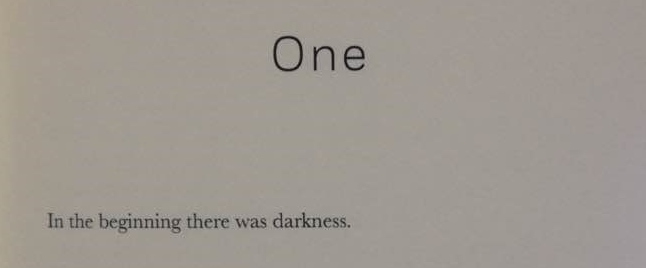
What a title, right? Wait til you see the opening page. I’ve zoomed in, but this is the entire content of page one and chapter one:

one

“In the beginning there was darkness.”

Don’t worry, though, it’s justified & appropriate for this book. Do I have your attention now? Stay tuned…

This quotation comes from an uncorrected advance proof and is subject to change.

movie: Annie (1982)

annieCaught this one on television just by accident, and it served as a good reminder – that nostalgia or sentiment can count for so much, and is entirely relative and individual in its effects.

I recently reviewed Stand by Me, which I found just so-so. I watched it to better appreciate a book (review still forthcoming) about the author’s attachment to that movie, and I found that the movie did less for me, although I could imagine how it might have felt to see it for the first time at twelve, or nine, or so. Well, perhaps for me that movie is Annie. I was born in the same year that this film was, and it’s the first musical I remember seeing, and I recall its impact well. I probably sang these songs 1,000 times, and I’m pretty sure I sang one or two (“Maybe”, “Tomorrow”) in show choir, as well. I knew every line as it was spoken.

And what’s even stranger is that I’d forgotten all about it til it came on television. I often read or do other things while Husband has the television on; but this movie brought my head up, and took me back. I hadn’t thought about it in years! but every word still echoed in my head. They’d been there all along.

This isn’t a movie review at all, is it. I’m just considering what a funny thing memory is – that we can forget we have them, but still store hours of dialog and lyrics in our heads; that associations with time and place and formative events can make us love a movie regardless of its objective worth. (And what is that, in art, anyway?) Annie didn’t get great reviews (only a score of 52% on Rotten Tomatoes), but I’m not even insulted when Roger Ebert writes, “It’s like some kind of dumb toy that doesn’t do anything or go anywhere, but it is fun to watch as it spins mindlessly around and around.” (That is one of the kinder lines in his review, actually.) Because I get that it is just the nostalgia that does it for me. (Although, to answer your wondering, Mr. Ebert, kids did like this movie. At least one did.)

More objectively, I find this movie a little saccharine, a little stiff and unrealistic in its characterizations, and a little flip about the real concerns of its Depression-era setting and treatment of children, etc. These are some of the standard criticisms, and they’re not wrong. But on the other hand, it’s relentlessly uplifting – if you’re up for that sort of thing – and the songs are undeniably catchy. Carol Burnett’s Miss Hannigan is perfectly wonderful, and she’s one of the characters I remember best. Albert Finney as Daddy Warbucks gives a fine performance as well. It’s a movie not without its charms, although it is essentially sentiment, spitshine and song. But it made its impression on me. I’ve loved many musicals since, but this was the first.


Rating: 8 tap dances, from a purely subjective perspective.

Paraíso by Gordon Chaplin

Set in Mexican “Paradise,” this moody novel combines fantasy, noir and the complexities of every form of love.

paraiso

Paraíso is an atmospheric novel both realistic and rooted in fantasy, traveling from New York City to Baja, Mexico, and exploring the nuances of love in all its forms. Gordon Chaplin (Joyride) offers a cast of whimsical, imperfect, loveable characters that readers will not soon forget.

As children, they were almost preternaturally close. Their mother named them Peter and Wendy, perhaps an early sign of something odd in family undercurrents. As teenagers, they stole the family minivan and ran for Mexico, but they never made it, apprehended instead at the very point Huck Finn and Jim aimed for.

These episodes are visited in flashbacks, from a present in which Peter and Wendy have been estranged for a decade, over a mysterious family secret. Wendy has finally made it to the little Mexican town of Paraíso, on the Baja peninsula, where she finds herself at the intersection of love and peril. Peter fled New York City after the towers fell, seeking his lost sister. They circle one another as Paraíso nears its conclusion, joined by charismatic associates, friends and lovers. These include Wendy’s best friend, who has been the siblings’ go-between for years; a sinister half-Mexican auto mechanic; an artista from Mexico City; and a teenage girl Peter mentors at work. The momentum of this expertly paced noir fairy tale increases as it nears its denouement.

Gorgeous, vivid scenery and fascinating people enrich a story that is both eccentric and universal: how to love and how to handle betrayal.


This review originally ran in the July 5, 2016 issue of Shelf Awareness for Readers. To subscribe, click here, and you’ll receive two issues per week of book reviews and other bookish news.


Rating: 7 letters.

movie: Walking Tall (1973)

walking tallIn this movie, Buford Pusser returns home, after a stint in the Marines and a career as a wrestler, to McNairy County, Tennessee with his wife and two children. The town has changed since he’s been away. Almost immediately, he gets beaten nearly to death at a bar where he busted the house cheating at craps. The sheriff wants nothing to do with the case, and tells him to drop it. Buford returns to the juke joint to beat the crap out of his attackers in turn; represents himself at trial for assault charges, and wins; and then goes on to run for sheriff, and win.

As the spunky new sheriff, Buford is determined to run the gambling, prostitution and illegal stills out of his home county. Corruption runs so high, however, that he is nearly a one-man crusade. He has a staff of deputies, a few of whom are loyal. But it’s uphill work.

This plot is based on a true story, and here I’ll confess that my interest is not in this movie in its own right. Instead, I am fascinated by the larger debate this movie is a part of: the legend and history of Sheriff Buford Pusser, in its various representations. I first heard of Pusser and Walking Tall in a couple of Drive-by Truckers songs. (Regular readers may recall this is my favorite band.) In “The Buford Stick,” I heard the perspective that Buford Pusser was a crooked sheriff and a bully, messing around with a system that had worked just fine before he came along, thank you. Or, from the lead-in to “The Boys From Alabama”:

We’re gonna take you up to McNairy County, Tennessee
Back in the days when Sheriff Buford Pusser ran things around there
Sheriff Buford Pusser was tryin’ to clean up McNairy County, Tennessee
From all them boot leggers that was bringin’ crime and corruption
And illegal liquor into his little dry county
And for his troubles he got ambushed, and his wife was murdered, and his house got blown up
And they made a movie about it called “Walkin’ Tall”
This is the other side of that story

And that’s what I knew about the movie.

One of the many things I love about the Truckers is that they are unafraid to look at the complexity of the real world, its ugliness, and they don’t turn to the easy out of choosing sides: they are neither consistently pro-establishment nor anti-authority, because it’s not that clear-cut, is it. In the case of Sheriff Buford Pusser, with these two songs, they experiment with the perspective of McNairy County’s criminal element – or, to put it another way, “a hardworking man with a family to feed.” In other songs and other cases drawn from real life, the Truckers continue to question corruption in positions of authority.

The movie shows Pusser in an on-balance-positive light; among other things, he pushes (not always gracefully) for civil rights for the black residents of McNairy County. But even in this portrayal, there are disturbing glimpses: he is not a fan of rights for the (alleged!) criminals he pursues, and I didn’t enjoy the scene when he is arresting a prostitute and slaps her ass. This history, like so many in life, was probably pretty complicated, with good guys and bad guys on both side of the law – or, good and bad within each guy.

I love this stuff: layers, ambiguity, and especially the intersection of art (movies, songs) and deeply serious real life. This is probably a great example of the interdisciplinary nature of life. (Even a teaching opportunity!) Literature and other creative, fictional forms comment on life, which responds to literature.

So I found the viewing experience engrossing, for reasons outside the movie itself. The movie itself is fine, and interesting; it certainly paints a picture of a time and place. And I think even without a backstory that it should provoke some consideration: like, just how “good” are the good guys? A social study, to be sure. I’d recommend this for any number of audiences.


Rating: 8 routine matters.

The Art of History: Unlocking the Past in Fiction & Nonfiction by Christopher Bram

A succinct survey of history in both fiction and nonfiction offers advice for writers and readers.

the art of history

Christopher Bram takes on the broad subject of what history has to offer literature–and vice versa–with The Art of History: Unlocking the Past in Fiction & Nonfiction.

Beginning with memories of a high school English teacher, Bram celebrates the interest and value of reading and writing history. His thesis is that history need not be written in dry, textbook form: in both fiction and nonfiction, a talent for storytelling and a keen eye for just the right details, in the right quantity, can render the near and distant past in enthralling fashion. “Details,” he says, “are the raisins in the raisin bread.” He examines works including Gabriel García Márquez’s Love in the Time of Cholera, David McCullough’s The Path Between the Seas and Leo Tolstoy’s War and Peace, and topics ranging through war, slavery in the United States, comedic perspectives and the blending of lines between fiction and nonfiction. An author in both disciplines, Bram does not claim objectivity: he is clear about his love for Toni Morrison’s Beloved and his disregard for Hilary Mantel’s Wolf Hall, among others.

Books in “The Art of” series inspect craft from a perspective seemingly for writers and critics, and Bram offers good advice: “In both fiction and nonfiction, writing well means knowing what to leave out.” But The Art of History works for readers as well, as in an appendix of Bram’s recommended reading. Exploration, appreciation and instruction combine in this slim, accessible study of literary history and historical literature.


This review originally ran in the July 5, 2016 issue of Shelf Awareness for Readers. To subscribe, click here, and you’ll receive two issues per week of book reviews and other bookish news.


Rating: 6 details.

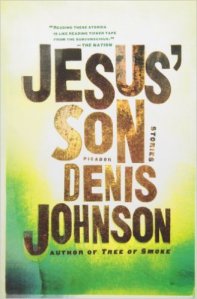
Jesus’ Son by Denis Johnson

jesus' sonThis is an intense, gritty collection of connected short stories that is almost a novel. The unnamed narrator (known only as Fuckhead) is clearly the same guy throughout, as we follow him through a nearly-chronological series of adventures in drug abuse, petty crime and violence, depravity and apathy. Also novelistically, there is something of an arc: the story ends with our narrator living sober with a part-time job, muddling along in a dingy, not-guilt-free version of redemption. It is not clearly told; the narrator is addled and deluded, and so is his story-telling style; it is performative of the character.
There is beauty throughout, as well. It is a fascinating, glittering series of tales in its emotional range and its tolerance for different viewpoints. Jesus’ Son has the power to entertain and amuse, to disturb and disquiet, and to uplift all at once. It is a strange, powerful creation.


Rating: 7 hits.

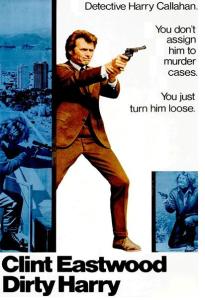
movie: Dirty Harry (1971)

I watched this movie because of a tiny mention of it in the description of a seminar I was preparing to attend. It was totally unnecessary as prep but what the heck, it was an excuse to see a classic I’d never seen before.

dirty harryWell, heck. I’m sure I’m supposed to admire this one, and I can certainly acknowledge that it must have looked much different in 1971. 1971. Do you realize that was 45 years ago? Golly. How old was Clint Eastwood in 1971? (He was 41 years old in 1971.)

This one is too well-known and much-written-about for me to waste many words on plot summation. “Dirty Harry” is Inspector Harry Callahan of the San Francisco Police Department, and he is investigating a crazed killer who calls himself Scorpio. Harry is a curmudgeonly fellow who is unhappy to be paired with the new, “young” cop Chico (who doesn’t look any younger than Harry to me).

So, in a different era, this movie must have had a very different effect on audiences. Some old films seem to hold up better than others. Here, I just found too much to pick at. How does $200,000 in tens and twenties fit into a little handbag? How did the doctor know to call in about the guy with the knife wound? (Presumably they put out an APB, but off-screen?) And with Harry being such an experienced investigator and all, it didn’t really ring true for me that he got his first lesson in evidence admissibility, legal searches, etc. in that lawyer’s office on this case. Maybe I’ve seen too many police procedurals. Finally, Harry’s classic line about how many bullets are left in the gun and do you feel lucky, punk? really fell short for me considering that other guns seemed to have unlimited bullets in them (as others also caught). Husband joked, “what are these, Walking Dead guns?” Ha.

More broadly, the killer Scorpio’s motivations, or the nature of his psychopathy, are never made clear. Again, maybe I’ve seen too many more modern shows. Harry’s general “dirty” attitude likewise receives no explanation or backstory. It’s just a shoot-em-up, and for pure shock effect, the 45 years that have passed since filming have done this film no favors. Perhaps if I had the nostalgia to attach me…

Sorry, fans.


Rating: 5 bullets.

movie: Stand by Me (1986)

Some months from now, you will see my review of Stephen King’s The Body, by Aaron Burch. One of the Bookmarked series, this slim book combines personal essay with literary appreciation – or in this case, film appreciation. Stand by Me is a movie based on Stephen King’s novella “The Body,” out of Different Seasons (a collection that also included “Rita Hayworth and the Shawshank Redemption”). For this reason, I put the book down halfway through to see this movie for the first time.

stand by meReleased in 1986, set in flashbacks to 1959, Stand by Me stars River Phoenix, Wil Wheaton, Corey Feldman and Jerry O’Connell as four childhood friends. Over a weekend, they hike through the woods to view the dead body of a boy their age, learning along the way about friendship and loss. It is a coming-of-age story.
I think I can see Burch’s attachment to this film, but it had a different effect on me, coming to it in adulthood. The emotional tones are there: sweet friendship, the pain of helpless childhood and loss at any time of life, nostalgia. I get them all, but I can see from here how they work; I didn’t get bowled over as Burch did. It is undeniably a sweet and sad story, though.

I marveled at how loving these boys are: lots of hugging, arms around one another, extended eye contact, explicit words of comfort. Have we gotten more homophobic as a culture since these days? I can’t see little boys loving each other this earnestly and physically today, which is sad. Maybe I’m wrong. I hope I am.

I enjoyed the humor, the pathos and the loving friendships. It was worth my time – especially in being able to appreciate Burch’s story. But I’m afraid it doesn’t have the same effect on an adult today that it did on a kid in the 1980’s, and I regret that. I’m also interested in “The Body” now (of course).

A worthwhile snapshot in time, but not one that reads the same now, unsurprisingly.


Rating: 7 cigarettes.

The Believer, issue 113: Chippy (fall 2015)

A little background: I’m working on developing as a reader and a writer, and approaching another graduate degree, this time in creative writing. As part of that process, I’m trying to read more literary journals. This is something we’re told to do if we want to get published by those journals, both to familiarize ourselves with what individual publications like and seek, and to support them. Over the course of six months or so, I’ve done a decent job of acquiring a bunch of print issues, but not such a great job of reading them. This summer, my resolution is to read a journal every Tuesday.

I don’t expect I’ll be writing about every one, but those I appreciate should certainly get a little space here at pagesofjulia. And that’s why I’m writing about The Believer today.

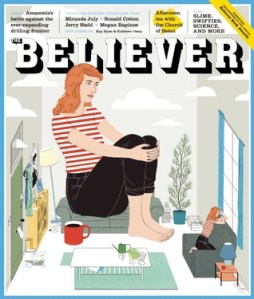
believer113The format is a little different. The table of contents is on the back cover, rather than in the first few pages. One element, the interview with Sheila Nevins (of HBO Documentary Films), is presented in pieces – “microinterviews” – spread throughout the issue. There are very few ads, and The Believer is printed on heavier, off-white paper, with nearly cardstock-weight covers. I’m sorry I don’t know the terms for these paper characteristics, but it’s got a nice feel in the hand. Oh, wait, here it is (from the website):

Each issue is perfect-bound and 128 pages, printed by friendly Canadians on recycled, acid-free, heavy-stock paper and suitable for archiving, framing in a very thick frame, or reading in the tub.

And despite the title, it’s got nothing to do with religion, or anything like that.

Also from the website, The Believer is

a bimonthly literature, arts, and culture magazine. In each issue, readers will find journalism and essays that are frequently very long, book reviews that are not necessarily timely, and interviews that are intimate, frank, and also very long.

In other words, overwhelmingly nonfictional and unafraid to go on a bit. I found the writing consistently very fine, and the widely-ranging subjects consistently fascinating. This is, in short, a magazine I want to read regularly. I am less sure that there is a place for my own writing on these pages (and if that’s self-centered, recall my original motivation in reading lit mags regularly), but that’s okay. I like finding good reading – obviously.

As to timing, I will note that the website still shows this issue, from Fall 2015, as the current issue. So I wonder a bit about their bimonthly-ness.

The highlights of issue 113, for me, included:

  • Kea Krause’s “What’s Left Behind,” about the nasty environmental disaster of a flooded copper mine on the edge of Butte, Montana. This piece made me think of Robert Michael Pyle, and hope that they know about one another.
  • Daniel Handler’s “What the Swedes Read,” a column in which he’ll read one book by each Nobel Laureate – this time, The Sovereign Sun by Odysseus Elytis, trans. by Kimon Friar. Handler’s often confused reading of these allusive poems, with frequent research digressions (“Out of my way, poem! I’m trying to understand you! Surely my loopy research was a disservice to poem and reader alike.”), really spoke to me and summed up some of my problems with poetry.
  • Ross Simonini’s interview with Miranda July finally got me really intrigued by this woman I’ve heard about here and there: now I want to check out her novel, The First Bad Man. Also, I was wowed by Simonini’s question, when July mentions that some of her early work embarrasses her: “Embarrassing because it wasn’t done well, or because it revealed something?” That is an exemplary interviewer: quick on his feet with an insightful question I wish I’d asked.

I’m excited to have discovered The Believer. I hope the missing issues of 2016 turn up, and I hope I can find the time to make this part of my regular reading.


Rating: 8 articles long enough to get lost in.

guest review: Mother Tongue: My Family’s Globe-Trotting Quest to Dream in Mandarin, Laugh in Arabic, and Sing in Spanish by Christine Gilbert, from Mom

My mother is here today to guest-review a book to which she brings special expertise. Mom has a Master’s degree in Applied Linguistics from the University of Houston; used to teach English as a foreign language to adults in community college settings; and now volunteers her time tutoring English language learners one-on-one. The disclosure here is that I was sent a free copy of this book in exchange for my mother‘s honest review. (It’s fun how that fact plays off this book’s title.) Thanks, Mom!

mother tongue

Christine Gilbert is quite the adventurous spirit. She tells the story in Mother Tongue about her quest to learn three languages – Mandarin, Arabic, Spanish – in less than three years, while living in three countries. This adventure includes a baby who acquires a sibling along the way. She and her husband have few ties to the U.S., and are able to work remotely. Thus they are perfectly placed for the language quest.

The quest is primarily hers, but includes her son as he grows and learns the local language effortlessly, as children do. (Her back-story includes a genetic disposition to Alzheimer’s disease, and she learns of brain research that suggests that young bilinguals have an advantage over monolinguals that gives about five extra years before onset of Alzheimer’s.) She sets out to understand language learning theories, while researching all the logistics of moving house and choosing the places.

Gilbert does her homework on language acquisition theory, and she makes her case for total immersion (no hanging out with English speakers!). She works long days in language study. In the beginning – Beijing during a very cold winter with pollution too severe for the family to go out much – she chooses to hire a tutor for working at home, as well as a housekeeper who doesn’t speak English. When a crisis takes the family away suddenly, she reviews her experience and decides complete isolation within the foreign country is not the only way to absorbing language and culture. Each move and new setting will bring more lessons, and Gilbert gets quite good at her tasks.

This is not a dry tome about memorizing vocabulary for long hours. We make friends along the journey, we learn to talk and savor local food. Gilbert is a fun character, and her husband’s story is equally interesting; the book is a travel story on lots of levels. As a parenting and family dynamics study, Mother Tongue is yet another book. I’ve been involved enough in the bigger story to follow her adventures as told on her blog, and can reveal that this is an unending quest – two more countries appear there, and since I haven’t looked lately, who knows where they may be now.