






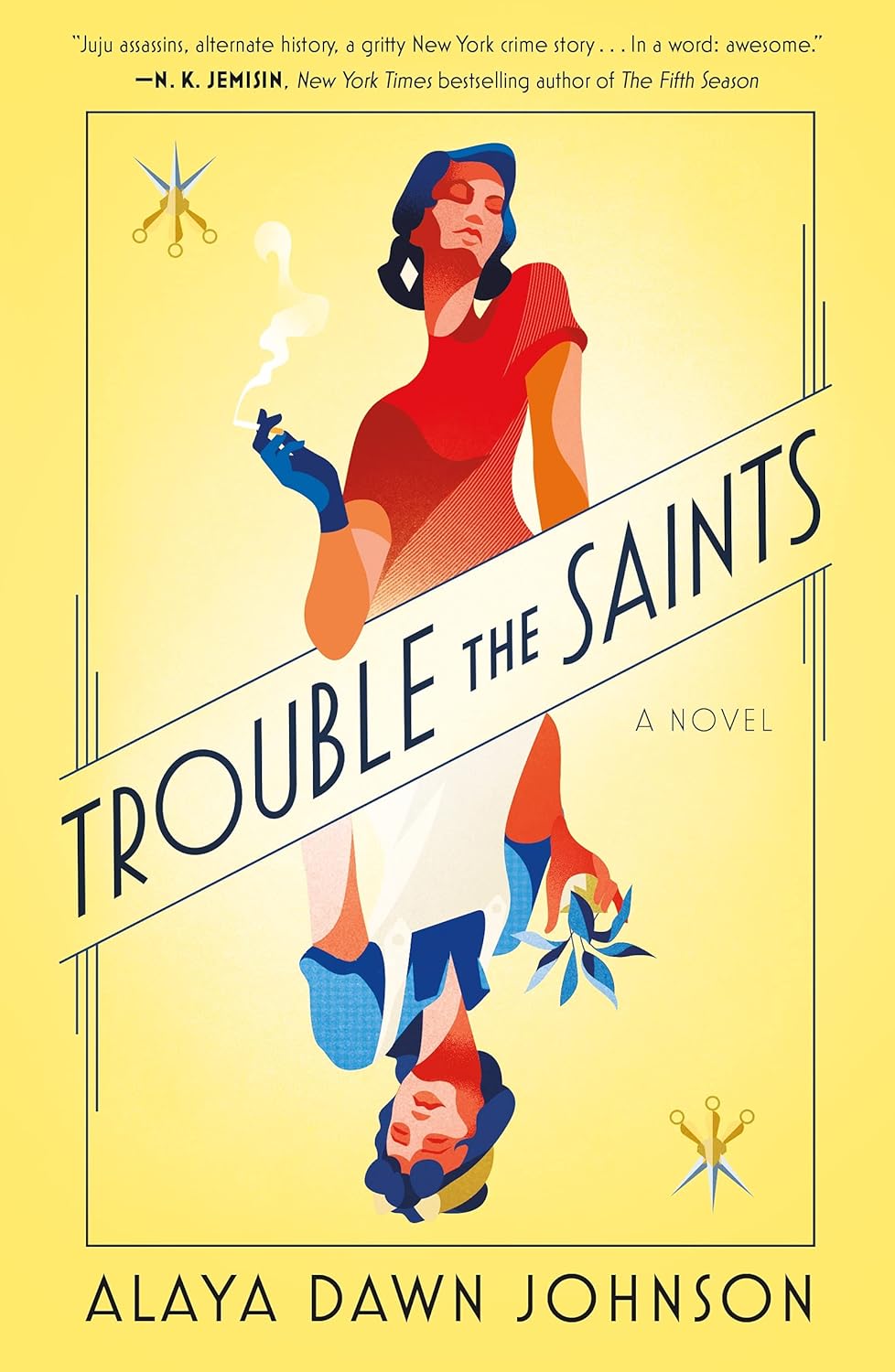
 Trouble the Saints is bewitching, mesmerizing. It begins mid-scene, a move that is always risky but can have big rewards: the writer asks the reader to wade through a little confusion in favor of action and immediacy, trusting her to wrangle the context clues and have patience with the pace at which details and secrets unfold. It’s well done here. There are cards, and dreams, and magic hands – saints’ hands – and a violent backstory for a protagonist who is however strongly committed to her own concept of justice. The reader finds out as she does how she’s been betrayed – and by the one she loves the most.
Phyllis, or Pea or Sweet Pea to those she is close to, is a paid assassin for a Russian mobster in early 1940s New York City. She is known as Victor’s knife, or Victor’s angel – because she only agrees to kill when the victim deserves to die. She is also a ‘high yellow’ woman of color passing for white in a pretty high-stakes setting. Her years-ago lover, Dev, is a Hindu man guided by karma and reincarnation; he could not abide Pea’s work. His current partner is also one of Pea’s dearest friends, the singer/dancer/entertainment manager Tamara, who is Black enough to suffer the full weight of prejudice and discrimination when Pea can sometimes skirt it. So: violence, organized crime, race and racism and colorism, oh and Hitler’s on the rise, and also Pea’s immaculate skill with her knives is owing to her saints’ hands, which manifest in different ways for different individuals. Dev can sense threats with his. Tamara doesn’t have the hands, but she is an oracle: with her great-aunt’s cards she can read fortunes, or the future, or both – the rules are revealed slowly, to us as well as to these characters. There are others, with different backgrounds, skin tones, and degrees of magic or understanding. Danger and hauntings are everywhere, but there is also romance and the kind of connection that transcends that label.
Trouble the Saints is an astonishing book that keeps surprising, not least with its changes in perspective. These subjects range widely and never feel overambitious for the remarkable Alaya Dawn Johnson, who imbues even the gruesome with poetry. She’s a new name to me but one I’ll be looking for. It took me a day or two to recover, and I’m still thinking about love, friendship, and what we carry on with us. Whew.
Filed under: book reviews | Tagged: historical fiction, misc fiction, noir, race, romance, speculative fiction |
 pagesofjulia
Leave a comment