






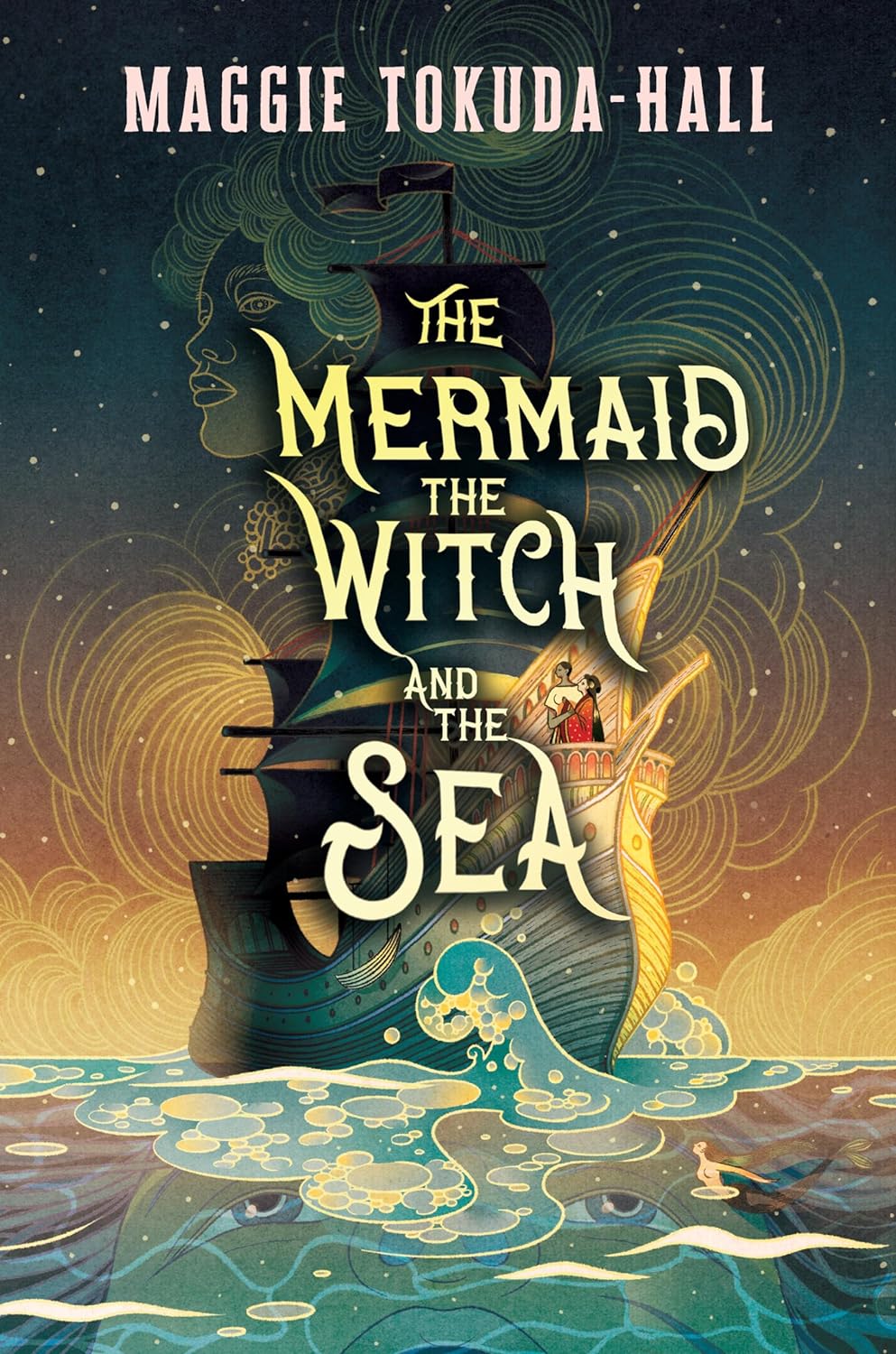
 There’s a little bit of everything in this unusual fantasy novel for older kids or young adults (or any of us, obviously). Sweet, heartwarming, and surprisingly bloody, The Mermaid, the Witch and the Sea offers mermaids, pirates, and young love. Imagine a bit of Treasure Island, but gender-bending and with a greater emphasis on political workings and class divisions. And magic.
We open with a murder on a pirate ship, then shift to high tea in a house of wealth and privilege. In the first scene, a teenaged boy named Florian earns his keep, having gambled on a life of piracy to save him and his brother from a life of deprivation and scant survival on the streets of the Imperial capital city. In the second, a girl named Evelyn chafes at the bounds of her household, where she enjoys status but not the love of her parents, who plan to send her away to be married to a man none of the family has ever met. Evelyn winds up on the same ship as Florian, where loyalties are split between factions supporting the Empire (who have colonized almost all of the known world, to the discontent of many) and the Pirate Supreme, who serves the Sea. “The Pirate Supreme’s forces were the only thing standing in the way of complete Imperial rule on the open sea. If pirates could still disrupt the merchants, still stymie the trade routes, then the Imperialists could not claim full control. Every robbery, every kidnapping, every galleon destroyed was a protest against the Emperor.” Some loyalties have yet to reveal themselves. And oh, Florian is also Flora, whose pronouns and identity as ‘boy’ or ‘girl’ shift throughout the story. “Both, maybe, but not neither.” “Both were equally true to her” (or him); “neither told the whole story.” Florian is Black and Evelyn is something like Japanese, although these seem to be descriptive details rather than identities that affect status or prejudice in their world.
Flora has lived life on the margins, making hard choices, fighting for life in the most basic ways. Evelyn has suffered a different kind of privation, unloved and lacking agency, but has never imagined the kinds of challenges Flora has faced. The two have much to learn from each other. And I haven’t even mentioned the effects of mermaid blood or its price on the open market, the scarcity of witches in Imperial colonies, or the far-seeing powers of a conscious Sea.
Delightful, weird, fanciful, queer coming-of-age with murder and magic. Violence, rather than sex, may recommend a readership in their teens more than their tweens, depending on blood tolerance, but the themes are solid: finding oneself, living one’s truth, navigating ethical puzzles, being a good friend. And it’s a page-turner to boot.
Filed under: book reviews | Tagged: children's/YA, coming of age, fantasy, LGBTQ, romance |
 pagesofjulia
Leave a comment