






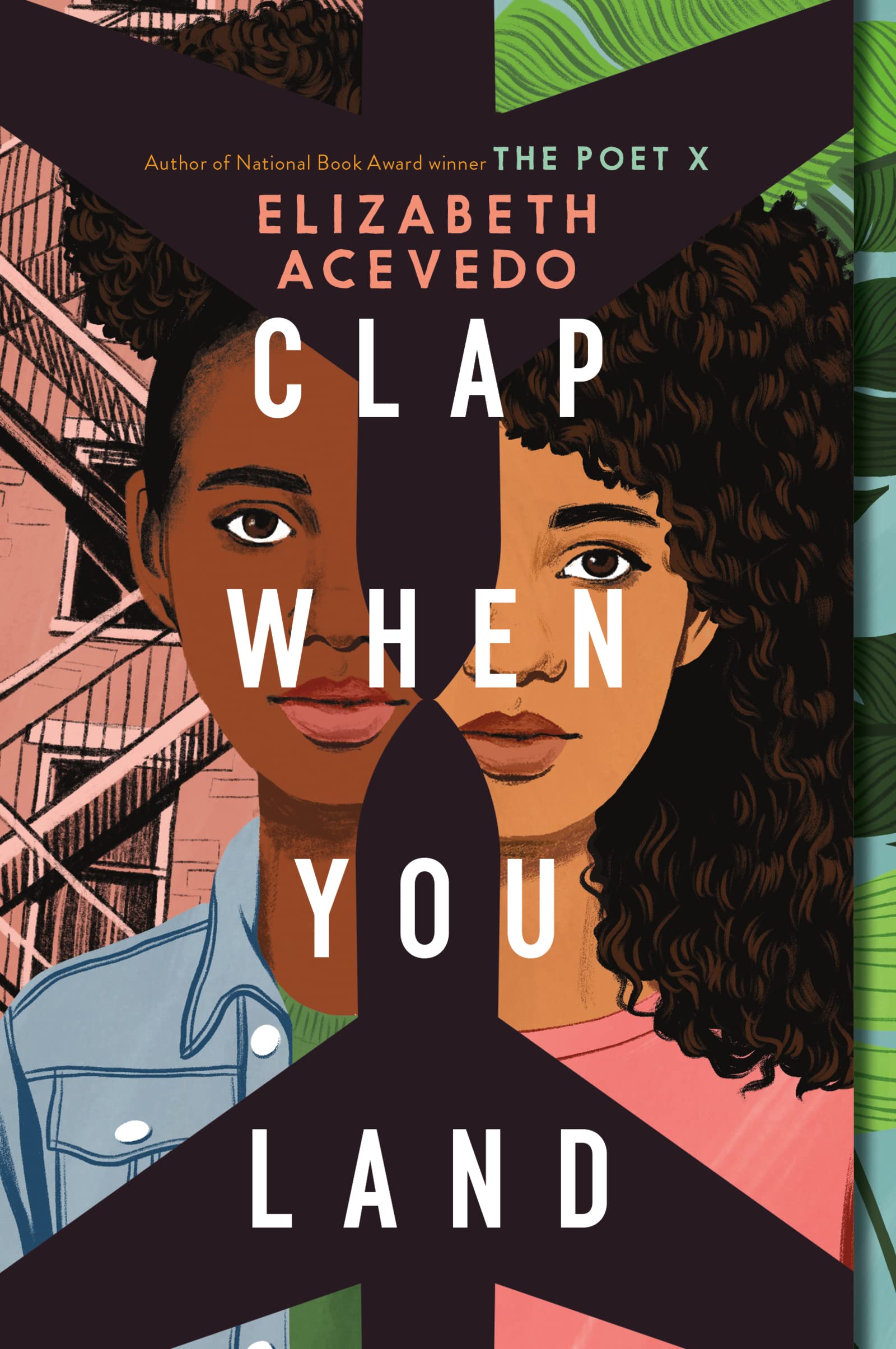
 Clap When You Land is a novel in verse, in two alternating perspectives. Camino lives in a village in the Dominican Republic with her Tía, who has raised her since her mother died some years ago. Her father lives in New York, and comes to stay each summer for several months. Camino loves her father, and feels loved in return; he supports her and her Tía better than they could afford to do on their own, with the small funds raised by Tía’s doctoring duties. She’s a healer and midwife, skilled with herbs and prayer, and Camino wants to follow in her footsteps, but take it a step further: her dream is to study medicine at Columbia University. Meanwhile, Yahaira lives in New York City with her parents. She’s a former chess champion, but she’s given it up, which has put a rift between her and her father. The two girls are just two months apart in age, approaching 17. They have the same father, but they don’t know it until after he is killed in a plane crash, traveling from his home with Yahaira to spend the summer in the DR, as he does every year.
In their alternating chapters, we see two teenaged girls wrestle, first, with their futures: Camino is concerned about where to go with her life if her father doesn’t help her get to the States. Her options in the DR are few, and there is a predatory young man after her. Yahaira is upset because she’s discovered that her father had a secret – although it’s not the big one she’s about to learn, that she has a sister. Each girl has a best friend: Camino’s is about to give birth, and Yahaira’s is also her partner. We see them both struck by the loss of a father that each loved and admired. And then we see them hit by another shock: they’ve lost a father, but each has gained a sister. What will they do with that knowledge?
I like the questions raised by the twinning of the two girls, what each might have been under different circumstances, what is conveyed by certain advantages. (Camino’s household is better off than most in her village, but still much poorer than Yahaira’s unremarkable middle-class home in Morningside Heights.) At its heart, this is a story about family love, grief, and forgiveness. It’s lovely told in simple verse: easy to read but also contemplatively paced, dealing as much with emotions as events. As a YA novel, I think it would be well suited to thinking about loss for young people, or for any of us.
Papi’s two families, and his keeping the girls in the dark about each other’s very existence, isn’t much dealt with: the character is dead before we meet him, so we only see him in their memories, and he never gets to justify his choices. That’s rather more complicated.
Another thread involves the crashed airplane, which is based on the real American Airlines flight 587. Both the fictional and the real flights left New York headed for the DR filled with Dominican-Americans; the Dominican community in New York was badly shaken by its loss, and that’s a large part of what inspired Acevedo to write this novel (as described in her Author’s Note). That community-wide impact is well described here, which I think is a service.
Sad, thought-provoking, but also a beautiful honoring of a community.
Filed under: book reviews | Tagged: children's/YA, coming of age, family, grief, misc fiction, poetry |
 pagesofjulia
Leave a comment