






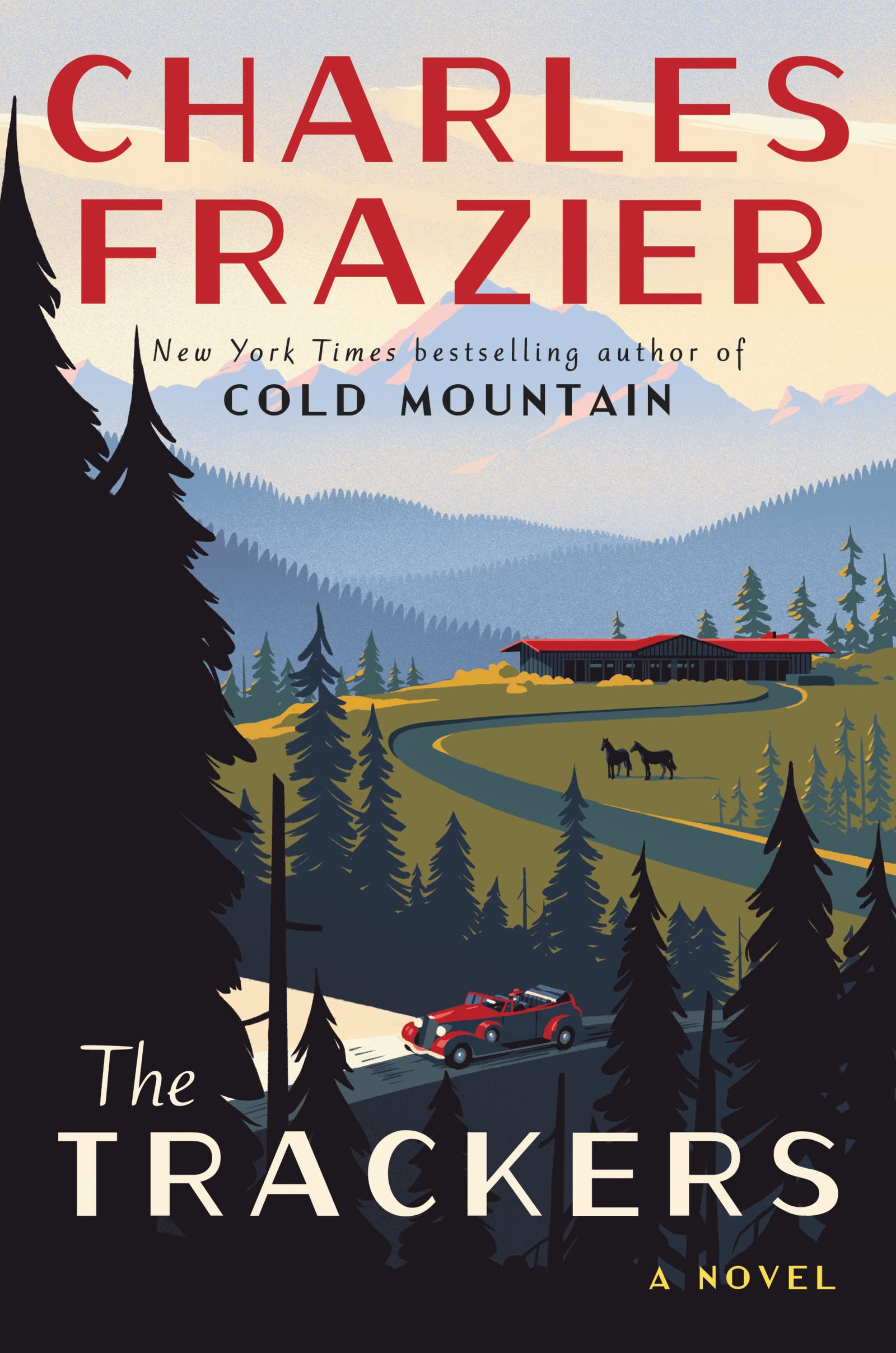
 I never read any Frazier before, although I’ve been aware of his well-received Cold Mountain. I liked what I saw in teasers about this recently-published historical novel: set in the Depression and centered around an artist named Val Welch who’s been hired to paint a mural in the post office of small-town Dawes, Wyoming. An old art school mentor helped him get this New Deal commission: “Hutch was the right kind of idealist for the times. He believed public art could be like a pebble thrown into a still pond, a small influence but spreading in all directions.” Val is back-and-forth between idealism and cynicism, but he does take art seriously, and earnestly wants to do a proper job of this mural. There is a public education aspect to the job, as locals wander in while he paints. He tells them,
The mural is going to express waves of history always swelling and cresting and breaking and rising again, and all the images will be slightly tilted forward, leaning into the future.
I was twenty-seven, so take that into consideration.
The locals are not always charmed. They keep telling him the joke that WPA really stands for We Piddle About (and he doesn’t even work for the WPA). But he still feels it’s important work.
In a nutshell, this is the book I was hoping to read: art, community, historical time and place. But the book Frazier wrote is a little different from that. We first meet Val Welch as he’s traveling west, from home in Virginia to Dawes; we see some of the country through his eyes, and we arrive with him at Long Shot, the ranch owned by the extremely wealthy John Long (old friend to Val’s mentor Hutch) and Long’s wife, Eve. Long Shot is opulent, and Long very pleased with himself. He’s hoping to go into politics. His right-hand man Faro is a hard-handed old cowboy, around whom rumors congregate. Eve is a beauty, much younger than her blowhard husband, with stories to tell about being a childhood tramp following the harvest cycle around the country and leading a successful cowboy band. She can offer hard edges, a movie star’s glamour, and whatever story her current audience is apt to find most engaging. It’s implied that her personal history is changeable at the least. Val is easily drawn into the odd family of Long, Eve and Faro. When Eve runs away, Long hires him (at an extraordinary wage) to track her. Val steps away from his mural with an alacrity that surprised me.
The rest of the novel is not about art, but about the intrigue and spiderwebs of Long and Eve’s marriage, Eve’s alleged first husband Jake, and the characters Val meets in Seattle, San Francisco, and a Florida backwater while trying to track down a woman no one understands. The Trackers refers in its title to Val’s efforts, obviously (and a few others who jump in on the game in the book’s present), but also to a couple of figures in Val’s mural. The mural trackers fall off the page pretty quickly, though, which is a metaphor for the mural and the public art thread in general. The tracking-of-Eve storyline is well executed, technically and in its craft elements, and Frazier writes beautifully and compellingly in descriptive details, characterization, and dialog; it’s not at all surprising that his books have won awards. The mystery of Eve is suspenseful and well paced. But as a thread, the beautiful, deceptive woman and her various bumble-headed male admirers didn’t do a lot for me. I was much more interested in the public art / historical angle. That’s not a great criticism of Frazier: he wrote a different book than the one I’d hoped to read, and it’s not his fault that I got a different impression from wherever I read about this book. I will make a slight criticism in that his female lead feels like a Hemingway woman to me. She doesn’t pass the Bechdel test but seems a male fantasy; does she have an interior life that’s not in relationship to the men around her and how they react to her? Her clothing, her literal onstage performances, the way she smokes a cigarette, are all about the male gaze. I find this disappointing.
It kept me reading, but I missed the book I wished I were reading. And I thought Eve was a missed opportunity. Passes technical muster, but not impressive to this reader.
Filed under: book reviews | Tagged: historical fiction |
 pagesofjulia
I’m listening to Wiil Patton read this book on cds. His voice and his cadence of speech makes the book extremely enjoyable. I like the author and look forward to reading or listening to his next book.
Thanks for sharing, Pamela! A good narrator makes all the difference. I thought the Patton name sounded familiar but I can’t find any of his I’ve read. I’ll keep my eyes open.