






A physician’s fervent quest for better information about medical options for patients nearing their end, and the steps necessary to make those choices clear.
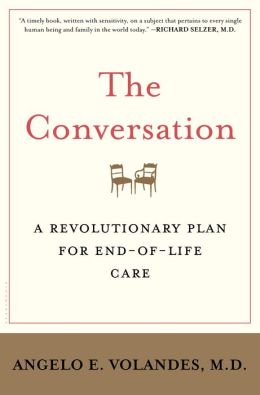
In The Conversation: A Revolutionary Plan for End-of-Life Care, Angelo Volandes, a medical doctor for decades, focuses on the extensive, intensive, intrusive medical interventions that patients routinely receive at the end of life, many of which extend life by a matter of hours or days or not at all, while decreasing its quality substantially. He earnestly argues that every patient should be offered the option to choose among three broad categories of care: life-prolonging, limited medical and comfort care–in other words, the choice between quantity and quality of life. The Conversation advocates for all patients and families to receive information about what end of life care looks like within these three categories, and firmly states the importance of patients, families and medical professionals having what he calls the Conversation about end-of-life wishes openly and often.
To make these points, Volandes describes his upbringing as the child of Greek immigrants and the impact it has had on his life: from his start as a student of Socrates and a Greek diner cook, his stint as a philosophy major and then his work as a medical practitioner, he has been interested in what good life (and good death) are. Appropriately, Volandes neither attempts nor claims to be impersonal or unemotional about this charged topic; rather, he brings his personal and professional experiences as well as research to his impassioned argument.
The majority of the book is devoted to stories of patients, families and circumstances–and Volandes’s own attempts, good and bad, at approaching the Conversation. With names changed, these are real-life anecdotes of choices made with more or less preparation and knowledge of what a decision will entail, or what an incapacitated patient would have wanted. The last quarter of the book is composed of several appendices and a lengthy, narrative notes section, all of which provides substantive hands-on advice aimed variously at the patient, or the patient’s spouse or children. The Conversation is a how-to manual, enlivened by engaging–if occasionally painful–true stories. Volandes makes his points succinctly and convincingly and offers readers the tools to make change within their own lives.
This review originally ran in the January 6, 2015 issue of Shelf Awareness for the Book Trade. To subscribe, click here, and you’ll receive two issues per week of book reviews and other bookish fun!
Filed under: book reviews | Tagged: end of life, health/hospitals, nonfiction, Shelf Awareness |
 pagesofjulia
This appears to be very sound thinking. My mother, who died last August, would have selected the “comfort care” option in a minute. She was 98, in full possession of her faculties, and her body was falling apart. No sane person thinks there’s a cure for that.
The things she came back to a lot were that she was ready to go, and she really hoped there wouldn’t be a lot of pain.
What I find horrifying (not surprising, but still horrifying) is that apparently next-of-kin family members sometimes try to overrule a person’s wishes. My mother had a living will and Do Not Resuscitate and everything else, but when she was dying the nursing home asked me to sign a form basically saying that her decisions were indeed her decisions.
Which I was happy to do, because her decisions seemed very reasonable to me, and, much more importantly, because that’s what she wanted. But I could tell they (the nursing home) were covering themselves, getting assurance that I wasn’t going to sue them or something. So, obviously, this does happen from time to time.
Yea, it’s a totally scary thing, and our system as it stands now is not particularly well suited to respecting the wishes of the patients if they wish for less than full interventions. Your story doesn’t surprise me, I’m sorry to say.