






My enjoyment of So We Read On (teaser here; review to come) convinced me that I needed to read Fitzgerald’s short story The Swimmers, which Corrigan regularly refers to. So I did. I found it easily enough online.
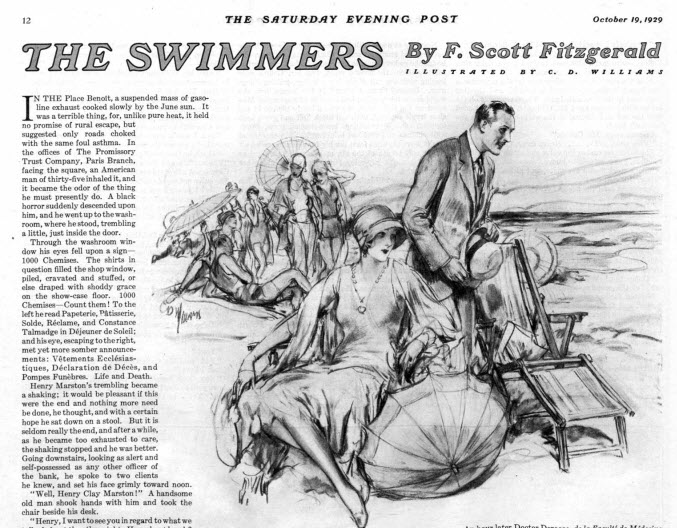
When we meet him at the opening of this story, Henry Marston is working in a bank and living in France with his two children and his French wife. He could make more money back home in the States, but that’s not what’s important – until it is. A nasty event prompts him to move his family to the U.S., where he is wealthier; but a recurrence of the same unpleasantness spurs him to make changes a second time.
Between the two events he meets a young woman who teaches him to swim. This takes place on a French beach, and the young woman is American; this juxtaposition (symbolism, even, as swimming stands in for Americanism) persists, and it will be his newfound ability and love for swimming that will free him at the end of the story.
The most noticeable element of this story is national differences, epitomized in the final paragraph, which closes out a remarkable last page. Sweeping statements and symbolism are very much at work here, and the language is lovely. Perhaps I’m suggestible after just reading Corrigan’s book which compares The Swimmers so strongly to The Great Gatsby, but I definitely recognized Fitzgerald’s voice as I remember it from his most famous work. There are also some strong statements about class, money, and values, similarly familiar to the Fitzgerald fan. And reference to the lost generation (no capitals here). Finally, I swear I heard shades of Cheever, but surely that’s just the confoundingly similar title to Cheever’s well known story…
What can I say? It’s Fitzgerald. I recommend it. I’ll leave you with that final paragraph:
But when, in a moment, he left her he knew that she could never tell him – she or another. France was a land, England was a people, but America, having about it still that quality of the idea, was harder to utter – it was the graves at Shiloh and the tired, drawn, nervous faces of its great men, and the country boys dying in the Argonne for a phrase that was empty before their bodies withered. It was a willingness of the heart.
I’m willing.
Filed under: book reviews | Tagged: short stories |
 pagesofjulia
Leave a comment