






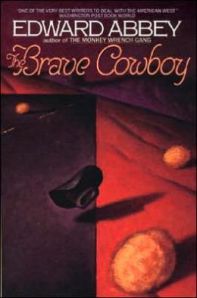
 For a man who writes evocatively of nose picking, armpit scratching, hard drinking, and crude womanizing, Edward Abbey can be surprisingly erudite and wordy. His more informed readers will note, however, that he held a master’s degree in philosophy, and enjoyed both a Fulbright Scholarship at Edinburgh University and a Wallace Stegner Creative Writing Fellowship at Standford.
In my recent reading of his second novel, The Brave Cowboy, I had to look up no fewer than 10 words, ranging from unfamiliar to entirely unknown to me. Perhaps you will find some new ones here, as well!
bartizan: “a small structure (as a turret) projecting from a building and serving especially for lookout or defense.”
scurf: “Scaly or shredded dry skin, such as dandruff.” Ewww! Leave it to Abbey. It was more or less clear, in context, what this word referred to; but I initially thought perhaps it was one he’d made up. Not so.
corundum: “a very hard mineral that consists of aluminum oxide occurring in massive and crystalline forms, that can be synthesized, and that is used for gemstones (as ruby and sapphire) and as an abrasive.” The first of several geological terms, not very surprisingly.
glister: As I’d suspected, a sort of blending of ‘glisten’ and ‘glitter’, but not one Abbey made up, as I’d also suspected (like ‘scurf’, above).
carnotite: “a yellow to greenish-yellow mineral consisting of a radioactive hydrous vanadate of uranium and potassium that is a source of radium and uranium.” Extra points if you go look up ‘vanadate’…
cuate: I am mostly confident following the little bits of Spanish Abbey uses, having grown up in a border state myself; but I had to check on cuate. As suggested in context, it’s another way to say “guy, buddy, pal.”
eschatology: I began to wrinkle my nose because of the similarity to scatology, but no. “A branch of theology concerned with the final events in the history of the world or of humankind.” A philosopher master’s, I said.
hosanna: “used as a cry of acclamation and adoration.”
passacaglia: “an instrumental musical composition consisting of variations usually on a ground bass in moderately slow triple time.”
tamarisk: “any of a genus (Tamarix of the family Tamaricaceae, the tamarisk family) of chiefly Old World desert shrubs and trees having tiny narrow leaves and masses of minute flowers with five stamens and a one-celled ovary —called also salt cedar.” To which I am tempted to grumble, why not just call it salt cedar?
I’m always happy to learn new words. Thanks, Ed.
You can see a few more “vocabulary lessons” posts here.
Filed under: musings | Tagged: reading as education, vocabulary |
 pagesofjulia
I had noticed this erudite trend with Abbey as well, and this is a notable list; I would comment on these two inclusions:
hosanna – reflects the shallow attention to religion in your “home” schooling, tho’ I am puzzled your vast reading hasn’t exposed this word
tamarisk – can only be explained by your decided indifference to two parents’ botanical interest!
Yes and yes, Pops!