






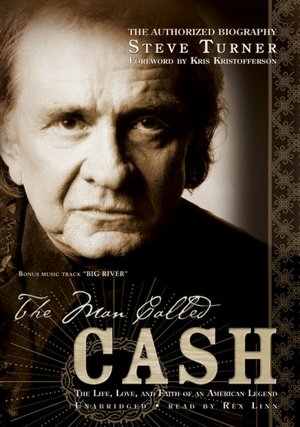
 How could a biography of Johnny Cash not be extraordinary? (Well, the question of whether we seek out biographies of interesting people, versus interesting biographies of any old people, is another blog post.) I was excited to start this one. But warning, folks: it hits hard, and early. The first chapter is about the death of June Carter Cash after 35 years of marriage to the Man in Black, and I cried.
Johnny Cash is truly larger-than-life, as a celebrity and a public figure as well as in his music career. I’m a fan, but not a scholar of Cash’s life: prior to this book, what I knew of him was general cultural knowledge, or gleaned from his songs and the movie Walk the Line (which I enjoyed). So now I know a great deal more.
He was born in Arkansas and grew up in a town called Dyess (which Cash jokingly refers to as a socialist experiment – it was designed under FDR’s New Deal) in the midst of the Great Depression, and after high school, joined the Air Force and served in Germany; he returned to the South to marry a girl named Vivian whom he had met just weeks before shipping out. Cash and Vivian would have four daughters.
His music career came about in an interesting way. Cash had always been passionate about music, from childhood; his mother shared and inspired this love. He was not particularly gifted as a singer, and he was a mediocre guitar player who mostly learned from his Air Force buddies; but his songwriting did impress his peers from the beginning. Back in the southern US, he teamed up with a few coworkers of his brother’s, and formed Johnny Cash and the Tennessee Two, recorded his first single apparently on the strength of will alone, and… things took off from there. Names like Carl Perkins, Sam Phillips, and Elvis Presley figure in the early years of his career.
The shape of his musical career surprised me the most in the story of Cash’s life. He was always an innovator: he played an integral role in the birth of rock-n-roll; he blended styles and approached subject matter previously deemed inappropriate; and even in the final years before his death broke new ground. But I never realized how sort of unguided and hesitant those innovations were. He needed musicians, producers, and sound engineers around him to help shape his creativity. I say none of this to take away from the genius of Johnny Cash: he was unique, and his art remains unparalleled. I just hadn’t realized that he didn’t do what he did in a vacuum, that he had no great image or plan for his work, that he didn’t see the bigger picture himself. He needed help for that.
On tour in the 1960’s, Cash became close to fellow musical artist June Carter; they carried on an affair until Cash’s divorce from Vivian. During the same period, he struggled with methamphetamine addiction, and June wouldn’t marry him until he was clean, which turned out to be 1968. The drug use came and went for many years, but his marriage to June was steady. They had one child together, John Carter Cash.
I enjoyed learning about Johnny Cash. As it turned out, for me, this book’s greatest strength was its subject: rather than being an excellent biography, it detailed an excellent life. One minor gripe I have is in its handling of Cash’s religious life. Now, let it be said, Christianity played a huge role in Cash’s life: he was devout as a young man; struggled with his faith during the years of drug abuse and adultery; found a stronger religious foundation in his years of happy marriage to June; made a great deal of religious music and spoke publicly of his faith; and in many ways led a truly Christian life in terms of charity, compassion, and standing up for the disadvantaged. Handling Cash’s religious life is obligatory in any biography of the man. However, this biography approaches it from a certain perspective: it takes for granted that Christianity is good, and any strayings from the church are bad. See mentions of Billy Graham as an absolutely virtuous figure; praise of June Carter Cash for her total devotion to her husband (with religious references); and straightforward use of “light” and “dark” or “good times and bad” in reference to Cash’s more and less religious periods.
Author Steve Turner never takes on a voice of his own in his book; and I think that, if he were going to take a religious position as he has, that he should have spoken to that in his own voice. Does that make sense? To write as a Christian is not to write from a journalistically neutral place. The fact is that not all Turner’s readers are Christians; and he has done them a disservice in failing to zoom out to a neutral position from which to view his subject. I feel it would have been more honest to acknowledge a personal perspective.
The Christian leaning did not ruin this book for me; but I noticed it. And in noticing it, I was distracted from the fascinating story Turner had to tell. I guess I should have taken warning from the subtitle of the book: The Man Called Cash: The Life, Love, and Faith of an American Legend. Ah well. Silly me: I thought faith could be covered from a faith-neutral perspective. My final judgment on this question is that if you’re seeking a neutral and non-faith-based reading of Johnny Cash’s life, you should seek elsewhere. There are far too many biographies of this enormous figure to settle for one with such a bias.
Similarly, Turner’s perspective assumes that Cash was basically a good man. His mistakes, his “sins” if you will, his lapses, are all forgiven in advance. Turner turns a fundamentally uncritical eye on his subject. This bothered me far less than the Christian angle; in fact I noticed it far less, for the vital fact that I am a Cash fan who was sympathetic to the assumption that he was a force of good. But that doesn’t make it any less an error of journalistic neutrality. Again, there are different ways to skin this horse. Christians may appreciate this reading; fans may appreciate this reading. Those seeking a neutral and critical examination of Cash’s life should seek elsewhere. The Man Called Cash is a fan’s biography.
How about the narration? Rex Linn reads this book for us, and his deep voice and southern vowel sounds evoke Cash, which is pleasant. But he doesn’t do different voices for different characters at all; and some of the pauses between phrases are disjointed. I got the feeling that there may be some sloppy audio-editing involved. It was fine, but not the finest audio narration I’ve encountered, by a long shot.
I have made three criticisms here: two on the biased perspective of the author as a Christian and as a fan of Cash, and one on the audio reading. I feel these are worth noting. But I still enjoyed the book, again, mainly for the strength of Cash’s life. I recommend it with qualifications. If the issues I’ve outlined here bother you, by all means look for another Cash biographer as there are plenty! But this one does the job, too.
I’ll end with a strength. As I said, the book opens with the death of June Carter Cash in 2003. Her final weeks and those following her death are detailed finely; we get to know the Cash family as affected by losing its matriarch, and it is a beautiful and thorough and moving introduction. Its emotional impact opens the story forcefully. From here, we rewind to Cash’s origins, and then follow his life chronologically; when we come back to June’s death again, we can pass over it more quickly, having studied it earlier, and focus more on its impact on Cash himself. I found this structure very effective and powerful, and I am impressed by Turner’s planning in this regard.
Final verdict: obviously mixed. Draw your own conclusions.
Filed under: book reviews | Tagged: audio, biography, nonfiction |
 pagesofjulia
Great review. Now I def want to pick it up, as I love the man,and thanks for the religious heads up…