four Hunger Games movies (2012-2015)

They made the three Hunger Games books into four movies, which I watched over a week or so with halfhearted interest. This is a brief review, but tldr: the books are better.

It was neat to see the characters brought alive onscreen. The visual interest of the Capital and its weird denizens was not, I think, exploited to its potential, but it was still worth seeing. And I confess I am as susceptible as anyone to the appeal of seeing the young love play out live-and-in-person (sort of). I was disappointed with the casting of Peeta’s character at first, but he won me over. Gale just looked old – too old for the character’s age – like, as usual, they picked a 30-year-old to play a 17-year-old. (Turns out Liam Hemsworth was 22 when the first movie came out, but this was my reaction.) Jennifer Lawrence as Katniss felt a little unconvincing; or maybe the acting in the final two movies (when her character is herself failing as an actor in the Mockingjay role) was a little too good? Most of my impressions can be summed up as ‘meh.’ The biggest problem, of course, is the one consistent with book-to-movie adaptations: they couldn’t fit the story and all its nuance, backstory, character motivation, interiority, etc. into this format. The movies failed to develop the history of Panem and of Katniss’s own family; they cut too many minor but instructive sideplots; minor characters were underdeveloped (Cinna!!) or missing; and Katniss’s thoughts and feelings, which make her human and complicated and conflicted, were entirely lost. I understand the challenge. It’s hard to do thoughts and feelings without straight narration, which comes with issues and dragginess of its own. But I thought a lot of what was best about Collins’s novels was missing from these films. I can see the appeal, and note I watched all four movies. But I watched them with about 65% of my attention. I think my recommendation would be to just stick to the books.

Anybody read the new prequel The Ballad of Songbirds and Snakes yet? Reviews are indifferent; not sure I’ll bother. Oh, well. The trilogy’s pretty great!


Rating: 5 meals.

Past Tense by Lee Child

I was having a bad day and hit a couple of not-great books in a row, so I checked this one out from my local library and sat back. It’s a wonderful system, to get that ebook on my Kindle in minutes. Fixed my day right up.

Even a mediocre Reacher novel is a fun time, but this is one of the better ones: a real joy ride. Past Tense sees Reacher leaving Maine and aiming for San Diego, more or less, as winter approaches. Why not the beach and some warm weather? But of course he doesn’t make it that far. Instead he takes a spontaneous turn toward Laconia, New Hampshire, because he knows that name: it’s where his father is from. Stan Reacher, who never talked much about his past, whose origins Reacher has never visited before. So why not? And when he gets to Laconia and goes looking for the old homestead – property records and all – thinking he’ll cruise by and see it from the curb at least – the records are dodgy. Where did Stan Reacher hail from, really, exactly?

Also, being Reacher, he gets himself into a scuffle or two right off the bat. First, he’s awakened at 3 a.m. by a cocktail waitress being assaulted in an alley, which he fixes for her, with the result that some people come looking for revenge. Secondly – but that’s a longer story. There’s also a parallel storyline going on with some unrelated characters off in the nearby woods.

This novel (the 29th published, called #23 in the series) has everything I love about a Reacher thriller: hand-to-hand combat, with clever internal monologue; intrigue and fast guesses; front of brain versus back of brain; some great Reacher family history; fascinating twists and surprises; and for a refreshing change, romance that isn’t just about a thin, hot, young woman having sex with our favorite hero. The collision of the two storylines is pretty neat, too. I like that I can see it coming but not precisely how it’ll come. I loved the ending. This is classic stuff here, Lee Child more or less at his best. On the one hand, I can see the caricature pretty clearly at this point – I don’t know if Child’s writing has gotten more over-the-top or if it’s just my having read a few dozen of them. I don’t really mind, but it does require some suspension of disbelief. On the other hand, I am always pleased when a mystery/thriller (especially from an author I know so well) can surprise me, and this one did.

I’m still a huge fan.


Rating: 8 quad-bikes.

Pachinko by Min Jin Lee

Recommended by Liz to help break my reading slump. I picked up Pachinko as an e-book from my local library, and saw the descriptors ‘multigenerational epic,’ among others, go by as I opened it. Now, normally ‘multigenerational’ and ‘epic’ are both turnoffs for me, but I trust Liz entirely. And it’s a great book – maybe I should consider more multigenerational epics.

The cultural backdrop was fascinating to me, and almost entirely new. Pachinko is set in Korea and Japan, following a family of Koreans who become Korean Japanese, across most of the twentieth century. The cultural implications – the perceptions of Koreans in Japan – were a big part of the appeal, and the point, of this novel. I learned a lot. And as far as that (potential) ‘multigenerational epic’ problem, any hesitations I might have felt were well taken care of by Min Jin Lee’s excellent handling of a large cast of characters over time. I didn’t have any trouble keeping track of them, because each was well-developed and clearly delineated. I lived so thoroughly with these people that I still feel myself a little bit with them, even now it’s been a few days since I finished reading.

The first line of the book reads: “History has failed us, but no matter.” In 1910, in a little Korean fishing village, an old fisherman and his wife have a single son, Hoonie. Given his cleft palate and club foot, he considers himself lucky to marry at all. With his wife Yangjin he has a single surviving daughter, Sunja. She becomes pregnant as a young woman by an older, wealthy, married man. Therefore she also considers herself lucky to marry Izak, a young minister who considers it a charitable act to give her child legitimacy. Izak and Sunja go to live in Osaka, in Japan, with Izak’s brother and sister-in-law. Sunja’s first son is Noa; her second, with Izak, is Mozasu.

Sunja is surprised to find how poorly Koreans are treated in Japan. Back home her family was poor; here they are poor and abused. Circumstances are harder still during World War II, until Sunja’s first lover Hansu – Noa’s biological father – resurfaces to help the family. It turns out he’s been helping behind the scenes all along, which is not equally appreciated by all. When Noa learns the truth, he cuts all ties, and establishes a new life for himself in another city, where he represents himself as full Japanese. Both brothers wind up working in pachinko parlors, in different parts of the country and in different contexts.

Sunja and her dearly loved sister-in-law support the household, now including elderly Yangjin as well. Mozasu’s wife dies young. They have one son, Solomo, who attends college in New York, then returns to Japan with his Korean-American girlfriend. But even in 1989, Korean Japanese occupy a special sort of cultural no-man’s-land, unable to return to a national home that no longer exists (Korea in its pre-war form), and not accepted in Japan despite having been there, in many cases, for four and five generations.

The book’s central themes include cultural dislocation and (the myth of) racial difference; home, identity, and belonging; gender (there is a refrain that “a woman’s lot is to suffer”), class, and the stereotypes about pachinko (a totally legal, highly profitable and enormously powerful industry, but with continuing perceptions of criminality). It is a gorgeously rendered novel, rich with details and with food (which I love), and with wonderfully wrought characters: complex, complete, sympathetic but flawed. I loved the, yes, epic sense of time and scope, everything that Hoonie’s generation and Solomon’s do and do not have in common. I noted that when Sunja got pregnant out of wedlock, her mother did not shame her; she seemed sorry that her daughter would have a hard road to walk, but she never called her any names. Yoseb and Kyunghee take her in and ignore the elephant in the room. It is only when Hansu returns to their lives that there is a sense of shame. “A woman’s lot is to suffer”: if she has a baby out of wedlock, certainly; if her brother-in-law won’t let her work for a living; if her son finds out she’d been pregnant out of wedlock; because she must work long and hard from childhood until old age ends her life; because she must bow to the wishes of the men in her life. But also, a Korean’s lot in Japan is to suffer; and they will remain “Korean” even when it’s been several generations since anyone in the family saw Korean soil. That sense of cultural homelessness touched me deeply.

My ebook came with an interview with the author. Lee indicates that it was indeed the cultural situation of Korean Japanese that she wanted to explore with this novel. “Although the history of kings and rulers is unequivocally fascinating, I think that we are also hungry for the narrative history of ordinary people, who lack connections and material resources,” Lee says, and I couldn’t agree more: the narrative history of ordinary people is endlessly appealing to me, and beautifully accomplished here.

This is an absorbing novel of a world quite far from the one I know, but with people I easily recognized and related to. I could spend more time lost in Lee’s remarkable writing and characters. Definitely recommended.


Rating: 8 cups of kimchi.

The Midnight Line by Lee Child

I read these nearly 400 pages in a single sitting, because that’s how compelling I continue to find Jack Reacher.

At the conclusion of another brief love affair, Reacher takes a bus out of Milwaukee, and gets out to stretch his legs at a comfort stop in a small Wisconsin town. In the window of a pawn shop, he spots a West Point class ring from 2005. It’s tiny; its owner must have been female, and small. He’s bothered: graduating West Point, as a diminutive woman, in 2005 – and whatever might have come afterward in Iraq or Afghanistan – would have been hard, meaningful. She shouldn’t have pawned her ring. Being Reacher, he doesn’t get back on his bus, but instead follows the ring’s tracks backward, through South Dakota into Wyoming.

He liked Wyoming. For its heroic geography, and its heroic climate. And its emptiness. It was the size of the United Kingdom, but it had fewer people in it than Louisville, Kentucky. The Census Bureau called most of it uninhabited. What people there were tended to be straightforward and pleasant. They were happy to leave a person alone.

Reacher country.

Being Reacher, again, he gets into scuffles along the way – in Wisconsin, in South Dakota, in Wyoming – and makes alliances: a retired FBI agent turned PI; a wealthy young woman with a mystery to solve. This installment in the series is satisfying in some of the usual ways. There are brawls and matches of wits, random trivia and landscapes and local color. There is rather less sex than in some Reacher novels (but not none). That last I didn’t mind; I was getting a little sick of Reacher getting laid in the same fashion and with the same type of woman over and over. I’d encourage Lee Child to keep exploring Reacher’s options in this regard. (Although now I have to lobby someone different, don’t I. Fingers crossed for the new guard.) And this time, there are cowboys. Mostly the retired, drug-addicted kind.

I found everything I wanted in this read, which was escapism; action; and the comfort of returning to an old favorite. I’m glad there are still a handful of Reacher books left (written by Child alone) for me to snuggle into.


Rating: 7 hikes uphill.

Men We Reaped by Jesmyn Ward (audio)

Jesmyn Ward’s Men We Reaped is lovely, painful, and important. It opens with three epigraphs, and the first, by Harriet Tubman, provides Ward’s title.

We saw the lightning and that was the guns; and then we heard the thunder and that was the big guns; and then we heard the rain falling and that was the blood falling; and when we came to get in the crops, it was dead men that we reaped.

This memoir focuses on the deaths of five young men, close friends and relatives of the author, including her brother. One suicide, one murder, two car wrecks, and one death by drugs. Roger, Demond, C.J., Ronald, Joshua. Ward profiles each, tracks a life and a death and the consequences for those who loved him. In shining her light on these five individuals, she also examines race and racism, gender, poverty, and the historical patterns that contribute to deaths like these. Most centrally, racism. (See footnote re: caste.)

Ward introduces her topic and the five young men, briefly, then handles them one by one in reverse death order, from Ronald back to her brother Joshua. In between, sections titled “We Are Born,” “We Are Wounded, “We Are Watching,” etc., track the experiences of Ward and her family, growing up the eldest of her mother’s four children, in chronological order. In this way, two threads of her story meet when the backwards-moving and forwards-moving chronologies intersect with Joshua’s death, hit by a drunk driver in a hit-and-run for which the driver – a white man – would receive a sentence of just five years.

Men We Reaped is a personal memoir of Ward’s own life, as well as a profile of five individuals and their social and family circles. It is also an examination and social critique of race, gender, and class, within the United States and within the historic Deep South. Ward was raised in and around DeLisle, Mississippi, near Gulfport-Biloxi. It’s a particular place, of the old Confederacy, divided by race even as its inhabitants recognize that this is a false division; poverty-stricken, it provides few opportunities for its young people, especially young black men. Ward offers her reader the history of this place as well as of her own family, hearkening to the town’s former name: “I want to impart something of its wild roots, its early savagery. Calling it Wolf Town hints at the wildness at the heart of it.” That this range of subjects is so neatly woven into Ward’s intriguing narrative structure – those forward- and backward-moving chronologies that meet in the middle – results in an extraordinary piece of literary work. Ward’s points about social structures and prejudice are intelligently made, her personal stories are deeply moving, and her craft is admirable. Her writing is lovely and expressive. I am deeply impressed.

This audio narration by Cherise Boothe felt right to me; I appreciated the pacing and weight and pronunciations of place names. (There are so many ways to say “New Orleans.”) As I’ve struggled to write this review – often more difficult the more I appreciate a book – I’ve missed having access to a text copy for reference, but the experience of the audiobook was excellent, so that format is recommended but having the print copy alongside would be ideal.

Everyone should read this book.


Rating: 8 holes in the ground.

I listened to this book while reading Isabel Wilkerson’s forthcoming Caste: The Origins of Our Discontent, also a stellar and deeply important book. As Wilkerson illustrates, these forces are the work of caste and casteism. I chose to stay with the term of racism for this review, as it’s the one Ward uses and I think it’s an accurate term, but please see also Wilkerson’s arguments.

Maximum Shelf author interview: Paul Beatty

Following Monday’s review of Cuyahoga, here’s Paul Beatty: History-Adjacent.


Pete Beatty is a Cleveland-area native. He has taught writing at Kent State University and the University of Alabama, and has worked for the University of Chicago Press, Bloomsbury, Open Road Media, Belt Publishing and other places, including a driving range behind a Dairy Queen and a liquor store in Chicago. He currently works at the University of Alabama Press and lives with his wife in Tuscaloosa, Ala. Cuyahoga, to be published by Scribner in October, is his first novel.

To what extent is this novel based on the true history of Ohio City and Cleveland?

For a novel that prominently features magical powers, it does have a pretty firm root in history. There is an Ohio City. It’s a neighborhood in Cleveland, and it was an independent city that rivaled with Cleveland. There was a bridge built between the cities, and they got in a nonsensical fight over where to put it and how many bridges to build. I’ve read all the newspapers I could get my hands on from the 1830s, and it doesn’t seem like it made any more sense then than it does now. There remains a rivalry in Cleveland between the east and the west side. It has elements of ethnicity, race, class and just plain old-fashioned… the narcissism of small differences. We’re 99.9% the same people, but we’re not exactly the same, so we’re going to hate each other because we’re next to each other.

The actual bridge war was a brawl on the bridge in the fall of 1837. I think one person got knocked down, and a cow was killed by an errant gunshot, and then the sheriff showed up and busted the fight up.

I was a history major, and prior to writing this novel almost everything I’d written was nonfiction. I was thinking the other day whether it’s fair to describe my book as a historical novel; it’s almost more history-adjacent, because of the fantastic elements. But that’s not to say that it doesn’t have real elements of history in it. In this moment, in 1837, people in northeastern Ohio–what was then the frontier–were dealing with a shift in identity from being frontierspeople to townspeople. There was a national economic crisis, and the region had its own economic crisis of there not being any money. The plot element of the hero not being able to get money for the heroic feats that he does–I sort of sublimated the Panic of 1837 into speculative fiction.

How did your background in editing and publishing help you write this novel–if it did?

The original version of this novel had no punctuation of any kind. Literally zero. No periods, no quotation marks, no apostrophes, nothing. It was almost written in verse; the lineation was a lot more distinct. Part of the motor of the book is that it runs at this constant mumbly speed–it was written in such a way as to be unpunctuated. I don’t recommend this–don’t write an entire book without punctuation just to see what happens.

As I was writing it, the version with no punctuation, I imagined it with an indie publisher or a university press or something. It was weirder. It had a lot of sharper edges. My editor brain did kick back in and I made it more accessible. I didn’t take out any of the themes, it just became a little less gnarly. There was a lot more barf and historically appropriate insensitivity that was taken out when I wanted to get into PG-13 as opposed to R.

Who came to you first, Big or Meed?

I was sitting in the Phoenix Coffee Shop in 2015 when the voice of Meed talking about his brother came into my head. At first I thought it was just a short story. I have this other novel I’ve been playing with forever, but this book just kind of took over. Meed has a very insistent voice. I’m always a little wary of writers talking about how their characters showed them the way, but now I know why people say that. It’s not entirely made up. Sometimes you latch onto something and it just goes.

That coffee shop is in Ohio City on Bridge Avenue, and it eventually becomes that same bridge.

Who’s your favorite character in this story?

Dog. I mean, he’s completely irredeemable. In earlier drafts of the book he was much more of a villain. He had an animosity toward any kind of change, any kind of better future. That ended up getting grafted into Meed. I realized that I was drawn to writing the story of how the things that have a potential for being destructive or vindictive or evil can happen inside a character, with the right sort of framing. Initially Dog was this scary villain, and he became much more a sort of sad angry grandpa who’s blowing stuff up because he wants the world to stop.

Stop changing? Or just stop?

I think he wants it to stop changing, but he isn’t entirely honest with himself about whether he wants it to stop changing or just end completely. He reminds me a little of Falstaff from Shakespeare, and that surfaces pretty explicitly. He’s the friend of the young central figure who’s set in his ways, and very charming, and whispering ideas in the ear of Meed that almost make sense, even though they’re not good ideas.

Meed’s voice is such a fascinating hodgepodge. How did you create and keep track of such a guy?

Even now I don’t know that I necessarily completely nailed the consistency of the character. And in a kind of backward way that makes me think I did succeed, because he feels human. He feels like somebody with a bundle of contradictions, who has a complicated relationship with his sibling, and I think we all have complicated relationships with our siblings. If we don’t have them, those complicated relationships bubble up inside us, with our parents or our friends. He obviously is familiar with scripture, with Shakespeare, with the Greek classics, the Iliad, the Odyssey–but his familiarity is almost naïve. It’s in his language and it’s part of his voice, and he doesn’t necessarily know his own resonances. But he can criticize himself: “I’m being really lazy comparing my brother to Jesus, or talking about Judas Escariot when I feel guilty.”

Meed’s voice, more than anything else I’ve ever written, was the product of equal parts inspiration and deliberate craft. I would be stuck for a while and then he’d just start talking. I’d be at the computer, like poking garbage with a stick, and then the Meed voice would tune in. It felt like a broadcast from my id or something. I listened to Johnny Cash reading the New Testament on audiobook, to get those cadences. I was single at the time, and my way of falling asleep was just to leave my phone with that audiobook playing in bed. I’d be listening to the Bible in the dark, and I’d fall asleep, and depending on whether I’d set the timer, I’d wake up and Johnny Cash would just be talking. So, somebody with a relatively thick Arkansas accent reading the Bible–that was sort of the metronome for the voice.


This interview originally ran on May 13, 2020 as a Shelf Awareness special issue. To subscribe, click here, and you’ll receive two issues per week of book reviews and other bookish fun.

Maximum Shelf: Cuyahoga by Paul Beatty

Maximum Shelf is the weekly Shelf Awareness feature focusing on an upcoming title we love and believe will be a great handselling opportunity for booksellers everywhere. The features are written by our editors and reviewers and the publisher has helped support the issue.

This review was published by Shelf Awareness on May 13, 2020.


Pete Beatty’s Cuyahoga is a wild romp, a colorful tall tale and a tender-hearted revisionist history. In the early days of Ohio City and Cleveland, the two cities at the mouth of the Cuyahoga River struggle for primacy, peopled by larger-than-life heroes and classical fools.
The year is 1837, and the narrator of this farfetched story is Meed (short for Medium Son). He promises “wholesome tales, without too many fricasseed widows. True mostly–I will not lie any more than is wanted for decency.” His own protagonist is his brother, Big Son, part superhero and part town mascot, a “foremost spirit of the times,” with “shoulders wide as ox yokes… waist trim as a sleek lake schooner.” In the opening pages, Big must subdue a forest before Ohio City can be founded. “I imagine you are accustomed to meek and mild trees that do not want correcting,” Meed tells readers in a confidential tone, but “you do not know the manners of our trees.” Big’s feats are the stuff of legend, and the crafting of that legend is Meed’s work:

“Stories will go to rot without puttingup. You must salt them into Egyptian mummies, or drown them in lying sugar. Bury them in winter and freeze their blood.

But you would hide the honest stink, the moschito bites, the wounds, the living glory.

Let you and me do without salt and sugar. Taste matters true–even if the truth is half rotten.”

Cuyahoga often appears to be Big’s story, but like many of the best narrators, Meed must eventually step forward and reveal himself. Along the way he will profile the conjoined cities and a number of their livelier inhabitants. The fate of the brothers is inextricable from the drama of the towns’ rivalry.

Big’s problem, which launches this picaresque tale, is that his fabled feats inspire the admiration of the townspeople, but rarely pay in currency. He wishes to marry the beautiful, strong, quick-witted and thoroughly independent Cloe Inches, “somewhat-sister” to Meed and Big (all three are adopted). Readers understand early on that Cloe does not wish to marry at all, but the protest she makes over Big’s lack of funds is the message he hears most clearly. Much of Cuyahoga tracks his attempts to earn a living that will let him “make an honest man of myself,” as Big puts it, and win her hand.

Big’s attempts to better himself merge with Ohio City’s bid for greatness. The towns’ rivalry comes to a head with the question of a bridge across the Cuyahoga: Who will pay for it? Where will it be located (and therefore who will get the business of the tradespeople who use it)? When a location is chosen that puts Cleveland at an advantage, a chant rises up in Ohio City: “Two bridges or none.” This is the kernel of conflict that will put Big at odds with his town, unsettle Meed’s established loyalties and threaten the peace of the Cuyahoga’s twin cities.

Cuyahoga is seasoned liberally with other memorable characters: the prickly Cloe is joined by “Elijah Frewly, the worst rastler in Ohio, who wore black eyes regular as whiskers” and the grimly nurturing Mrs Tabitha, who “ambuscades” her children (adopted and natural) with corncakes each morning. (One of Meed’s poetic traits is the coining of words: “To ABSQUATULATE were a general term for departing with haste.”) Even among such a cast, grocer (read: barkeeper) August “Dog” Dogstadter stands out. Dog’s bar brims with uncouth characters and bristles with weaponry: “Hoes, plows, rakes, scythes. Mattocks and sledges. Pokers and tongs. Mammoth laundry spoons and rusted cleavers. Implements for encouraging people. Pikes, clubs, a spear….” Dog himself embodies and leads this menagerie, not necessarily a force for good. After the first attack on the hated bridge, Dog and his motley crew are immediate suspects. Meed is always on hand to record the drama, including horse and boat races, midnight graveyard hauntings, threatening nocturnal pigs and the finer points of the frontier coffin-making business.

For all its vivid spirits and outsize feats, Cuyahoga‘s greatest achievement is Meed’s unorthodox voice, unpolished but often piercingly wise, and peppered with surprising allusions. “FIVE DOLLARS SHERIFF’S FINE FOR ANY PIG TO WONDER IN THESE PREMISES,” the graveyard sign reads; “I believe the sign maker meant WANDER and only spelled badly. But the mistake had a poem to it.” Meed is given to poetry in his own cockeyed way. Early morning events take place “before dawn put a rosy finger on Ohio,” in reference to ancient Greek classics. His voice and perspective are by turns simple, philosophical, silly and serious. Readers are entirely on his side by the time the loveable, hapless Meed must eventually balance his devotion to his hero brother with his own desires, and ask: “If I were a spirit, how would I go?”

Zany Midwestern history, oddball superhero story, poignant tale of brotherhood and self-discovery: this is an utterly fresh debut novel. Cuyahoga is ever surprising.


Rating: 7 shinplasters.

Come back Wednesday for my interview with Beatty.

Mockingjay by Suzanne Collins

I took a few days off, but that was all I could stand before returning to book 3 of this compelling series. As I wrote the other day, this review will contain spoilers for the first two books but not for this one.

Following the events of Catching Fire, Katniss learns that District 12 was burned by the Capitol, and the surviving residents – including Katniss’s mother and sister, Gale and his family – were taken in by 13. We thought 13 no longer existed, after the way-back-then uprising, but it was all a hoax; in fact, 13 moved (literally) underground, where Katniss and her family now dwell as well, following her airlift rescue from the most recent Games. She’s having trouble adjusting to the highly regimented, militarized society and the claustrophobic setting. She’s been reunited with Gale, but separated from Peeta – he was captured by the Capitol, and we can just imagine the terrible torture he’s undergoing. As the book opens, Katniss is still trying to recover from a concussion and also to decide whether she will agree to serve as Mockingjay, sort of a figurehead symbol of rebellion, in propaganda videos. Thirteen’s social order is ill suited to this surly teenager’s disposition, and being a figurehead does not necessarily come naturally, but she gives it a try.

Of course, it does not suit the series for Katniss to serve as mere symbol, and she’ll end up back in some real action soon enough. The love triangle continues with a fascinating new twist.

This book included some satisfying combat sequences, and some engaging new characters, as well as the development of (for instance) Finnick Odair. I am intrigued by the questions about what the next version of this world could look like: if the uprising is successful in tearing down the social structures we know, what will we put in their place? It’s much easier to criticize existing worlds than to build decent new ones from scratch. When I encounter dystopian stories, this is always the part that fascinates me the most, I think. So in this way, I appreciated that the series continues with the zoomed-out perspective I mentioned when reviewing Catching Fire.

But on the other hand, I yearned for a little more of Katniss’s love triangle – feelings, discussions of feelings, and, well, action… I guess a young adult novel can only take romance so far! I’m pretty satisfied with how things turned out, but I think I could have used more of Katniss’s internal workings throughout this story. She’s pretty bound up inside, and it’s probably realistic that she’d have been so unclear on her own feelings, but I wish we could have felt a little more of her emotional life.

The theme throughout the series of the blurred line between reality and reality television is brought forward a touch in this story, where a central character gets extra-confused and must ask repeatedly, “Real or not real?” This feels like the literalization of larger concerns throughout, and while it could have been heavy-handed, it’s not. It’s poignant, and serves as reminder that this is the real problem with so much of this world (and of our own).

My opinion of Collins’s prose remains: mostly it’s serviceable and effective enough, but there are just occasional hilarious flubs. I chuckled at “Boggs does emergency first aid on people to hold them until we get back.” He “does first aid”? What does that look like? On “people”? That’s some lazy writing, y’all. But of course this line is just a placeholder meant to move us on to what we care about, which is what Katniss does next. I picture the author sort of waving her hand – “people do things, and then Katniss…” But these moments do crack me up.

Looking back on the series, I don’t think there’s much question that book one, The Hunger Games, is the best one, where we meet and learn to care about the key characters, and are introduced to the enthralling world of the Games. You need all three to see the story through, though. And my mild criticisms aside, the series is a feat. I rarely feel compelled to read all day and into the night without looking up, and Collins had me riveted, so hat’s off. This is a hell of an imaginative, gripping story, whose details will I think continue to haunt me. I believe I’ll try and see the movies. Worth every minute spent, and highly recommended – especially for younger readers.


Rating: 7 bowls of mushy beets.

As I write this review, a prequel by Suzanne Collins titled The Ballad of Songbirds and Snakes is forthcoming; it will be available when this post goes live. Head’s up, Hunger Games fans!

Catching Fire by Suzanne Collins

I didn’t even pause between The Hunger Games and this book 2 in the series. Hmm… I don’t guess I can do this without spoilers from book 1, but I’ll keep them general. (No spoilers for book 2.) Stop here if you want to read these books blind (which you should, if you’ve avoided them this long).

Katniss and Peeta have returned home from the Games to find what every big-time lottery winner knows: fame and fortune do not, in fact, solve everything. And they have their decidedly unclear relationship to navigate. Katniss, unsurprisingly, just opts out of that complicated task and avoids Peeta entirely; she’d like to patch things up with Gale somehow but hasn’t the first clue where to begin. Meantime, the districts are likewise grumbling and unsettled; it seems that without meaning to, Katniss stirred up some tendencies toward rebellion with the way she finished the Games. Now she’s got some bigwigs out to get her if she can’t figure out how to put things back together. As a hero, Katniss is both impressive and frustrating; she’s a badass, but not very self-aware, and she’s a typical teen in that she can’t begin to see herself as others see her, let alone boys. Her bluster and bumbling can be trying, but we love her, and we clearly have no choice but to root for her. Because, yes, the Games are back – she and Peeta end up back in a new arena with other past victors in an unprecedented all-star-game event. Strange to say, because they’re always a fight to the death, but somehow the stakes are even higher this time.

I noted, again, the importance of appearances, of playing to the camera, and therefore (especially for someone like Katniss, for whom motives and desires were already muddied by adolescence), it’s really difficult to tell what anyone really thinks or feels, to figure out their truest emotions and motivations. What is truth and what is a lie? Which of several versions is the true one? For me, the most important metaphor of these books is the idea of duplicity and deception and performance for an invisible but all-important audience. It’s quite disturbing – which is a compliment to these novels.

This installment did feel like a sequel, and in fact like the middle book in a trilogy: it relies heavily on what came before and leads directly into whatever it is that comes after. I appreciated a little bit of character development (particularly with Haymitch, Katniss and Peeta’s drunken mentor and former Games victor), and the details and complexity of the arena were cool. But this book had nothing amazing to contribute that wasn’t there in book 1; it’s really just a continuation.

That said, I do appreciate the zooming-out of focus. Where The Hunger Games centered on Katniss, her own survival, and her budding romance(s) and love triangle, Catching Fire widens the lens angle to take in the plight of all 12 districts (or are there 13?) in relation to the Capitol. Katniss has more to worry about than her boyfriends now. As we head into book 3, I’m looking forward to more of this wider world and the idea of revolution.


Rating: 7 o’clock.

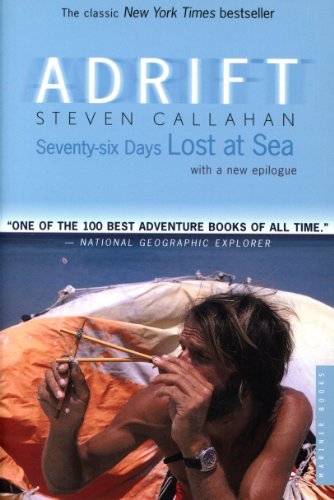
Adrift: Seventy-six Days Lost at Sea by Steven Callahan

This book came recommended by one of my favorite faithful readers here at the blog, so I’m sorry to say I’m not an unqualified fan.

Adrift is a memoir of survival. Steven Callahan is a lifelong sailor, and from boyhood had wanted to sail across the Atlantic, which he eventually managed to do in his late twenties in a 21-foot sailboat of his own design and build. Her name is Napoleon Solo, and with a friend, Callahan sails her from New England to old England. Here the friend flies home and Callahan putters south with another short-term crew member; they part at the Spanish island of Tenerife. Callahan sets out alone for Antigua, and it is in this second attempted Atlantic crossing that things go wrong. The subtitle gives the briefest summary. Callahan spends the 76 days in an inflatable raft with few and meager tools, whose accelerating failures require increasingly creative solutions, even as the man’s body and mind self-cannibalize and break down.

For one thing, this book is interesting in that it is both suspenseful and riveting, and spoiled from the beginning: that Callahan got to write the book (never mind that subtitle) gives away the ending. In fact, the subtitle’s specificity gives away yet more. As I read the log, I see we’re in day 41 and know we’re nowhere near done. I was nevertheless absorbed by the story. It’s hard to say to what extent I enjoyed this read; I was often frustrated, but always reluctant to close the book and walk away.

I think I might have been more able to enjoy the story if I’d better understood the practical aspects of it. Sometimes Callahan throws out terms or processes unconcernedly that are meaningless to me. Sometimes he tries to explain but entirely passes me by – which may be as much on me as it is on him; certainly I don’t know my way around a boat, and mechanical intelligence is not a strength of mine. He includes some diagrams and step-by-step explications that so entirely passed me by that I started skipping them, as trying and failing to understand only irritated me. That said, giving up on the details still left me able to follow the life-and-death struggle.

Callahan conceives of himself as operating in three parts: physical, emotional, and rational. Especially as he starts to really lose it (with fatigue, starvation and dehydration, frustration, sleep deprivation, and the general crazy-making of his situation), these parts become a chorus of arguing voices in his head. There is a philosophical, if not meta-physical, thread to the story: will to live versus peace with death, and how people suffer and work through experiences like this. I suspect such a story is one of the hardest things to write, to communicate such profundities… and so if I say he didn’t do an entirely convincing job of it, I mean that as mild criticism. Certainly I’ve never lived through anything like this, nor tried to write it, and I can’t imagine I’d do any better.

The story was undoubtedly compelling. I didn’t want to stop reading. And yet I felt a certain impatience, too. It’s strange to say, but the events of these 76 days, while they included much variation, were also much of the same over and over. Much minutia of patching holes and reconfiguring a speargun, but on the other hand, just the ocean: “that torn blue desert,” he calls it, with dorados and flying fish and triggerfish and calm weather or angry weather, hot days and cold nights. Possibly this could have been done in fewer than 238 pages to better effect. (That’s a major decision to be made with a book like this: degree of detail; pacing.) Maybe I’m not the ideal reader of this book, or not at the ideal time. When I think about survival-in-nature stories, I think of Krakauer first, of course; Into Thin Air remains the pinnacle for me, in memory, with Into the Wild a close second. (Both of these, apparently, pre-blog. And what would I think of them if I reread them now?) Stories this elemental must be among the hardest to get right. Isn’t this kind of survival narrative the definition of ineffable?

Interesting in its own ways, and demands to be finished (no question of a did-not-finish here), but not something I loved reading.


Rating: 7 eyes.